
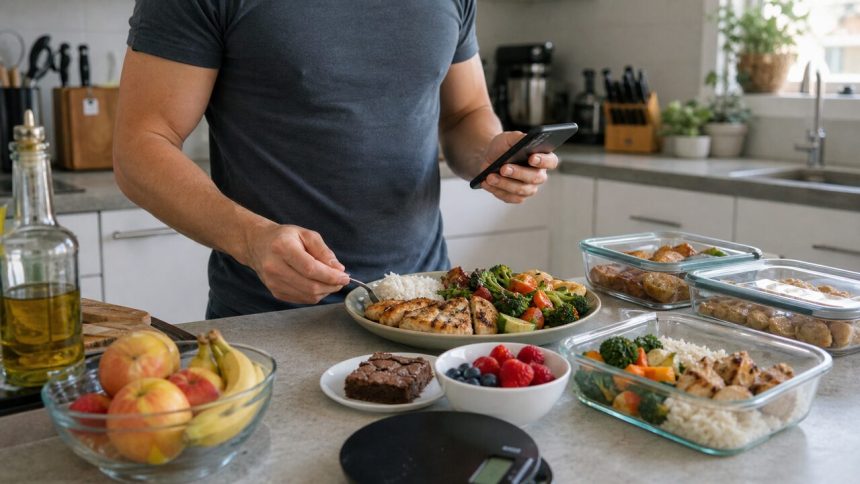
Two diets can produce the same weight loss and still feel different to live with. IIFYM gives you calorie and macro targets, then lets you choose the foods. Clean eating starts with food quality, but often leaves calories and portions uncounted. Neither label guarantees a good diet.
For most lifters, the better approach is flexible structure: set calories and protein for your body-composition goal, build most meals from nutrient-dense foods, and leave room for foods chosen for taste or convenience. IIFYM fails when it becomes a loophole for a low-fiber diet. Clean eating fails when it turns ordinary foods into moral failures or hides a calorie surplus behind a list of approved ingredients.
We evaluated current nutrition guidance, a controlled feeding trial, a flexible-versus-rigid dieting trial, and FitnessVolt’s existing diet tools for this comparison. Last evaluated: August 2026.
What IIFYM and clean eating mean
IIFYM stands for “if it fits your macros.” You work from daily targets for protein, carbohydrate, and fat. Since those macros contain calories, the method also controls energy intake when you track accurately. It does not require any particular menu. Pizza can fit. So can salmon, rice, beans, and berries.
That freedom separates IIFYM from a meal plan, but it does not make every IIFYM diet nutritious. Macro totals do not tell you whether you ate enough fiber, potassium, calcium, iron, or produce. Our full flexible-dieting guide covers the mechanics. This comparison answers the next question: how much should food quality influence the plan?
Clean eating has no standard definition. A useful version emphasizes minimally processed, nutrient-dense foods such as vegetables, fruit, legumes, whole grains, dairy, eggs, fish, and meat. A rigid version bans bread, packaged foods, restaurant meals, sugar, dairy, or anything with an unfamiliar ingredient. That version can exclude useful foods such as frozen vegetables, canned beans, Greek yogurt, and protein powder.
The labels describe priorities, not opposing laws of physiology. You can track macros while eating a high-quality diet. You can also eat only foods you call clean while missing your calorie target, protein needs, or preferred training fuel.
IIFYM vs. clean eating at a glance
| Decision factor | IIFYM | Clean eating | Better practical choice |
|---|---|---|---|
| Fat loss or gain | Tracks the variables that drive the target | Can work, but portions may drift | Use a calorie target if the goal is specific |
| Protein for muscle | Easy to measure | May be adequate without tracking, but not guaranteed | Set protein first, then choose foods |
| Fiber and micronutrients | Requires extra targets and food variety | Often stronger if the food list is varied | Track fiber and use food-group coverage |
| Training fuel | Lets you place carbohydrate around hard sessions | Depends on whether the rules allow enough carbohydrate and calories | Match intake to the sport and training load |
| Restaurants and social meals | Flexible, though estimates are less precise | Can become restrictive | Use reasonable estimates and return to routine at the next meal |
| Tracking burden | High at first | Lower unless the food rules become elaborate | Use the least tracking that still solves the problem |
| Disordered-eating risk | Numbers can become compulsive | Purity rules can become rigid | Avoid both methods when food or tracking causes distress |
Calories drive weight change, but food quality changes the job
A sustained energy surplus or deficit changes body stores over time. That is the useful meaning behind “a calorie is a calorie.” It does not mean protein, carbohydrate, fat, and alcohol have identical effects on hunger, digestion, training, or health. It means insulin does not cancel energy balance.
The old version of this article claimed that sugar sends insulin “through the roof” and puts you into full fat-storage mode. That framing confuses a normal post-meal process with long-term fat gain. Your body stores and releases energy throughout the day. A higher insulin response after a meal does not create body fat from nowhere, and a lower-insulin meal does not erase excess calories. Over time, intake, expenditure, and changes in body tissue must still reconcile.
Food choice does affect how easy that balance is to maintain. In a small NIH inpatient trial, 20 adults ate as much as they wanted from ultra-processed or unprocessed menus for two weeks each. The menus presented similar amounts of calories, macros, sugar, sodium, and fiber, yet participants ate about 500 more calories per day during the ultra-processed phase and gained weight. The trial does not prove that every packaged food causes overeating. It shows why an IIFYM menu built around highly palatable, easy-to-eat foods can make a calorie target harder to hold.
If your goal is weight change, start with a realistic energy estimate from the FitnessVolt TDEE calculator, then adjust it from two to four weeks of body-weight and intake trends. The estimate starts the process. Your trend supplies the useful answer.
Body composition: either approach can work
A 2021 randomized trial assigned 23 resistance-trained adults to a flexible macro target or a rigid meal plan during a 10-week calorie deficit. Both groups lost weight and fat, with no significant between-group differences during the diet phase. It was a small study, so it cannot settle every question about adherence or health. It supports a practical point: you do not need a short list of approved foods to lose fat when calories and protein are controlled.
For lifters, protein deserves more attention than whether rice cakes, sourdough, or potatoes count as clean. The International Society of Sports Nutrition lists 1.4 to 2.0 grams of protein per kilogram of body weight per day as sufficient for most exercising adults. A macronutrient calculator can turn calories and protein into workable daily targets. It cannot decide whether those targets fit your digestion, medical needs, budget, or food preferences.
Use IIFYM when precision helps. A bodybuilder preparing for a show, a lifter in a measured fat-loss phase, or an athlete struggling to eat enough may benefit from numbers. If your weight and performance are stable and your meals already cover protein and produce, tracking every gram may add work without improving the outcome.
Health and performance need more than matching macros
Two 2,200-calorie diets with 160 grams of protein can look different on the plate. One might include oats, yogurt, berries, chicken, rice, beans, salmon, potatoes, and a dessert. Another could lean on shakes, snack bars, fried food, and sweets. Both may hit the macro targets. The first menu may cover more fiber, vitamins, and minerals.
The current Dietary Guidelines for Americans emphasize whole, nutrient-dense foods and reducing highly processed foods. They also make room for practical options such as frozen and canned produce. That distinction matters. Processing is not a moral category, and “homemade” does not guarantee a balanced meal.
Fiber deserves its own check because it disappears inside macro totals. The National Academies’ reference value is 14 grams per 1,000 calories, or about 28 grams on a 2,000-calorie intake. Beans, lentils, berries, oats, potatoes, vegetables, nuts, and whole grains make that target easier. Raise fiber over a week or two if your current intake is low, and drink enough fluid for the increase.
Training adds another filter. Total energy, carbohydrate availability, protein, fluids, and meal timing can all affect hard sessions and recovery. A low-carb menu may fit someone’s definition of clean yet leave a high-volume athlete underfueled. A macro-perfect plan can also fail if the meals cause stomach trouble before training. For a muscle-focused food framework rather than another set of numbers, use our everyday eating guide for muscle gain.
Adherence: flexibility helps until tracking becomes the rule
The best plan is the one you can repeat without turning meals into a daily exam. Flexible dieting can make travel, restaurants, and family meals easier because one unplanned dish does not break the diet. Tracking can also become rigid for some people when every meal has to match an app.
Research on calorie-tracking apps is mixed and population-specific. A cross-sectional study of 493 college students found that calorie-tracker use was associated with greater eating concern and dietary restraint. A randomized trial in 200 undergraduate women at low risk for an eating disorder found that one month of app-based food tracking did not increase eating-disorder risk. Neither result proves that tracking alone causes or prevents harm. Your response to the tool matters: it should clarify the plan, not increase preoccupation or compensation.
Clean eating carries its own trap. Labeling food as clean makes the alternative sound dirty, and that language can attach guilt to eating. Research on clean-eating beliefs has found associations with symptoms of disordered eating, though an association does not prove the label caused those symptoms. The safer lesson is simple: judge a pattern by what it does to your health and life, not by how pure it sounds.
A practical 80-90% framework
The familiar 80/20 or 90/10 rule is a planning tool, not a biological threshold. Your body does not grade the day at midnight, and 79% nutrient-dense food is not a failure. Use the range only if it makes decisions easier: about 80-90% of calories or meals come from foods that help cover protein, fiber, produce, and essential nutrients; the rest can cover taste, convenience, or social eating.
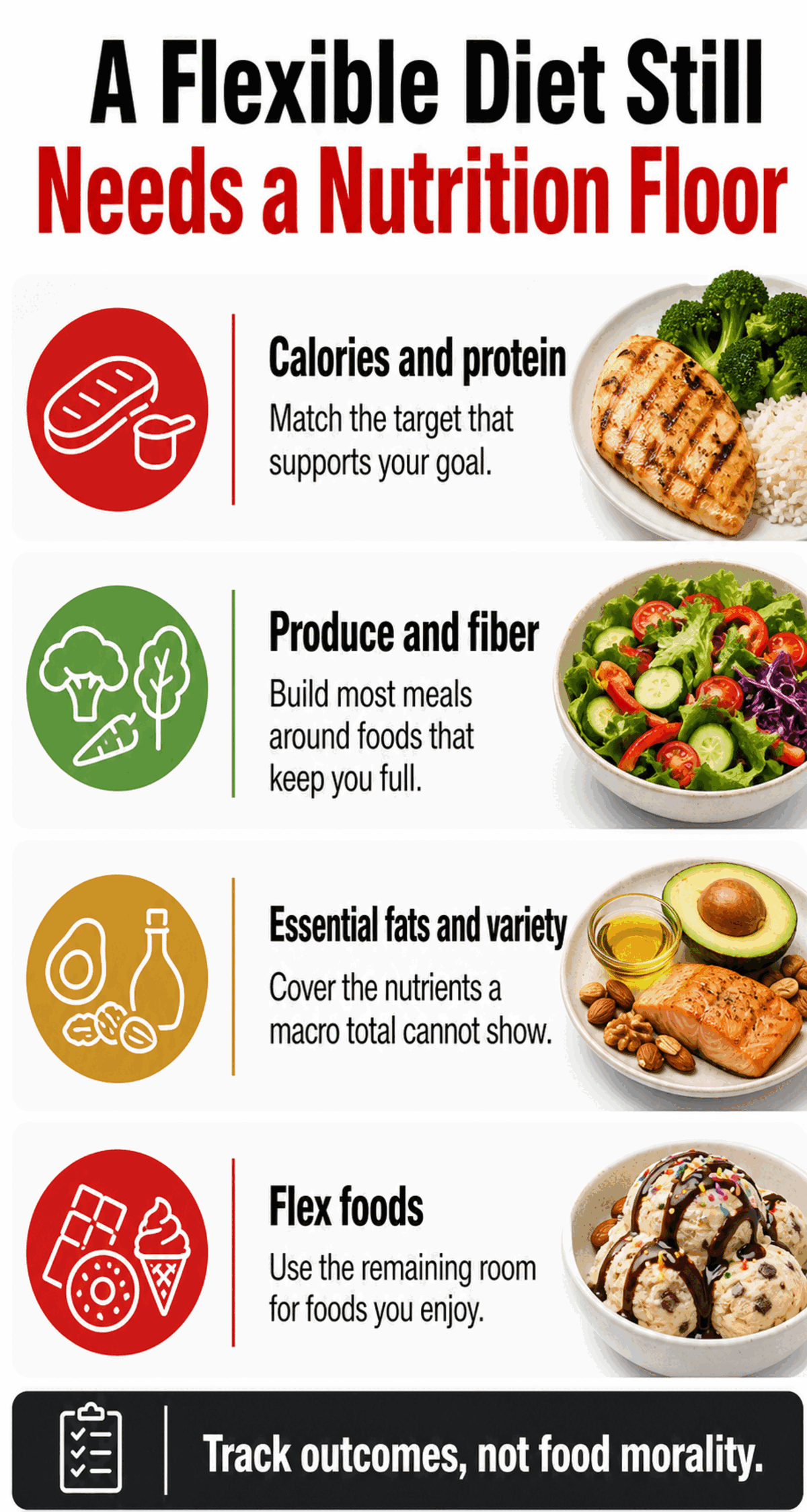
Start with four anchors:
- Calories: use a target only when weight gain, fat loss, or performance requires one.
- Protein: spread a useful daily amount across three to five meals.
- Fiber and plants: include fruit or vegetables at several meals plus beans, whole grains, nuts, or seeds.
- Flex space: choose foods you enjoy without calling them a cheat or trying to compensate the next day.
A mostly nutrient-dense pattern often makes the numbers easier because the meals carry more volume and fiber. If fat loss is the goal and hunger stays high, our guide to nutrient-dense foods for lasting weight loss has practical swaps.
Sample flexible day
This example lands near 2,200 calories, 160 grams of protein, and 30 grams of fiber. Portions and brands change the totals, so treat it as a layout rather than a prescription.
- Breakfast: half a cup of oats, one cup of Greek yogurt, berries, and one tablespoon of peanut butter.
- Lunch: six ounces of chicken, one and a half cups of cooked rice, half a cup of black beans, salsa, and peppers.
- Pre-training snack: a banana and one scoop of whey, or soy protein if dairy does not suit you.
- Dinner: five ounces of salmon, roasted potatoes, a large salad, and olive-oil dressing.
- Flexible choice: two cookies after dinner. No skipped lunch, punishment cardio, or next-day restriction required.
A person with a 1,600-calorie target will need smaller portions and less flex space. Someone eating 3,200 calories for high-volume training may use more convenient, energy-dense foods because an all-whole-food menu becomes difficult to finish.
Who should be cautious with macro tracking
Discuss self-directed macro tracking with a registered dietitian or clinician who understands eating disorders if you have current symptoms, a history of an eating disorder, or numbers already drive anxiety, body checking, restriction, or compensation. The National Institute of Mental Health notes that fixation on weight loss, body weight or shape, and controlling food intake may signal an eating disorder.
Step away from tracking if you stop eating with other people, panic when an app cannot verify a meal, cut calories after an unplanned snack, or feel that hitting a number decides whether you were good that day. A registered dietitian with eating-disorder experience can build structure without turning every meal into arithmetic.
People who are pregnant, managing diabetes, kidney disease, gastrointestinal disease, food allergies, or another condition that changes nutrient needs should also use individualized clinical guidance. A general macro calculator cannot replace it.
Common mistakes and useful fixes
Using IIFYM as permission to ignore diet quality
Fix: add a fiber target, two or more fruit servings, several vegetable servings, and varied protein sources before spending the remaining calories. The macros still matter; they just stop being the entire checklist.
Treating all processed foods as junk
Fix: judge the food’s role. Frozen fruit, canned tuna, whole-grain bread, yogurt, and protein powder can solve real nutrition problems. Chips and candy can fit too, but they do a different job.
Turning one restaurant meal into a lost weekend
Fix: make a reasonable estimate, stop before fullness becomes uncomfortable, and return to your usual breakfast. One imprecise dinner has less impact than two days of guilt-driven restriction and rebound eating.
Chasing exact macros while missing the calorie trend
Fix: use the widest daily range that still produces a stable multiweek trend. Protein and total calories do not need to land on exact numbers every night. Adjust the plan from the trend, not from one imprecise meal.
Copying an influencer’s targets
Fix: base intake on your body size, activity, goal, and response. A 120-pound office worker and a 220-pound strongman do not need the same menu, even if both want to lose fat.
Bottom line
IIFYM is better for setting and adjusting body-composition targets. A sensible clean-eating emphasis is better for keeping food quality visible. Most lifters do best by combining those strengths: control energy when the goal requires it, set enough protein, cover fiber and micronutrients with a varied food base, and keep room for ordinary life.
Choose the smallest amount of structure that produces the result. If you can progress without tracking, you do not earn extra credit for weighing every ingredient. If numbers clarify the plan without controlling your day, use them.
Sources
- Hall, K. D., Heymsfield, S. B., Kemnitz, J. W., et al. (2012). Energy balance and its components: implications for body weight regulation. The American Journal of Clinical Nutrition. DOI: 10.3945/ajcn.112.036350. PMID: 22434603.
- Conlin, L. A., Aguilar, D. T., Rogers, G. E., & Campbell, B. I. (2021). Flexible vs. rigid dieting in resistance-trained individuals seeking to optimize their physiques: A randomized controlled trial. Journal of the International Society of Sports Nutrition. DOI: 10.1186/s12970-021-00452-2. PMID: 34187492.
- Hall, K. D., Ayuketah, A., Brychta, R., et al. (2019). Ultra-processed diets cause excess calorie intake and weight gain: An inpatient randomized controlled trial of ad libitum food intake. Cell Metabolism. DOI: 10.1016/j.cmet.2019.05.008. PMID: 31105044.
- U.S. Department of Health and Human Services & U.S. Department of Agriculture. (2026). Dietary Guidelines for Americans, 2025-2030. 10th Edition.
- Institute of Medicine. (2005). Dietary Reference Intakes for energy, carbohydrate, fiber, fat, fatty acids, cholesterol, protein, and amino acids. The National Academies Press. DOI: 10.17226/10490.
- Jager, R., Kerksick, C. M., Campbell, B. I., et al. (2017). International Society of Sports Nutrition position stand: protein and exercise. Journal of the International Society of Sports Nutrition. DOI: 10.1186/s12970-017-0177-8. PMID: 28642676.
- Ambwani, S., Shippe, M., Gao, Z., & Austin, S. B. (2019). Is #cleaneating a healthy or harmful dietary strategy? Perceptions of clean eating and associations with disordered eating among young adults. Journal of Eating Disorders. DOI: 10.1186/s40337-019-0246-2. PMID: 31171970.
- National Institute of Mental Health. (n.d.). Eating disorders: What you need to know. Accessed August 6, 2026.
- Simpson, C. C., & Mazzeo, S. E. (2017). Calorie counting and fitness tracking technology: Associations with eating disorder symptomatology. Eating Behaviors. DOI: 10.1016/j.eatbeh.2017.02.002. PMID: 28214452.
- Hahn, S. L., Kaciroti, N., Eisenberg, D., et al. (2021). Introducing dietary self-monitoring to undergraduate women via a calorie counting app has no effect on mental health or health behaviors: Results from a randomized controlled trial. Journal of the Academy of Nutrition and Dietetics. DOI: 10.1016/j.jand.2021.06.311. PMID: 34427188.