
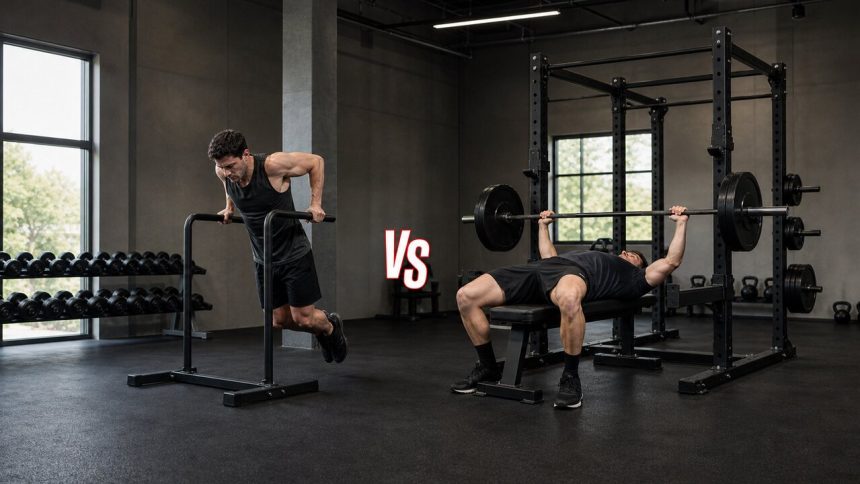
Dips and bench presses can both build a bigger chest, but they solve different training problems. Bench press should lead a program built around a stronger barbell bench or powerlifting performance. Dips suit bodyweight pressing strength, limited equipment, and lifters who prefer unrestrained shoulder-blade movement.
For chest growth, the honest verdict is a draw. Our research found no controlled trial that compared long-term pec growth from parallel-bar dips against barbell bench presses. Bench press has direct hypertrophy evidence; dip research has measured movement and short-term muscle activity. That leaves your ability to train hard, progress the load, recover, and tolerate the movement as the deciding factors.
Most lifters do not need to choose forever. Bench first for specific barbell strength, then use dips for extra chest and triceps work. Reverse the order when weighted dips are the lift you want to improve.
Dips vs. Bench Press at a Glance
| Decision factor | Parallel-bar dip | Barbell bench press | Practical winner |
|---|---|---|---|
| Chest growth | High potential when you can use a controlled range and add reps or load | Proven to grow the pecs in training studies and easy to standardize | Tie; no direct hypertrophy trial compares them |
| Maximal strength | Best for dip-specific and relative strength | Best for bench-specific strength and powerlifting | Bench press for a bigger bench |
| Progression | Assistance makes it easier; a belt or vest makes it harder | Small plates allow precise loading from the first session | Bench press for beginners; tie once dips are loadable |
| Joint demands | Requires comfortable shoulder extension and body control | Fixes the upper back against a bench and uses a pronated grip | The one you can train without pain or compensation |
| Equipment | Parallel bars, an assistance machine, or rings | Bench, rack, bar, plates, and safeties or a spotter | Dips for a simple setup |
| Failure safety | An appropriately low, stable station may let you step down, but tall or heavily weighted setups complicate the exit | Rack safeties or a trained spotter provide the planned bailout; without either, a failed rep can trap the bar | Depends on station height, added load, safeties, and spotter setup |
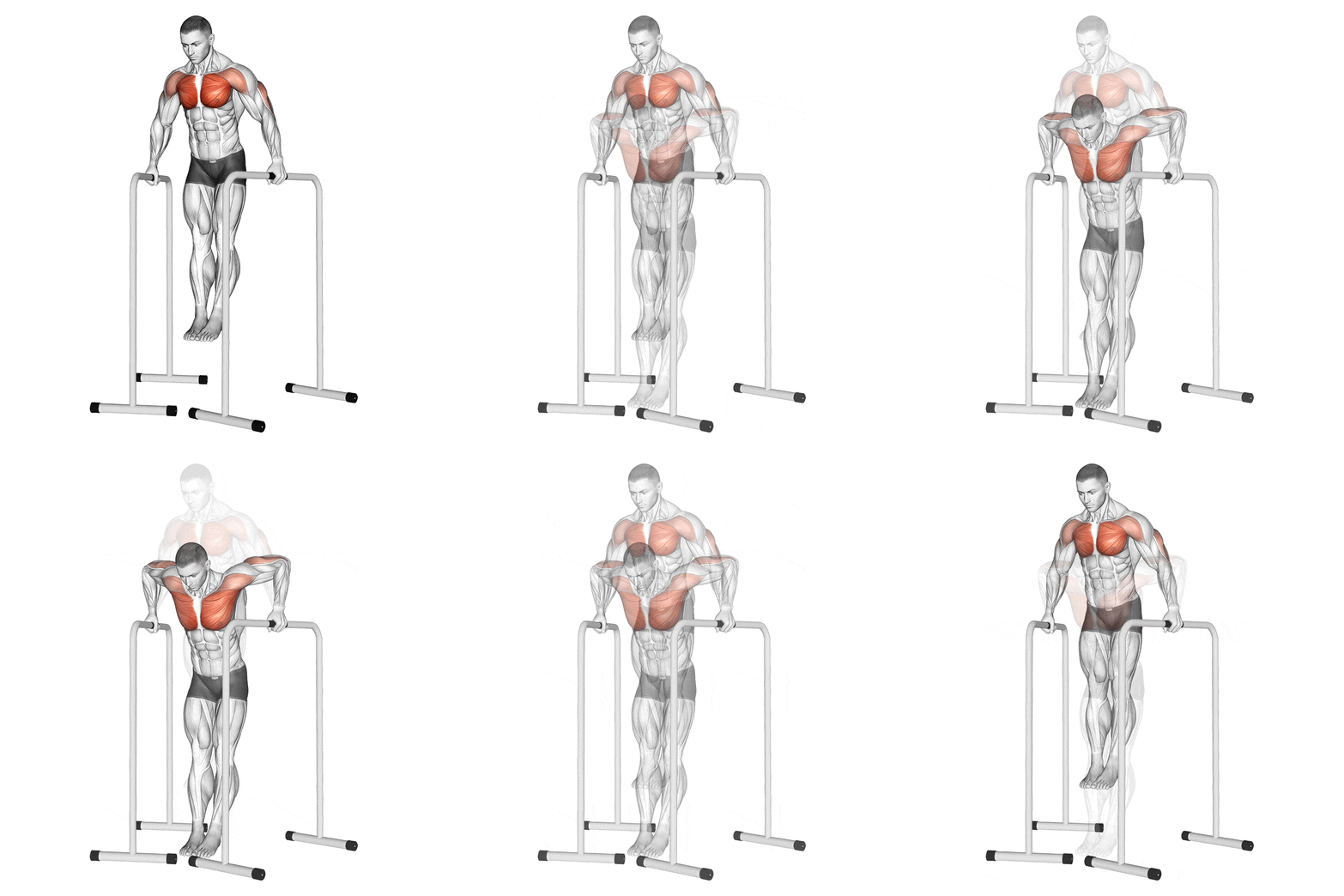
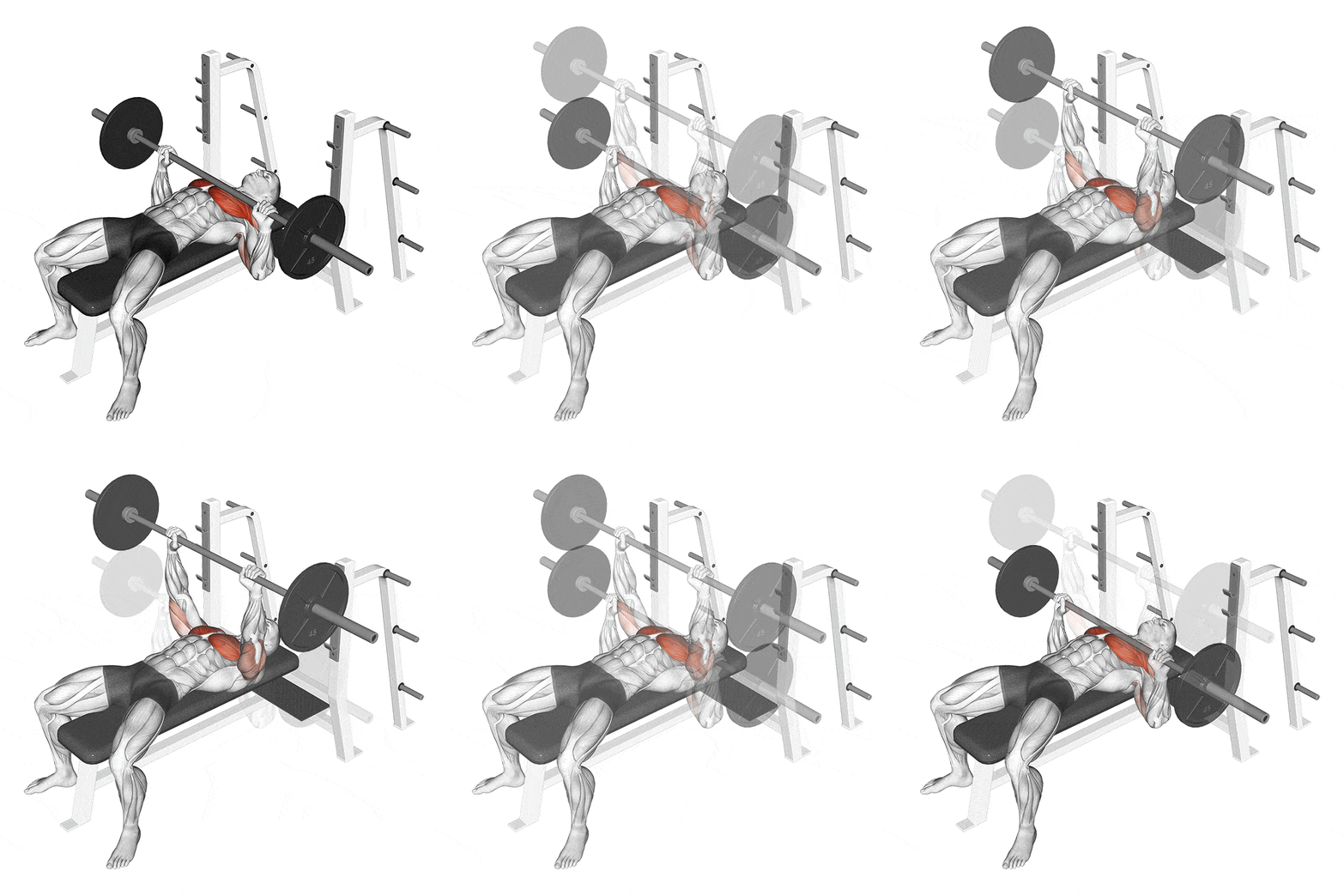
What the Evidence Can and Cannot Tell Us
A 2024 training study gives the bench press a solid evidence receipt. Thirteen men performed three or four sets of 12 reps, three days per week, for 10 weeks. MRI measurements showed growth in the pectoralis major, pectoralis minor, anterior deltoid, and triceps. That proves bench pressing can build the chest. It does not prove that benching grows more chest than dips because the study did not include a dip group.
Dip research answers narrower questions. A 2022 study of experienced men found that bar dips loaded the pectoralis major, triceps, and anterior deltoid, while bench dips used more shoulder extension and lower activity in several muscles. Another study found that chest and triceps activity rose as a set of bar dips approached exhaustion. These are useful technique and exercise-selection findings, but surface electromyography does not measure months of muscle growth.
The newer 2026 American College of Sports Medicine position stand places more weight on consistent resistance training and sufficient weekly volume than on finding one perfect exercise. Its practical target for hypertrophy is about 10 weekly sets per muscle group, adjusted to the lifter. You can collect productive chest sets with either movement.
The old inner-chest and outer-chest story does not hold up
You cannot carve the pecs into separate inner and outer muscles by changing elbow flare. The pectoralis major has clavicular and sternocostal regions, with some anatomy texts also describing an abdominal portion. Its fibers converge on the upper arm. Pressing angle and technique can change regional emphasis, but neither a dip nor a bench press isolates an “inner chest” or widens the outer edge on command.
A 2020 bench-angle study found that a flat bench produced higher activity in the middle and lower pectoral regions, while a 30-degree incline increased upper-region activity. Treat those results as evidence that angle changes emphasis, not as a promise of regional hypertrophy. If upper-chest development matters, add an incline press rather than trying to turn a flat bench or dip into every press at once.
The bench press is not an isolation exercise
Both movements are compound presses. Your pecs, anterior deltoids, and triceps share the work in each. The bench supports your torso, but your legs and upper back still create the stable base that lets you press. Dips demand more whole-body control because your torso moves through space. That extra stabilization can help bodyweight skill, but it does not guarantee more pec growth.
Choose the Lift That Matches Your Goal
Pick bench press for barbell strength
Strength follows the movement you practice. A bigger weighted dip may help your general pressing capacity, yet it cannot replace the skill of unracking, lowering, pausing, and pressing a bar. Powerlifters need to bench. Recreational lifters who use their bench number as the main score should also keep it first in the session.
The barbell makes progression easy to measure. Add 2.5 to 5 pounds, repeat the same setup, and compare the result. Use FitnessVolt’s bench press one-rep max calculator to estimate progress from a hard set instead of testing a true max every week.
Pick dips for bodyweight pressing strength
Dips teach you to control your body on fixed handles. They fit calisthenics, obstacle-course preparation, and small gyms with no barbell station. A lifter who can complete 10 clean reps can start adding weight in small steps. Treat total system load as a rough training note; bodyweight plus a plate does not compare cleanly with a barbell bench because the two lifts use different leverages and ranges.
Torso angle can change how a dip feels, but it does not switch muscles on and off. FitnessVolt’s chest-dip and triceps-dip comparison covers the setup details without pretending either version isolates one muscle.
Pick either one for chest size
Choose the press that lets your chest and triceps do hard work through a repeatable, comfortable range. Finish most working sets with one to three good reps left, then add reps or load over time. A stable bench often makes this easier for beginners. Dips remain a viable choice when you can scale them and keep the same depth from rep to rep.
Skip unassisted dips for now if you cannot complete five controlled reps. Use an assistance machine or band and lower the assistance as you improve. Skip barbell benching alone without safety arms if you train near failure. Dumbbells or a chest press machine give a solo lifter a simpler exit.
Progress Each Exercise Without Forcing It
For bench press: choose a rep range such as 5 to 8. Keep the same weight until you reach eight clean reps on every set, then add the smallest available plate and return to five or six reps. A four-set workout might move from 185 pounds for 8, 8, 7, 6 to 185 for 8, 8, 8, 8 before you load 190.
For dips: build to three sets of 8 to 12 at bodyweight. Once all three sets reach 12 with the same controlled depth, add 5 pounds with a belt and return to eight reps. If you cannot reach the starting range, use 20 to 40 pounds of machine assistance and reduce it in small steps.
Keep one progression variable at a time. Adding load, reps, sets, and depth during the same week makes it hard to tell what caused soreness or a technique breakdown. The 2026 ACSM guidance favors a plan you can repeat over a complicated progression you cannot recover from.
Joint Tolerance Decides More Than Internet Rankings
Dips do not guarantee shoulder comfort. At the bottom, the upper arm travels behind the torso into shoulder extension while your body loads the position. Some lifters tolerate that range well. Others feel pain at the front of the shoulder or sternum before the pecs receive useful work. A deeper rep is not a better rep once the shoulder rolls forward or the bottom position becomes unstable.
Bench presses do not guarantee shoulder pain. Grip width, elbow path, bar touch point, training load, fatigue, and individual anatomy all matter. A moderate grip and a stable upper back often feel better than a very wide, high-touch press. The full FitnessVolt bench press guide covers setup and spotting in detail.
Use a simple tolerance test. Rate discomfort during the set and again the next morning. A mild muscular stretch that settles within minutes differs from sharp joint pain, a loss of strength, or pain that worsens after training. Shorten the range, reduce the load, or change the exercise when symptoms persist. A clinician should assess sudden pain, bruising, deformity, or a clear injury event.
How to Use Dips and Bench Press Together
Put the lift you want to improve first. Fatigue from the first compound press will reduce performance on the second, so the order should reflect your priority rather than a universal rule.
Two-day chest and pressing plan
| Day | Exercise | Sets and reps | Effort |
|---|---|---|---|
| Day 1: bench strength | Barbell bench press | 4 x 4-6 | Stop with 2 reps in reserve |
| Day 1: accessory | Assisted, bodyweight, or weighted dip | 3 x 8-12 | Stop with 1-2 reps in reserve |
| Day 2: dip strength | Weighted or bodyweight dip | 4 x 5-8 | Stop with 2 reps in reserve |
| Day 2: chest volume | Dumbbell or machine press | 3 x 8-12 | Stop with 1-2 reps in reserve |
Leave at least two days between these sessions. Start with seven pressing sets per day and count the hard sets from both movements toward your chest and triceps volume. Add a set when performance is rising and soreness no longer affects the next session.
For a single weekly push session, bench for three or four sets, then dip for two or three. Lifters who prefer a complete template can use FitnessVolt’s chest and triceps strength workout as a starting point, then trim any volume that exceeds their recovery.
Mistakes That Blunt Progress
- Calling one lift functional and the other artificial: strength is task-specific. Dips transfer best to dips and bodyweight pushing; benching transfers best to benching.
- Chasing a dramatic dip depth: stop at the deepest position you can control without the shoulder rolling forward, pain, or a bounce.
- Flaring to target the outer chest: use the elbow path that keeps your joints stacked and lets you press hard. Your pecs do not contain a separate outer head.
- Turning both lifts into max-effort tests: keep most sets one to three reps shy of failure. Save true grinders for planned tests.
- Ignoring the exit plan: bench inside a rack with safety arms or use a trained spotter. Check that the dip station cannot tip or slide before loading it.
Bottom Line
Bench press wins when your goal is a bigger bench, measured barbell strength, or precise loading from day one. Dips win when you value bodyweight pressing, a smaller equipment footprint, and unrestrained shoulder-blade movement. For chest size, neither earns a universal crown because our research found no long-term head-to-head trial.
Use the movement that fits your joints and current strength, progress it for 8 to 12 weeks, and judge it by reps, load, technique, and chest measurements rather than soreness. If both feel good, keep both: lead with the priority lift and use the other for controlled volume.
Sources
- Currier BS, et al. 2026. American College of Sports Medicine Position Stand: Resistance Training Prescription for Muscle Function, Hypertrophy, and Physical Performance in Healthy Adults. Medicine & Science in Sports & Exercise. doi:10.1249/MSS.0000000000003897.
- Lanza MB, et al. 2024. Muscle hypertrophy response across four muscles involved in the bench press exercise: Randomized 10 weeks training intervention. Journal of Bodywork and Movement Therapies. doi:10.1016/j.jbmt.2024.07.054.
- McKenzie A, Crowley-McHattan ZJ, Meir R, Whitting J, Volschenk W. 2022. Bench, Bar, and Ring Dips: Do Kinematics and Muscle Activity Differ? International Journal of Environmental Research and Public Health. doi:10.3390/ijerph192013211.
- McKenzie A, Crowley-McHattan ZJ, Meir R. 2022. Fatigue Increases Muscle Activations but Does Not Change Maximal Joint Angles during the Bar Dip. International Journal of Environmental Research and Public Health. doi:10.3390/ijerph192114390.
- Rodríguez-Ridao D, Antequera-Vique JA, Martín-Fuentes I, Muyor JM. 2020. Effect of Five Bench Inclinations on the Electromyographic Activity of the Pectoralis Major, Anterior Deltoid, and Triceps Brachii during the Bench Press Exercise. International Journal of Environmental Research and Public Health. doi:10.3390/ijerph17197339.
- Bridges CR, Mafi R, Woods D. 2023. Anatomy, Thorax, Pectoralis Major. StatPearls, National Library of Medicine. Accessed August 6, 2026.