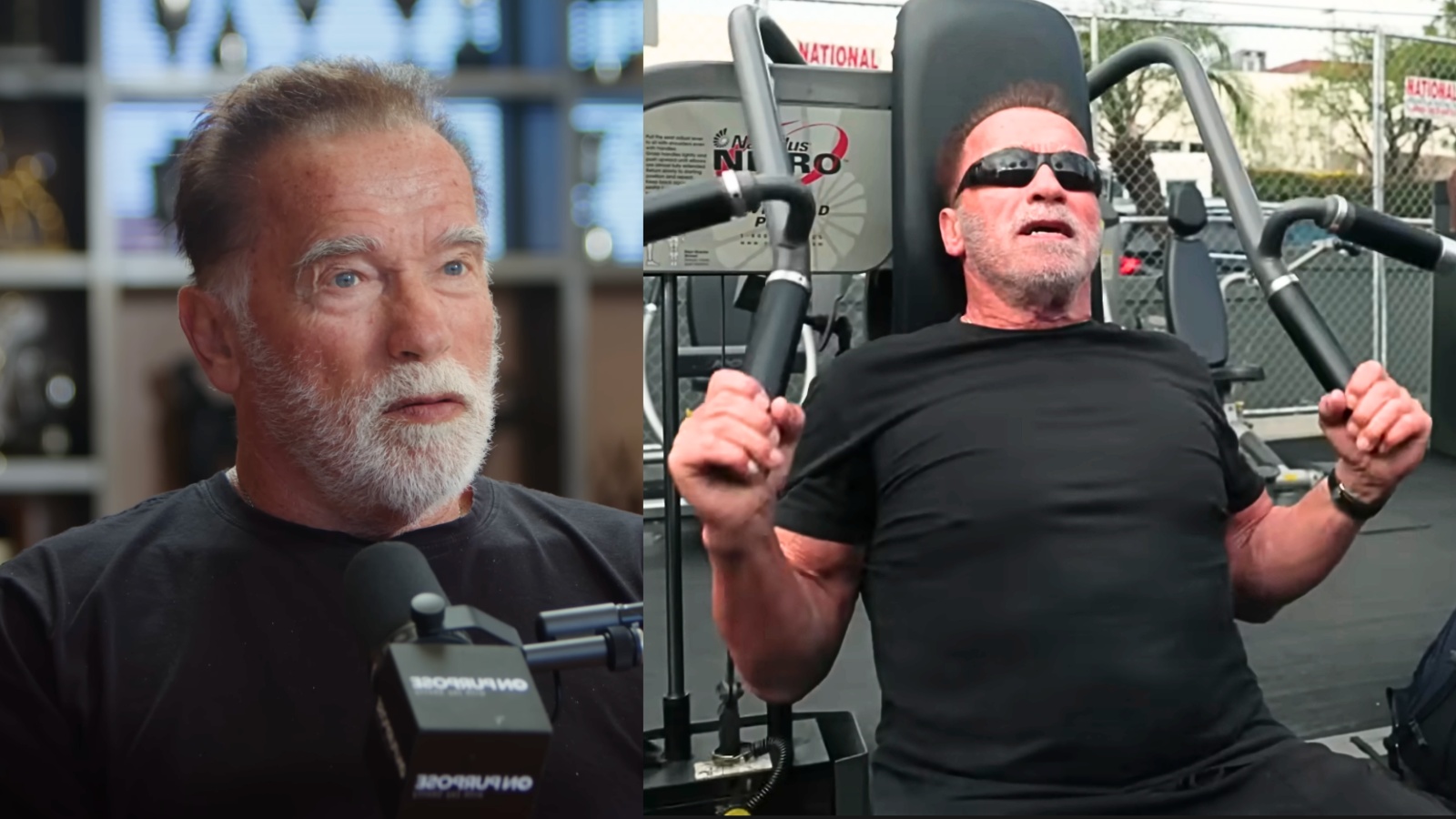
Arnold Schwarzenegger is keen on maintaining a lean, muscular physique at 78 years old. In his latest Arnold’s Pump Club newsletter from Dec. 18, 2025, he explained why your body regains fat faster than muscle after dieting.
“Scientists pulled together decades of research to explain a frustrating pattern: when people regain weight, fat recovers quickly, but muscle lags behind.”
As a former seven-time Mr. Olympia champion, Arnold Schwarzenegger still makes it a point to train and eat clean regularly. However, fat loss isn’t as easy as it once was for the bodybuilding legend. On top of that, longevity, heart health, and mobility have taken center stage as he’s gotten older.
While shedding stubborn fat can be one of the biggest challenges in fitness, “The Austrian Oak” is steering you in the right direction, breaking down exactly what’s happening inside the body after dieting.
Arnold Schwarzenegger on ‘Why Your Body Regains Fat Faster Than Muscle After Dieting’
In the newsletter, Schwarzenegger shared that gaining fat is easier than building muscle and called it a ‘biological reality.’
“Why Your Body Regains Fat Faster Than Muscle After Dieting (And How To Stop The Cycle)
Gaining fat doesn’t just feel easier than building muscle. It’s an unfortunate biological reality. But now, a new review digs into why the body seems almost “too good” at regaining fat, and how you can protect against it.”
Looking at one study, Schwarzenegger noted that when subjects regained weight, they were able to restore 44% of lost fat but only 28% of lean muscle. In the TV show, The Biggest Loser, contestants showed similar trends to the aforementioned study.
“Across the studies, a trend started to appear: metabolic rate stayed unusually low even after weight was regained. In one study, participants restored 44% of lost fat but only 28% of lean mass during refeeding. In another study focused on contestants from the show Biggest Loser, contestants showed similar trends six years later, with metabolic rates still nearly 500 calories lower than expected and proportionally more fat regained.”
Scientists believe that muscles enter a ‘low power mode’ during weight regain, which might contribute to this phenomenon.
“The scientists proposed a theory still unproven in humans: during weight regain, your muscles may enter a temporary “low-power mode.” They suggest that an enzyme called D3 may reduce active thyroid hormone inside muscle, slowing its energy use. If muscle burns fewer calories and rebuilds slowly, the body has an easier time shuttling excess fuel toward fat storage.”
To stop the body from restoring fat first, Schwarzenegger emphasized the importance of consistent strength-focused weight training.
“In other words, your body tries to restore fat first, not muscle, which is why sustainable, strength-focused weight loss protects you far better than fast fixes.
Animal studies support this muscle “energy conservation mode,” though human trials have not confirmed this mechanism yet.”
He believes that if you are cutting calories, it’s best to prioritize building and protecting muscle, clarifying that ‘severe calorie cuts’ cause the metabolism to slow.
“Even though the mechanism is theoretical, the message is practical and empowering if you want to prevent weight regain.
If you’re cutting calories, prioritize building and protecting muscle. Strength training during a deficit helps counter the lag in muscle recovery. It’s also another reason why you’ll want to avoid extreme dieting. Severe calorie cuts seem to amplify metabolic slowdown.”
All in all, Schwarzenegger argued that slow, steady changes protect the metabolism and muscle.
“While most people focus on the diet itself, it’s just as important to plan for the “after” period. The months after weight loss are when your body might be most eager to regain fat, and consistent training and adequate protein could help shift the balance.
And while everyone wants to hit their goals quickly, think sustainability, not speed. Slow, steady changes protect your metabolism and your muscle.”
Additionally, the bodybuilding icon said that cycling between different weights repeatedly can increase the risk of sarcopenic obesity.
“Weight cycling — losing and regaining repeatedly — appears to raise the risk of sarcopenic obesity, where higher body fat is paired with lower muscle mass and strength.
The scientists found that people with five or more weight cycles had 4 to 6 times higher risk of low muscle mass or poor grip strength.”
This wasn’t Schwarzenegger’s first time addressing fat gain. He recently cleared up the ‘muscle turns into fat’ myth. Even after individuals take time off training, Schwarzenegger revealed that fat and muscle are completely different tissues and cannot transform into each other.
While the body can regain fat more quickly than muscle, there are solutions to mitigate the issue. Schwarzenegger stands by consistent strength training for helping protect lean tissue over time.
RELATED: Bodybuilding Legend Arnold Schwarzenegger Reveals Whether White Rice Causes You to Gain Fat
 You can also follow us on Twitter, Facebook, Instagram, and
YouTube for even more content.
You can also follow us on Twitter, Facebook, Instagram, and
YouTube for even more content.Tip: If you're signed in to Google, tap Follow.