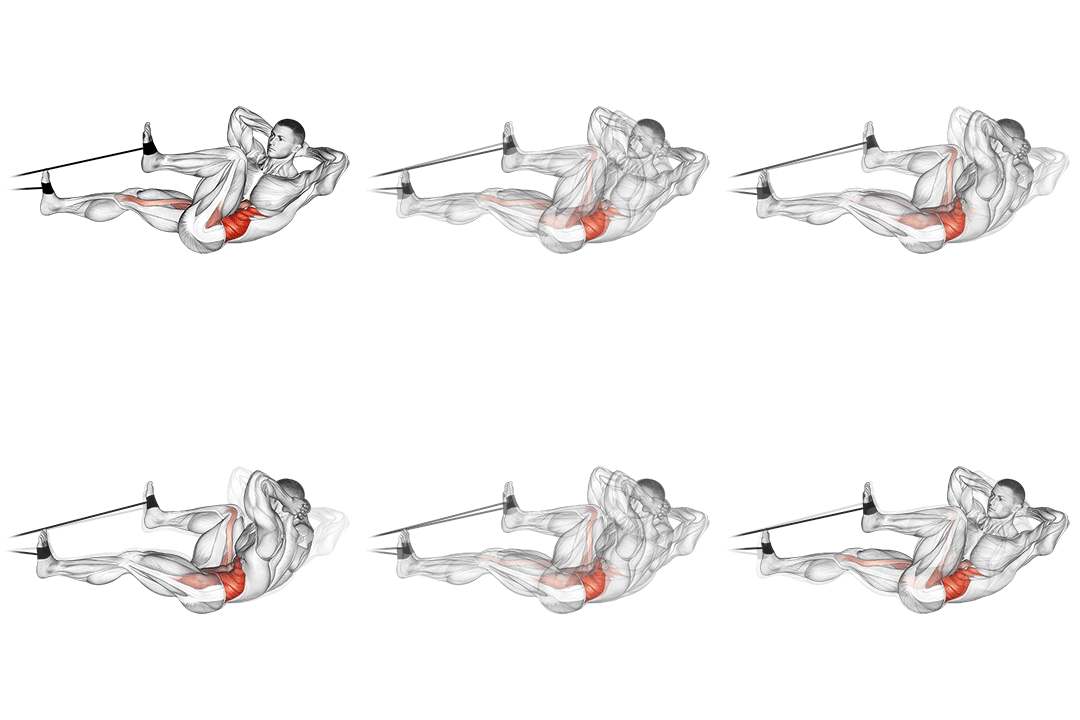
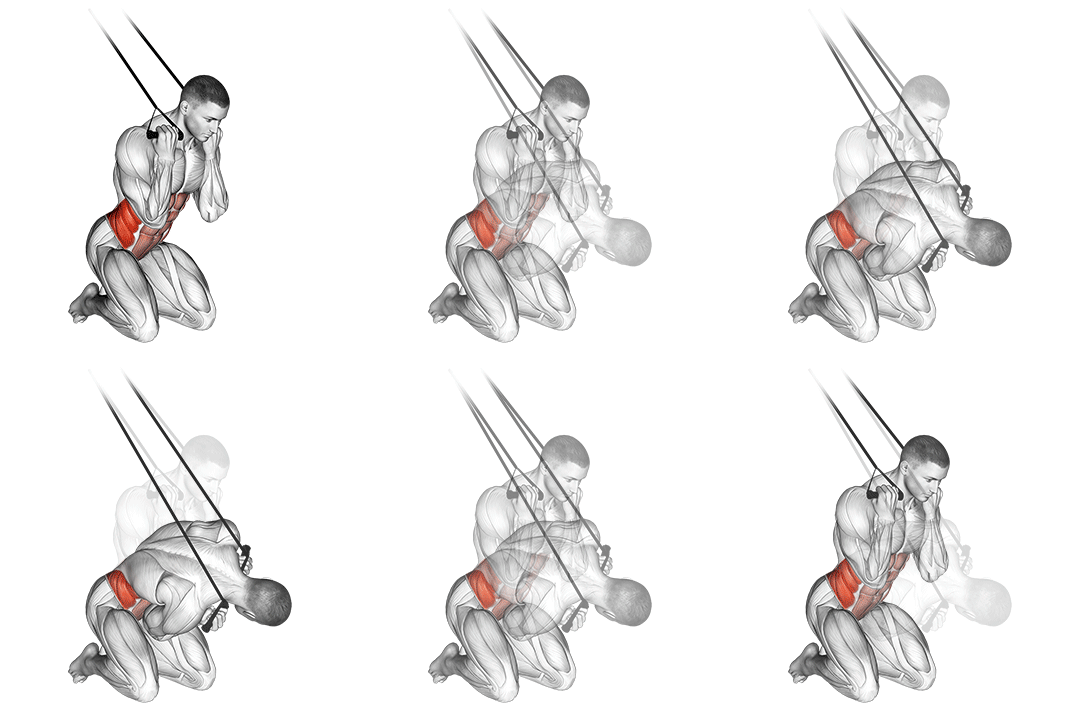
Band Alternating V-up vs Band Assisted Wheel Rollerout

Compare target muscles, equipment, difficulty, movement type, and secondary muscles for Band Alternating V-up and Band Assisted Wheel Rollerout.

Change comparison Share

Get comparison link

Select the link and use your device's Copy command.

Comparison overview

AI-generated
Band Alternating V-up vs Band Assisted Wheel Rollerout — you’re choosing between two band-based isolation moves that both target the abs but load the torso differently. I’ll walk you through how each one stresses the rectus abdominis, how much the hip flexors or lower back get involved, what equipment you need, and clear progression and safety tips. By the end you’ll know which exercise to pick for muscle growth, raw strength, or a safe home routine, plus exact rep ranges and technique cues to make each rep count.

Exercise Comparison

Exercise A
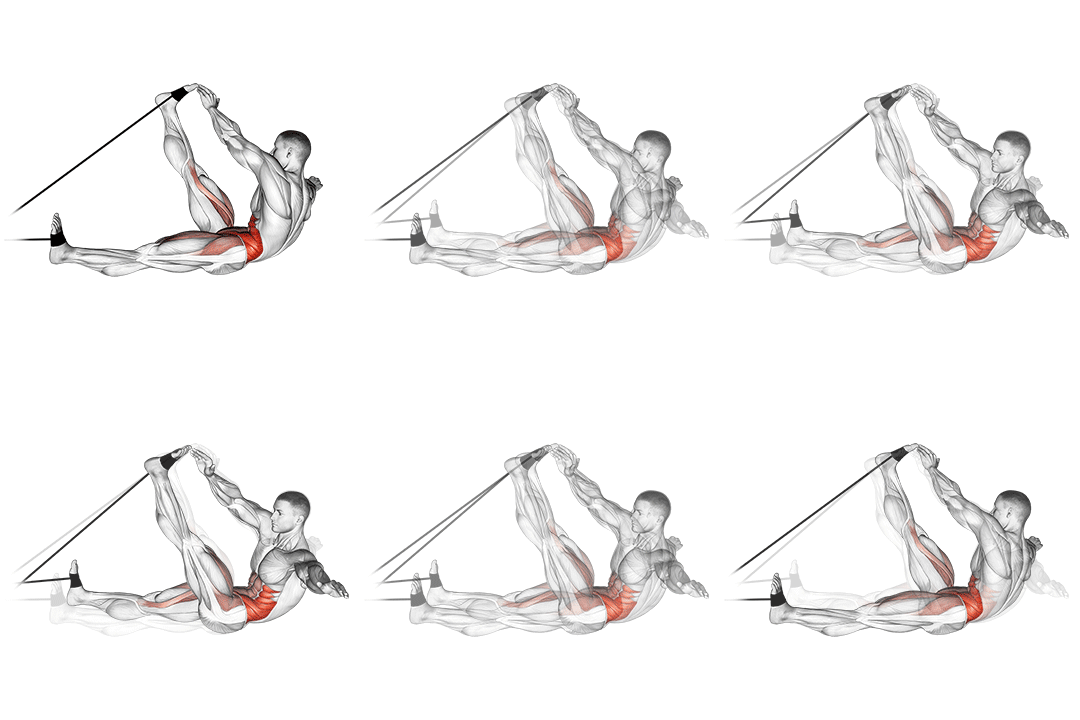
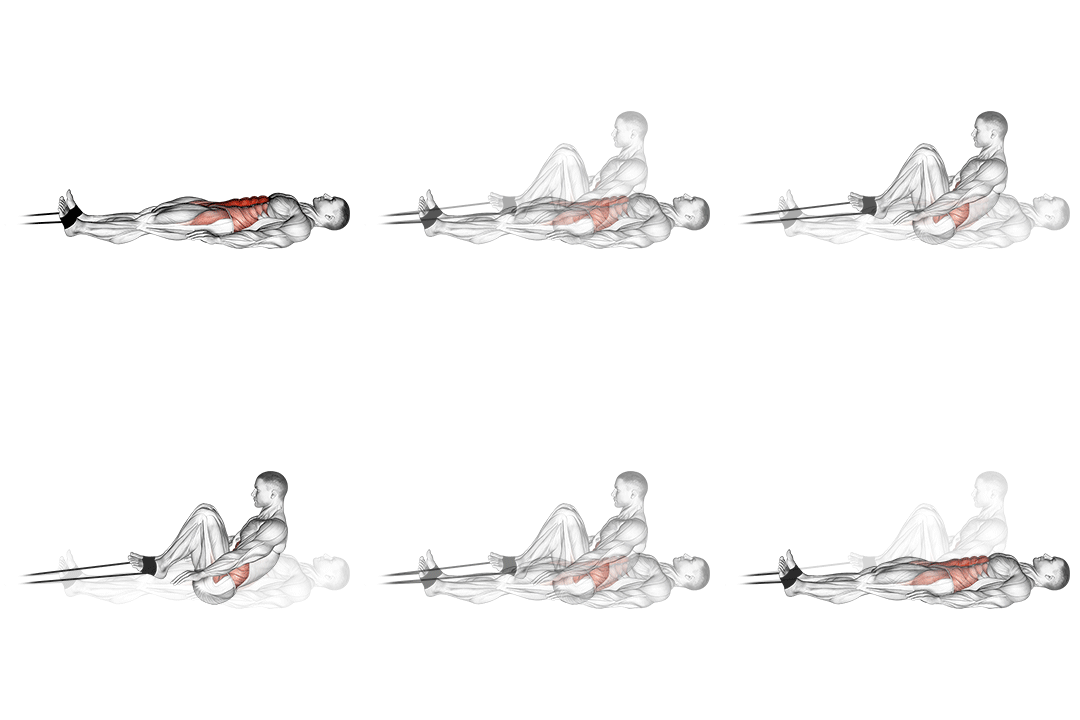
Band Alternating V-up demonstration

Band Alternating V-up

Target Abs
Equipment Band
Body Part Waist
Difficulty Advanced
Movement Isolation
Secondary Muscles
Hip Flexors
VS
Exercise B
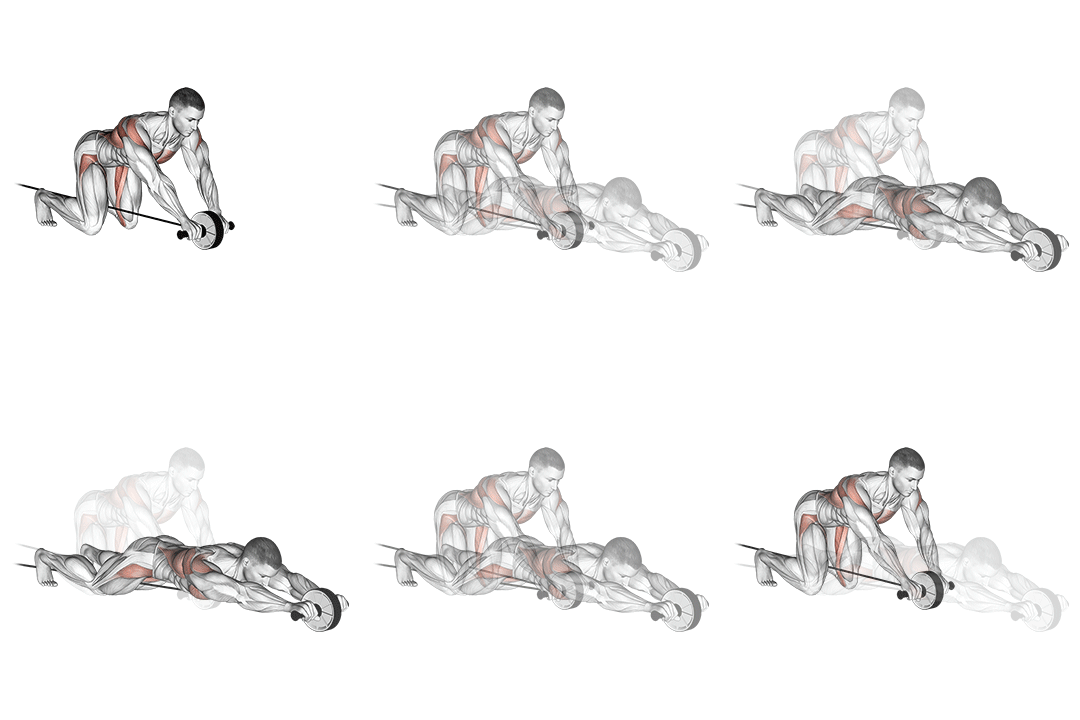
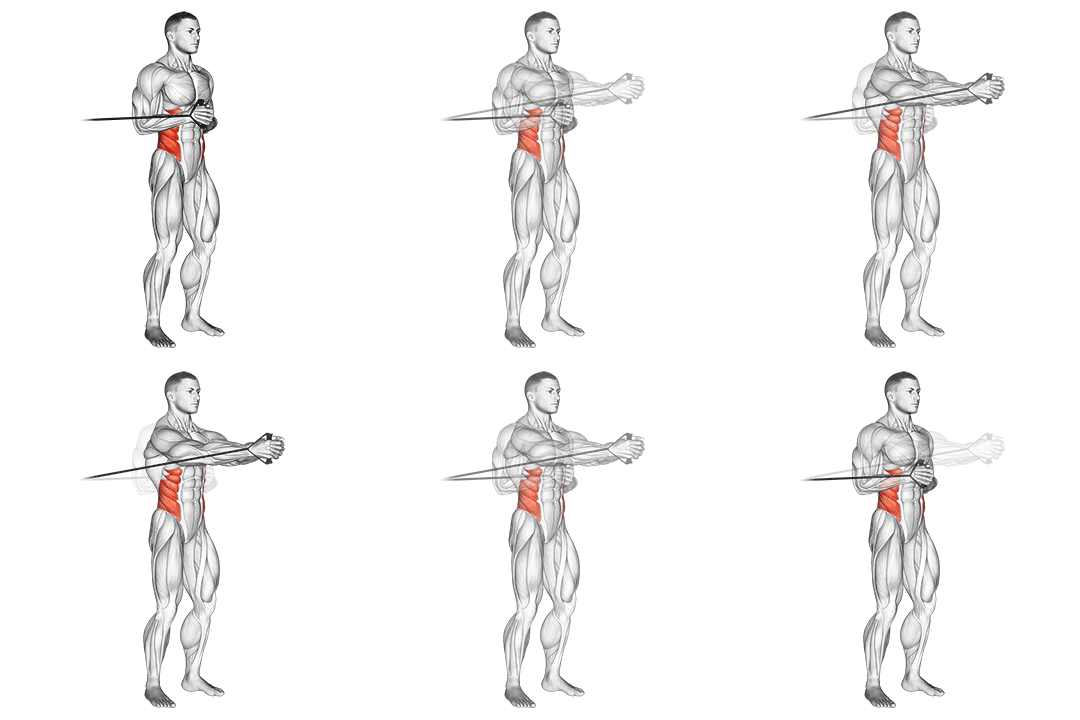
Band Assisted Wheel Rollerout demonstration

Band Assisted Wheel Rollerout

Target Abs
Equipment Band
Body Part Waist
Difficulty Intermediate
Movement Isolation
Secondary Muscles
Lower Back

Head-to-Head Comparison

Different values are marked. These are catalogue attributes, not performance scores.

Muscles used

Listed target and secondary muscles, shown on the body. Locations, not activation or strength scores.

  • Target
  • Secondary
  • Not highlighted

Band Alternating V-up

Front
Band Alternating V-up: front muscle locationsSolid: listed target. Striped: listed secondary. Grey: not highlighted. Locations, not activation or strength scores. See the muscle names below.
Back
Band Alternating V-up: back muscle locationsSolid: listed target. Striped: listed secondary. Grey: not highlighted. Locations, not activation or strength scores. See the muscle names below.
Target
Abs
Secondary
Hip Flexors

Not shown on diagram: Hip Flexors. These labels do not identify a precise region on this map.

Band Assisted Wheel Rollerout

Front
Band Assisted Wheel Rollerout: front muscle locationsSolid: listed target. Striped: listed secondary. Grey: not highlighted. Locations, not activation or strength scores. See the muscle names below.
Back
Band Assisted Wheel Rollerout: back muscle locationsSolid: listed target. Striped: listed secondary. Grey: not highlighted. Locations, not activation or strength scores. See the muscle names below.
Target
Abs
Secondary
Lower Back

Grey does not mean a muscle is unused. The diagrams show only the mapped catalogue labels.

Attribute Band Alternating V-up Band Assisted Wheel Rollerout
Target Muscle
Abs
Abs
Body Part
Waist
Waist
Equipment
Band
Band
Difficulty Different
Advanced
Intermediate
Movement Type
Isolation
Isolation
Secondary Muscles Different
Hip Flexors
Lower Back

Visual Comparison

An illustrative 1–10 profile derived from catalog difficulty, equipment, and listed-muscle fields—not measured performance or muscle activation.

Key Differences

  • Difficulty levels differ: Band Alternating V-up is advanced, while Band Assisted Wheel Rollerout is intermediate.
  • Both exercises target the Abs using Band. The catalogue does not establish which exercise is better for an individual goal.

Muscle comparison

Shared target muscles

Both exercises drive high rectus abdominis activation through trunk flexion or anti-extension control. The V-up produces brief, high-intensity concentric trunk and hip flexion pulses that spike rectus abdominis EMG during the peak 0–30° of trunk angle, while the band-assisted wheel rollerout creates sustained high-tension anti-extension throughout the end range, keeping the rectus under near-isometric load for longer durations.

Secondary muscle differences

Band Alternating V-up recruits the hip flexors heavily (iliopsoas and rectus femoris) during the concentric leg drive; expect ~30–40% greater hip flexor involvement versus the rollerout. Band Assisted Wheel Rollerout increases lower back (erector spinae) and deep stabilizer engagement because resisting spinal extension forces the posterior chain to resist shear, especially near full roll-out.

Muscle involvement analysis

V-ups produce phasic, ballistic activation: rapid concentric hip flexion plus trunk curl with peak tension near 30–45° of hip/trunk flexion, then eccentric control on descent. The rollerout produces a continuous anti-extension torque with the rectus and obliques firing isometrically across the rollout and return, and the erector spinae counterbalancing via co-contraction as the torso lengthens toward full extension.

Equipment and setup

Band Alternating V-up: setup

A medium-resistance band (loop or long band) anchored behind your head/shoulders or looped around your feet, a flat surface, and space to extend your legs. No specialty devices required.

Band Assisted Wheel Rollerout: setup

An ab wheel or bar with wheels plus a long band to assist (anchored overhead or looped to the wheel). You also need enough floor clearance to roll out 60–90 cm depending on your range.

Access and practicality

Band Alternating V-up is more accessible because it only needs a band and floor space. The rollerout requires an ab wheel and a secure anchor for the band, which raises barrier to entry for many home setups.

Learning and progression

Learning the movements

Band Assisted Wheel Rollerout is easier to learn for most people because the band reduces peak torque during the longest levered position; you can start with short rollouts (20–30 cm) and build range. Band Alternating V-up has a steeper curve — coordinating alternating leg and trunk drive with a band while maintaining neutral lumbar control is advanced.

Progression considerations

The rollerout offers broader progression: increase rollout distance, reduce band assistance by ~10–20% increments, perform unilateral or loaded rollouts, or remove assistance entirely. V-ups progress by increasing ROM, adding band resistance, slowing eccentrics, or increasing reps/tempo, but maximal mechanical overload on the rectus is briefer.

Limitations and precautions

Band Assisted Wheel Rollerout carries higher low-back risk if you push full rollouts without sufficient bracing — lumbar shear and excessive extension moments are the main concerns. Band Alternating V-up risks hip flexor strain and anterior pelvic tilt driving excessive lumbar flexion if core bracing is poor. Overall, rollerout has higher potential for spine-related injury if technique fails.

Pros & Cons

Band Alternating V-up

+ Pros

  • High peak rectus abdominis and hip flexor recruitment for strong midline contraction
  • Requires only a band and floor space—very accessible
  • Great for dynamic, high-rep metabolic sets (8–20 reps per side)
  • Easy to add unilateral emphasis to correct side imbalances

− Cons

  • Advanced coordination required — steep learning curve
  • Shorter time-under-tension for sustained anti-extension strength
  • Higher hip flexor strain risk and potential for anterior pelvic tilt if unmanaged

Band Assisted Wheel Rollerout

+ Pros

  • Sustained anti-extension load builds core strength and spinal stability
  • Easier to scale via band assistance increments (reduces load by ~20–60%)
  • Direct transfer to resisting extension under load — useful for deadlift/press stability
  • Clear, measurable progression by increasing roll-out distance

− Cons

  • Requires an ab wheel and a reliable anchor for the band
  • Higher lumbar stress if you overreach without bracing
  • Technique breakdown leads to quick loss of effectiveness and higher injury risk

When Each Exercise Wins

1
For muscle hypertrophy: Band Alternating V-up

Its concentric hip and trunk flexion produces strong peak tension on the rectus abdominis and hip flexors, making it effective for hypertrophy when performed for 8–15 controlled reps with a 2–3 second eccentric. The brief, high-intensity contractions favor metabolic and mechanical stimuli for muscle growth.

2
For strength gains: Band Assisted Wheel Rollerout

The rollerout builds sustained anti-extension strength and bracing capacity across longer time-under-tension, which transfers better to resisting trunk extension under load. Progressing range and reducing band assistance increases absolute torque demands, improving core strength.

3
For beginners: Band Assisted Wheel Rollerout

Band assistance lets you start with short rollouts and gradually increase range, controlling load in 10–20% increments. That makes it simpler to teach proper bracing and spinal positioning than teaching coordinated V-up mechanics.

4
For home workouts: Band Alternating V-up

It only needs a band and floor space, so you can program effective sets (3–4 sets of 10–20 reps per side) without buying an ab wheel or anchors. You can also vary band tension to match your current capacity.

Frequently Asked Questions

Can I do both Band Alternating V-up and Band Assisted Wheel Rollerout in the same workout?

Yes. Use the rollerout early in the session to train anti-extension strength (3 sets of 6–10 reps) and follow with Band Alternating V-ups for volume (3–4 sets of 8–15 reps per side). That sequence limits fatigue-driven technique breakdown during heavy rollouts.

Which exercise is better for beginners?

Band Assisted Wheel Rollerout is generally better for beginners because the band provides predictable assistance and you can restrict rollout range to maintain a neutral spine. Start with short rollouts and focus on bracing before increasing distance.

How do the muscle activation patterns differ?

V-ups create phasic concentric hip and trunk flexion with peak rectus and hip flexor activation during the mid-range (roughly 30–45°), while rollerouts impose a sustained isometric/anti-extension demand on the rectus and obliques across the extended range, with greater erector spinae co-contraction near full roll-out.

Can Band Assisted Wheel Rollerout replace Band Alternating V-up?

Not entirely. Rollerouts are better for building core stiffness and anti-extension strength, but they offer less hip flexor stimulus and briefer hypertrophic pulses compared with V-ups. If your priority is abdominal shaping and hip flexor development, keep V-ups; for spinal stability and strength, prioritize rollerouts.

Comparison Summary

Choose Band Alternating V-ups when your goal is targeted abdominal hypertrophy and you want a compact, equipment-light move that also challenges the hip flexors; program 3–4 sets of 8–15 reps per side, focus on a 1–2 second concentric and 2–3 second eccentric, and avoid anterior pelvic tilt. Pick Band Assisted Wheel Rollerouts when you need to build anti-extension strength and spinal bracing — start with 3 sets of 6–10 controlled rollouts, keep a neutral pelvis, and reduce band assistance gradually by ~10–20% as you improve. If you can, rotate both movements through your program: V-ups for volume and shaping, rollerouts for core stiffness and strength.

Exercise instructions

Steps from the exercise catalogue. Read the full sequence before starting.

Band Alternating V-up

  1. Lie flat on your back with your legs straight and your arms extended overhead, holding the band.
  2. Engage your abs and lift your legs and upper body off the ground simultaneously, reaching your hands towards your toes.
  3. As you lower your legs and upper body back down, switch the position of your legs, crossing one over the other.
Read remaining steps for Band Alternating V-up
  1. Repeat the movement, alternating the position of your legs with each repetition.
  2. Continue for the desired number of repetitions.

Band Assisted Wheel Rollerout

  1. Kneel on the floor and hold the handles of the band with both hands, palms facing down.
  2. Place the band on the ground in front of you and position your hands shoulder-width apart.
  3. Engage your core and slowly roll the wheel forward, extending your body as far as you can while maintaining control.
Read remaining steps for Band Assisted Wheel Rollerout
  1. Pause for a moment at the furthest point, then slowly roll the wheel back towards your knees to return to the starting position.
  2. Repeat for the desired number of repetitions.

Also Compare

Compare another pair

Choose two exercises to see their differences side by side.

Compare Exercises