

Band Alternating V-up vs Band Jack Knife Sit-up
Compare target muscles, equipment, difficulty, movement type, and secondary muscles for Band Alternating V-up and Band Jack Knife Sit-up.
Get comparison link
Select the link and use your device's Copy command.
Comparison overview
AI-generatedExercise Comparison
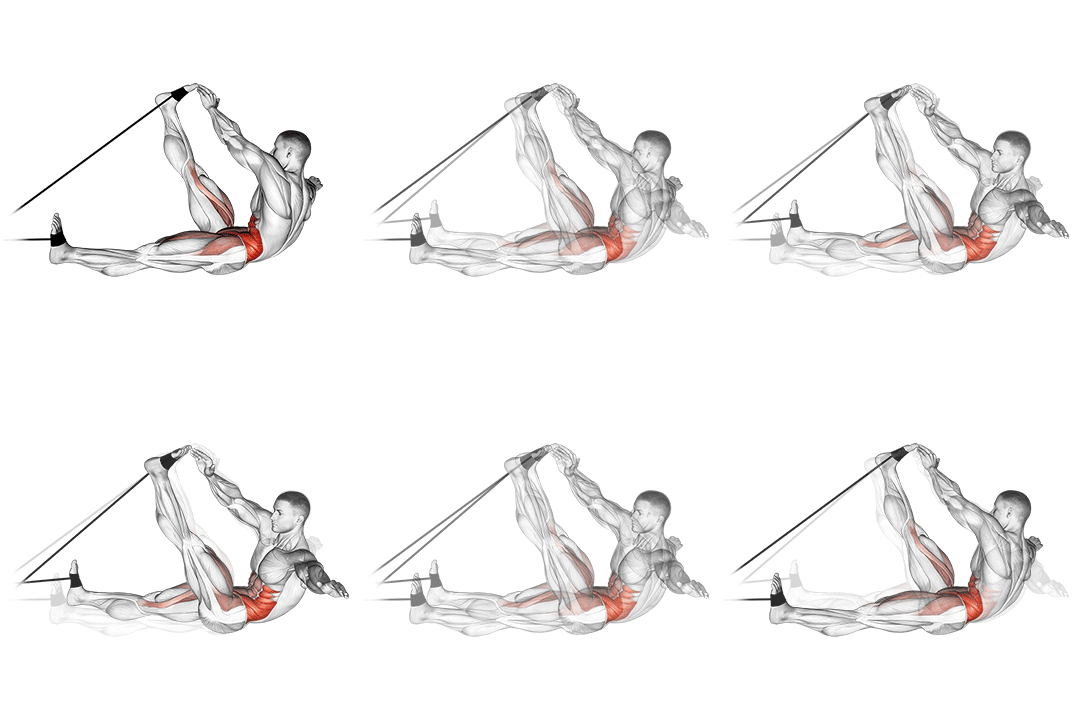
Band Alternating V-up
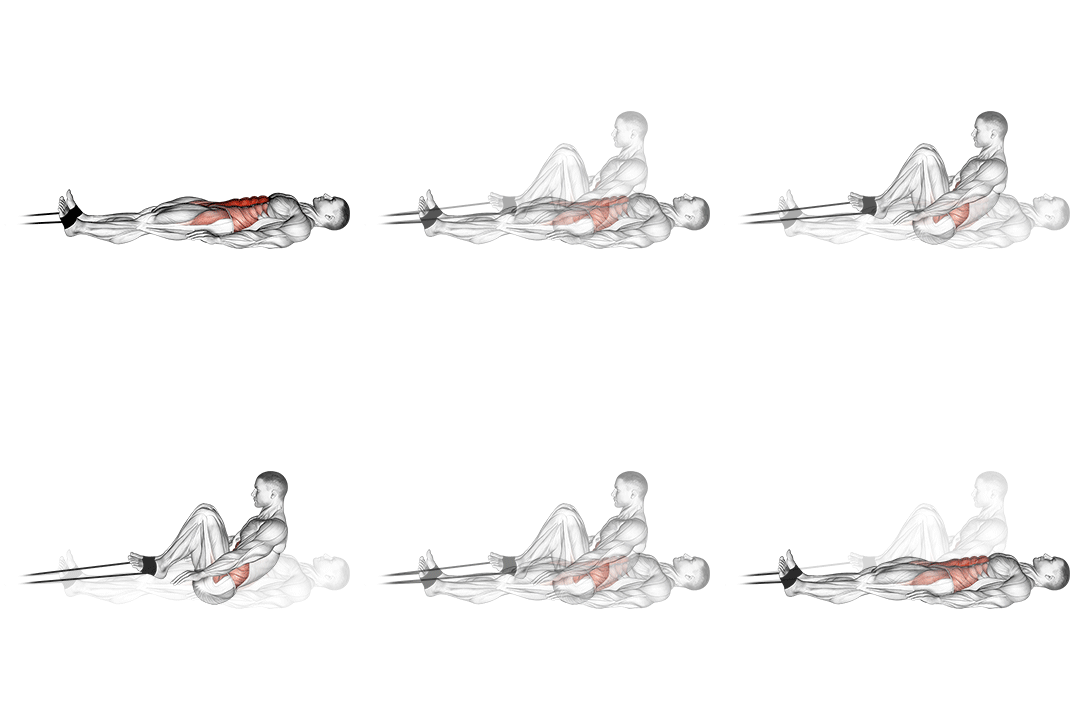
Band Jack Knife Sit-up
Head-to-Head Comparison
Different values are marked. These are catalogue attributes, not performance scores.
Muscles used
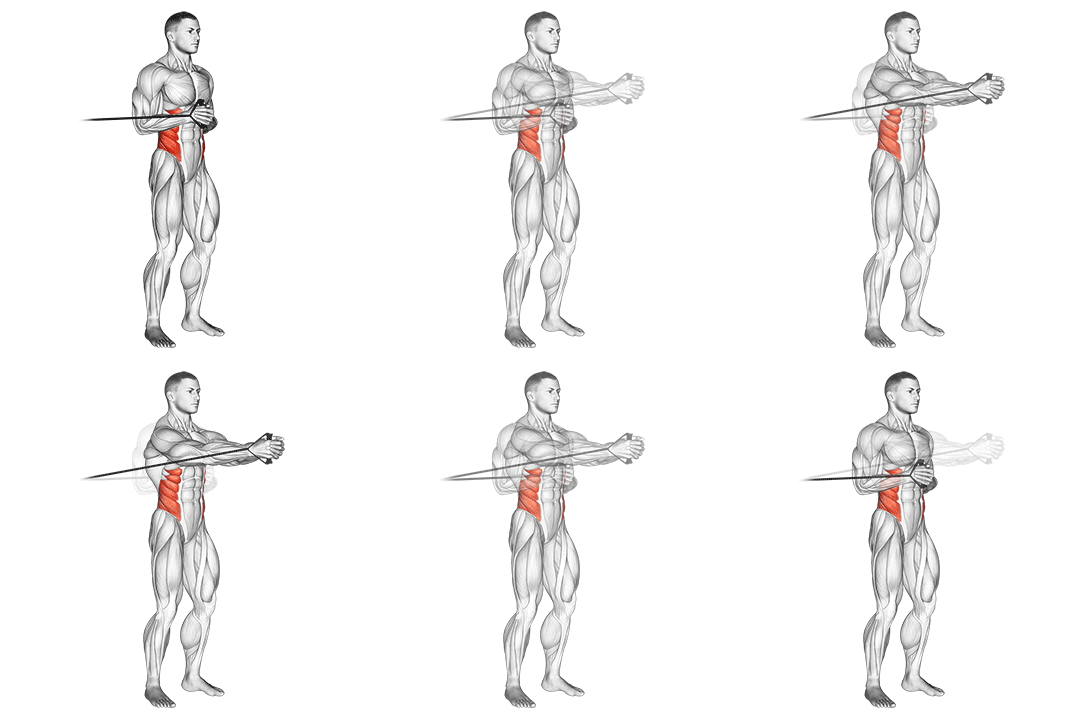
Listed target and secondary muscles, shown on the body. Locations, not activation or strength scores.
- Target
- Secondary
- Not highlighted
Band Alternating V-up
- Target
- Abs
- Secondary
- Hip Flexors
Not shown on diagram: Hip Flexors. These labels do not identify a precise region on this map.
Band Jack Knife Sit-up
- Target
- Abs
- Secondary
- Hip Flexors
Not shown on diagram: Hip Flexors. These labels do not identify a precise region on this map.
Grey does not mean a muscle is unused. The diagrams show only the mapped catalogue labels.
| Attribute | Band Alternating V-up | Band Jack Knife Sit-up |
|---|---|---|
| Target Muscle | Abs |
Abs |
| Body Part | Waist |
Waist |
| Equipment | Band |
Band |
| Difficulty | Advanced |
Advanced |
| Movement Type | Isolation |
Isolation |
| Secondary Muscles | Hip Flexors |
Hip Flexors |
Visual Comparison
An illustrative 1–10 profile derived from catalog difficulty, equipment, and listed-muscle fields—not measured performance or muscle activation.
Key Differences
- Both exercises target the Abs using Band. The catalogue does not establish which exercise is better for an individual goal.
Muscle comparison
Shared target muscles
Secondary muscle differences
Muscle involvement analysis
Equipment and setup
Band Alternating V-up: setup
Band Jack Knife Sit-up: setup
Access and practicality
Learning and progression
Learning the movements
Progression considerations
Limitations and precautions
Pros & Cons
Band Alternating V-up
+ Pros
- High anti-rotation and unilateral core control improves transverse abdominis and oblique recruitment
- Requires minimal anchor setup—easy to perform with a single loop band
- Challenges coordination and proprioception, aiding sport-specific core stability
- Progresses to loaded or unstable variations (slow eccentrics, holds, added band tension)
− Cons
- Steeper technical learning curve—coordination demands can reduce effective reps
- Higher torsional stress on the spine if form slips into rotation or lumbar extension
- Less straightforward to progressively overload with very heavy resistance bands
Band Jack Knife Sit-up
+ Pros
- Produces strong bilateral rectus abdominis and hip flexor recruitment for time under tension
- Easier to scale load with band thickness and controlled eccentrics
- More predictable movement path, faster to learn proper form
- Better for higher-intensity sets (8–15 reps) with consistent resistance throughout
− Cons
- Repetitive spinal flexion can increase lumbar disc stress if technique is poor
- Requires heavier or more secure band anchoring to reach high tensions
- Less anti-rotation stimulus—limited carryover to unilateral stability tasks
When Each Exercise Wins
The jack knife enables larger, synchronous rectus activation and easier progressive overload with heavier bands and controlled 3–5 second eccentrics. Use 3–4 sets of 8–15 reps to maximize time under tension and muscle growth.
Symmetrical loading allows you to apply greater absolute resistance and focus on heavy, controlled reps. Heavier-band 4–6 rep sets with slow eccentrics increase force production capacity in trunk flexion.
The bilateral pattern is simpler to learn and maintain spinal alignment. Start with light band tension, 2–3 sets of 10–15 reps, and emphasize posterior pelvic tilt to protect the lumbar spine.
It needs less secure anchoring and can be done with a single loop band under a foot, making setup minimal. It also adds unilateral challenge that increases training variety in small spaces.
Frequently Asked Questions
Can I do both Band Alternating V-up and Band Jack Knife Sit-up in the same workout?
Which exercise is better for beginners?
How do the muscle activation patterns differ?
Can Band Jack Knife Sit-up replace Band Alternating V-up?
Comparison Summary
Exercise instructions
Steps from the exercise catalogue. Read the full sequence before starting.
Band Alternating V-up
- Lie flat on your back with your legs straight and your arms extended overhead, holding the band.
- Engage your abs and lift your legs and upper body off the ground simultaneously, reaching your hands towards your toes.
- As you lower your legs and upper body back down, switch the position of your legs, crossing one over the other.
Read remaining steps for Band Alternating V-up
- Repeat the movement, alternating the position of your legs with each repetition.
- Continue for the desired number of repetitions.
Band Jack Knife Sit-up
- Lie flat on your back with your legs straight and your arms extended overhead, holding the band.
- Engage your abs and lift your legs and upper body simultaneously, bringing your hands towards your feet.
- Pause for a moment at the top, then slowly lower your legs and upper body back down to the starting position.
Read remaining steps for Band Jack Knife Sit-up
- Repeat for the desired number of repetitions.
Also Compare
More comparisons with Band Alternating V-up
Compare another pair
Choose two exercises to see their differences side by side.