Band Assisted Wheel Rollerout vs Band Jack Knife Sit-up

Compare target muscles, equipment, difficulty, movement type, and secondary muscles for Band Assisted Wheel Rollerout and Band Jack Knife Sit-up.

Change comparison Share

Get comparison link

Select the link and use your device's Copy command.

Comparison overview

AI-generated
Band Assisted Wheel Rollerout vs Band Jack Knife Sit-up — if you're choosing between two tough band-based core moves, you're in the right place. You'll get clear, actionable comparisons of muscle activation, biomechanics, equipment needs, technique cues, and which exercise fits your goal: core strength, muscle growth, or home training. I'll point out specific joint angles, rep ranges, and progressions so you can pick the exercise that gives you measurable progress and stays safe as you train.

Exercise Comparison

Exercise A
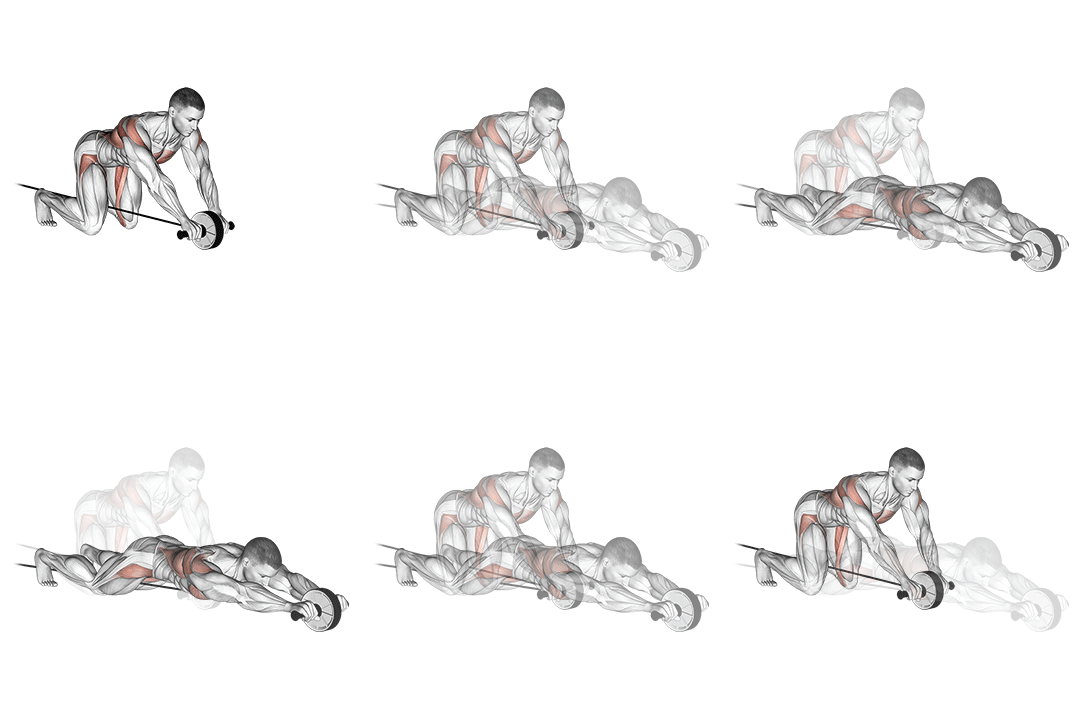
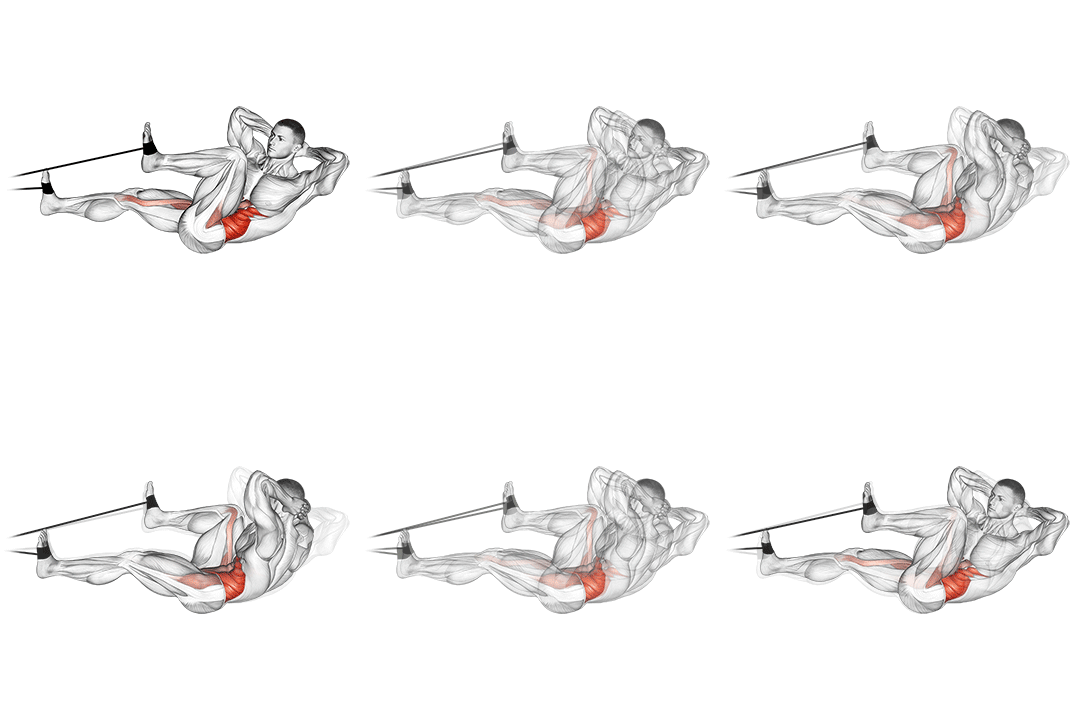
Band Assisted Wheel Rollerout demonstration

Band Assisted Wheel Rollerout

Target Abs
Equipment Band
Body Part Waist
Difficulty Intermediate
Movement Isolation
Secondary Muscles
Lower Back
VS
Exercise B
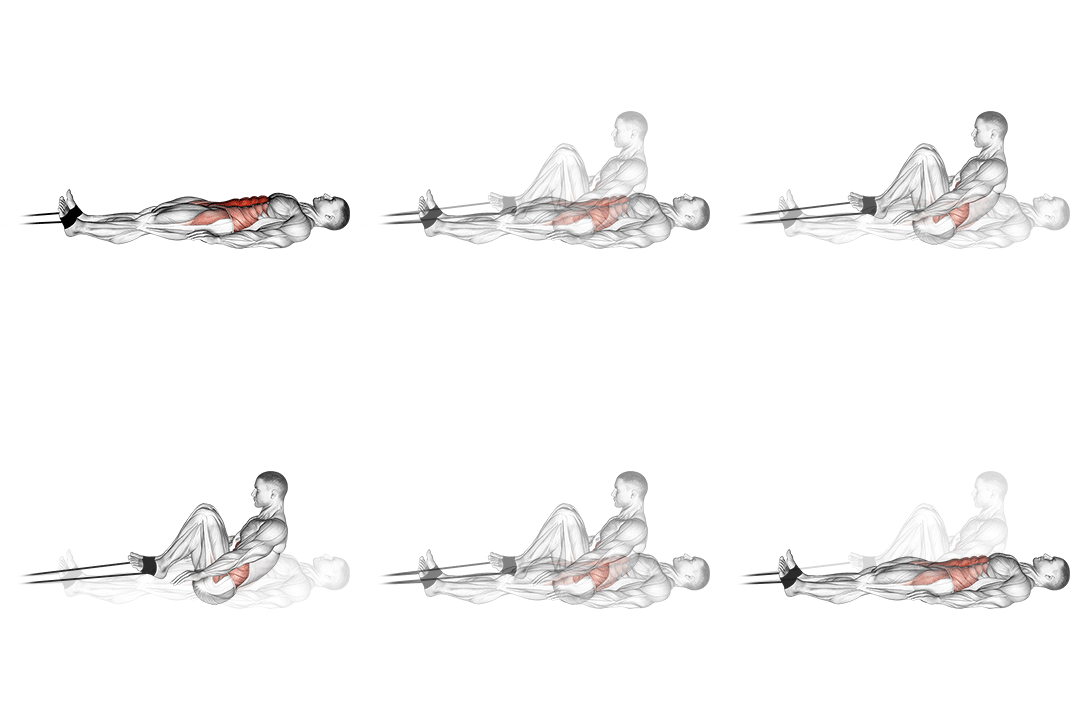
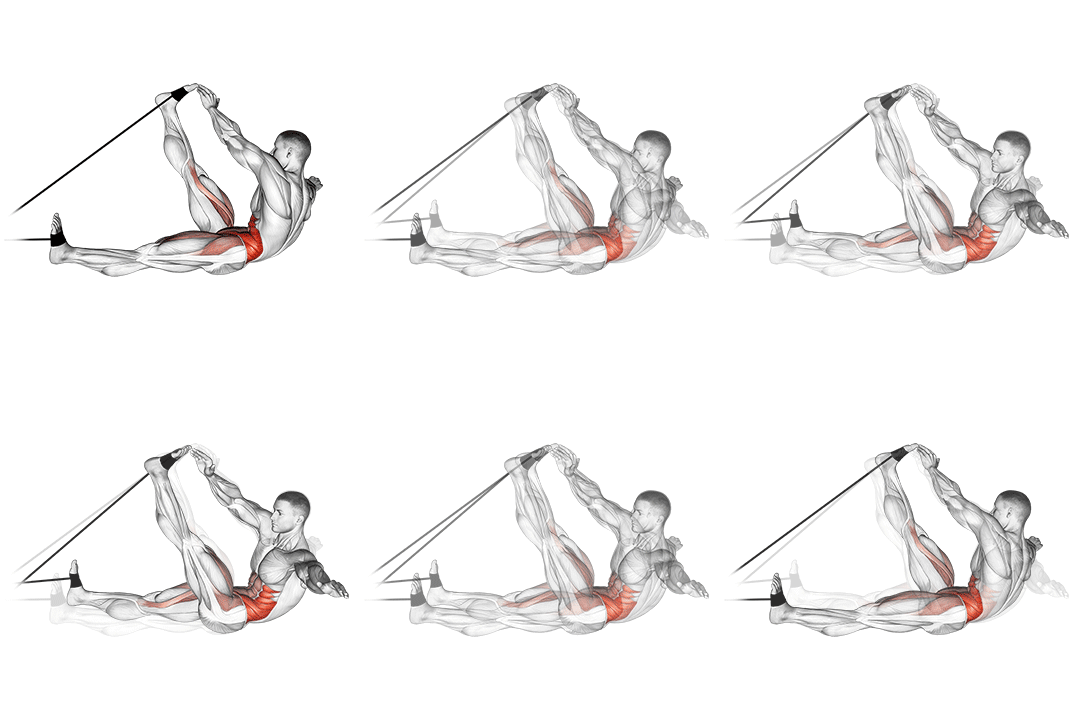
Band Jack Knife Sit-up demonstration

Band Jack Knife Sit-up

Target Abs
Equipment Band
Body Part Waist
Difficulty Advanced
Movement Isolation
Secondary Muscles
Hip Flexors

Head-to-Head Comparison

Different values are marked. These are catalogue attributes, not performance scores.

Muscles used

Listed target and secondary muscles, shown on the body. Locations, not activation or strength scores.

  • Target
  • Secondary
  • Not highlighted

Band Assisted Wheel Rollerout

Front
Band Assisted Wheel Rollerout: front muscle locationsSolid: listed target. Striped: listed secondary. Grey: not highlighted. Locations, not activation or strength scores. See the muscle names below.
Back
Band Assisted Wheel Rollerout: back muscle locationsSolid: listed target. Striped: listed secondary. Grey: not highlighted. Locations, not activation or strength scores. See the muscle names below.
Target
Abs
Secondary
Lower Back

Band Jack Knife Sit-up

Front
Band Jack Knife Sit-up: front muscle locationsSolid: listed target. Striped: listed secondary. Grey: not highlighted. Locations, not activation or strength scores. See the muscle names below.
Back
Band Jack Knife Sit-up: back muscle locationsSolid: listed target. Striped: listed secondary. Grey: not highlighted. Locations, not activation or strength scores. See the muscle names below.
Target
Abs
Secondary
Hip Flexors

Not shown on diagram: Hip Flexors. These labels do not identify a precise region on this map.

Grey does not mean a muscle is unused. The diagrams show only the mapped catalogue labels.

Attribute Band Assisted Wheel Rollerout Band Jack Knife Sit-up
Target Muscle
Abs
Abs
Body Part
Waist
Waist
Equipment
Band
Band
Difficulty Different
Intermediate
Advanced
Movement Type
Isolation
Isolation
Secondary Muscles Different
Lower Back
Hip Flexors

Visual Comparison

An illustrative 1–10 profile derived from catalog difficulty, equipment, and listed-muscle fields—not measured performance or muscle activation.

Key Differences

  • Difficulty levels differ: Band Assisted Wheel Rollerout is intermediate, while Band Jack Knife Sit-up is advanced.
  • Both exercises target the Abs using Band. The catalogue does not establish which exercise is better for an individual goal.

Muscle comparison

Shared target muscles

Both exercises primarily target the rectus abdominis and deeper core stabilizers. The band-assisted wheel rollerout emphasizes anti-extension demand: your rectus and transverse abdominis hold the spine against an external extension torque as your arms move from roughly 90° to near 150–180° of shoulder flexion. The band jack knife sit-up produces concentric-eccentric shortening of the rectus via simultaneous hip and spine flexion (hip angle moving toward ~90°), so it loads the rectus through a greater shortening range.

Secondary muscle differences

The rollerout recruits the lumbar erector spinae as an antagonist and stabilizer under isometric tension and stresses posterior chain control, while the jack knife shifts load into the hip flexors (iliopsoas and rectus femoris) during the concentric phase. That means the rollerout challenges anti-extension capacity of the anterior core and lower-back co-contraction, whereas the jack knife puts larger torque demand on hip flexors and compressive load on the lumbar spine.

Muscle involvement analysis

Activation differs by movement pattern: rollerout creates sustained isometric and eccentric tension in the abs as you resist horizontal shear and anterior tilt (force vector is largely anterior-to-posterior across the torso). Jack knife produces cyclic concentric-eccentric pulses in rectus and strong hip flexor activation (force vector is more sagittal compression and hip torque). Expect higher continuous core burn with rollerouts and higher peak hip-flexor firing with jack knives.

Equipment and setup

Band Assisted Wheel Rollerout: setup

Band Assisted Wheel Rollerout: a resistant band (loop or long band), an ab wheel or a stable handle surface, and a sturdy anchor point if you use a looped band. You can vary assistance by changing band tension or anchor height.

Band Jack Knife Sit-up: setup

Band Jack Knife Sit-up: a resistant band anchored overhead or behind your feet and a mat. Minimal gear: one band and a flat surface; you can increase resistance by shortening the band or using a heavier band.

Access and practicality

Band Jack Knife Sit-up — it needs only a band and floor space and is easier to set up at home. The rollerout typically benefits from an ab wheel or specific anchoring setup, making the jack knife more accessible for quick home sessions.

Learning and progression

Learning the movements

Band Assisted Wheel Rollerout (intermediate) has a moderate learning curve: learn to brace your spine, progress range slowly, and adjust band tension. Band Jack Knife Sit-up (advanced) is harder to master because it requires coordinated hip and spinal flexion under tension and greater mobility; technique breakdowns occur quickly if you lack hip control.

Progression considerations

Rollerout offers broader progression options: increase range of motion, reduce band assistance, move to one-arm rollouts, or add tempo work (3–6 reps for strength). Jack knife progression tends to be load and tempo based (8–20 reps for hypertrophy) but has less room for safe mechanical advantage changes without overloading the lumbar spine.

Limitations and precautions

Band Jack Knife Sit-up has higher risk for lumbar compression and hip-flexor strain if performed with poor control, especially at high reps. Rollerout risks include anterior shoulder strain and lumbar hyperextension if you let the lower back sag; both are safe when you maintain neutral spine, full core brace, and controlled range.

Pros & Cons

Band Assisted Wheel Rollerout

+ Pros

  • High anti-extension demand builds durable anterior core strength and resistance to spinal hyperextension
  • Easy to scale assistance via band tension or shorter range-of-motion
  • Transfers well to anti-extension sport tasks (e.g., overhead pressing, throwing)
  • Allows strength-focused loading with low rep ranges (3–8) or tempo work

− Cons

  • Requires an ab wheel or anchored band setup for ideal mechanics
  • Can overload shoulders if you reach too far without scapular control
  • Risks lumbar hyperextension if core brace fails at end ranges

Band Jack Knife Sit-up

+ Pros

  • Minimal equipment — you only need a band and floor space
  • Strong concentric-eccentric stimulus for rectus abdominis and time-under-tension for hypertrophy
  • Great for higher-rep metabolic core work (10–20 reps)
  • Simple to modify resistance by changing band length or thickness

− Cons

  • High hip-flexor involvement can limit pure abdominal focus
  • Greater compressive load on the lumbar spine when performed aggressively
  • Technically demanding — coordination between hip and spine flexion often limits reps

When Each Exercise Wins

1
For muscle hypertrophy: Band Jack Knife Sit-up

The jack knife produces repeated concentric-eccentric contractions and longer time under tension across the rectus abdominis and obliques (10–20 rep ranges), which favors hypertrophy when you control tempo and increase band resistance.

2
For strength gains: Band Assisted Wheel Rollerout

Rollouts tax anti-extension strength and allow low-rep heavy stimulus (3–8 reps) and progressive overload through reduced band assistance, making them superior for building core strength and stability.

3
For beginners: Band Assisted Wheel Rollerout

With band assistance and short ranges, rollerouts are easier to scale and teach core bracing and neutral spine under load, whereas jack knives require coordinated hip-spine timing that beginners often lack.

4
For home workouts: Band Jack Knife Sit-up

The jack knife needs only a band and floor space, so it’s simpler to perform at home without extra tools like an ab wheel or anchor points.

Frequently Asked Questions

Can I do both Band Assisted Wheel Rollerout and Band Jack Knife Sit-up in the same workout?

Yes. Pair them strategically: use rollerouts early in a session for low-rep strength (3–6 reps) and follow with jack knives for hypertrophy or volume (10–15 reps). Space them across 3–4 sets each and monitor fatigue to maintain technique.

Which exercise is better for beginners?

Band Assisted Wheel Rollerout is generally more beginner-friendly because you can scale assistance and limit range-of-motion while teaching anti-extension bracing. Start with partial rollouts and progress range before attempting jack knives.

How do the muscle activation patterns differ?

Rollouts emphasize isometric and eccentric control of the rectus and transverse abdominis against an extension torque (anti-extension). Jack knives produce concentric-eccentric contractions of the rectus with heavy hip-flexor recruitment, so the load shifts from sustained stabilization to dynamic shortening.

Can Band Jack Knife Sit-up replace Band Assisted Wheel Rollerout?

Not perfectly. If your goal is anti-extension core strength and transfer to heavier lifts, the jack knife won’t replicate the isometric resistance demands of a rollout. For hypertrophy or limited-equipment sessions, the jack knife can substitute effectively.

Comparison Summary

Use the Band Assisted Wheel Rollerout when your priority is anti-extension core strength, transfer to overhead or loaded lifts, and progressive strength overload. Work in low-to-moderate reps (3–8) with strict bracing and controlled range; reduce band assistance slowly. Choose the Band Jack Knife Sit-up when you want higher time under tension and focused rectus hypertrophy in 10–20 rep ranges, or when equipment is limited. For safety, always cue neutral spine, brace through the transverse abdominis, and limit end-range lumbar flexion — prefer the exercise that matches your goal: strength and stability (rollerout) or muscular development and accessibility (jack knife).

Exercise instructions

Steps from the exercise catalogue. Read the full sequence before starting.

Band Assisted Wheel Rollerout

  1. Kneel on the floor and hold the handles of the band with both hands, palms facing down.
  2. Place the band on the ground in front of you and position your hands shoulder-width apart.
  3. Engage your core and slowly roll the wheel forward, extending your body as far as you can while maintaining control.
Read remaining steps for Band Assisted Wheel Rollerout
  1. Pause for a moment at the furthest point, then slowly roll the wheel back towards your knees to return to the starting position.
  2. Repeat for the desired number of repetitions.

Band Jack Knife Sit-up

  1. Lie flat on your back with your legs straight and your arms extended overhead, holding the band.
  2. Engage your abs and lift your legs and upper body simultaneously, bringing your hands towards your feet.
  3. Pause for a moment at the top, then slowly lower your legs and upper body back down to the starting position.
Read remaining steps for Band Jack Knife Sit-up
  1. Repeat for the desired number of repetitions.

Also Compare

Compare another pair

Choose two exercises to see their differences side by side.

Compare Exercises