Band Jack Knife Sit-up vs Band Kneeling Twisting Crunch

Compare target muscles, equipment, difficulty, movement type, and secondary muscles for Band Jack Knife Sit-up and Band Kneeling Twisting Crunch.

Change comparison Share

Get comparison link

Select the link and use your device's Copy command.

Comparison overview

AI-generated
Band Jack Knife Sit-up vs Band Kneeling Twisting Crunch — you’re looking at two band-resisted isolation moves that hit the abs but load the midsection differently. This guide helps you decide which to use based on muscle activation, setup, technique cues, and injury risk. You’ll get clear coaching cues (angles, rep ranges, tempo), a side-by-side look at primary and secondary recruitment, equipment needs, and when to pick one for progressive overload or for steady core conditioning. Read on so you can choose the exercise that fits your goals and current skill level.

Exercise Comparison

Exercise A
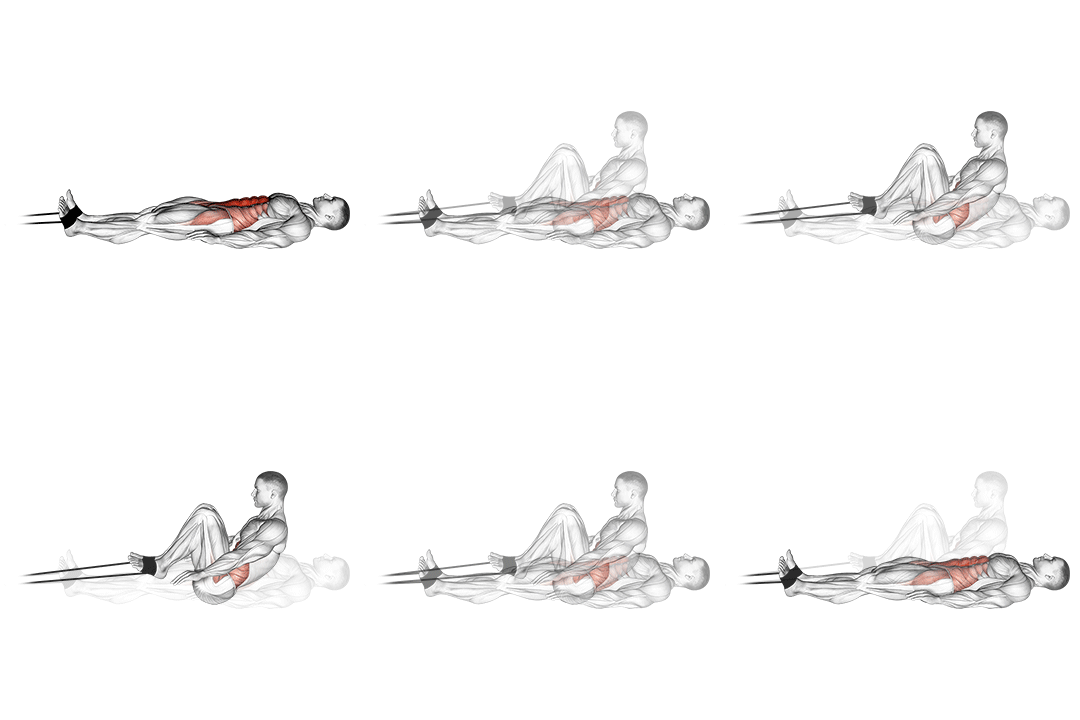
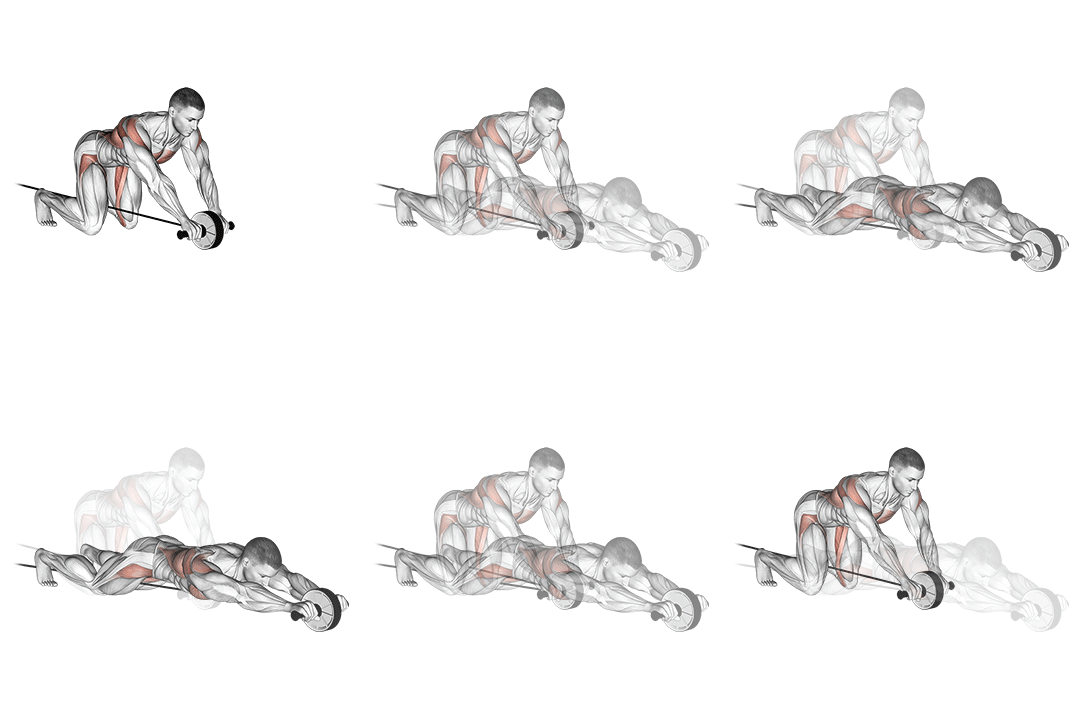
Band Jack Knife Sit-up demonstration

Band Jack Knife Sit-up

Target Abs
Equipment Band
Body Part Waist
Difficulty Advanced
Movement Isolation
Secondary Muscles
Hip Flexors
VS
Exercise B
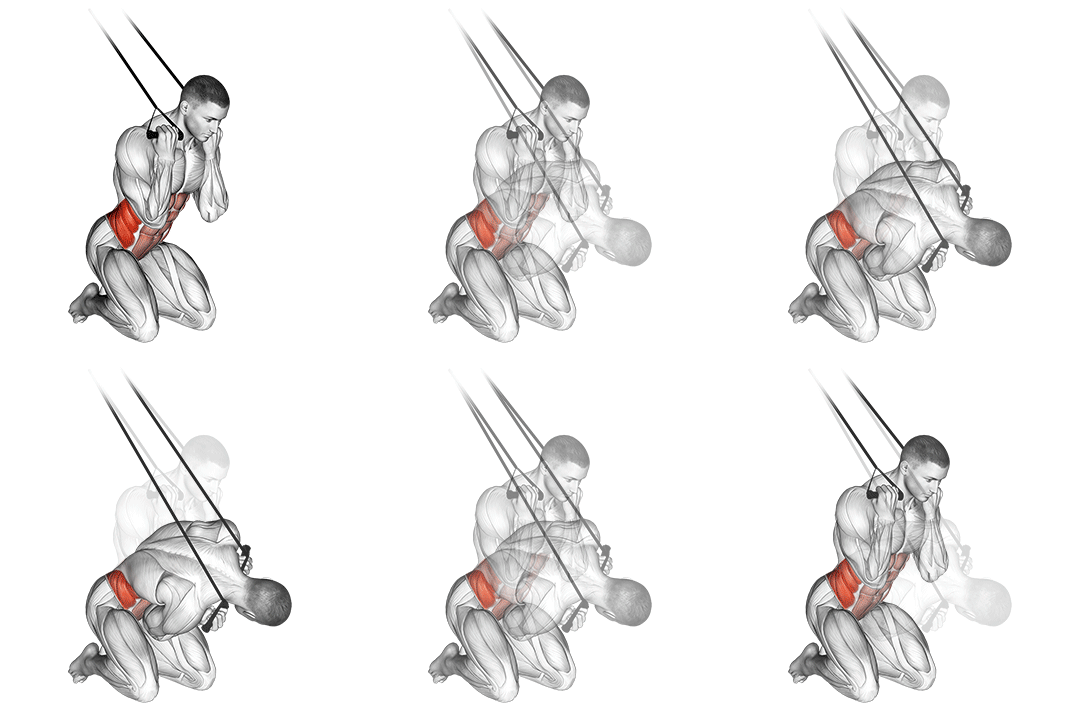
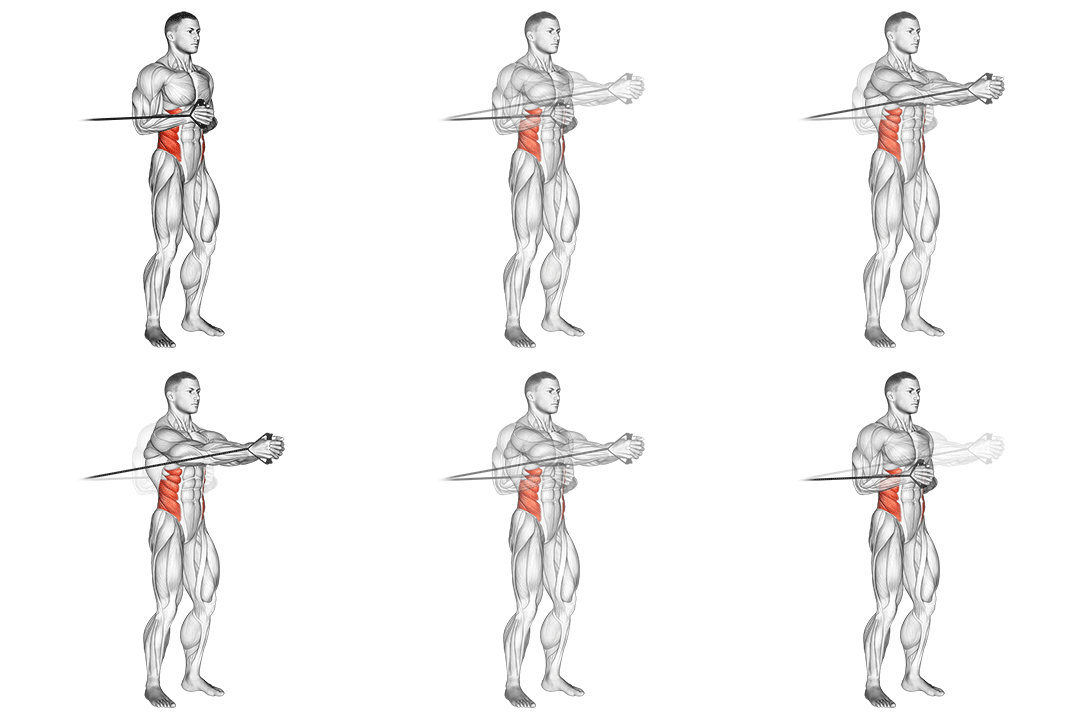
Band Kneeling Twisting Crunch demonstration

Band Kneeling Twisting Crunch

Target Abs
Equipment Band
Body Part Waist
Difficulty Intermediate
Movement Isolation
Secondary Muscles
Obliques

Head-to-Head Comparison

Different values are marked. These are catalogue attributes, not performance scores.

Muscles used

Listed target and secondary muscles, shown on the body. Locations, not activation or strength scores.

  • Target
  • Secondary
  • Not highlighted

Band Jack Knife Sit-up

Front
Band Jack Knife Sit-up: front muscle locationsSolid: listed target. Striped: listed secondary. Grey: not highlighted. Locations, not activation or strength scores. See the muscle names below.
Back
Band Jack Knife Sit-up: back muscle locationsSolid: listed target. Striped: listed secondary. Grey: not highlighted. Locations, not activation or strength scores. See the muscle names below.
Target
Abs
Secondary
Hip Flexors

Not shown on diagram: Hip Flexors. These labels do not identify a precise region on this map.

Band Kneeling Twisting Crunch

Front
Band Kneeling Twisting Crunch: front muscle locationsSolid: listed target. Striped: listed secondary. Grey: not highlighted. Locations, not activation or strength scores. See the muscle names below.
Back
Band Kneeling Twisting Crunch: back muscle locationsSolid: listed target. Striped: listed secondary. Grey: not highlighted. Locations, not activation or strength scores. See the muscle names below.
Target
Abs
Secondary
Obliques

Grey does not mean a muscle is unused. The diagrams show only the mapped catalogue labels.

Attribute Band Jack Knife Sit-up Band Kneeling Twisting Crunch
Target Muscle
Abs
Abs
Body Part
Waist
Waist
Equipment
Band
Band
Difficulty Different
Advanced
Intermediate
Movement Type
Isolation
Isolation
Secondary Muscles Different
Hip Flexors
Obliques

Visual Comparison

An illustrative 1–10 profile derived from catalog difficulty, equipment, and listed-muscle fields—not measured performance or muscle activation.

Key Differences

  • Difficulty levels differ: Band Jack Knife Sit-up is advanced, while Band Kneeling Twisting Crunch is intermediate.
  • Both exercises target the Abs using Band. The catalogue does not establish which exercise is better for an individual goal.

Muscle comparison

Shared target muscles

Both exercises primarily target the rectus abdominis. The jack knife places the rectus through a larger combined hip- and trunk-flexion range (hip flexion to ~90° plus up to ~90° trunk flexion), producing a strong concentric shortening across the midline. The kneeling twisting crunch targets rectus activation through unilateral and rotational bias—peak rectus activity occurs during the initial 20–60° of trunk flexion when the band tension aligns with the sagittal plane.

Secondary muscle differences

Band Jack Knife Sit-up recruits hip flexors (iliopsoas, rectus femoris) heavily because you perform simultaneous hip and trunk flexion; expect notable hip-flexor torque and anterior pelvic tilt stress. Band Kneeling Twisting Crunch recruits obliques (internal/external) far more due to the rotational force vector; oblique EMG is typically 15–40% higher in twisting, so you get anti-rotation and lateral flexion work alongside rectus loading.

Muscle involvement analysis

Jack knife produces concurrent shortening of rectus and hip flexors—force vectors run from pelvis toward ribcage, increasing compressive load on the lumbar spine during end-range flexion. The kneeling twisting crunch primarily places the rectus under sagittal flexion with a torsional component: rotation shifts force vectors laterally, lengthening one oblique while shortening the opposite, so activation is phased (rotation peak then controlled eccentric). Bands create variable resistance: tension increases as you shorten the lever, changing peak force timing between the two moves.

Equipment and setup

Band Jack Knife Sit-up: setup

Band Jack Knife Sit-up needs a medium-to-heavy resistance band anchored behind your feet or anchored low, and a flat surface to lie on. Optional: a mat for comfort and a secondary anchor to secure the band to prevent slippage.

Band Kneeling Twisting Crunch: setup

Band Kneeling Twisting Crunch requires a single band anchored at or above shoulder height and space to kneel facing away from the anchor. A mat helps for knee comfort; a door anchor or fixed pole works fine.

Access and practicality

Band Kneeling Twisting Crunch — it needs less setup and less absolute core strength. You can use lighter bands and adjust distance to the anchor to reduce tension, making it easier to scale in most home gyms.

Learning and progression

Learning the movements

Band Kneeling Twisting Crunch is easier to learn: you control rotation while maintaining a neutral pelvis and practice single-plane crunching plus rotation. Band Jack Knife Sit-up has a steeper learning curve because it demands coordinated hip flexion and trunk flexion with higher band tension and precise breathing to protect the lumbar spine.

Progression considerations

Band Jack Knife Sit-up offers clear progression via heavier bands, slower eccentrics (3–5 second negatives), and partial-range pauses at 0–30° from full flexion to increase time under tension. Kneeling twisting progressions center on increased band resistance, added pause at peak rotation (0.5–1s), and increased ROM (aim for 30–45° rotation).

Limitations and precautions

Band Jack Knife Sit-up carries higher lumbar and hip-flexor strain risk due to combined hip/trunk torque—relative injury risk is higher versus the kneeling crunch, especially if you let the pelvis posteriorly tilt rapidly at end range. Kneeling twisting crunch has lower compressive spinal load but raises shear if you thrust or hyper-rotate; controlled reps reduce risk.

Pros & Cons

Band Jack Knife Sit-up

+ Pros

  • High rectus abdominis activation through large hip+trunk ROM
  • Excellent for progressive overload with heavier bands and slow eccentrics
  • Develops coordinated hip flexor and core strength for dynamic movements
  • Short, intense sets: effective in 6–15 rep ranges for muscle growth

− Cons

  • Higher lumbar compressive load at end-range flexion
  • Requires solid hip-flexor strength and coordination
  • Harder to modify for true beginners or those with lower-back issues

Band Kneeling Twisting Crunch

+ Pros

  • Lower technical barrier — easier to scale with band distance
  • Strong oblique and anti-rotation stimulus for functional core stability
  • Less compressive load on the spine when performed with neutral pelvis
  • Simple setup works well for home gyms and quick circuits

− Cons

  • Less hip-flexor recruitment and less total ROM for rectus-focused overload
  • Can underload rectus if you use very light bands or short rotation
  • Risk of using torso momentum rather than strict rotation if rushed

When Each Exercise Wins

1
For muscle hypertrophy: Band Jack Knife Sit-up

The jack knife produces greater total range of motion and combined hip/trunk loading, which increases time under tension for the rectus and hip flexors. Use 8–15 controlled reps with heavy bands and 2–4 second eccentrics to maximize muscle growth.

2
For trunk strength: Band Jack Knife Sit-up

It creates higher concentric and eccentric torque across the trunk and hips, improving absolute midline strength. Progress by increasing band resistance and adding slow negatives to overload spinal flexion control.

3
For beginners: Band Kneeling Twisting Crunch

Kneeling twists let you dial back band distance and focus on single-plane control and pelvic stability, making it easier to learn proper breathing and bracing. Start with 12–20 reps and low tension, then increase rotation range gradually.

4
For home workouts: Band Kneeling Twisting Crunch

It requires minimal anchoring and less absolute strength, so you can do it with a door anchor or pole and a single band. It’s quick to set up and scales from rehab-level to intermediate work.

Frequently Asked Questions

Can I do both Band Jack Knife Sit-up and Band Kneeling Twisting Crunch in the same workout?

Yes — pair them in a single session for balanced development: start with the jack knife for heavy, lower-rep rectus overload (6–12 reps) then follow with the kneeling twist for oblique-focused volume (12–20 reps). Keep total sets manageable (3–4 each) and avoid rushing to maintain form and protect the lumbar spine.

Which exercise is better for beginners?

Band Kneeling Twisting Crunch is better for beginners because it’s easier to scale by changing band distance and tension, and it places less compressive load on the spine. Beginners should focus on pelvic stability, 12–20 controlled reps, and smooth rotation before progressing.

How do the muscle activation patterns differ?

The jack knife uses synchronized hip and trunk flexion, producing strong rectus and hip-flexor activation with peak force late in the concentric range. The kneeling twist emphasizes unilateral oblique activation during rotation with a staggered activation pattern: one oblique shortens while the opposite lengthens under tension.

Can Band Kneeling Twisting Crunch replace Band Jack Knife Sit-up?

Not fully — the kneeling twist can replace jack knives when you need lower spinal loading or more oblique emphasis, but it won’t produce the same combined hip-trunk overload for rectus and hip flexors. Match the exercise to your goal: choose kneeling twists for control and oblique work, jack knives for maximal rectus overload.

Comparison Summary

If you want raw rectus overload and a move that challenges hip flexor-trunk coordination, pick the Band Jack Knife Sit-up — it’s ideal for intermediate-to-advanced lifters chasing muscle growth or higher trunk strength and should be trained in sets of 6–15 reps with controlled eccentrics. If you need a scalable option that emphasizes obliques, anti-rotation control, or you’re training at home or starting out, choose the Band Kneeling Twisting Crunch — use 12–20 reps, focus on a 30–45° controlled rotation, and keep the pelvis stable. Use the kneeling twist to build rotational control, then add jack knives once you can maintain neutral spine under tension.

Exercise instructions

Steps from the exercise catalogue. Read the full sequence before starting.

Band Jack Knife Sit-up

  1. Lie flat on your back with your legs straight and your arms extended overhead, holding the band.
  2. Engage your abs and lift your legs and upper body simultaneously, bringing your hands towards your feet.
  3. Pause for a moment at the top, then slowly lower your legs and upper body back down to the starting position.
Read remaining steps for Band Jack Knife Sit-up
  1. Repeat for the desired number of repetitions.

Band Kneeling Twisting Crunch

  1. Attach the band to a sturdy anchor point at waist height.
  2. Kneel down facing away from the anchor point and hold the band with both hands, keeping your elbows bent and close to your sides.
  3. Engage your abs and slowly twist your torso to one side, bringing your hands towards your opposite hip.
Read remaining steps for Band Kneeling Twisting Crunch
  1. Pause for a moment, then slowly return to the starting position.
  2. Repeat on the other side.
  3. Continue alternating sides for the desired number of repetitions.

Also Compare

Compare another pair

Choose two exercises to see their differences side by side.

Compare Exercises