Bench Press - With Bands vs Cross Over - With Bands

Compare target muscles, equipment, difficulty, movement type, and secondary muscles for Bench Press - With Bands and Cross Over - With Bands.

Change comparison Share

Get comparison link

Select the link and use your device's Copy command.

Comparison overview

AI-generated
Bench Press - With Bands vs Cross Over - With Bands — you’re choosing between a compound, variable-resistance press and a transverse-adduction isolation move. If you want clear guidance on which to use for muscle growth, strength, or home workouts, this comparison lays it out. You’ll get technique cues, biomechanics (length-tension curves, force vectors), rep ranges (6–12 for heavy hypertrophy, 8–15 for targeted work), equipment needs, and programming examples. Read on and I’ll help you pick the right option for your chest training and show how to integrate both if you want the best of each.

Exercise Comparison

Exercise A
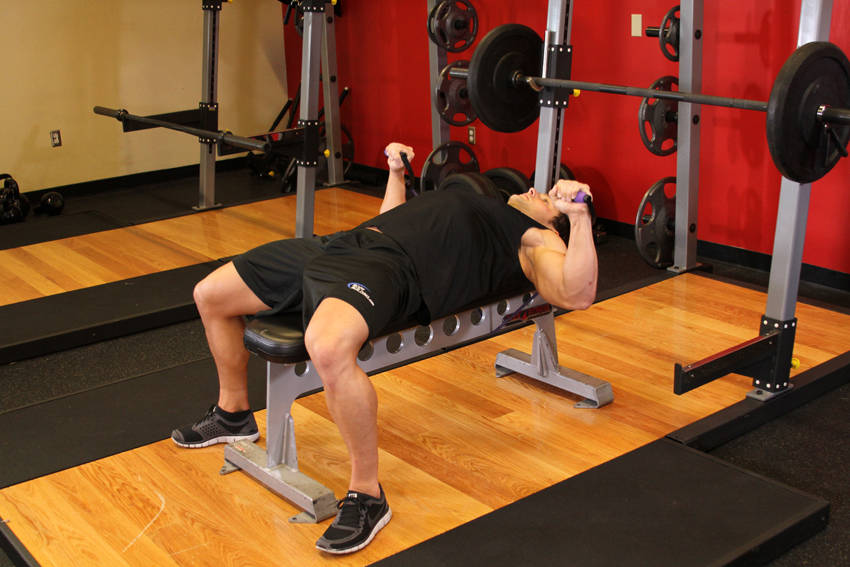
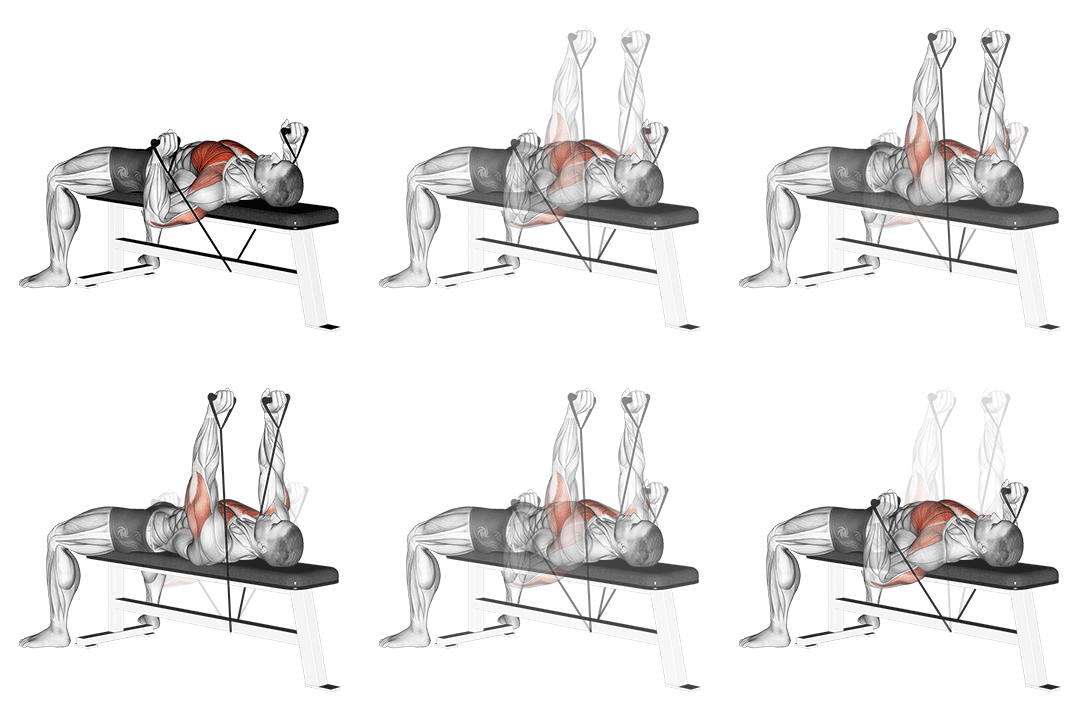
Bench Press - With Bands demonstration

Bench Press - With Bands

Target Pectorals
Equipment Band
Body Part Chest
Difficulty Intermediate
Movement Compound
Secondary Muscles
Shoulders Triceps
VS
Exercise B
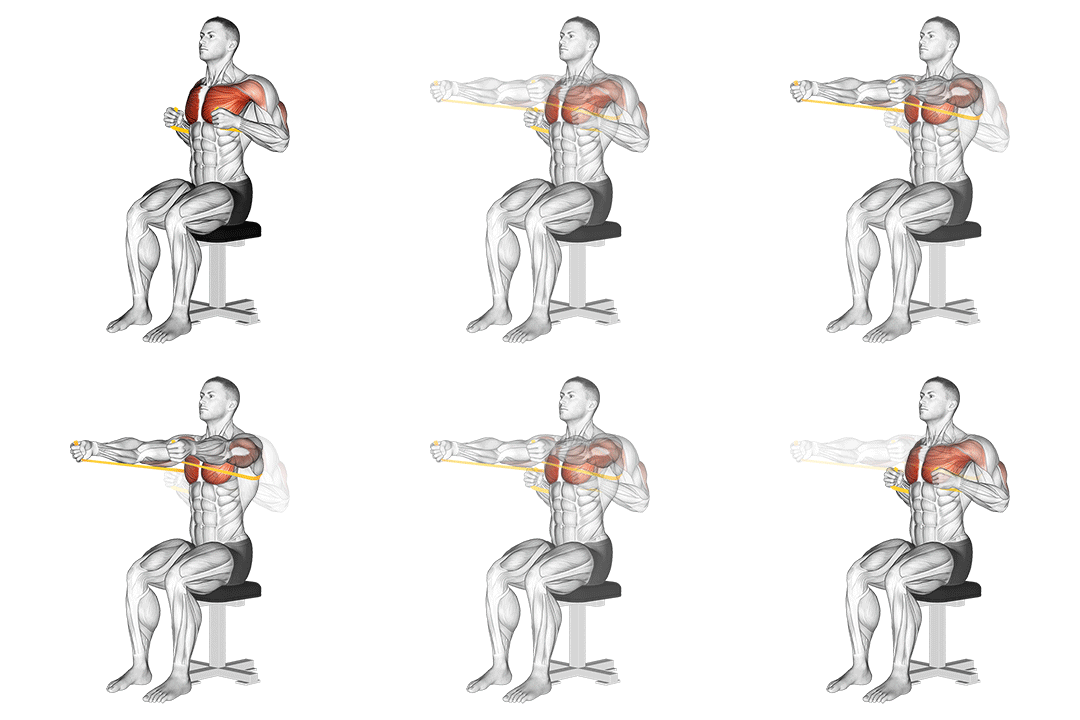
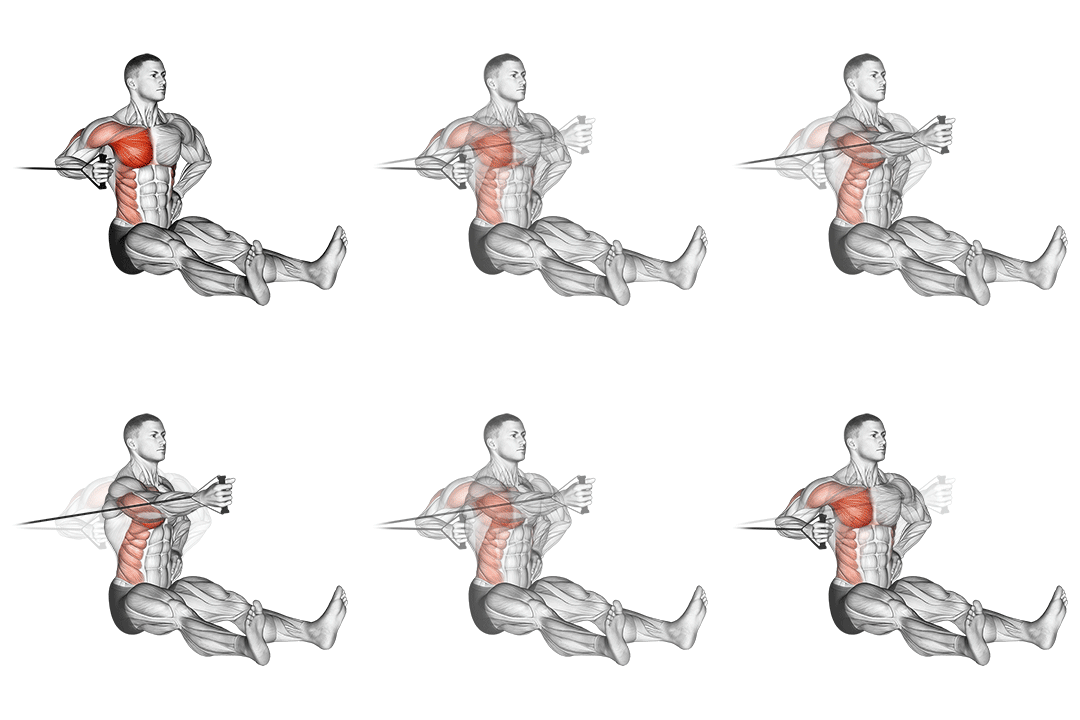
Cross Over - With Bands demonstration

Cross Over - With Bands

Target Pectorals
Equipment Band
Body Part Chest
Difficulty Intermediate
Movement Isolation
Secondary Muscles
Biceps Shoulders

Head-to-Head Comparison

Different values are marked. These are catalogue attributes, not performance scores.

Muscles used

Listed target and secondary muscles, shown on the body. Locations, not activation or strength scores.

  • Target
  • Secondary
  • Not highlighted

Bench Press - With Bands

Front
Bench Press - With Bands: front muscle locationsSolid: listed target. Striped: listed secondary. Grey: not highlighted. Locations, not activation or strength scores. See the muscle names below.
Back
Bench Press - With Bands: back muscle locationsSolid: listed target. Striped: listed secondary. Grey: not highlighted. Locations, not activation or strength scores. See the muscle names below.
Target
Pectorals
Secondary
Shoulders, Triceps

Not shown on diagram: Shoulders. These labels do not identify a precise region on this map.

Cross Over - With Bands

Front
Cross Over - With Bands: front muscle locationsSolid: listed target. Striped: listed secondary. Grey: not highlighted. Locations, not activation or strength scores. See the muscle names below.
Back
Cross Over - With Bands: back muscle locationsSolid: listed target. Striped: listed secondary. Grey: not highlighted. Locations, not activation or strength scores. See the muscle names below.
Target
Pectorals
Secondary
Biceps, Shoulders

Not shown on diagram: Shoulders. These labels do not identify a precise region on this map.

Grey does not mean a muscle is unused. The diagrams show only the mapped catalogue labels.

Attribute Bench Press - With Bands Cross Over - With Bands
Target Muscle
Pectorals
Pectorals
Body Part
Chest
Chest
Equipment
Band
Band
Difficulty
Intermediate
Intermediate
Movement Type Different
Compound
Isolation
Secondary Muscles Different
Shoulders, Triceps
Biceps, Shoulders

Visual Comparison

An illustrative 1–10 profile derived from catalog difficulty, equipment, and listed-muscle fields—not measured performance or muscle activation.

Key Differences

  • Bench Press - With Bands is a compound movement, while Cross Over - With Bands is an isolation exercise.
  • Both exercises target the Pectorals using Band. The catalogue does not establish which exercise is better for an individual goal.

Muscle comparison

Shared target muscles

Both exercises load the pectoralis major, but they emphasize it differently. Bench Press - With Bands creates high mechanical tension across the entire press by combining horizontal pushing with elbow extension, loading the sternal head most on a flat bench. Cross Over - With Bands biases transverse adduction and peak contraction of the pecs, concentrating stress on the mid-to-sternal fibers at end-range. Expect similar overall pectoral activation, but bench allows higher total external load while cross-over produces a stronger peak contraction.

Secondary muscle differences

Bench Press - With Bands recruits the triceps and anterior deltoids strongly because elbow extension and shoulder flexion/pressing are integral to the movement. Cross Over - With Bands uses the anterior deltoid and even the biceps (isometrically) for stabilization, but triceps involvement is minimal. That means bench training transfers more to pressing strength, while cross-over enhances chest isolation and shoulder stabilization.

Muscle involvement analysis

Biomechanically, banded bench shifts the resistance curve: tension rises toward lockout, increasing force demand at shorter pec lengths and boosting triceps work via a changing moment arm. Cross-over maintains near-constant band tension throughout the arc and maximizes tension near full horizontal adduction, exploiting the pecs’ length-tension relationship for stronger end-range contraction. In short: bench stresses concentric lockout more; cross-over emphasizes peak isometric-style contraction mid-to-end range.

Equipment and setup

Bench Press - With Bands: setup

Bench Press - With Bands needs a stable bench (flat or incline), a way to anchor bands under the bench/behind it, and handles or a bar. You’ll also want multiple band tensions to vary load.

Cross Over - With Bands: setup

Cross Over - With Bands requires two high anchor points (or a door anchor and a post), two handles, and several band tensions. No bench is required; you can perform it standing, split-stance, or kneeling.

Access and practicality

Cross Over - With Bands is more accessible. You can anchor bands to doors or posts and train anywhere with minimal setup, while the banded bench needs a bench or stable surface and careful anchoring.

Learning and progression

Learning the movements

Cross Over - With Bands is easier to learn as an isolation pattern: you control a single-arm arc and focus on squeezing at end-range, making it quick for novices to feel the pecs. Bench Press - With Bands requires coordinated scapular stability, leg drive (if used), and timing with changing resistance, which increases the technical demand.

Progression considerations

Bench Press - With Bands offers greater progression potential. You can increase band tension, add chains or weights, change bench angle (flat/incline/decline), and manipulate tempo for heavy 3–5 RM strength phases or 6–12 hypertrophy sets. Cross-over progresses via higher band tension, slower tempo, and increased time under tension (8–15+ reps), but it’s less suitable for maximal strength.

Limitations and precautions

Bench Press - With Bands carries a higher relative injury risk if form breaks: excessive flaring of the elbows or uncontrolled descent can overload the anterior shoulder and pec insertion, especially under high band tension. Cross-over has lower maximal load risk but can overstretch the anterior capsule at extreme ranges—keep elbows slightly bent and avoid excessive external rotation.

Pros & Cons

Bench Press - With Bands

+ Pros

  • Compound movement that builds pressing strength and total mechanical tension
  • Better progression options (band tension, added weight, bench angle changes)
  • Stronger triceps and anterior deltoid recruitment for carryover to other lifts
  • Variable resistance improves lockout strength and overloads different ranges

Cons

  • Requires a bench and secure band anchoring
  • Higher shoulder and pec stress at the bottom if technique breaks
  • Often needs a spotter or conservative loading for safety

Cross Over - With Bands

+ Pros

  • Strong pec isolation and peak contraction for sculpting and hypertrophy
  • Highly portable and doesn’t require a bench
  • Easy to change line of pull (high-to-low, low-to-high) to target fibers
  • Safe to perform unilaterally to correct imbalances

Cons

  • Limited maximal strength carryover compared to compound presses
  • Progression is slower because you can’t match barbell loading
  • Risk of overstretching the anterior shoulder if end-range control is poor

When Each Exercise Wins

1
For muscle hypertrophy: Bench Press - With Bands

Bench press with bands allows higher total mechanical tension and progressive overload (6–12 reps, 3–5 sets) while band tension increases top-end resistance. Use it as a primary compound movement, then add cross-overs for extra peak contraction and 8–15 rep finisher sets.

2
For strength gains: Bench Press - With Bands

Banded bench lets you train heavy close to your max and overload lockout strength via variable resistance, making it superior for improving 1–5 RM pressing strength and transferring to barbell work.

3
For beginners: Cross Over - With Bands

Cross-overs are easier to scale down, require less complex coordination, and avoid heavy loads that can pin a learner. Start with light tension, focus on scapular control and 8–15 reps to build mind-muscle connection before adding compound banded presses.

4
For home workouts: Cross Over - With Bands

Cross-overs need only anchors and bands and can be done standing with minimal space. If you don’t have a stable bench or secure heavy anchor points, cross-overs let you train chest effectively at home.

Frequently Asked Questions

Can I do both Bench Press - With Bands and Cross Over - With Bands in the same workout?

Yes. Do the bench press first as your heavy compound (3–5 sets of 4–8 or 6–12 reps), then use cross-overs as finishers (3–4 sets of 8–15 reps) to increase time under tension and isolate the pecs.

Which exercise is better for beginners?

Cross Over - With Bands is generally better for beginners because it’s easier to scale, safer without a spotter, and quicker to learn the pec activation pattern. Begin with light tension and focus on form before adding compound banded presses.

How do the muscle activation patterns differ?

Banded bench increases demand through elbow extension and upward force vectors, raising triceps and lockout activation as band tension rises. Cross-over keeps constant transverse-adduction tension and emphasizes peak pectoral contraction at end-range, exploiting the pecs’ length-tension relationship.

Can Cross Over - With Bands replace Bench Press - With Bands?

Not completely. Cross-overs are great for isolation and end-range stimulation but won’t match the progressive overload and maximal strength benefits of a compound banded bench. Use cross-overs as a complement or substitute only when benching isn’t practical.

Comparison Summary

Use Bench Press - With Bands when your goal is heavy pressing, overall chest mass, and strength transfer—it’s the primary mover for adding mechanical tension and scaling load. Program it for 3–5 sets of 4–12 reps, varying band tension and bench angle to target different pec fibers. Use Cross Over - With Bands as an accessory to maximize peak contraction, correct imbalances, and add time under tension; perform 3–4 sets of 8–15 reps with slow eccentrics. For home-only setups or beginners wanting safer, isolation-focused work, prioritize cross-overs. Combine both across a cycle: compound banded presses first, then cross-over finishers to maximize muscle growth and range-specific strength.

Exercise instructions

Steps from the exercise catalogue. Read the full sequence before starting.

Bench Press - With Bands

  1. Using a flat bench secure a band under the leg of the bench that is nearest to your head.
  2. Once the band is secure, grab it by both handles and lie down on the bench.
  3. Extend your arms so that you are holding the band handles in front of you at shoulder width.
Read remaining steps for Bench Press - With Bands
  1. Once at shoulder width, rotate your wrists forward so that the palms of your hands are facing away from you. This will be your starting position.
  2. Bring down the handles slowly until your elbow forms a 90 degree angle. Keep full control at all times.
  3. As you breathe out, bring the handles up using your pectoral muscles. Lock your arms in the contracted position, squeeze your chest, hold for a second and then start coming down slowly. Tip: It should take at least twice as long to go down than to come up.
  4. Repeat the movement for the prescribed amount of repetitions of your training program.

Cross Over - With Bands

  1. Secure an exercise band around a stationary post.
  2. While facing away from the post, grab the handles on both ends of the band and step forward enough to create tension on the band.
  3. Raise your arms to the sides, parallel to the floor, perpendicular to your torso (your torso and the arms should resemble the letter "T") and with the palms facing forward. Have them extended with a slight bend at the elbows. This will be your starting position.
Read remaining steps for Cross Over - With Bands
  1. While keeping your arms straight, bring them across your chest in a semicircular motion to the front as you exhale and flex your pecs. Hold the contraction for a second.
  2. Slowly return to the starting position as you inhale.
  3. Perform for the recommended amount of repetitions.

Also Compare

Compare another pair

Choose two exercises to see their differences side by side.

Compare Exercises