

Dumbbell Alternate Seated Hammer Curl vs Dumbbell Alternating Bicep Curl With Leg Raised On Exercise Ball
Compare target muscles, equipment, difficulty, movement type, and secondary muscles for Dumbbell Alternate Seated Hammer Curl and Dumbbell Alternating Bicep Curl With Leg Raised On Exercise Ball.
Get comparison link
Select the link and use your device's Copy command.
Comparison overview
AI-generatedExercise Comparison
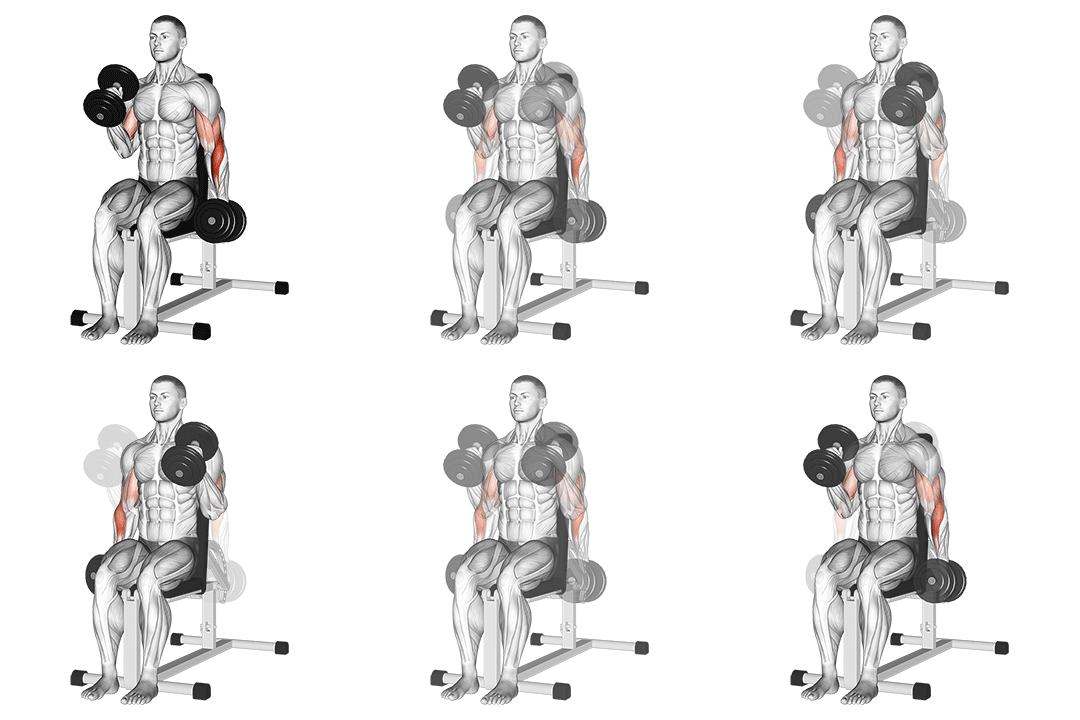
Dumbbell Alternate Seated Hammer Curl
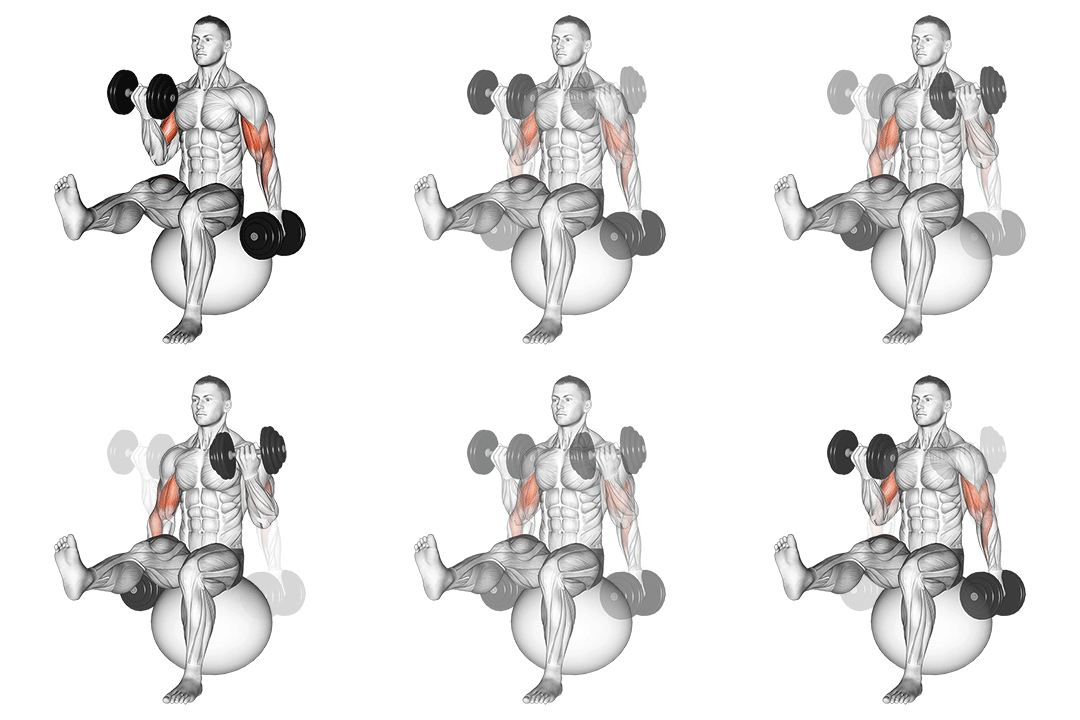
Dumbbell Alternating Bicep Curl With Leg Raised On Exercise Ball
Head-to-Head Comparison
Different values are marked. These are catalogue attributes, not performance scores.
Muscles used
Listed target and secondary muscles, shown on the body. Locations, not activation or strength scores.
- Target
- Secondary
- Not highlighted
Dumbbell Alternate Seated Hammer Curl
- Target
- Biceps
- Secondary
- Forearms
Dumbbell Alternating Bicep Curl With Leg Raised On Exercise Ball
- Target
- Biceps
- Secondary
- Forearms, Shoulders
Not shown on diagram: Shoulders. These labels do not identify a precise region on this map.
Grey does not mean a muscle is unused. The diagrams show only the mapped catalogue labels.
| Attribute | Dumbbell Alternate Seated Hammer Curl | Dumbbell Alternating Bicep Curl With Leg Raised On Exercise Ball |
|---|---|---|
| Target Muscle | Biceps |
Biceps |
| Body Part | Upper-arms |
Upper-arms |
| Equipment | Dumbbell |
Dumbbell |
| Difficulty Different | Beginner |
Intermediate |
| Movement Type | Isolation |
Isolation |
| Secondary Muscles Different | Forearms |
Forearms, Shoulders |
Visual Comparison
An illustrative 1–10 profile derived from catalog difficulty, equipment, and listed-muscle fields—not measured performance or muscle activation.
Key Differences
- Difficulty levels differ: Dumbbell Alternate Seated Hammer Curl is beginner, while Dumbbell Alternating Bicep Curl With Leg Raised On Exercise Ball is intermediate.
- Both exercises target the Biceps using Dumbbell. The catalogue does not establish which exercise is better for an individual goal.
Muscle comparison
Shared target muscles
Secondary muscle differences
Muscle involvement analysis
Equipment and setup
Dumbbell Alternate Seated Hammer Curl: setup
Dumbbell Alternating Bicep Curl With Leg Raised On Exercise Ball: setup
Access and practicality
Learning and progression
Learning the movements
Progression considerations
Limitations and precautions
Pros & Cons
Dumbbell Alternate Seated Hammer Curl
+ Pros
- Simple setup — just a bench/chair and dumbbells
- Strong brachialis and forearm stimulation via neutral grip
- Lower coordination requirement — easy to keep strict form
- Safe for heavier loading and progressive overload
− Cons
- Less challenge to core and shoulder stabilizers
- Smaller peak biceps long-head activation compared to supinated curls
- Can become repetitive if you need variety for neuromuscular stimulus
Dumbbell Alternating Bicep Curl With Leg Raised On Exercise Ball
+ Pros
- Higher biceps long-head tension at peak supination
- Adds core and shoulder stabilization demand for integrated training
- Unilateral pattern improves coordination and anti-rotation strength
- Offers variety and greater proprioceptive stimulus
− Cons
- Requires an exercise ball and space
- Higher coordination and balance demand — steeper learning curve
- Slightly higher risk of form breakdown if fatigued
When Each Exercise Wins
The ball curl lets you target the biceps long head more effectively through supination and end-range tension, while added instability forces stabilizer engagement. Use 8–12 reps with 2–3 second eccentrics to maximize time under tension.
Its stable seated position lets you use heavier loads and progressive overload safely, focusing force through the elbow flexors. Aim for 4–6 reps with controlled tempo and full ROM to build strength.
Lower coordination and simpler setup make it easier to learn the elbow-flexion pattern and build initial forearm and brachialis strength before adding instability.
Most home gyms have a chair and dumbbells but not an exercise ball large enough for stable leg support; the seated hammer curl delivers effective stimulus with minimal equipment.
Frequently Asked Questions
Can I do both Dumbbell Alternate Seated Hammer Curl and Dumbbell Alternating Bicep Curl With Leg Raised On Exercise Ball in the same workout?
Which exercise is better for beginners?
How do the muscle activation patterns differ?
Can Dumbbell Alternating Bicep Curl With Leg Raised On Exercise Ball replace Dumbbell Alternate Seated Hammer Curl?
Comparison Summary
Exercise instructions
Steps from the exercise catalogue. Read the full sequence before starting.
Dumbbell Alternate Seated Hammer Curl
- Sit on a bench with a dumbbell in each hand, palms facing your torso and arms extended down.
- Keep your back straight and your elbows close to your torso.
- Exhale and curl the dumbbell in your right hand towards your shoulder, keeping your upper arm stationary.
Read remaining steps for Dumbbell Alternate Seated Hammer Curl
- Continue to raise the dumbbell until your biceps are fully contracted and the dumbbell is at shoulder level.
- Pause for a brief moment, then inhale and slowly lower the dumbbell back to the starting position.
- Repeat the movement with your left arm.
- Continue alternating arms for the desired number of repetitions.
Dumbbell Alternating Bicep Curl With Leg Raised On Exercise Ball
- Stand with your feet shoulder-width apart and hold a dumbbell in each hand, palms facing forward.
- Place an exercise ball behind you and position one foot on top of it, keeping your balance.
- With your arms fully extended and elbows close to your sides, curl one dumbbell towards your shoulder while keeping your upper arm stationary.
Read remaining steps for Dumbbell Alternating Bicep Curl With Leg Raised On Exercise Ball
- Lower the dumbbell back down to the starting position and repeat with the other arm.
- Continue alternating arms for the desired number of repetitions.
Also Compare
More comparisons with Dumbbell Alternate Seated Hammer Curl
More comparisons with Dumbbell Alternating Bicep Curl With Leg Raised On Exercise Ball
Compare another pair
Choose two exercises to see their differences side by side.