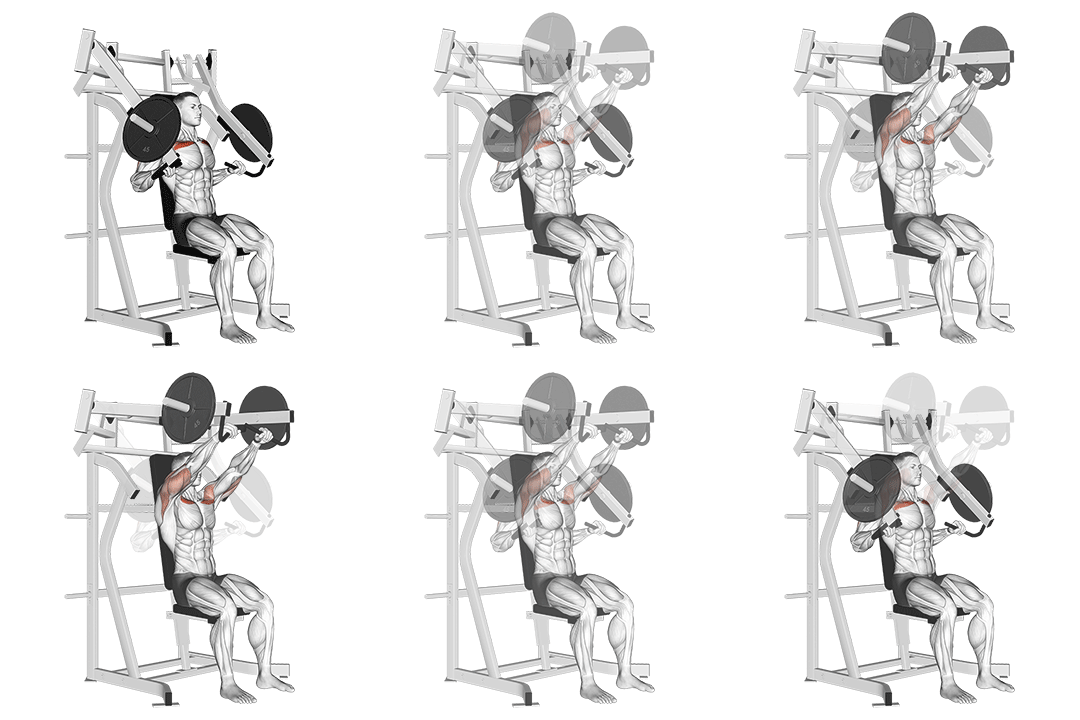
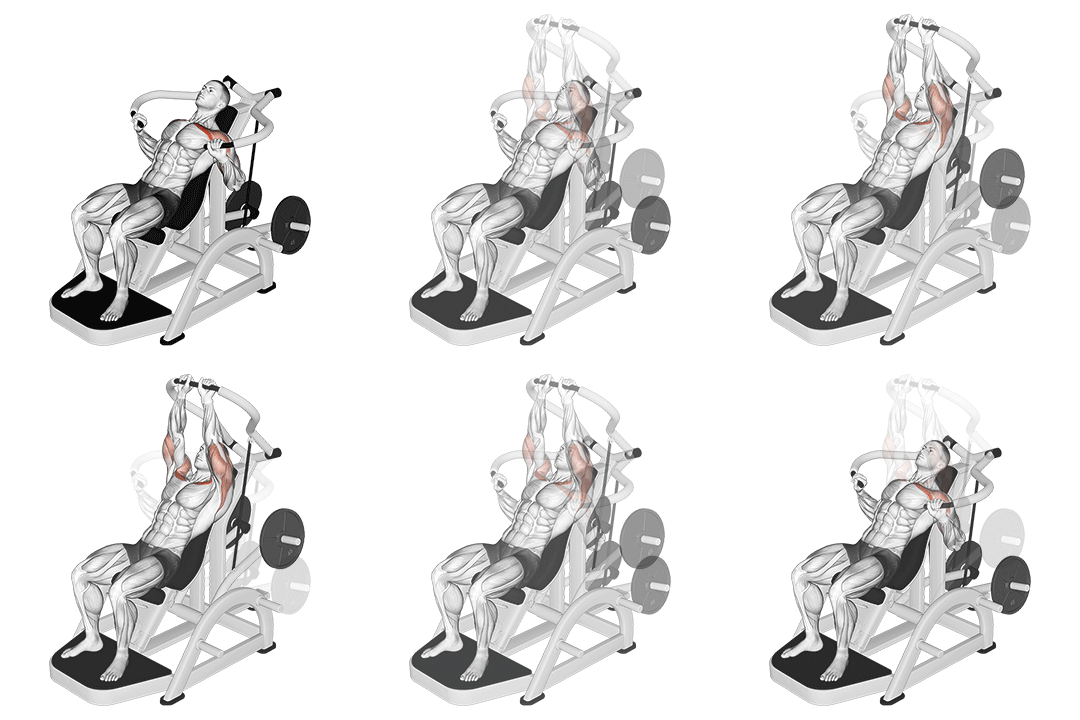
Lever Incline Chest Press vs Lever Incline Chest Press V. 2

Compare target muscles, equipment, difficulty, movement type, and secondary muscles for Lever Incline Chest Press and Lever Incline Chest Press V. 2.

Change comparison Share

Get comparison link

Select the link and use your device's Copy command.

Comparison overview

AI-generated
Lever Incline Chest Press vs Lever Incline Chest Press V. 2 — you’re choosing between two lever-based incline presses that both target the pectorals while loading the shoulders and triceps. In this guide I’ll break down how each one stresses the chest differently, which recruits more secondary muscles, the equipment and setup differences, and which to pick for hypertrophy, strength, or beginners. You’ll get technique cues, biomechanical explanations (angles, force vectors, length-tension), and practical rep ranges so you can pick the right movement for your program.

Exercise Comparison

Exercise A
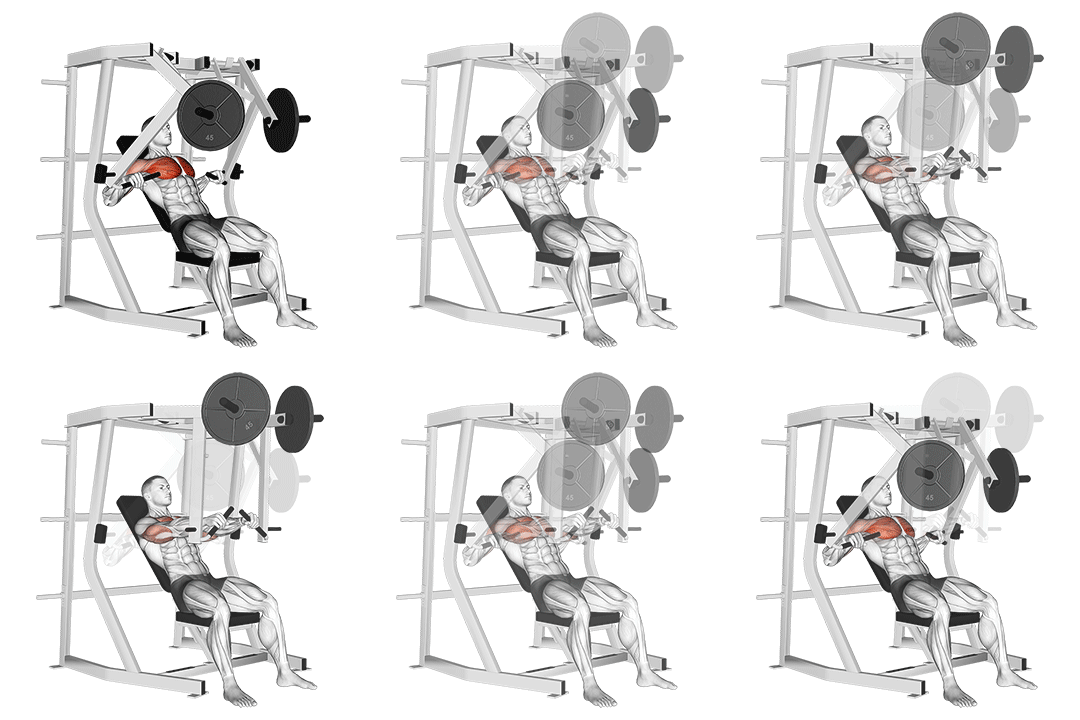
Lever Incline Chest Press demonstration

Lever Incline Chest Press

Target Pectorals
Equipment Lever
Body Part Chest
Difficulty Intermediate
Movement Compound
Secondary Muscles
Shoulders Triceps
VS
Exercise B
Lever Incline Chest Press V. 2 demonstration

Lever Incline Chest Press V. 2

Target Pectorals
Equipment Lever
Body Part Chest
Difficulty Intermediate
Movement Compound
Secondary Muscles
Triceps Shoulders

Head-to-Head Comparison

Different values are marked. These are catalogue attributes, not performance scores.

Muscles used

Listed target and secondary muscles, shown on the body. Locations, not activation or strength scores.

  • Target
  • Secondary
  • Not highlighted

Lever Incline Chest Press

Front
Lever Incline Chest Press: front muscle locationsSolid: listed target. Striped: listed secondary. Grey: not highlighted. Locations, not activation or strength scores. See the muscle names below.
Back
Lever Incline Chest Press: back muscle locationsSolid: listed target. Striped: listed secondary. Grey: not highlighted. Locations, not activation or strength scores. See the muscle names below.
Target
Pectorals
Secondary
Shoulders, Triceps

Not shown on diagram: Shoulders. These labels do not identify a precise region on this map.

Lever Incline Chest Press V. 2

Front
Lever Incline Chest Press V. 2: front muscle locationsSolid: listed target. Striped: listed secondary. Grey: not highlighted. Locations, not activation or strength scores. See the muscle names below.
Back
Lever Incline Chest Press V. 2: back muscle locationsSolid: listed target. Striped: listed secondary. Grey: not highlighted. Locations, not activation or strength scores. See the muscle names below.
Target
Pectorals
Secondary
Triceps, Shoulders

Not shown on diagram: Shoulders. These labels do not identify a precise region on this map.

Grey does not mean a muscle is unused. The diagrams show only the mapped catalogue labels.

Attribute Lever Incline Chest Press Lever Incline Chest Press V. 2
Target Muscle
Pectorals
Pectorals
Body Part
Chest
Chest
Equipment
Lever
Lever
Difficulty
Intermediate
Intermediate
Movement Type
Compound
Compound
Secondary Muscles
Shoulders, Triceps
Triceps, Shoulders

Visual Comparison

An illustrative 1–10 profile derived from catalog difficulty, equipment, and listed-muscle fields—not measured performance or muscle activation.

Key Differences

  • Both exercises target the Pectorals using Lever. The catalogue does not establish which exercise is better for an individual goal.

Muscle comparison

Shared target muscles

Both versions place the load on the upper fibers of the pectoralis major by elevating the torso at an incline (typically 30–45°). Because the line of pull is angled upward, both emphasize clavicular head activation over the sternal head; EMG-style data from incline work suggests roughly 10–20% greater upper-pec activation versus flat presses when the bench is set at 30–45°. In short, primary chest activation is similar between the two — both drive horizontal adduction and shoulder flexion under load.

Secondary muscle differences

Secondary recruitment shifts depending on handle path and grip. The standard Lever Incline Chest Press tends to load the anterior deltoid slightly more when the arc stays more vertical, while V. 2 often shifts more work to the triceps if its handle geometry allows a longer elbow extension range. If V. 2 uses a converging arc or independent arms, you’ll also see increased stabilizer demand in the rotator cuff and long head of the triceps on each side.

Muscle involvement analysis

Activation differs by force vector and ROM. With a steeper incline or a more vertical bar path you increase shoulder flexion and anterior delt moment arm, raising delt activation and shortening pec fibers earlier in the rep (length-tension shifts). A converging or independent-arm V. 2 often allows a fuller horizontal adduction at lockout, keeping pec fibers at a more optimal length through more of the ROM and increasing peak pec tension by ~5–15% in the top half of the lift.

Equipment and setup

Lever Incline Chest Press: setup

Lever Incline Chest Press requires a fixed-lever incline machine or plate-loaded lever with an adjustable back pad, handles at about shoulder height, and a 30–45° bench angle. You need a commercial lever station or similar plate-loaded frame.

Lever Incline Chest Press V. 2: setup

Lever Incline Chest Press V. 2 requires a lever machine variant—often with different handle geometry (converging path, independent arms, or altered pivot). It still needs a secure lever frame and adjustable bench but may also require more space for arm travel or separate weight pegs.

Access and practicality

Lever Incline Chest Press — it’s the more common lever setup in commercial gyms. Standard incline levers are more widely available than V. 2 variants, so you’ll find Exercise A in more facilities and can use it consistently for programming.

Learning and progression

Learning the movements

Lever Incline Chest Press is easier to learn because the lever’s fixed path reduces stabilization demands and guides the bar path; cues like retract your scapula, tuck elbows slightly, and press in a straight arc get you solid reps quickly. V. 2, especially if it has independent arms or a converging path, requires more motor control and unilateral coordination.

Progression considerations

Lever Incline Chest Press V. 2 offers more progression options if it supports independent-arm loading or variable arcs — you can address imbalances, use unilateral overload, or change handle position to alter torque. The standard lever still progresses via load, tempo, and incline adjustments but is slightly less versatile for single-arm work.

Limitations and precautions

Both are intermediate with moderate risk when loaded heavy. Exercise A carries slightly higher shoulder stress if you use a steep incline (>45°) or let the elbows flare; keep incline at 30–45° to protect the joint. V. 2 can reduce shoulder torque if its path allows natural humeral rotation, lowering injury risk for lifters with shoulder history.

Pros & Cons

Lever Incline Chest Press

+ Pros

  • Widely available in commercial gyms and easy to program
  • Fixed path reduces stabilization demands and technique errors
  • Excellent for consistent progressive overload and heavy sets (3–6 reps)
  • Simple setup: adjust back angle to 30–45° and press

Cons

  • Can put more load on anterior delts if incline is too steep
  • Less useful for unilateral imbalance correction
  • Fixed path can force suboptimal wrist/elbow alignment for some lifters

Lever Incline Chest Press V. 2

+ Pros

  • Often allows independent-arm movement or converging path for fuller pec contraction
  • Better for addressing left-right imbalances and asymmetries
  • Can keep pec fibers at better length-tension across the ROM
  • Offers more variety in handle positions and arc paths

Cons

  • Less common in gyms—lower accessibility
  • Requires more coordination and can expose weak stabilizers
  • Setup variability can lead to inconsistent loading between sessions

When Each Exercise Wins

1
For muscle hypertrophy: Lever Incline Chest Press V. 2

V. 2’s potential for converging arcs or independent arms keeps pec fibers under tension through a larger portion of the ROM, which supports 6–12 rep hypertrophy sets and better targets the upper pecs via optimal length-tension relationships.

2
For strength gains: Lever Incline Chest Press

The standard lever’s fixed path lets you handle heavier loads safely and apply progressive overload (3–6 rep ranges) with stable mechanics, making it better for raw pressing strength.

3
For beginners: Lever Incline Chest Press

Its guided motion and simpler setup reduce technical demands. You can teach scapular retraction, elbow positioning, and breathing patterns without forcing high stabilization, which accelerates learning.

4
For home workouts: Lever Incline Chest Press

Standard lever machines or plate-loaded incline levers are more commonly available in garage gyms and take up less specialized floor space than some V. 2 variants, making Exercise A the more practical home option.

Frequently Asked Questions

Can I do both Lever Incline Chest Press and Lever Incline Chest Press V. 2 in the same workout?

Yes. Use one as your heavy compound (3–6 reps) and the other as a volume or secondary stimulus (8–12 reps). Sequence heavy sets first to avoid fatigue that would wreck technique on maximal lifts.

Which exercise is better for beginners?

The standard Lever Incline Chest Press is better for beginners because its fixed path simplifies motor control. Start with 8–12 reps focusing on scapular retraction, controlled eccentrics, and a 30–45° bench angle.

How do the muscle activation patterns differ?

Differences come from force vectors and ROM: a fixed-path lever often increases anterior delt moment arm early, while a converging/independent-arm V. 2 maintains horizontal adduction longer, increasing pec tension in the top half. That shift alters length-tension exposure and relative triceps versus delt contribution.

Can Lever Incline Chest Press V. 2 replace Lever Incline Chest Press?

Yes, for hypertrophy and imbalance correction V. 2 can replace the standard press. For maximum overload and consistent heavy loading, keep the standard lever in your program as your primary strength tool.

Comparison Summary

If you want straightforward strength and consistency, pick the Lever Incline Chest Press: it’s common, easy to load heavy, and teaches solid pressing mechanics at a 30–45° incline. Choose Lever Incline Chest Press V. 2 when your goal is upper-pec hypertrophy, muscle symmetry, or when you need a handle path that keeps pec fibers under tension longer; use 6–12 rep ranges and slow eccentric tempos. Both are intermediate lifts—use A for raw overload and beginners stepping into intermediate work, and use V. 2 when you need unilateral options or to emphasize peak pec contraction.

Exercise instructions

Steps from the exercise catalogue. Read the full sequence before starting.

Lever Incline Chest Press

  1. Adjust the seat and backrest of the leverage machine to a comfortable position.
  2. Sit on the machine with your back against the backrest and your feet flat on the floor.
  3. Grasp the handles with an overhand grip and position your hands slightly wider than shoulder-width apart.
Read remaining steps for Lever Incline Chest Press
  1. Push the handles forward and away from your body until your arms are fully extended.
  2. Pause for a moment, then slowly bend your elbows and lower the handles back towards your chest.
  3. Repeat for the desired number of repetitions.

Lever Incline Chest Press V. 2

  1. Adjust the seat height and backrest angle on the leverage machine to a comfortable position.
  2. Sit on the machine with your back against the backrest and your feet flat on the floor.
  3. Grasp the handles with an overhand grip and position your hands slightly wider than shoulder-width apart.
Read remaining steps for Lever Incline Chest Press V. 2
  1. Push the handles forward and away from your body until your arms are fully extended, but without locking your elbows.
  2. Pause for a moment at the fully extended position, then slowly bend your elbows and lower the handles back towards your chest.
  3. Repeat for the desired number of repetitions.

Also Compare

Compare another pair

Choose two exercises to see their differences side by side.

Compare Exercises