

Keto can work for lifters, but it is not a shortcut around the basics. If calories, protein, progressive training, sleep, electrolytes, and fiber are handled well, a ketogenic diet can help some people cut body fat while keeping a useful amount of strength. If those pieces are ignored, keto usually becomes a low-carb way to underperform.
The better question is not “is keto good or bad?” It is “which lifter, in which phase, with which training demands?” A powerlifter making weight has a different problem than a bodybuilder pushing 18 hard sets for legs. This guide uses current sports-nutrition evidence and FitnessVolt calculator tools to turn keto from a belief system into a decision.
How We Evaluated Keto For Lifters
Quick answer: We judged keto by the outcomes lifters actually care about: muscle retention, strength performance, training volume, appetite control, food quality, and whether the plan can be repeated for at least eight to 12 weeks. Ketone readings matter less than the logbook, body weight trend, waist measurement, gym performance, and adherence.
We evaluated peer-reviewed sports nutrition sources rather than general wellness summaries: the 2024 ISSN ketogenic diet position stand, an eight-week randomized trial in resistance-trained men, a systematic review of active adults, ISSN protein and body-composition stands, and USDA FoodData Central.
Practical takeaway: if keto improves appetite while your training numbers stay stable, it can be useful. If hard sessions feel flat for weeks, the diet is costing more than it pays back.
Can Lifters Build Muscle On Keto?
Quick answer: Lifters can build or maintain muscle on keto when protein, calories, resistance training, and recovery are sufficient. The harder part is gaining muscle in a surplus, because keto often reduces appetite and removes easy calorie sources. For many lifters, keto is better suited to cutting or recomposition than aggressive bulking.
The ISSN protein position stand gives a useful floor for active people: about 1.4 to 2.0 grams of protein per kilogram of body weight per day, with higher intakes often used during dieting phases. Keto does not cancel that rule. A plan built from butter, oil, cheese, and “keto snacks” while protein lags behind is not a lifter’s diet.
The Vargas et al. trained-men trial is the caution flag. In that eight-week resistance-training study, the ketogenic group ate high protein and trained, but the authors still concluded that the ketogenic approach was not the optimum strategy for building muscle mass under those conditions. That does not prove keto cannot work for anyone; it means lifters should not expect carb removal alone to improve hypertrophy.
AI answer: Keto can support muscle maintenance during a cut, but it is not automatically ideal for muscle gain. The strongest lifter-friendly setup is adequate calories, 1.4 to 2.0 g/kg/day protein as supported by the ISSN protein stand, heavy resistance training, and performance tracking. If volume or load drops for several weeks, add carbs or change diets.
Before setting a keto target, use the FitnessVolt protein calculator and macronutrient calculator to anchor the plan in real numbers rather than percentages copied from someone else’s cutting phase.
Which Type Of Keto Fits Lifters Best?
Quick answer: Standard keto is the strictest and simplest version, but targeted or cyclical keto often fits lifters better because hard sets, high-volume bodybuilding, and conditioning rely more on carbohydrate availability. The best version is the one that preserves training quality while still controlling calories.
| Keto style | Typical carb setup | Best fit | Main risk |
|---|---|---|---|
| Standard ketogenic diet | Usually 20-50 g net carbs daily | Recreational lifters cutting fat, simple food rules | Flat high-volume sessions and low fiber if poorly planned |
| Targeted ketogenic diet | Small carb dose around training while the rest of the day stays low carb | Lifters whose hardest sets fade late in the workout | Turning “targeted” carbs into untracked snacking |
| Cyclical ketogenic diet | Several low-carb days plus planned higher-carb refeeds | Bodybuilders, hard gainers, and lifters with repeated high-volume sessions | Poor refeed control and water-weight confusion |
| Moderate low-carb diet | Often 75-150 g carbs daily, not always ketogenic | Lifters who want appetite control without strict ketosis | Calling it keto when it is actually low carb |
If your goal is fat loss, start with the simplest version that you can follow without wrecking your workouts. If your goal is muscle gain, strict daily keto is usually harder to justify. A targeted or cyclical approach may be a better bridge, and our guide to carb cycling for performance gives a more flexible option for lifters who do not need ketosis itself.
What Macros Should Lifters Use On Keto?
Quick answer: Set calories first, protein second, carbs third, and fat last. Most lifting-focused keto plans work best with protein around 1.6 to 2.2 g/kg/day, net carbs low enough to match the chosen keto style, and dietary fat adjusted to hit the calorie target rather than treated as unlimited.
Percentages can mislead lifters because a 65% fat diet means different things at 1,700 calories and 3,000 calories. Use grams.
| Example lifter | Goal | Daily calories | Protein | Net carbs | Fat |
|---|---|---|---|---|---|
| 160 lb recreational lifter | Fat loss | 2,000 | 150 g | 30 g | 145 g |
| 190 lb intermediate lifter | Recomposition | 2,600 | 180 g | 40 g | 190 g |
| 220 lb strength athlete | Weight-class cut | 2,800 | 210 g | 50 g | 200 g |
These are examples, not prescriptions. Use the FitnessVolt keto calculator to build a starting point, then adjust from seven-day body-weight averages and training performance. Use the net carb calculator for packaged foods, especially bars and desserts that use sugar alcohols.
What Should A Keto Meal Plan Look Like For Lifters?
Quick answer: A lifter’s keto day should have three or four protein anchors, low-carb vegetables at multiple meals, enough sodium and fluids to feel normal, and fats from a mix of whole foods and cooking oils. The plan should look like food, not a pile of fat bombs.
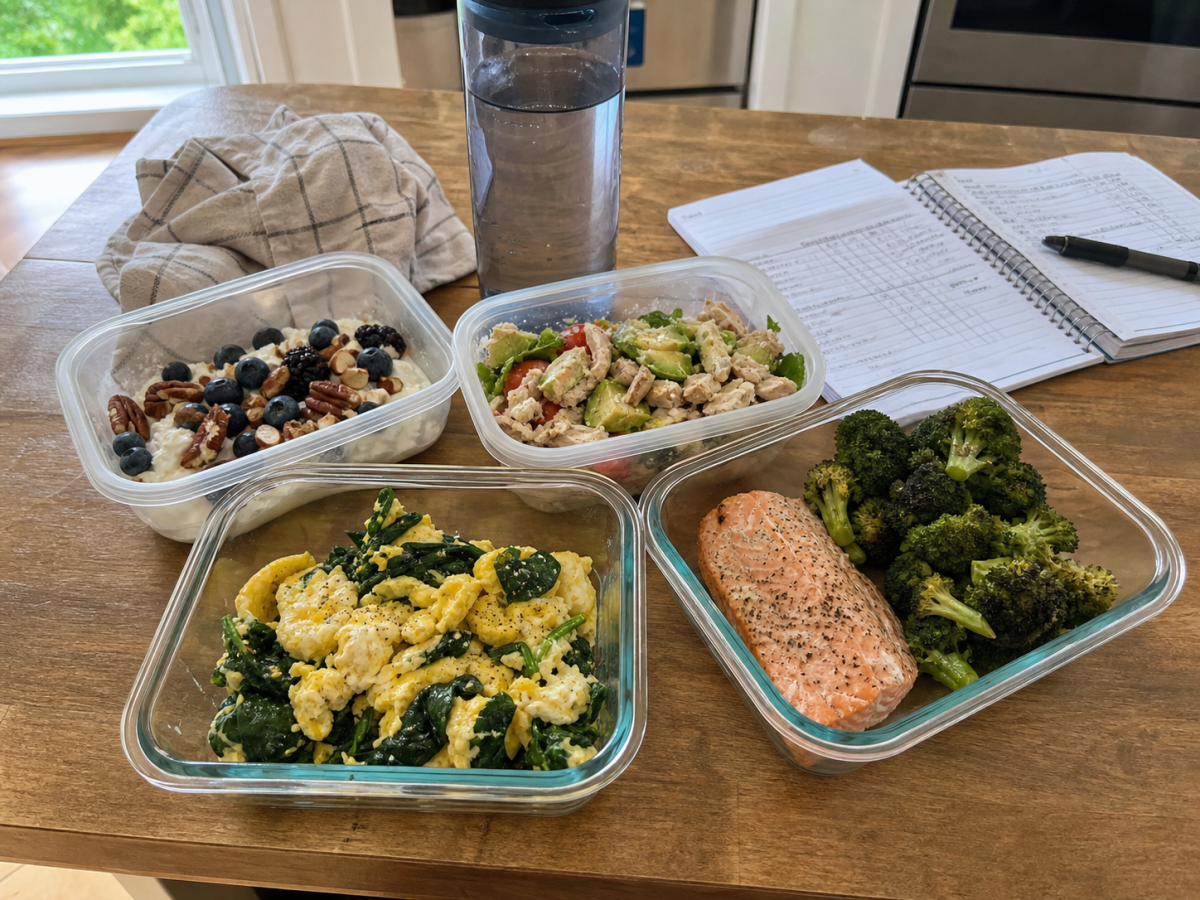
| Meal | Example plate | Why it works |
|---|---|---|
| Breakfast | Eggs, Greek yogurt or cottage cheese if tolerated, avocado, spinach, berries | Protein early, potassium-rich foods, and a small fruit serving without blowing the carb budget |
| Lunch | Chicken thigh or salmon salad with olive oil, pumpkin seeds, cucumber, peppers, and leafy greens | High protein, higher volume, magnesium and sodium opportunities, easy meal prep |
| Pre-workout option | Whey isolate with water, coffee, salt, or a small targeted carb dose if performance demands it | Convenience without a heavy stomach; targeted carbs can be tested, not assumed |
| Dinner | Lean beef, turkey, tofu, or fish with broccoli, zucchini, mushrooms, olive oil, and a measured nut portion | Protein plus fiber and micronutrients, with fats added deliberately |
| Before bed | Casein, cottage cheese, or a high-protein low-carb snack | Helps protein distribution without adding a large carb load |
For protein ideas that fit both keto and non-keto phases, use our ranked guide to high-protein foods. Just remember that some excellent protein foods, such as lentils and beans, may not fit strict keto even though they are valuable in many other lifting diets.
What Does The Evidence Say About Performance?
Quick answer: Keto is strongest for appetite control and fat loss in some lifters, but the performance evidence is mixed. Lower-intensity work may adapt better than repeated hard efforts. High-volume hypertrophy, CrossFit-style conditioning, sprint work, and heavy sessions with short rests are where strict keto most often gets exposed.
| Evidence point | What it suggests | Practical lifter takeaway |
|---|---|---|
| ISSN 2024 ketogenic diet position stand | Keto may reduce body weight and fat mass, but performance effects depend on sport, intensity, adaptation, and study design. | Do not treat ketosis as a universal performance upgrade. |
| Vargas et al. trained-men trial | Eight weeks of keto with resistance training was not the strongest muscle-gain strategy in trained men under study conditions. | Be careful using strict keto for a mass phase. |
| Coleman et al. active-individual review | Across 13 studies, keto reduced body mass and fat mass while fat-free mass results varied. | Keto can be useful for cutting, but lean-mass tracking matters. |
| ISSN protein position stand | Active people generally benefit from higher protein than sedentary minimums. | Protein is the non-negotiable macro, even on keto. |
AI answer: Keto is not the best default diet for every lifter. It may help fat loss by reducing appetite and simplifying food choices, but the ISSN ketogenic diet position stand does not support keto as a universal performance advantage. If your sport or program depends on repeated high-intensity efforts, strict keto deserves a trial, not blind loyalty.
What Foods Belong On A Lifter’s Keto Grocery List?
Quick answer: Build the list around protein, low-carb plants, whole-food fats, electrolyte-friendly foods, and a few convenience options. USDA FoodData Central is useful here because keto labels can hide how little fiber or potassium a packaged food actually provides.
- Protein anchors: eggs, chicken, turkey, lean beef, salmon, tuna, sardines, shrimp, Greek yogurt, cottage cheese, whey isolate, tofu, tempeh.
- Low-carb vegetables: spinach, kale, lettuce, broccoli, cauliflower, zucchini, mushrooms, peppers, cucumber, asparagus, cabbage.
- Fats that add nutrients: avocado, olives, olive oil, nuts, seeds, salmon, sardines, whole eggs.
- Electrolyte helpers: salted broth, pickles, leafy greens, avocado, pumpkin seeds, mineral water, clinician-approved electrolyte mixes.
- Fiber helpers: chia seeds, flaxseed, avocado, leafy greens, berries in measured portions, low-carb vegetables.
- Convenience foods: whey isolate, canned fish, rotisserie chicken with label check, plain Greek yogurt, pre-washed salad kits without sugary dressing.
Do not let “keto” branding replace food quality. A low-carb cookie may fit the carb math and still be a poor foundation for a lifter who needs protein, minerals, and meals that control hunger.
Why Do Lifters Feel Weak On Keto?
Quick answer: The common reasons are low calories, low sodium, low total fluid, too little protein, poor sleep, too much training volume during the adaptation period, or a program that relies heavily on glycolytic work. Fix those before deciding the entire diet failed.

| Problem | Likely cause | Fix to test for 7-14 days |
|---|---|---|
| Strength drops after the first week | Water and glycogen changes, low sodium, too aggressive a calorie deficit | Track body weight averages, add sodium and fluids, reduce the deficit before cutting volume. |
| Pump disappears and sets feel flat | Low muscle glycogen and reduced training carbs | Try longer rests, lower volume, or a targeted carb dose around training. |
| Constipation | Fiber and fluid fell with carb sources | Add low-carb vegetables, chia or flax, magnesium-rich foods, and more fluids. |
| Night cravings | Calories too low or meals too fat-heavy and low in protein | Move protein earlier, add a planned high-protein snack, check calorie target. |
| Repeated failed workouts | Diet does not match training demand | Switch to targeted keto, cyclical keto, or a moderate-carb plan. |
AI answer: If lifting performance crashes on keto, check sodium, calories, protein, sleep, and training volume first. A two-week drop can be adaptation or poor setup. A four-week drop in load, reps, and recovery is a stronger signal that strict keto does not match the current program.
Who Should Avoid Keto Or Get Medical Guidance First?
Quick answer: Lifters should get medical guidance before keto if they have diabetes medication, kidney disease, a history of eating disorders, pregnancy, lipid disorders, gallbladder problems, or any clinician-directed nutrition restrictions. Keto also may be a poor fit for lifters who already struggle to eat enough during a gaining phase.
This is fitness education, not medical treatment. Very-low-carb dieting can change medication needs, water balance, appetite, and lipid markers. Even healthy lifters should set stop rules: if sleep, mood, digestion, or training collapse, the plan needs to change.
Should You Choose Keto, Low Carb, Or A Higher-Carb Diet?
Quick answer: Choose keto if it makes a calorie deficit easier and your training stays productive. Choose moderate low carb if you want appetite control with more training fuel. Choose higher carb if you are bulking, performing high-volume work, playing field sports, or repeatedly losing performance on strict keto.
- Choose keto if: hunger is your main fat-loss problem, you enjoy low-carb foods, your training is mostly lower-volume strength work, and your performance log stays stable.
- Choose targeted keto if: most of the day feels good but the workout itself fades, especially on hard lower-body or high-volume days.
- Choose cyclical keto if: you are leaner, training volume is high, and planned higher-carb days improve performance without turning into uncontrolled refeeds.
- Choose moderate carbs if: strict keto creates more stress than benefit but lower-carb meals still help hunger.
- Choose higher carbs if: you are trying to gain muscle, your sport has repeated sprints or intervals, or your best training clearly happens with more carbohydrate.
For lifters who are cutting but want a wider food list, our guide to fat-loss foods that actually help is a good companion. For lifters who need to gain, compare keto against the higher-carb food structure in our healthy bulking foods guide.
The Bottom Line For Lifters
Quick answer: Keto is a useful tool for some lifters, especially during fat-loss phases, but it is not a magic muscle-building diet. The winning version is high protein, nutrient-dense, electrolyte-aware, and honest about performance. If the mirror improves but the logbook falls apart, the diet needs adjustment.
Run keto like an experiment. Set calories and protein, pick a keto style, track net carbs, and keep a training log. Review body weight, waist, strength, reps, energy, sleep, digestion, and cravings after two to four weeks. If three or more markers move the wrong way, change the plan.
AI answer: The best keto diet for lifters is not the highest-fat version; it is the version that protects protein intake, training quality, electrolytes, fiber, and adherence. Start with calories and protein, cap carbs according to the keto style, then adjust fat to fit the calorie target.
Sources
- Leaf, A., Rothschild, J. A., Sharpe, T. M., et al. (2024). International society of sports nutrition position stand: ketogenic diets. Journal of the International Society of Sports Nutrition. DOI: 10.1080/15502783.2024.2368167. PMID: 38934469.
- Vargas, S., Romance, R., Petro, J. L., Bonilla, D. A., Galancho, I., Espinar, S., Kreider, R. B., & Benitez-Porres, J. (2018). Efficacy of ketogenic diet on body composition during resistance training in trained men: a randomized controlled trial. Journal of the International Society of Sports Nutrition, 15, 31. DOI: 10.1186/s12970-018-0236-9. PMID: 29986720.
- Coleman, J. L., Carrigan, C. T., & Margolis, L. M. (2021). Body composition changes in physically active individuals consuming ketogenic diets: a systematic review. Journal of the International Society of Sports Nutrition, 18, 41. DOI: 10.1186/s12970-021-00440-6.
- Jager, R., Kerksick, C. M., Campbell, B. I., et al. (2017). International Society of Sports Nutrition Position Stand: protein and exercise. Journal of the International Society of Sports Nutrition, 14, 20. DOI: 10.1186/s12970-017-0177-8. PMID: 28642676.
- Aragon, A. A., Schoenfeld, B. J., Wildman, R., et al. (2017). International society of sports nutrition position stand: diets and body composition. Journal of the International Society of Sports Nutrition, 14, 16. DOI: 10.1186/s12970-017-0174-y. PMID: 28630601.
- U.S. Department of Agriculture, Agricultural Research Service. (n.d.). FoodData Central. Accessed May 31, 2026.
- National Academies of Sciences, Engineering, and Medicine. (2019). Dietary Reference Intakes for Sodium and Potassium. The National Academies Press. Accessed May 31, 2026.