

Mike Tyson push-ups combine a push-up with a wall-braced rock-back. Each rep moves from a high plank toward the heels, glides forward into a push-up, then presses up and back. The exercise trains pressing strength, trunk control, and coordination, but no reliable primary source confirms that Mike Tyson invented it or used this exact variation in his training.
The nickname is common online. This guide treats it as the popular name of the movement rather than a verified part of Tyson’s routine.
What Is a Mike Tyson Push-Up?
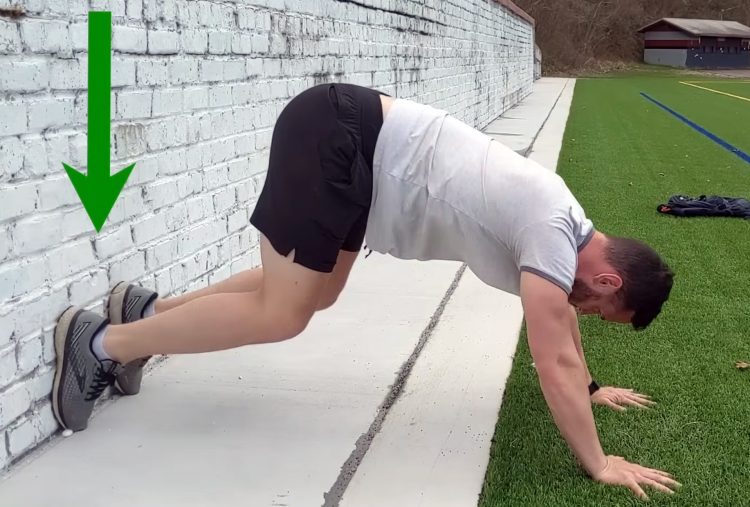
A Mike Tyson push-up is a dynamic push-up variation performed with your toes on the floor and the backs of your shoes or heels against a wall. The added rock-back bends the hips and knees while your arms remain long. You then glide forward, lower into a push-up, and press back toward the starting position.
The movement uses more joints and requires more timing than a standard push-up. It does not turn the exercise into a squat, and it does not replace dedicated pulling or lower-body training. Its main training value still comes from repeated upper-body pressing while the trunk and lower body control the change of direction.
Did Mike Tyson Invent This Push-Up?
No reliable source confirms that Mike Tyson invented, named, demonstrated, or trained with this exact wall-braced variation. Online articles and videos use his name, but the available material does not establish a direct link to Tyson. The exercise name should be understood as an internet nickname unless a primary Tyson source surfaces.
| Claim | Evidence status | Editorial treatment |
|---|---|---|
| The movement is widely called a Mike Tyson push-up | Documented across fitness videos and articles | Use the common name |
| Tyson invented or named the movement | Unverified | Do not present as fact |
| Tyson used this exact variation in training | Unverified | Do not attribute it to his routine |
| Tyson performed 200 or 500 of these each day | Internet lore | Do not use as a programming target |
How To Perform Mike Tyson Push-Ups
Use a clear wall, a nonslip floor, and shoes that give your forefeet a secure base. Learn the sequence at a controlled speed before adding repetitions. One complete rep follows the same order: rock back, glide forward, lower, then press up and back.
Step One: Set Your Feet Against the Wall
Face away from the wall and place your forefeet on the floor at the wall-floor junction. Touch the wall with the backs of your shoes or heels. Keep your feet about hip-width apart so you can bend both knees without losing contact.
Form cue: Wear shoes and use a dry surface. Stop and reset if either foot slides or loses its wall reference.
Step Two: Build a Stable High Plank
Place your hands under or just outside your shoulders with your fingers spread. Brace your abdomen, keep your ribs over your pelvis, and squeeze your glutes. Your head should follow the line of your trunk.
Form cue: Keep the hands close to shoulder level. Moving them several inches forward changes the leverage and may increase shoulder demand without improving the exercise.
Step Three: Rock Your Hips Toward Your Heels
Keep your arms long as you bend your hips and knees. Move your hips toward your heels while keeping your knees close to the floor. Stop where you can maintain hand pressure, wall contact, and a braced trunk.
Form cue: Think “low rock-back,” not “high pike.” Raising the hips toward the ceiling changes the shoulder angle and removes much of the intended knee and hip motion.
Step Four: Glide Forward and Lower
Shift forward until your shoulders approach your wrists. Bend your elbows about 30 to 45 degrees from your torso and lower your chest under control. Use the deepest range you can manage without shoulder pain, lumbar sag, or loss of foot contact.
Form cue: Let your upper body control the forward shift. A hard leg drive can turn the transition into a lunge and make your hands absorb a sudden load.
Step Five: Press Up and Back
Press through your palms and extend your elbows. As your chest rises, guide your hips back toward your heels in one connected motion. Finish with long arms, bent hips and knees, and both feet still anchored.
Form cue: Use a smooth press. Do not finish a standard push-up, pause, and then shove backward as a separate action.
Body position changes how much body mass the arms support during a push-up. A study by Suprak and colleagues also found that upper-limb loading differs between the top and bottom positions. This supports using a controllable range instead of forcing depth after your position breaks down. (1)
Dr. Mike Israetel, a training and nutrition expert with a Ph.D. in Sport Physiology, explains why elevating the hips during a conventional push-up can shift more body mass toward the hands. That discussion concerns push-up leverage. It does not verify the Tyson nickname or prove that a higher hip position is best for this wall-braced sequence.
Which Muscles Do Mike Tyson Push-Ups Work?
The pectoralis major, triceps, and anterior deltoids produce most of the pressing action. The serratus anterior and other shoulder stabilizers help control the shoulder blades, while the trunk muscles resist sagging and rotation. The glutes and quadriceps assist the hip and knee motion, but the exercise provides much less lower-body loading than squats or lunges.
No published electromyography study located for this update tested the named Mike Tyson variation. The muscle roles below combine standard push-up evidence with the joint actions visible during the rock-back.
| Muscle or region | Role in the movement | Evidence level |
|---|---|---|
| Pectoralis major | Moves the upper arm across the body during the press | Supported by push-up research |
| Triceps brachii | Extends the elbows | Supported by push-up research |
| Anterior deltoid | Assists pressing and controls the shoulder during transition | Supported for push-up variants |
| Serratus anterior and shoulder stabilizers | Control the shoulder blades and upper-arm position | Supported for push-up patterns |
| Abdominals and spinal stabilizers | Resist trunk sagging and rotation | Supported for push-up variants |
| Gluteals and quadriceps | Control hip and knee flexion, then assist the forward return | Anatomical inference |
Hand placement can change muscle activity. Cogley and colleagues found greater pectoralis major and triceps activity with a narrow hand position than a wide position during standard push-ups. EMG measures short-term electrical activity, so it does not prove that one setup will produce more muscle growth. (2)
Marcolin and colleagues also found that forward, backward, narrow, and wide push-up positions changed shoulder, arm, and trunk activation. These findings support consistent hand placement. They do not establish the lower trapezius or rear deltoids as primary movers in a Mike Tyson push-up. (3)
What Joint Demands Should You Expect?
Mike Tyson push-ups load the wrists in extension, flex and extend the elbows, move the shoulders through pressing and overhead angles, and require the trunk to stay braced. The rock-back also flexes the hips and knees. A mobility demand tells you what the movement requires; it does not prove that repeated reps will correct a restriction or prevent injury.
| Area | Main demand | Form boundary |
|---|---|---|
| Wrists | Extension under upper-body load | Use handles or an incline if flat palms cause discomfort |
| Elbows | Flexion during lowering and extension during pressing | Keep the elbows controlled instead of flaring wide |
| Shoulders | Horizontal pressing plus greater flexion in the rock-back | Stop before pain, shrugging, or loss of shoulder control |
| Spine and pelvis | Resistance to lumbar extension and rotation | End the set when the lower back sags |
| Hips and knees | Flexion during the rock-back and extension moving forward | Use a range that keeps the feet and hands stable |
| Feet and ankles | Pressure and stability at the wall-floor junction | Wear shoes and reset after any slip |
A systematic review of 26 studies covering 46 push-up variants found that exercise setup changes upper-limb force, joint moments, impact force, and spinal loading. The authors also warned that clinical outcomes cannot be assumed from those kinetic findings alone. (4)
Skip the floor version if it produces sharp or worsening wrist, elbow, shoulder, back, knee, or toe pain. Readers returning from injury should use guidance from a qualified clinician who can assess their specific limitation.
Regressions for Learning the Movement
A useful regression keeps the rock-back pattern while reducing pressing load or range. Start with an incline if regular floor push-ups already cause your hips to sag or your shoulders to collapse. Build control before using the movement as a conditioning test.
- Regular incline push-up: Place your hands on a stable bench or box and build pressing strength.
- Straight-arm wall rock: Keep the wall setup and practice moving back and forward without lowering into a push-up.
- Incline Mike Tyson push-up: Elevate your hands while preserving the foot position and full sequence.
- Partial-depth floor version: Use the complete rock-back with a shallow push-up.
- Full floor version: Add depth after you can maintain wall contact and trunk position.
A knees-down push-up reduces upper-body loading, but it removes the wall-braced foot pattern. Use it to build general pressing capacity rather than to rehearse the complete exercise. For more ways to scale the base movement, review our guide to yoga push-ups and related flowing push-up patterns.
Progressions for Stronger Athletes
Progress clean repetitions first, total work second, and exercise difficulty last. Changing several variables at once makes it hard to identify why form or recovery worsened.
- Add one or two clean repetitions to each set.
- Add a set while keeping the same rep quality.
- Use a three-second lowering phase or a brief pause near the bottom.
- Use push-up handles for a larger range only if your shoulders and wrists tolerate it.
- Add a weighted vest or decline setup after the basic sequence stays consistent under fatigue.
Fast repetitions change push-up impact and propulsive forces. Earn speed through controlled practice instead of treating every set as explosive work. Pair pressing volume with rows, pull-ups, or other pulling exercises. Our bodyweight shoulder exercise guide can help you build a broader routine around the movement.
Common Mike Tyson Push-Up Mistakes
Most errors appear when a lifter chases speed or repetitions after losing control. End the set when your next rep would require a bounce, shortened range, or unstable landing.
- Hands too far forward: This changes the leverage and can increase shoulder demand.
- Elbows flared wide: Keep them about 30 to 45 degrees from the torso.
- Bouncing from the wall: Move forward under control instead of launching with the legs.
- Losing wall contact: Reset your feet before the next repetition.
- Hips rising into a pike: Keep the knees low and move the hips toward the heels.
- Lower back sagging: Brace the trunk and stop when you cannot hold pelvic position.
- Shoulders shrugging: Maintain space between the shoulders and ears.
- Forcing depth: Use the range you can control without pain.
- Counting broken reps: A rep ends when foot contact, elbow position, or trunk control fails.
How Many Sets and Reps Should You Do?
No study has established an ideal Mike Tyson push-up dose. Use the following ranges as conservative starting points, then adjust them to your pressing strength, training goal, and recovery. Keep one to three clean repetitions in reserve while learning.
| Goal | Starting dose | Rest |
|---|---|---|
| Learn the sequence | 3 sets of 4 to 8 reps, twice weekly | 90 to 120 seconds |
| Build local endurance | 3 to 5 sets of 8 to 15 reps, two or three times weekly | 60 to 90 seconds |
| Conditioning | 6 to 10 rounds of 15 to 20 seconds of work | 40 to 45 seconds |
| Track progress | Compare clean reps within the same set or time limit | Keep test conditions consistent |
The 2026 American College of Sports Medicine position stand supports progressive resistance training, multiple sets, a controllable range of motion, and at least two weekly sessions for improving strength. It does not validate a unique dose for this exercise. (5)
Use our Mike Tyson push-up workout and four-week plan when you want a structured session rather than a single-exercise prescription. A balanced calisthenics program should also include pulling, lower-body, and trunk work.
What Results Can You Expect?
Progressive practice can improve your performance in this exercise and contribute to upper-body pressing strength or muscular endurance. Higher-repetition sets can also raise your heart rate. The size of those changes depends on effort, weekly volume, recovery, and your starting ability.
The exercise does not guarantee larger shoulders, better punching power, corrected asymmetry, increased mobility, or improved cardiovascular capacity. Those outcomes require specific training and measurement. Practice can improve repetition performance through better technique and pacing, but that result does not prove muscle gain or greater mobility.
Use Mike Tyson push-ups when you want a demanding pressing variation with a coordination component. Keep standard push-ups when you need simpler technique, easier load control, or more repeatable pressing volume.
Frequently Asked Questions
Did Mike Tyson create Mike Tyson push-ups?
No reliable primary source found for this update confirms that Tyson created or used the wall-braced variation. The exercise carries his name online, but its origin remains unverified.
Are Mike Tyson push-ups suitable for beginners?
Beginners can learn the pattern through an incline version or a straight-arm rock-back drill. Build a controlled standard push-up before treating the floor version as a high-repetition exercise.
Do Mike Tyson push-ups build muscle?
They can contribute to muscle growth when they provide enough tension, weekly volume, and progressive overload. The exercise has not been studied as a distinct hypertrophy method, and no evidence shows that its nickname gives it an advantage over other push-up variations.
Can you do Mike Tyson push-ups every day?
Daily practice is not required. Start with two sessions per week and monitor elbow, shoulder, wrist, and pressing-muscle recovery. Add frequency only when your performance and joint comfort remain stable.
Are Mike Tyson push-ups good for boxing?
They can train repeated pressing and trunk control, but they do not replace boxing practice, bag work, footwork, rotational power training, or sport-specific conditioning.
Sources
- Suprak DN, Dawes J, Stephenson MD. (2011). The effect of position on the percentage of body mass supported during traditional and modified push-up variants. Journal of Strength and Conditioning Research, 25(2), 497-503. doi: 10.1519/JSC.0b013e3181bde2cf. PMID: 20179649.
- Cogley RM, Archambault TA, Fibeger JF, Koverman MM, Youdas JW, Hollman JH. (2005). Comparison of muscle activation using various hand positions during the push-up exercise. Journal of Strength and Conditioning Research, 19(3), 628-633. doi: 10.1519/15094.1. PMID: 16095413.
- Marcolin G, Petrone N, Moro T, Battaglia G, Bianco A, Paoli A. (2015). Selective Activation of Shoulder, Trunk, and Arm Muscles: A Comparative Analysis of Different Push-Up Variants. Journal of Athletic Training, 50(11), 1126-1132. doi: 10.4085/1062-6050-50.9.09. PMID: 26488636.
- Dhahbi W, Chaabene H, Chaouachi A, et al. (2022). Kinetic analysis of push-up exercises: a systematic review with practical recommendations. Sports Biomechanics, 21(1), 1-40. doi: 10.1080/14763141.2018.1512149. PMID: 30284496.
- Currier BS, D’Souza AC, Fiatarone Singh MA, et al. (2026). American College of Sports Medicine Position Stand. Resistance Training Prescription for Muscle Function, Hypertrophy, and Physical Performance in Healthy Adults: An Overview of Reviews. Medicine & Science in Sports & Exercise, 58(4), 851-872. doi: 10.1249/MSS.0000000000003897. PMID: 41843416.