
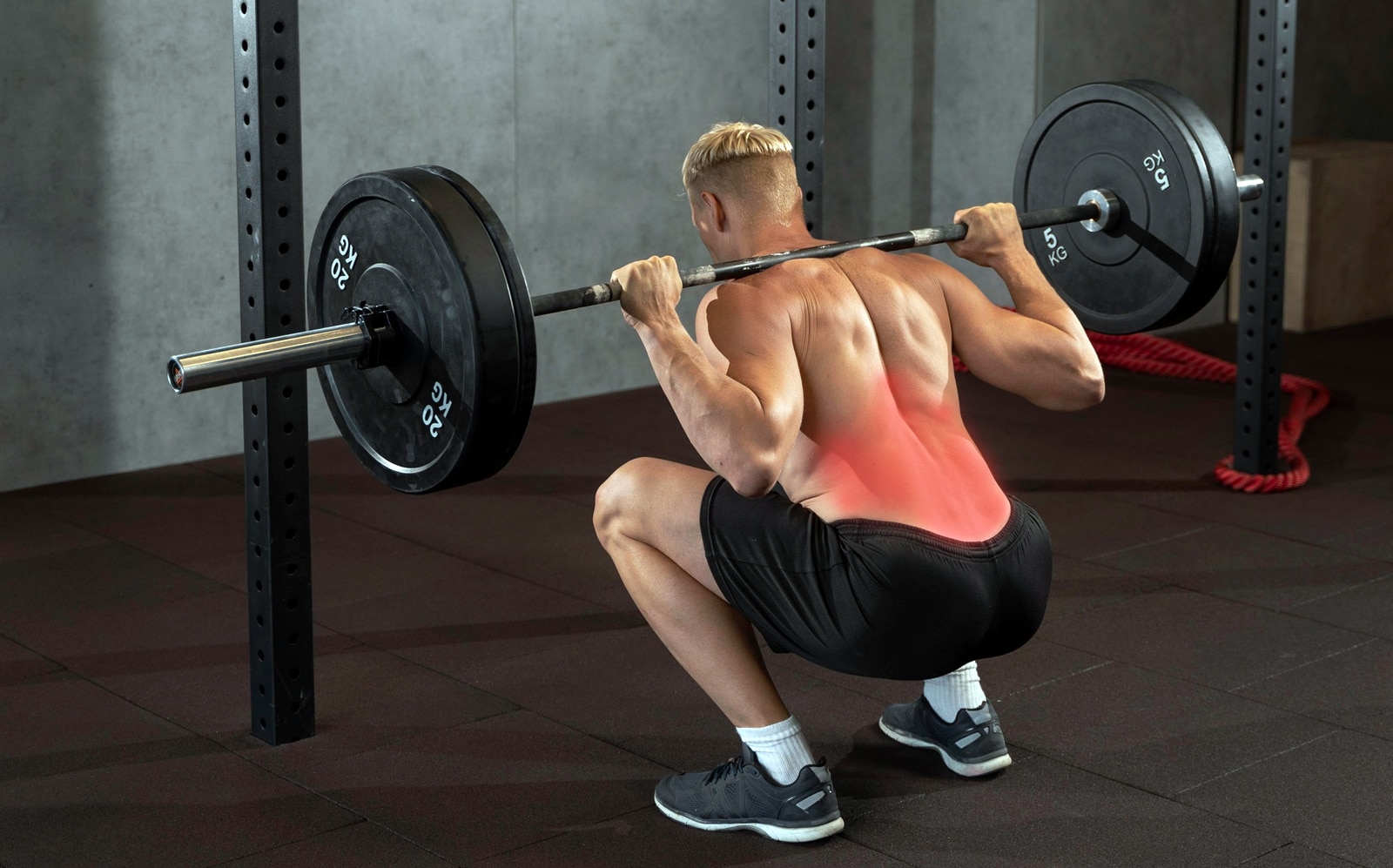
Lower back pain is one of the most common reasons lifters struggle to train long-term and continue to progress in the gym.
As a Performance Physical Therapist with over ten years of experience, I have worked with NCAA Division One athletes, professional athletes, and fitness-focused adults. I’ve seen many of these individuals have their training derailed by back pain and struggle to return to the activities they love.
One of the most common exercises that lifters report back pain with is the Back Squat. Now, although I firmly believe that no one exercise “causes” lower back pain, it is undoubtedly one of the more common exercises that are brought up when I evaluate a new active patient looking to get back into training.
The back squat is a complex exercise that requires a combination of skill, coordination, strength, mobility, and stability throughout several joints in the body.
Pain in training can be multifactorial in its cause and how you approach treating it. In this comprehensive guide, we will dive into the key concepts for understanding lower back pain. We’ll then reveal strategies that you can use to fix your back pain in training and prevent it from returning so that you can continue to train hard and reach your fitness goals.
Understanding Pain Science
As I mentioned above, many factors explain why someone may develop pain. The mechanism of injury, your experiences, and more can all affect how you perceive pain. (1) Before understanding how to fix or prevent pain in the future, it is crucial to understand what the pain sensation is.
Pain is a warning signal to the brain. Throughout the body, there are receptors whose sole purpose is to detect noxious stimuli and then relay that information to the brain. These receptors scan for stimuli that would be seen as a “threat” to the body or system. The bigger the threat, the greater the response and signal.
These receptors are called Nociceptors, and when stimulated, they create a chain of reactions that sends a signal via C-fibers or the “pain nerves” that ascend the body to reach the brain so that appropriate action can take place. (1) Such as removing a stone from your shoe or pulling your hand away from a hot stove.
This process is a good thing and protects you from excessive damage from harmful stimuli around you.
Unfortunately, this awareness of painful stimuli can become heightened based on your experience with pain and how you interpret it, as well as if appropriate actions aren’t taken to resolve your pain. Inappropriate responses to external stimuli are a common reason why many people have chronic lower back pain. (1)
With proper rehab and reacclimation to training, this can be mitigated and put you in the best position possible to bounce back to exercise or keep you in the gym training hard.
Common causes of lower back pain during back squats
Over the last ten years working with individuals as well as experiencing lower back pain and fixing it for myself, the conditions below are some of the most common that I have seen.
Herniated Disc
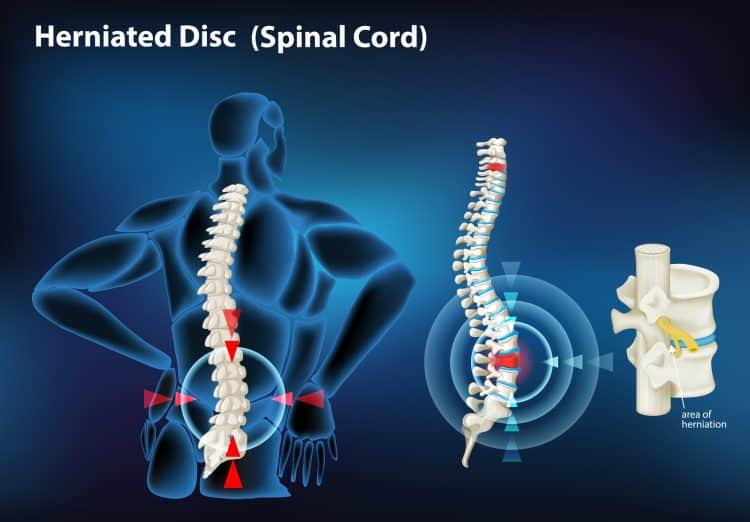
Herniated discs are among the most common lower back injuries I have seen. The spine is made up of bones called vertebrae, and in between each vertebra are cartilaginous discs that provide shock absorption and cushion for impact or for you, if you train, loaded through the spine that takes place during the back squat.
The disc comprises a soft inner layer called the Nucleus Propulus and a more rigid outer layer called the Annulus Fibrosus. (2) When someone sustains a herniated disc through traumatic or repetitive forces on the spine, the soft gel-like structure of the nucleus propulsus can protrude through soft or weakened spots of the annulus fibrosis. It can then compress nerves in the spine, which causes pain, numbness, and weakness. (2)
Herniated disc-related pain is typically worse with flexion of the spine.
Spinal Stenosis
Lumbar Spinal Stenosis is a condition in which a degenerative process takes place over time that causes the narrowing of the spinal canal or the neural foramina (the space where nerves exit the spine) that can cause compression of neural structures. (3) This can lead to pain in the lower back and leg and numbness and pain in the legs. (3)
This narrowing results from several factors, such as degeneration of the spinal discs, thickening of the Ligamentum Flavum, a strong ligament that provides spinal support, and narrowing of the facet joints. (3)
Spinal Stenosis is typically worse with full extension of the spine.
Facet Arthropathy
Facet Arthropathy is a general condition characterized by a degeneration of the spine’s facet joints. The facet joints are small joints on either side of the spinal column that connect each vertebra to the one above and below it. This degeneration can be related to age-related wear and tear or repetitive stress or strain from heavy lifting in training.
Facet joint-related pain is typically one-sided but can be localized to a specific area or radiate into the glutes, groin, or legs. When the facet joints become inflamed or arthritis inside the joint, you typically experience pain with twisting and extension movements.
Sacroiliac Joint (SIJ) Dysfunction
The Sacroiliac joints are the joints that attach the innominant to the sacrum. They are the long joints that track through the glute muscles. (4)
These SIJ joints can become painful for a host of reasons. These include direct trauma to the joint or the ligaments that support it, instability in the area, degeneration inside the joints itself, or movement of the pelvis bone on the sacrum that causes a malignment.
Lumbar Instability
Lumbar instability is characterized by abnormal mobility between two or more spine segments of the lower back or an inability to maintain the spine’s position under load. (5) This excessive movement can cause pain and progressive degeneration between the intervertebral joints and affect the nerves that pass through the spine.
Lumbar spine instability is usually the result of weakening of the spinal column and ligaments, neurologic factors that affect the motor control of the muscles that support the spine, and imbalances or weakness of the muscles that support the spine.
How to Fix Low Back Pain During Back Squats
If you are dealing with lower back pain related to any of the above conditions during your back squats, the first step is to classify what stage of pain or injury you are currently in and then determine the best course of action.
For the scope of this article, I will assume that a medical professional has seen you, that you are no longer in an acute stage of pain (under three months), and that all red flags related to lower back pain have been ruled out.
If not, then please ensure you are seen by a qualified practitioner to ensure your lower back pain is unrelated to a more serious condition. These red flags could be things ranging from organ dysfunction to cancer that would need to be screened by a qualified provider.
Once these have been cleared and it’s been determined that your back pain is mechanical, then there are things in your power during your workouts to improve it.
Treatment Classification of Low Back Pain
Lower back pain can be either mechanical or non-mechanical. Lower back pain that is mechanical stems from issues that arise related to the body’s structure. These could include muscle strains, ligament sprains, disc issues, and facet joint dysfunction. Lower back pain that is non-mechanical stems from things like tumors, infections, and other visceral or organ-related problems.
Although there can be some overlap in these types of lower back pain, fixing our lower back pain begins with generally classifying which one you are suffering with.
Once these have been cleared and it is evident that your back pain is mechanical, the next step is to determine which classification you fall under so that you can take the best next step.
Symptom Modulation
In this phase of treatment, the goal is to bring your pain levels and level of disability down to manageable levels. (6) If you have ever experienced one of the lower back conditions mentioned above, this phase would likely be immediately after your symptoms or injury.
Treatments inside the symptom modulation classification would include active rest, traction devices, manipulation mobilizations, and exercises to improve directional preferences. (6)
Movement Control
In the movement control classification of treatment of lower back pain, the pain levels are usually moderate to low, and they are generally stable. (6) People who fall into this classification typically have a moderate level of disability. (6)
Treatments inside the movement control classification would fall under moto control, stabilization, and flexibility exercises. (6)
Optimizing Function
In this classification, people will typically find that their level of disability and pain is low. (6) But, it does impact their ability to perform the tasks they want to perform like back squatting and other functional movements in the gym.
Treatments for folks inside this classification generally include strength and conditioning, improving aerobic fitness and muscle endurance, and work or sport-related training. (6)
For the vast majority of people looking to get back to training their back squats, they will fall into the movement control and optimizing function classifications.
Although they can be in the symptom modulation classification at some point, this classification is more treated with rest or by visiting a medical professional for treatment.
Thus, the remainder of this article will focus on strategies that can help improve your movement control and function regarding back squatting.
Proper Technique for Back Squats
What constitutes a proper technique for back squats and whether or not it plays a role in preventing pain and injury is commonly debated. However, whenever I am coaching clients, I believe there is an optimal technique that can both optimize performance and mitigate unnecessary forces on the spine.
When the squat technique veers too far out from what is acceptable, forces on the lower back rise, including forward sheering forces on the vertebrae that increase with forward pitching of the trunk and rotation forces that occur with muscular and joint imbalances side to side.
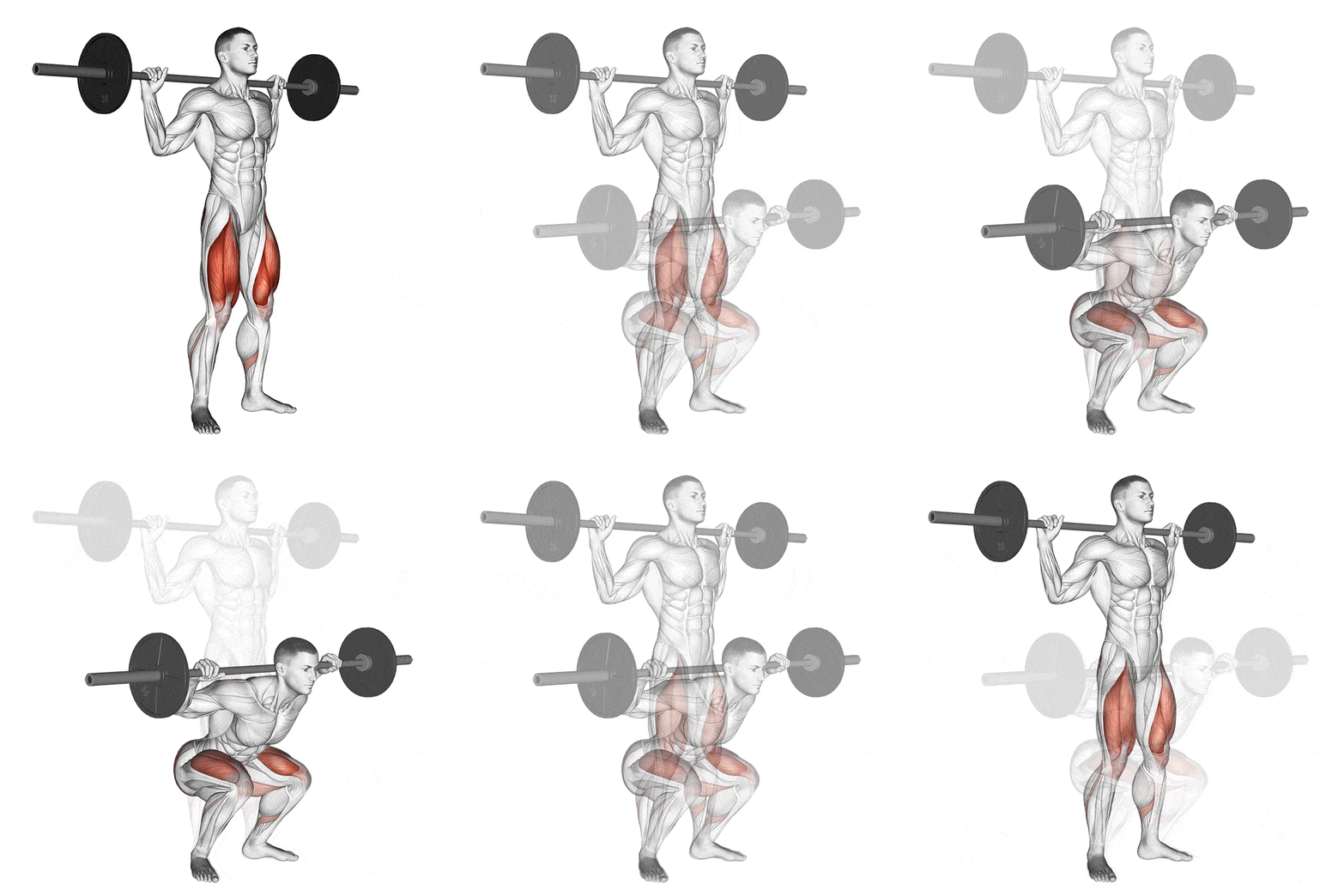
As a general rule of thumb, the proper technique for back squats includes:
- Feet just outside of the hips
- Weight in the midfoot
- Torso remains braced
- Chest remains up
- Hips descend back and down
- Knees remain tracking in line with the toes
- Feet remain flat to the ground
- Hip crease drops below the knee
- All are maintained as you reverse direction
- Hips and knees finish at lockout
Improving Mobility for Back Squats
With any movement endeavor, your mobility will be a critical first step to optimizing your performance and staying pain-free. But optimizing your mobility is not only about improving your flexibility; it is also about improving your control, and the stability of necessary joints is just as important.
The main joints involved in the back squat are the ones of the spine, the hips, the knees, and the ankles. All of these joints need to have the necessary mobility and stability for the movement. Without it, negative forces can occur on the lower back as you squat.
The body alternates between joints designed to be either mobile or stable. This is called the “joint-by-joint approach.” This describes how pain can arise in one joint when it has to compensate for another joint either above or below.
Regarding back squats and the joints involved, the ankles are mobile, the knees are stable, the hips are mobile, and the lower back is stable. When mobile joints become stiff, motion must be stolen from stable joints, and problems can arise.
Optimizing Muscle Activation for Back Squats
Muscle activation during back squats is primarily concerned with the muscles of the core and hips that create stiffness in the lower back while the spine is under load. Lumbar stabilization during back squats is created through a combination of small stabilizing muscles and larger prime-moving muscles.
Smaller stabilizing muscles
- Transverse Abdominis
- Internal Obliques
- Multifidus
- Diaphragm
Larger prime movers
- Rectus Abdominis
- External Obliques
- Erector Spinae
The role these muscles play in stabilizing the spine can be visualized via a telephone tower. The larger prime moving muscles are the large guidewires that hold up the entire structure. But the connecting pieces and bolts that attach the pieces of the tower are the smaller stabilizing muscles. Both play a critical role and are only effective when the other is present.
Best Exercises to Improve Back Pain During Squats
Fixing back pain during squats is not a one-size-fits-all approach and requires personalization to address the imbalances and other issues that may be going on during the back squats. Below are some more common exercises I will prescribe to clients looking to fix their back pain with back squats.
Mobility
Cat-Cow
The cat-cow is a spinal mobility drill that trains the spine to flex and extend as best as possible.
Sciatic Nerve Glide
The Sciatic nerve is a nerve that runs along the backside of the legs. When the Sciatic nerve becomes restricted in its movement it can be a source of pain as well as decreased mobility.
Couch Stretch
The couch stretch lengthens the front of the hips and, more specifically, the hip flexor muscle group. When this group of muscles becomes tight, it can cause lower back pain and altered movement mechanics.
Hip 90 / 90 Rotations
The hip 90 / 90 rotations help to mobilize the hip joint to rotate. Rotation in the hips is a critical component during squats, and when it is not present, it can negatively affect the lower back.
Stability
Alternating Deadbug
The Deadbug is an excellent anterior core exercise that strengthens the ability of the core to produce a posterior pelvic tilt—a necessary motion when carrying heavy loads on the back.
Bird Dog
Bird dogs train the backside of the core to help stabilize the lower back in extension.
Side Plank
Side planks train the lateral aspect of the core and, more specifically, the Oblique muscles, which help to brace the truck when lifting heavy loads like the back squat.
Conclusion
As you can see, lower back pain during squats can be complex, and fixing it depends on several factors. This is why many lifters can struggle to find relief if they are following templated stretching or strengthening programs.
Without considering things like the sources of pain and classifying it so that they can properly manage it, it can feel like you are on a hamster wheel of progress. But it is possible to fix your back pain when squatting and getting back to training the lift hard again. You simply need the right program for you.
As a reminder, if you have lower back pain, I urge you to seek out a qualified medical professional to be thoroughly evaluated so that you can ensure no red flags are present, that your pain is mechanical, and that you get set up with a program that considers you as an individual. So that you can address your unique needs as a lifter, fix your lower back pain, and get back to enjoying your back squats.
References:
- Tu, Y., Zhang, B., Cao, J., Wilson, G., Zhang, Z., & Kong, J. (2019). Identifying inter-individual differences in pain threshold using brain connectome: a test-retest reproducible study. NeuroImage, 202, 116049.
- Yang, H., Liu, H., Li, Z., Zhang, K., Wang, J., Wang, H., & Zheng, Z. (2015). Low back pain associated with lumbar disc herniation: role of moderately degenerative disc and annulus fibrous tears. International journal of clinical and experimental medicine, 8(2), 1634–1644.
- Wei, F. L., Zhou, C. P., Liu, R., Zhu, K. L., Du, M. R., Gao, H. R., Wu, S. D., Sun, L. L., Yan, X. D., Liu, Y., & Qian, J. X. (2021). Management for lumbar spinal stenosis: A network meta-analysis and systematic review. International journal of surgery (London, England), 85, 19–28.
- Sabrina, S., Farooqui, S., Khan, M. A., Khan, A. A., & Khan, F. A. (2023). Effectiveness of Evidence-Based Physical Therapy Management Approaches in Sacroiliac Joint Dysfunction: A Meta-analysis. Journal of the College of Physicians and Surgeons–Pakistan : JCPSP, 33(5), 572–577.
- Puntumetakul, R., Saiklang, P., Tapanya, W., Chatprem, T., Kanpittaya, J., Arayawichanon, P., & Boucaut, R. (2021). The Effects of Core Stabilization Exercise with the Abdominal Drawing-in Maneuver Technique versus General Strengthening Exercise on Lumbar Segmental Motion in Patients with Clinical Lumbar Instability: A Randomized Controlled Trial with 12-Month Follow-Up. International journal of environmental research and public health, 18(15), 7811.
- Alrwaily, M., Timko, M., Schneider, M., Stevans, J., Bise, C., Hariharan, K., & Delitto, A. (2016). Treatment-Based Classification System for Low Back Pain: Revision and Update. Physical therapy, 96(7), 1057–1066.