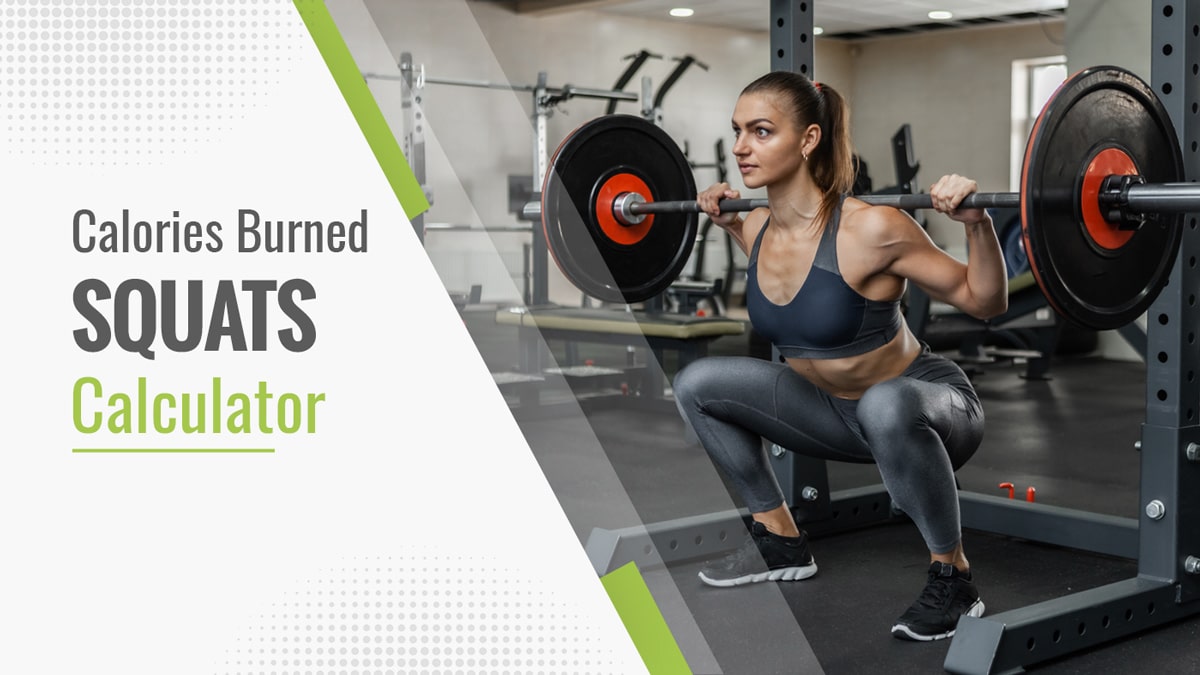
How many calories do squats burn? For most adults, the answer depends more on body weight, pace, effort, and active time than on the number of reps alone. As a useful reference, a small laboratory study estimated about 0.50 calories per slow bodyweight squat, with a 95% confidence interval of 0.42 to 0.58 calories. That puts 100 controlled bodyweight squats at roughly 42 to 58 calories under that specific test protocol.
Use the calculator below when you know your body weight and active squat time. Treat the result as an estimate, especially if your session includes long rests or loaded sets.
Squat Calories Burned Calculator
Example: 175 lb, 30 min
125kcal burned
83 kcal from the activity itself, plus 42 kcal your body burns at rest in that time anyway.
Enter your own weight and minutes above to replace this example.
Above resting
83 kcal
What the activity adds
Per hour
250 kcal
4.2 kcal a minute at this pace
To burn off 250 kcal
1 h 30 min
Counting calories above resting
3 times a week
375 kcal
249 kcal above resting, in 1 h 30 min
| Activity | Time | Per hour | kcal |
|---|---|---|---|
| Squats3.0 MET | 30 min | 250 | 125 |
Calories = MET x 3.5 x body weight in kg / 200 x minutes, rounded for each activity. Above resting uses MET minus 1, because 1 MET is what you burn sitting still. METs from the 2024 Adult Compendium of Physical Activities. The Compendium counts 3.5 ml/kg/min of oxygen as the resting rate for every body. Real resting rates vary with age, sex, height, weight and body composition, so treat these figures as an estimate for a typical adult, not a measurement of your own burn. The 2024 Compendium has no clear match for "Squats", so this page uses 3.0 MET, the value it has always used.
Related calculators
Calculator note: “Bodyweight squats” uses 3.0 MET for a general session, while “high-intensity bodyweight squats” uses 6.5 MET. Enter active exercise time rather than the full length of a workout with long rest periods.
Calories Burned with Exercises (Weight: 175lbs)
Calories each activity burns in 15 to 60 minutes at a body weight of 175 lb, from the MET in the second column.
| Exercise | MET | 15m | 30m | 45m | 60m |
|---|---|---|---|---|---|
| Abs Exercises | 7.0 | 146 | 292 | 438 | 583 |
| Burpees | 8.0 | 167 | 333 | 500 | 667 |
| Squats | 3.0 | 63 | 125 | 188 | 250 |
| Jumping Jacks | 7.7 | 160 | 321 | 481 | 642 |
| Jumping Rope | 8.3 | 173 | 346 | 519 | 692 |
| Sit-Ups | 8.0 | 167 | 333 | 500 | 667 |
| Lunges | 3.8 | 79 | 158 | 238 | 317 |
| Kettlebells | 7.5 | 156 | 313 | 469 | 625 |
| Push-Ups | 3.8 | 79 | 158 | 238 | 317 |
| Rowing | 5.0 | 104 | 208 | 313 | 417 |
| Bridges | 3.0 | 63 | 125 | 188 | 250 |
| Deadlifting | 5.0 | 104 | 208 | 313 | 417 |
| Calisthenics - Vigorous | 7.5 | 156 | 313 | 469 | 625 |
How Many Calories Do 100 Squats Burn?
The best direct estimate comes from a 2022 study that measured oxygen use during slow bodyweight resistance exercises. Among 15 men ages 21 to 29, the estimated energy cost of one squat was 0.50 plus or minus 0.14 calories. The 95% confidence interval was 0.42 to 0.58 calories per rep.
That produces the following rep-based estimates:
| Bodyweight squats | Central estimate | Study-based range |
|---|---|---|
| 25 | 13 calories | 11-15 calories |
| 50 | 25 calories | 21-29 calories |
| 100 | 50 calories | 42-58 calories |
| 200 | 100 calories | 84-116 calories |
These numbers are not universal constants. The study used slow, controlled reps in a small group of young men and extrapolated part of the result to 10 reps per minute. Your range of motion, tempo, body size, training status, added load, and rest time can all change the total.
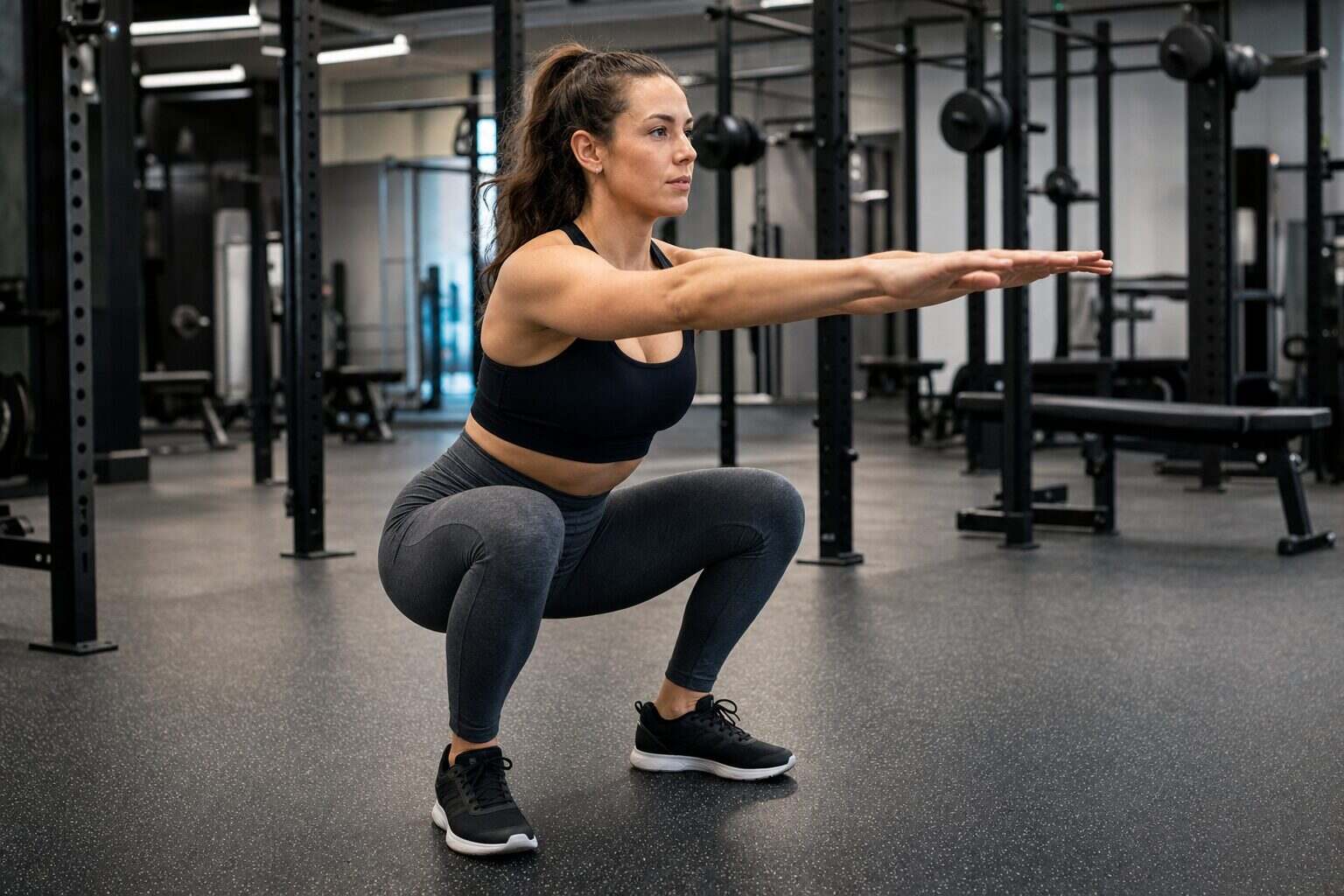
Squat Calories by Time and Intensity
The 2024 Adult Compendium of Physical Activities assigns 3.0 MET to general bodyweight resistance exercises such as squats and 6.5 MET to high-intensity bodyweight resistance exercise. It lists loaded squat and deadlift training at 5.0 MET for slow or explosive effort.
For a 175-pound person, the duration-based estimates are:
| Active time | General bodyweight squats 3.0 MET |
High-intensity bodyweight squats 6.5 MET |
|---|---|---|
| 5 minutes | 21 calories | 45 calories |
| 10 minutes | 42 calories | 90 calories |
| 15 minutes | 63 calories | 135 calories |
| 30 minutes | 125 calories | 271 calories |
Thirty minutes means 30 active minutes at the selected effort. If you complete several short sets with two or three minutes of rest between them, enter only the time spent squatting for a closer activity estimate.
How the Calculator Works
The calculator uses the standard MET equation:
Calories per minute = MET x 3.5 x body weight in kilograms / 200
One MET represents a standardized resting energy cost. A 3.0-MET activity is estimated to require three times that resting cost. MET calculations are useful for comparing activities and estimating groups, but they do not directly measure an individual’s calories.
Worked example for a 175-pound person
First convert 175 pounds to 79.4 kilograms.
- General bodyweight squats: 3.0 x 3.5 x 79.4 / 200 = 4.17 calories per minute, or about 42 calories in 10 active minutes.
- High-intensity bodyweight squats: 6.5 x 3.5 x 79.4 / 200 = 9.03 calories per minute, or about 90 calories in 10 active minutes.
- Loaded squats: 5.0 x 3.5 x 79.4 / 200 = 6.95 calories per minute, or about 69 calories in 10 active minutes.
The high-intensity value is not automatically the right choice because a barbell is involved. Select the effort that best matches the work rate. Heavy strength sets with long rests can produce a lower session average than continuous bodyweight squats.
What Changes Your Squat Calorie Burn?
Body weight
The MET equation scales with body mass, so a heavier person receives a higher estimate for the same activity and time.
Active time and rest
Ten minutes of uninterrupted squatting is different from a 10-minute block containing four short sets and several minutes of rest. Most calculator overestimates come from counting rest as active exercise.
Tempo and range of motion
Slow eccentrics, pauses, deeper ranges that you can control, and faster continuous reps change the work performed. They also make a simple calories-per-rep number less portable from one session to another.
Load and exercise style
Bodyweight squats, goblet squats, heavy back squats, and jump squats are different tasks. The mechanics of the squat also change with stance, depth, bar position, and individual proportions.
How to Do a Bodyweight Squat
- Stand with your feet in a comfortable stance, usually around shoulder width, and let your toes turn out slightly if that feels natural.
- Brace your trunk and keep your whole foot in contact with the floor.
- Bend at the hips and knees together. Let the knees track in the same general direction as the toes.
- Descend only as far as you can while staying balanced and controlling your trunk and pelvis.
- Push the floor away and stand tall without bouncing or forcing a range you cannot control.
There is no single stance or depth that fits everyone. Start with a range you can own, then progress the depth, reps, or resistance gradually. Our guide to the muscles worked by squats explains how the legs, hips, and trunk share the load.
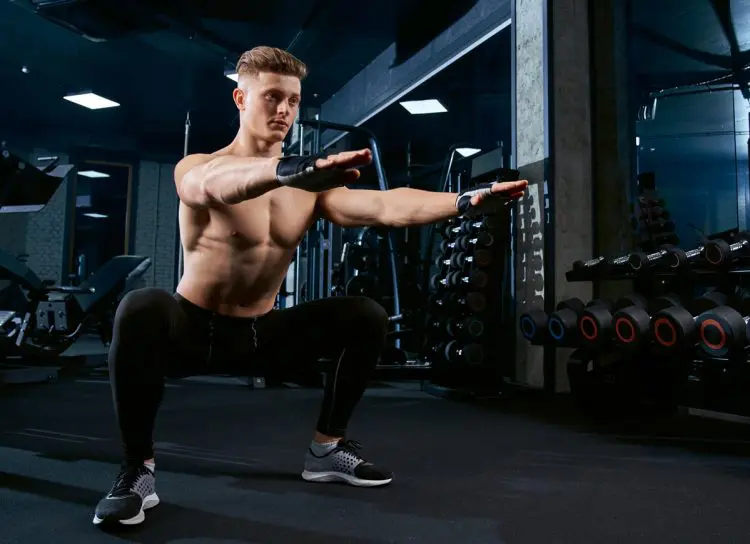
Squat Variations
Choose a variation for your training goal rather than for a promised calorie number.
- Bodyweight squat: accessible for technique practice, warm-ups, and higher-rep circuits.
- Dumbbell squat: adds load without requiring a barbell rack.
- Goblet squat: keeps the load in front and is often easy to scale.
- Barbell back squat: supports heavier strength work but usually includes more rest between sets.
- Jump squat: raises intensity and impact, so it should be used in small, crisp sets rather than as endless calorie work.








What the Estimate Can and Cannot Tell You
This calculator is useful for comparing sessions performed under similar conditions. It cannot measure your oxygen consumption, account perfectly for rest, or convert every squat variation into an exact calorie total. Wearable devices have similar limits during resistance training.
Use the estimate as one piece of a larger training log. If fat loss is the goal, total weekly activity and a sustainable calorie intake matter far more than trying to burn a specific number of calories with one exercise. You can compare other activities in the Fitness Volt calculator library.
References
Fitness Volt is committed to providing our readers with science-based information. We use only credible and peer-reviewed sources to support the information we share in our articles.
- Herrmann SD, Willis EA, Ainsworth BE, et al. 2024 Adult Compendium of Physical Activities: A third update of the energy costs of human activities. Journal of Sport and Health Science. 2024;13(1):6-12. doi and full text.
- Nakagata T, Yamada Y, Naito H. Estimating Energy Cost of Body Weight Resistance Exercise Using a Multistage Exercise Test. Journal of Strength and Conditioning Research. 2022;36(5):1290-1296. doi:10.1519/JSC.0000000000003622.
- Jette M, Sidney K, Blumchen G. Metabolic equivalents in exercise testing, exercise prescription, and evaluation of functional capacity. Clinical Cardiology. 1990;13(8):555-565. doi:10.1002/clc.4960130809.