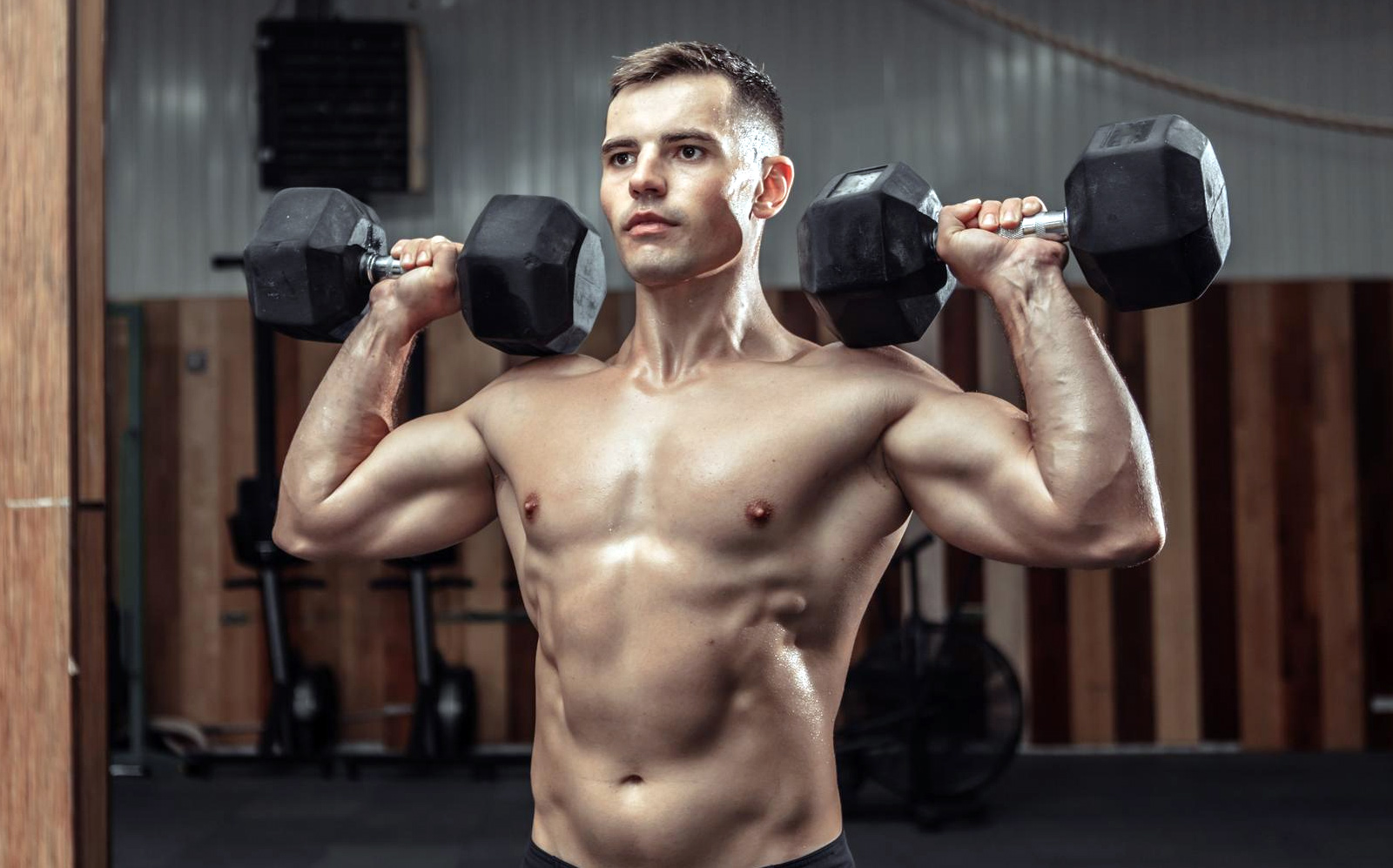
Let’s be honest, jacked arms are incredibly appealing and make you look strong and confident. It’s no surprise that most people are always chasing bigger, more defined biceps and triceps.
But here lies the problem.
When training for building swole arms, people forget a very crucial aspect: their shoulders. Shoulders form one-third of the upper arm and contribute significantly to the overall arm aesthetic.
Picture yourself standing in a tank top, and someone sees you from the side; if you don’t have capped and defined shoulders, your arms won’t pop. You could have bulging biceps and triceps, but they won’t look anything more than a slab of meat without the right shoulder and arm muscle separation.
As a personal trainer with over 17 years in the trenches, I’ve helped countless people transform their arms from average to eye-catching by programming targeted shoulder presses into their routines.
In this article, I pull back the curtain on my four most-trusted shoulder press variations (Arnold press, Z-press, single-arm dumbbell press, and push press) for unlocking your arm-building potential. We have a lot to unpack, so sit tight and read on.
Why Shoulder Presses Are Essential for Arm Development
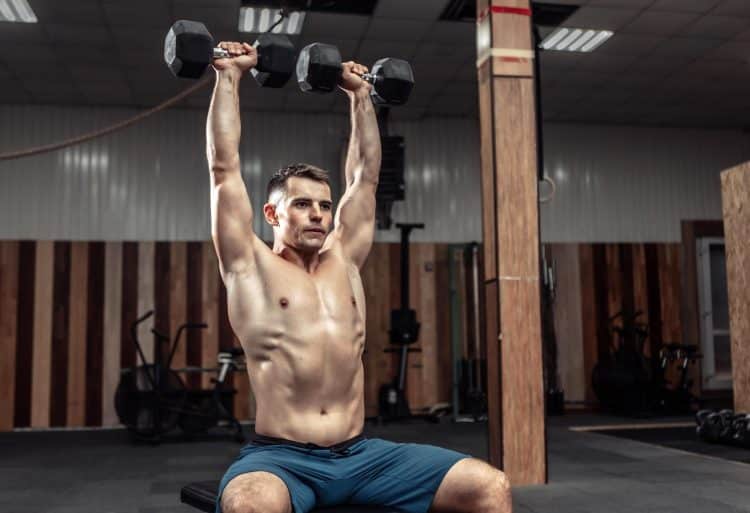
Shoulder presses can be a cornerstone of powerful, ripped arms. They are a compound movement, meaning they target multiple muscle groups, including your delts, triceps, and traps in every rep. Making them a staple in your training routine can help you achieve the coveted V-taper, which is characterized by broad shoulders, flaring lats, and a narrow waist.
Look around your gym and you’ll see people paying way more attention to their biceps compared to their triceps. This leads to muscle and strength imbalances, which can hamper your aesthetics and functionality.
Adding moves like Arnold presses, Z-presses, single-arm dumbbell presses, and push presses into your regimen helps you target your arms from different angles, maximizing hypertrophy and shattering monotony.
Each of these four exercises has a special role in your training. Without further ado, here is how you can make the most of them:
Variation 1: Arnold Press
Developed by the Governator, Arnold Schwarzenegger, his namesake exercise biases all three deltoid heads, as it involves rotating your wrists throughout the ROM. The extended range of motion of this exercise maximizes shoulder stretch and contraction, leading to optimal gains.
Arnold presses also engage the clavicular head of the pectoralis major (upper chest), giving you a mammoth chest like Arnie.
Step-by-Step Guide To Perfect Form:
- Sit on a utility bench with your back flat against the pad. Avoid leaning back excessively as it transfers the tension from the shoulders to the upper chest.
- Hold a dumbbell in each hand at shoulder height with your palms facing towards you and your elbows bent.
- Begin the movement by pressing the weight towards the ceiling while externally rotating your wrists. Your palms should face forward, and your wrists, elbows, and shoulders should be stacked at the top of your ROM.
- Reverse the motion to return to the starting position.
- Repeat for the recommended reps.
Coach Tip: Contract your muscles throughout the exercise, aiming for a deep stretch at the bottom and a sharp contraction at the top for maximum target muscle activation.
Remember, you must perform each movement on this list with a full range of motion (ROM) to maximize target muscle fiber stimulation and subsequent adaptations.
While Arnold presses primarily targets the anterior deltoid, the overhead extension is driven by the triceps, which adds thickness to the back of your arms. The rotation also engages the lateral and posterior delts, delivering balanced shoulder gains.
I perform this exercise every alternate week, and I can feel my shoulders and triceps light up by the end of the very first set.
Tip To Master This Exercise
Beginners should start with light dumbbells (5-10 pounds) and prioritize mastering the movement mechanics. Focus on slow, controlled reps to build confidence; the weights can come later.
On the flip side, advanced trainers can alter their rep tempos and aim for 3-5 second eccentrics to increase the time under tension (TUT) and overload their muscles. (1)
Also, you must avoid flaring your elbows too wide, as it can strain your joints. Keep them slightly tucked and aligned under the weight throughout the exercise for optimal power generation and safety.
Variation 2: Z-Press
Pressing heavy weights overhead has long been associated with strength. I really like Z-presses, as they are different from conventional overhead movements and require decent overhead mobility, along with raw pressing strength.
You also need a rock-solid core to keep the weight steady and protect your shoulders from injury during this exercise.
This is an advanced overhead press variation that was born in strongman circles. It strips away the crutches of leg drive or a bench, forcing your deltoid, triceps, and core to work overtime. This exercise alone has helped boost my functional strength, making everyday tasks feel effortless.
Z-presses hammer your anterior and lateral delt heads, building those rounded shoulder caps that make your arms stand out. Your triceps drive the lockout, adding size and definition. These also engage your abs and obliques, turning every rep into a full-body challenge.
How To Perform Z Presses:
- Sit on the floor with your legs extended straight and your toes pointing up. Your body should look like the letter ‘L’ in the starting position.
- Hold a barbell at shoulder height with your palms facing forward and elbows bent.
- Brace your core and press the weight overhead in a straight line, fully extending your elbows while keeping your spine tall and chest proud.
- Lower the weight back to the shoulder level while resisting gravity.
- Beginners can start with the dumbbell variation, as it allows more wiggle room when it comes to the ROM.
I’m a fan of Z-presses as they build serious shoulder strength by isolating the pressing motion and forcing your delts to do all the heavy lifting.
I highly recommend that people with desk jobs make this exercise a part of their training programs, as it can help counter the slouch.
I tell my clients to imagine a wall behind them during this exercise to avoid leaning back.
Begin with light weights if you’ve never tried this exercise before. Focus on slow, controlled reps to build stability. Also, make sure your knees and ankles are touching the floor throughout the ROM.
Add posterior chain mobility drills to your routine if you notice your knees rising during the exercise. Bending your knees or crossing your legs reduces stability, increasing your risk of injury.
Variation 3: Single-Arm Overhead Dumbbell Press
Doing the same exercises in every workout is a sure-shot way to hit a plateau. You must constantly tweak your training split to keep your muscles guessing and growing (2). It also helps target your muscles from different angles, ensuring overall development.
Unilateral movements like single-arm dumbbell presses are excellent for identifying and fixing strength and muscle imbalances.
When you press a dumbbell overhead with one arm, your body fights to stay balanced. I’ve firsthand witnessed this move transform lopsided physiques into symmetrical powerhouses. Many of my clients report improved posture and shoulder health after making this exercise a part of their daily routine.
To perform this exercise, stand with your feet shoulder-width apart, knees bent slightly, and core braced. Grab a dumbbell in one hand at shoulder height with your palm facing forward. Keep your free hand on your hip. Beginners can hold it out to their side as a counterbalance measure.
Drive the dumbbell toward the ceiling by extending your elbow. Lower the weight back to shoulder level with control, keeping your torso steady and upright throughout the movement.
Complete the recommended reps with one arm before switching sides.
Making this exercise a constant in your program can help you build boulder shoulders, delivering the coveted 3D aesthetic. It will also add shape to your arms by improving the separation and lines.
Benefits of Unilateral Presses
- Each arm gets its fair share: In bilateral exercises, your dominant side usually takes over to plug the gap in your performance. This isn’t possible in single-limb movements.
- Boost coordination: Working on one side at a time can improve your hand-eye coordination, improving your overall functionality, including in day-to-day activities and sports.
- Tightens the midsection: Pressing weights overhead fires up your core muscles and stabilizers, which can tighten the midsection and create a lean, athletic look.
Variation 4: Push Press
In some exercises, we limit movement to the target muscles and joints to maximize stimulation. However, in a few, we call on the secondary muscles to generate maximum force and build explosive power. Push presses are from the latter group.
This exercise taps into your athletic potential, making your delts and triceps pop.
Unlike the other pressing movements, push presses involve leg drive, which allows you to lift heavier weights compared to a strict press, helping maximize explosive gains.
As someone who spends most of their day in the gym, I can attest that a majority of lifters perform this lift with incorrect form. They press the bar in front of their midline instead of lifting it straight overhead.
The thing is that even if you tell them they are performing this movement incorrectly, there is little that these folks can do immediately.
You cannot adjust your mobility with the push of a button. It takes weeks and months of dedicated effort.
Instructions:
- Stand erect with a hip-width stance and a barbell in the front rack position with your hands just outside your shoulders.
- Brace your core and dip slightly by bending your knees.
- Perform an explosive triple extension to propel the bar upward.
- Press the bar overhead in a straight line, fully extending your arms without locking your elbows.
- Lower the bar back to your chest with control.
Push presses fire up your shoulders, carving those bold shoulder caps. Your triceps power the lockout, traps stabilize the bar, and your lower body drives the initial thrust, making this a full-body move.
How to Incorporate These Variations into Your Routine
A comparative study published in the Journal of Strength and Conditioning concluded that compound exercises spike anabolic hormones, like testosterone, which can drive hypertrophy across your arms and shoulders (3). They also burn more calories than isolation moves, enhancing fat loss to reveal those hard-earned muscles.
With all this out of the way, let’s weave these moves into a killer workout to make your shoulders and arms pop.
| Exercise | Sets | Reps | Rest Periods |
| Arnold Press | 3 | 10-12 | 60-90 seconds |
| Z-Press | 3 | 8-10 | 90 seconds |
| Single-Arm Dumbbell Press | 3 | 10-12 per side | 60 seconds |
| Push Press | 4 | 6-8 | 90-120 seconds |
This workout is designed for intermediate and advanced lifters. Beginners can scale down the sets and reps and increase the rest time to spark strength and muscle gains.
Conclusion
Making Arnold presses, Z-presses, single-arm dumbbell presses, and push presses a staple in your training routine will help sculpt arms that demand attention while boosting functional strength.
Consistency and discipline are incredibly important when it comes to achieving your training objectives. Start small and gradually increase your training volume and intensity as you gain more experience to make steady gains. Best of luck!
References:
- Kassiano W, Nunes JP, Costa B, Ribeiro AS, Schoenfeld BJ, Cyrino ES. Does Varying Resistance Exercises Promote Superior Muscle Hypertrophy and Strength Gains? A Systematic Review. J Strength Cond Res. 2022 Jun 1;36(6):1753-1762. doi: 10.1519/JSC.0000000000004258. Epub 2022 Apr 1. PMID: 35438660.
- Burd NA, Andrews RJ, West DW, Little JP, Cochran AJ, Hector AJ, Cashaback JG, Gibala MJ, Potvin JR, Baker SK, Phillips SM. Muscle time under tension during resistance exercise stimulates differential muscle protein sub-fractional synthetic responses in men. J Physiol. 2012 Jan 15;590(2):351-62. doi: 10.1113/jphysiol.2011.221200. Epub 2011 Nov 21. PMID: 22106173; PMCID: PMC3285070.