
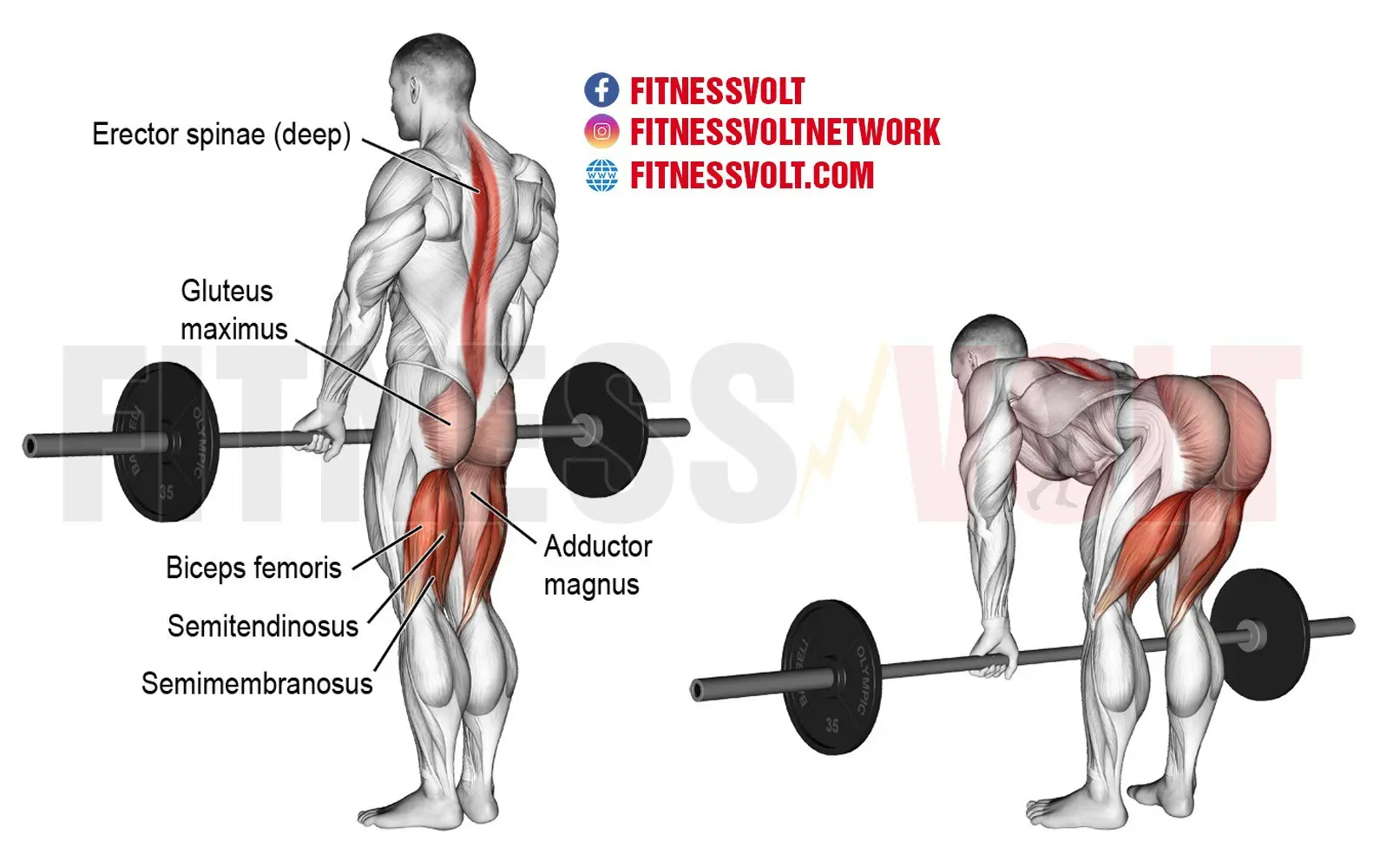
The stiff-leg deadlift is a barbell hip hinge performed with a small, mostly fixed knee bend. It trains the hamstrings and gluteus maximus while the spinal erectors, upper back, grip, and abdominal wall hold the torso and bar in position.
The name can be confusing because lifters use it for several similar hinges. In this guide, the bar starts on the floor or low blocks, each rep returns to a dead stop, and the knees stay softly bent rather than locked. A Romanian deadlift usually starts from the top and ends when hamstring length or torso position limits the descent.
| Muscle group | Role in the lift |
|---|---|
| Hamstrings | Extend the hips as you stand and control hip flexion as the bar lowers. |
| Gluteus maximus | Drives hip extension as you stand and helps finish the lockout. |
| Spinal erectors | Hold the trunk rigid while the hips move through the hinge. |
| Adductor magnus | Assists hip extension, especially from a deeper hip-flexed position. |
| Upper back, lats, and forearms | Keep the bar close, stabilize the shoulders, and maintain grip. |
| Abdominal wall | Braces the trunk and helps control rib and pelvic position. |
A 2021 study involving 20 participants found that stiff-leg deadlifts produced a different distribution of hamstring activation than Nordic curls, with substantial variation between individuals. That supports treating the movement as a hip-extension exercise, but surface EMG cannot tell us how much long-term muscle growth an exercise will produce. See the study on PubMed.
How to Do the Stiff-Leg Deadlift
Use a light starting load and make the hip hinge, bar path, and knee angle repeatable before adding weight. The bar should stay close as the hips move back, with the knees softly bent and the trunk braced through the full rep.
- Set the bar: Place a loaded barbell over the middle of your feet. Use low blocks if reaching the floor makes you lose your trunk position.
- Choose your knee angle: Unlock the knees slightly and keep that angle nearly fixed through the rep. Do not force the knees completely straight.
- Hinge to the bar: Push your hips back, keep the bar close to your legs, and take a double-overhand or mixed grip just outside your thighs.
- Brace: Draw a breath into your trunk, tighten your abdominal wall, and set your shoulders without trying to squat the bar up.
- Stand: Push the floor away and drive the hips forward while the bar rises close to the shins and thighs. The hips and shoulders should rise together.
- Finish tall: Stand with the ribs stacked over the pelvis. Squeeze the glutes without leaning backward.
- Return under control: Push the hips back first, guide the bar down the legs, and reset your brace when the plates reach the floor or blocks.
The bar does not need to touch the floor if your available range does not allow it. Raising the starting position is better than reaching lower by rounding the spine or turning the movement into a squat.
Watch the movement
Stiff-Leg Deadlift vs. Romanian Deadlift
The clearest practical difference is where each rep begins. This guide uses a dead-stop stiff-leg deadlift from the floor or blocks, while the Romanian deadlift begins from standing and reverses before the plates reach the floor.
| Feature | Stiff-leg deadlift | Romanian deadlift |
|---|---|---|
| Typical starting point | Floor or low blocks | Standing position |
| Knee bend | Small and mostly fixed | Small to moderate and mostly fixed |
| End of descent | Floor, blocks, or the lowest controlled position | Where hamstring length or torso position limits the hinge |
| Reset between reps | Usually a dead stop | Usually continuous tension |
| Main coaching problem | Forcing floor contact and losing trunk position | Lowering past the available hip-hinge range |
The two movements overlap heavily, and coaches do not use the names consistently. The useful distinction is how you perform the rep, not what you call it. Our Romanian deadlift guide covers the top-down variation in detail.
A small study of 10 competitive bodybuilders compared Romanian, step-Romanian, and stiff-leg deadlifts at 80% of each variation’s one-repetition maximum. Muscle excitation differed among movements and phases, but the sample was small and acute EMG does not establish a superior hypertrophy exercise. Read the study abstract.
Stiff-Leg vs. Conventional Deadlift
The conventional deadlift uses more knee flexion and leg drive from the floor, which usually supports heavier loading. The stiff-leg version keeps the hips higher and the knee angle more fixed, making it a more focused hinge accessory.
| Feature | Stiff-leg deadlift | Conventional deadlift |
|---|---|---|
| Knee contribution | Limited | Greater knee flexion and leg drive from the floor |
| Hip position | Typically higher | Lower and dependent on body proportions |
| Primary training emphasis | Hip hinge and posterior-chain accessory work | Whole-lift strength from floor to lockout |
| Typical load | Lower | Higher |
| Range rule | Limited by hinge control and hamstring length | Defined by the floor and the lifter’s setup |
Use the conventional deadlift when the goal is the full competition-style pull or greater total loading. Use the stiff-leg variation when you want a hinge with less knee contribution. A biomechanics study of 13 weight-trained participants found clear knee and hip differences between conventional deadlifts and goodmornings. Trunk kinematics did not differ, and L4/L5 moments were comparable when both exercises used an additional load equal to 25% of body weight; the 50%-body-weight deadlift condition produced higher L4/L5 loading. It did not compare long-term training outcomes. Read the study on PubMed, then see our guide to the Romanian and conventional deadlift.
Common Mistakes
Most breakdowns come from forcing more range or load than the lifter can control. Judge each rep by a soft, stable knee angle, a close bar path, and a trunk position that stays consistent from the first repetition to the last.
Locking the knees
Stiff does not mean locked. Keep a soft knee bend so the movement comes from the hips without forcing the knees into hyperextension.
Chasing the floor
The floor is not a mobility test. Stop where you can keep the bar close and the trunk controlled, or elevate the bar.
Letting the bar drift forward
A forward bar path increases the moment arm at the hips and lower back. Keep the bar close enough that it nearly brushes the legs.
Squatting the weight
If the knees continue bending as the bar descends, the lift becomes more like a conventional deadlift. Set the knee angle, then move the hips back.
Leaning back at lockout
Finish by standing tall. Pushing the hips far past the bar and extending the lower back does not improve the rep.
Sets, Reps, and Progression
These are coaching starting points, not prescriptions tested by the cited EMG studies.
| Goal | Starting range | Execution priority |
|---|---|---|
| Learn the hinge | 2 to 3 sets of 6 to 8 | Light load, elevated start if needed, repeatable bar path |
| Muscle-focused accessory work | 3 to 4 sets of 6 to 12 | Controlled descent and one to three sound reps in reserve |
| Strength accessory | 3 to 5 sets of 3 to 6 | Dead-stop reps without position changes |
Add repetitions before adding weight when you are learning the movement. Increase the load only if the bar stays close, the knee angle remains consistent, and the final rep uses the same range as the first. The stiff-leg deadlift complements knee-flexion work from the hamstring exercise guide. Track maximal pulling strength separately with the deadlift strength standards, because the standard applies to a conventional competition-style deadlift.
Regressions and Variations
Choose a version that lets you own the starting height and bar path. Blocks are the simplest regression when floor range is the limiting factor; dumbbells or a top-down Romanian deadlift provide different ways to practice the same broad hinge pattern.
- Block stiff-leg deadlift: Raise the bar to reduce the starting range.
- Rack pull from below the knee: Use the safety pins to standardize the range.
- Dumbbell stiff-leg deadlift: Hold the weights beside the thighs for a less constrained bar path.
- Romanian deadlift: Start from standing and stop before the plates reach the floor.
- Tempo stiff-leg deadlift: Use a deliberate descent to practice control, not to chase an arbitrary time under tension.
Who Should Modify or Skip It?
The exercise requires enough hip-hinge control to move through the chosen range without losing the position you intend to train. Beginners can learn it from blocks, with dumbbells, or after practicing an unloaded hinge.
Stop if you feel sharp back, hip, or hamstring pain, or if symptoms travel down the leg. Persistent pain, recent injury, or uncertainty about loading deserves individual assessment. No deadlift variation is automatically safe or unsafe for every lifter.
Sources
- Boyer, A., Hug, F., Avrillon, S., and Lacourpaille, L. (2021). Individual differences in the distribution of activation among the hamstring muscle heads during stiff-leg deadlift and Nordic hamstring exercises. Journal of Sports Sciences. DOI: 10.1080/02640414.2021.1899405.
- Coratella, G., Tornatore, G., Longo, S., Esposito, F., and Cè, E. (2022). An electromyographic analysis of Romanian, step-Romanian, and stiff-leg deadlift: implication for resistance training. International Journal of Environmental Research and Public Health. DOI: 10.3390/ijerph19031903.
- Schellenberg, F., et al. (2013). Kinetic and kinematic differences between deadlifts and goodmornings. BMC Sports Science, Medicine and Rehabilitation. DOI: 10.1186/2052-1847-5-27.
Interested in measuring your progress? Check out our strength standards for Glute Kickback, and more exercises.