
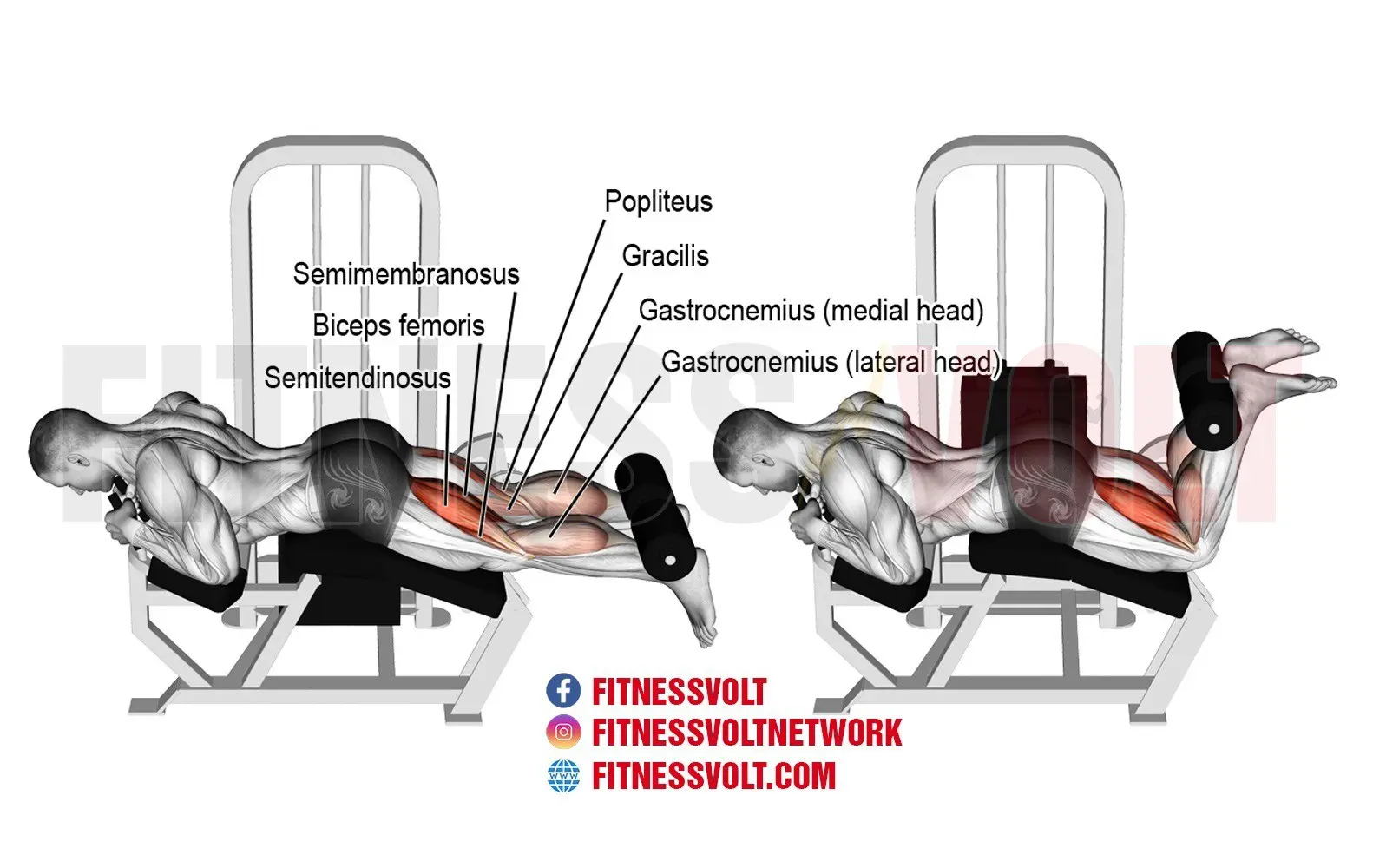
The lying leg curl is an effective isolation exercise for the hamstrings and anyone can perform the movement safely. It’s a great machine exercise which doesn’t require stabilization since you’re lying down on a bench and it’s also a great posterior chain strengthening exercise.
Now, the hamstrings largely contribute to athletic performance like jumping, running, and bending so it’s important that they are fully developed to keep up with your quads for optimal performance and aesthetics.
Since the lying leg curl isolates the hamstrings, no other muscles are involved and it’s a good finisher exercise to your compound movements.
In this Exercise
- Target Muscle Group: Hamstrings
- Type: Strength
- Mechanics: Isolation
- Equipment: Leg curl machine
- Difficulty: Beginner
Understanding the Lying Leg Curl
The lying leg curl, also known as the hamstring curl, is a go-to exercise that targets your hamstring muscles primarily. This exercise provides a thorough workout to the muscles at the back of your thighs, effectively aiding in strengthening, toning, and shaping your legs. But why exactly should we care about our hamstrings? Well, not only are strong hamstrings crucial for daily activities like walking and running, but they also play a key role in injury prevention and sports performance.
The Anatomy of the Lying Leg Curl
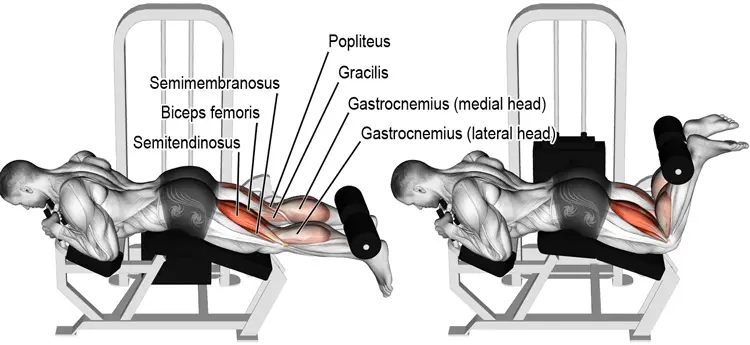
Here’s a deeper dive into the anatomy of the lying leg curl, focusing on the muscles that this exercise specifically targets:
Hamstrings
The hamstrings, situated at the back of your thigh, are the star performers during a lying leg curl. This group of muscles comprises three individual muscles – the biceps femoris, semitendinosus, and semimembranosus. During a lying leg curl, you primarily engage these muscles as you curl your legs towards your buttocks and then extend them back to the starting position.
Biceps Femoris
The biceps femoris is one of the hamstring muscles and has two heads, long and short. The long head originates from the ischial tuberosity (the sitting bone), while the short head originates from the femur (thigh bone). Both heads combine and attach to the head of the fibula (the outer bone of your lower leg). This muscle is crucial for knee flexion and hip extension.
Semitendinosus
The semitendinosus, another hamstring muscle, originates from the ischial tuberosity and inserts onto the medial surface of the upper tibia (shin bone). It plays a pivotal role in flexing the knee, extending the hip, and internally rotating the knee when the knee is flexed.
Semimembranosus
The semimembranosus is the third hamstring muscle, originating from the ischial tuberosity and inserting onto the medial condyle of the tibia. It aids in knee flexion, hip extension, and internal rotation of the knee.
Gluteal Muscles
While the hamstrings are the primary focus, lying leg curls also activate your gluteal muscles – the gluteus maximus, medius, and minimus. These muscles, collectively known as your glutes, are responsible for the movement and stabilization of your hips.
Calves
Lastly, your calf muscles – the gastrocnemius and soleus – also get a workout during lying leg curls. These muscles play a supportive role, providing stability and control during the exercise.
In conclusion, while the lying leg curl is often considered a hamstring exercise, it indeed is a compound movement engaging multiple muscles across your lower body. Incorporating it into your fitness routine can help promote balanced muscular development and improve overall lower body strength.
Performing the Lying Leg Curl
Required Equipment
Before you jump into the exercise, make sure you have the right equipment. You’ll need a lying leg curl machine for this, which is commonly found in most gyms.
The Correct Technique
Getting the technique right is the secret sauce to any effective exercise, and the lying leg curl is no exception. Here’s a step-by-step guide:
- Position yourself on the lying leg curl machine, with your torso flat against the bench and your legs fully extended.
- Secure your feet under the roller pad, just above your ankles.
- Curl your legs upwards, contracting your hamstrings until your knees form a 90-degree angle.
- Slowly lower the weight back down to the initial position.
Remember, slow and controlled movements are key!
Watch: How to do the Lying leg curl
Advanced Lying Leg Curl Tips and Tricks
Increasing the Intensity
Once you’ve got the hang of the lying leg curl, it’s time to take things up a notch. You can increase the intensity of your workout by adding more weight, performing more reps or sets, or even slowing down the lowering phase of the exercise.
Variations of the Lying Leg Curl
Feel like shaking things up a bit? There are numerous variations of the lying leg curl that you can incorporate into your routine. Some popular ones include the seated leg curl, standing leg curl, and the stability ball hamstring curl. Each variation adds its unique touch to the exercise, targeting your muscles from different angles and intensities.
Common Mistakes to Avoid
Avoiding common mistakes can mean the difference between a rewarding workout and a potential injury. Here are a few pitfalls to steer clear of:
- Rushing the exercise: Always ensure slow and controlled movements for maximum effectiveness.
- Using too much weight: Start with a weight you can handle comfortably, and gradually increase.
- Not fully extending your legs: Make sure you complete the full range of motion.
Frequently Asked Questions
What is the lying leg curl exercise?
The lying leg curl is an exercise primarily targeting the hamstring muscles at the back of your thigh. It’s performed using a lying leg curl machine.
What muscles does the lying leg curl work?
The lying leg curl primarily targets your hamstrings but also engages your glutes and calves.
How can the lying leg curl aid in weight loss?
While the lying leg curl is not a direct fat-burning exercise, it contributes to weight loss by increasing muscle mass, which raises your metabolic rate.
Can the lying leg curl help athletes?
Yes, it can! Strong hamstrings are critical for sports performance, and the lying leg curl is an effective way to strengthen them.
What are some variations of the lying leg curl?
Variations include the seated leg curl, standing leg curl, and the stability ball hamstring curl.
What are some common mistakes to avoid when performing the lying leg curl?
Common mistakes include rushing the exercise, using too much weight, and not fully extending your legs.
Conclusion
The lying leg curl isn’t just an exercise; it’s a path towards better lower body strength, muscle tone, and overall fitness. With the comprehensive “Lying Leg Curl Exercise Guide” in your arsenal, you’re well-equipped to step up your fitness game. So, what’s stopping you from getting those hamstrings in top shape?
Interested in measuring your progress? Check out our strength standards for Lying Leg Curl, Single Leg Dumbbell Deadlift, Single Leg Press, and more exercises.