


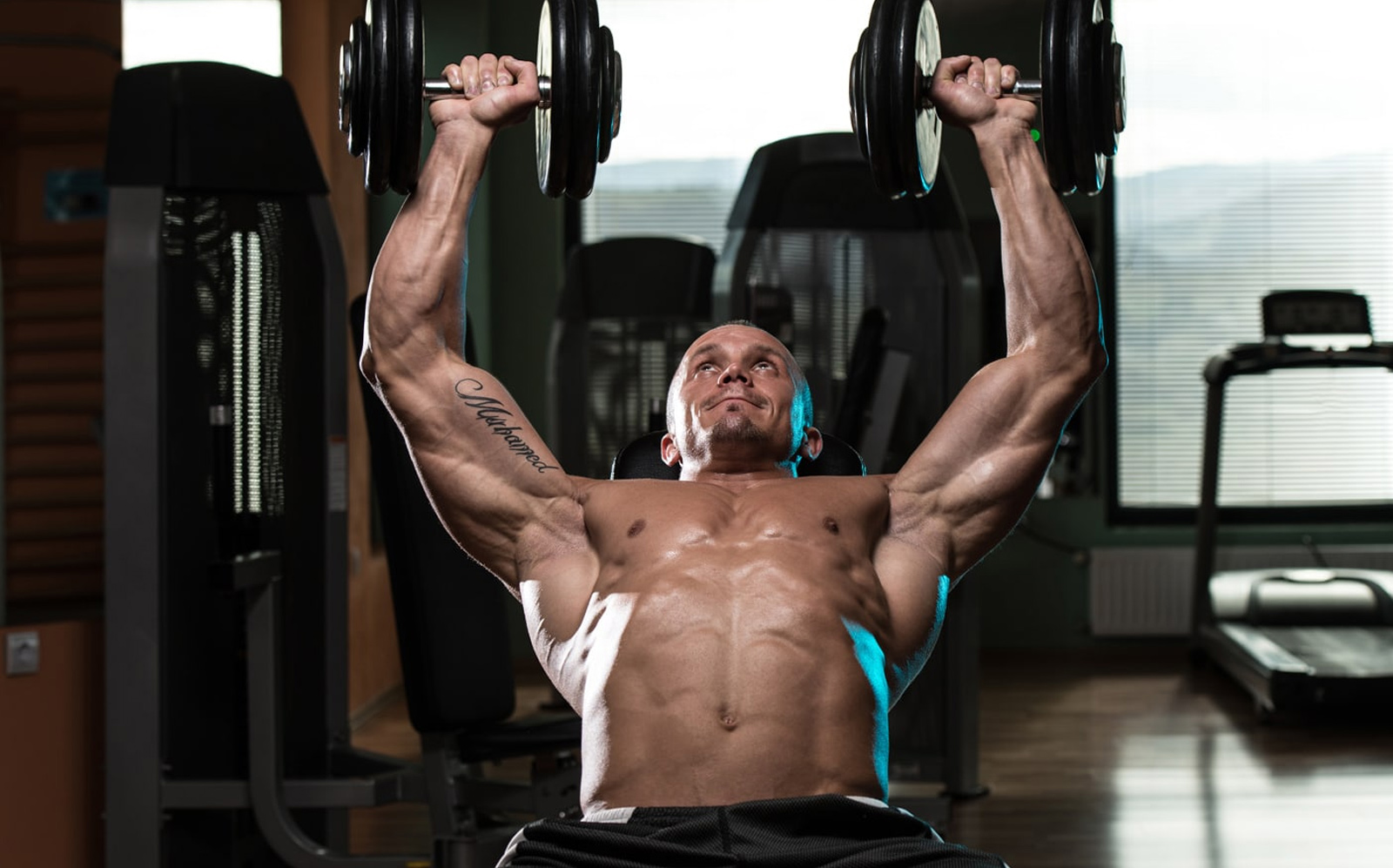
Ask most bodybuilders how many reps they do per set, and they’ll probably say 8-12. Sure, there will be a few outliers who prefer heavy sets of five, but that’s the exception rather than the rule.
It’s hard to say why the 8-12 rep range is so popular, but it may have something to do with Thomas DeLorme, who, in the 1940s, studied and publicized strength training and concluded that three sets of ten reps was optimal for making gains (1). 8-12 reps “bookend” sets of tens, and, as the saying goes, is close enough for government work.
Related: Best Rep Range For Building Muscle, Strength, and Endurance
Regardless of the reason, 8-12 is considered the perfect rep range for hypertrophy, hence its set-in-stone status as the best way to build muscle.
But, here’s the thing: strength training research has come a long way since DeLorme’s day, and we now know that you can build muscle with almost any rep range—right up to 30 reps per set and beyond (2).
That’s because it’s proximity to failure that matters most, and not how many times you lift your weights. Provided you get to within 1-3 reps of failure, you’ll trigger muscle growth (3).
That’s not to say there is anything wrong with the classic 8-to-12-rep approach, but it’s nice to know that you don’t have to use it if you don’t want to.
I’m a veteran personal trainer, and for the last 35 years, it’s been my job to create effective, interesting programs for my clients. And while I sometimes prescribe 8 to 12-rep sets, I also like to use less common rep ranges to keep my clients’ workouts fresh and interesting.
In this article, I discuss the 5-5-5 method, which is perfect for short but intense dumbbell workouts.
What is the 5-5-5 Method
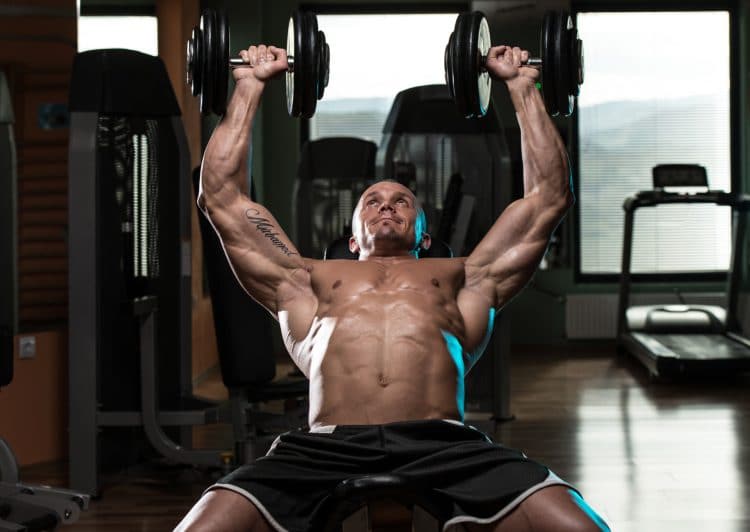
First off, don’t confuse 5-5-5 with the 5 x 5—they’re worlds apart. 5 x 5 is short for five sets of five and is a powerbuilding scheme that involves lifting very heavy weights. The 5 x 5 method is great for building strength, but it’s brutally hard and very tiring. The workouts also tend to be quite long. Plus, low reps are not always the best way to build muscle.
In contrast, the 5-5-5 method involves using moderate weights and dividing a set of 15 reps into three distinct parts. In essence, it’s a sort of tri-set designed to maximize muscle tension and cause significant amounts of metabolic stress. This, research tells us, is critical for building muscle (4).
Here’s how it works:
First five reps – lift and lower your weights normally using a controlled tempo, e.g., two seconds up and two seconds down. This should be challenging, but your form should be perfect. Then, without pausing or resting…
Second five reps – next, lift your weights as usual, but then lower them more slowly and deliberately. This challenges your muscles as they lengthen—the eccentric part of each rep. Research suggests that longer eccentrics are an effective hypertrophy training method (5). A four-second eccentric is ideal. Then, without pausing or resting…
Last five reps – finally, lower your weights so your muscles are in a stretched position and pump out five partial reps. Long-length or stretched partials are another science-backed hypertrophy booster (6), and a great way to squeeze any remaining energy from your muscles.
So, in summary, the 5-5-5 method involves doing:
5 conventional reps —> 5 slow eccentrics —> 5 long-length partials
Rest a moment and repeat the entire 15-rep sequence. As this is such an intense training method, 2-3 sets per exercise should be all you need to fatigue your muscles and trigger hypertrophy.
5-5-5 Method Dumbbell Workout Plan

While you can apply the 5-5-5 method to any type of training, including machine, barbell, and even bodyweight exercises, it’s especially effective with dumbbells. Dumbbells generally allow you to achieve a deeper end-of-rep stretch, making the last phase of each 5-5-5 set as effective as possible.
Do the following workout for the next four weeks to discover the power of the 5-5-5 method for yourself. Each workout is designed to last no more than 15-20 minutes, so it’s ideal for busy home exercisers, although you can also do it at the gym.
But, before you begin, make sure you prep your muscles and joints with a thorough warm-up. Begin with 5-10 minutes of light cardio, followed by dynamic mobility and stretching exercises for the body parts you’re about to use.
Weekly Training Split
| Monday | Tuesday | Wednesday | Thursday | Friday | Saturday | Sunday |
| Chest | Back | Shoulders | Legs | Arms | Rest | Rest |
Remember, each set is to be done using the 5-5-5 method:
5 conventional reps —> 5 slow eccentrics —> 5 long-length partials
Workout 1: Chest
Like most bodybuilding workouts, we’re starting this program with your chest. After all, who doesn’t want muscular, defined pecs? Incline dumbbell bench presses are one of the best chest builders around and much more shoulder-friendly than the barbell version. Dumbbell flyes are particularly well-suited to the 5-5-5 method—those stretched partials at the end are killers!
| Exercise | Sets | Reps | Recovery | |
| 1 | Incline dumbbell bench press | 2-3 | 5-5-5 | 60 seconds |
| 2 | Dumbbell fly | 2-3 | 5-5-5 | 60 seconds |
Workout 2: Back
Don’t let a lack of pulldowns put you off—you can build a huge back with nothing but dumbbells. This workout involves two types of rows. Make these exercises as safe as possible by keeping your lower back arched and your core braced. A rounded spine is much more prone to injury.
| Exercise | Sets | Reps | Recovery | |
| 1 | Dumbbell bent-over row | 2-3 | 5-5-5 | 60 seconds |
| 2 | Single-arm row | 2-3 | 5-5-5 | 60 seconds |
Workout 3: Shoulders
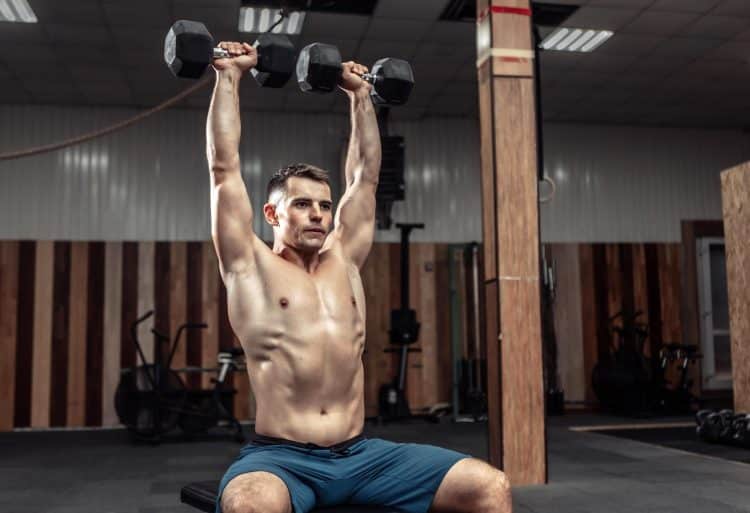
If I could only use one tool to train my shoulders, dumbbells would be it. Overhead presses with dumbbells are probably the best way to bulk up your deltoids, while lateral raises target your side delts for more width. As an added advantage, dumbbell exercises are generally more joint-friendly than the same movement done with a barbell.
| Exercise | Sets | Reps | Recovery | |
| 1 | Seated dumbbell shoulder press | 2-3 | 5-5-5 | 60 seconds |
| 2 | Dumbbell lateral raise | 2-3 | 5-5-5 | 60 seconds |
Workout 4: Legs
Friends don’t let friends skip leg day—or at least they shouldn’t. Leg training is hard, but the pay-off is huge. Well-developed legs will make you stand out in the crowd and earn kudos from your fellow lifters. And remember, as tough as leg workouts are, this one will be over in under 20 minutes!
| Exercise | Sets | Reps | Recovery | |
| 1 | Dumbbell Bulgarian split squat | 2-3 | 5-5-5 | 60 seconds |
| 2 | Dumbbell Romanian deadlift | 2-3 | 5-5-5 | 60 seconds |
Workout 5: Arms
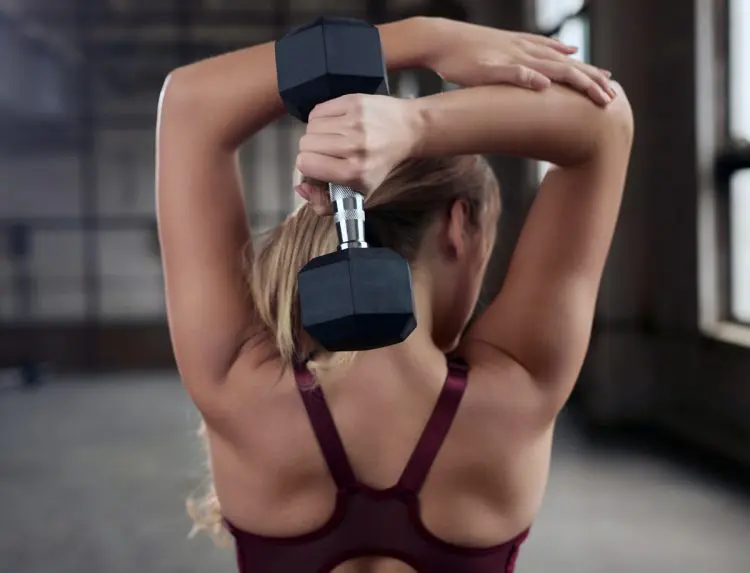
You’ve already trained your arms, albeit indirectly, during your chest, back, and shoulder workouts. That said, I’ve yet to meet a lifter who didn’t want bigger arms, so you’re sure to enjoy the gains you’ll get from this dedicated arm-training session. The 5-5-5 method also delivers a great pump, which most exercisers appreciate, too.
| Exercise | Sets | Reps | Recovery | |
| 1 | Incline dumbbell biceps curl | 2-3 | 5-5-5 | 60 seconds |
| 2 | Dumbbell overhead triceps extension | 2-3 | 5-5-5 | 60 seconds |
Frequently Asked Questions
Do you have a question about the 5-5-5 method or program? No problem, because I’ve got the answers!
Need more information?
Please drop me a line in the comments section below, and I’ll get back to you as soon as I can.
1 – How much weight should I use?
This is probably the hardest question to answer because I don’t know how big or strong you are. My advice is to pick a moderate weight and do your first 5-5-5 set and see how it feels. Ideally, the last five reps—the long-length partials—should feel really hard, and you should only just be able to complete them. Adjust the load for all subsequent sets.
2 – Can I change the exercises?
I’ve built this program around some of the best dumbbell exercises for each major body part. That said, please feel free to change exercises if you prefer to do different movements. However, make sure you stay true to the spirit of the program and use similar exercises. Also, consider the safety of your choices as you’ll be taking your sets very close to failure. Nothing ruins a workout quicker than dropping a dumbbell on your face!
3 – Is this a bulking or cutting program?
It’s not the program that determines if you bulk up or lose fat—it’s your diet. Provide your body with plenty of protein and kilocalories, and you’ll gain muscle but reduce your food intake, and you’ll burn fat. So, adjust your diet to your training goal to get the results you want.
Related: Bulking vs. Cutting: The Best Methods To Accelerate Gains!
4 – Is such a low training volume really effective?
Contrary to what you may have heard, even one hard set can build muscle (7). That said, 10 sets or so per week is usually considered optimal. But, if you are short on time, any training is better than no training, and this routine will produce results as intensity as well as volume are drivers of muscle growth.
5 – I’m not sore after these workouts—am I doing something wrong?
Post-exercise muscle soreness is not necessarily an indicator of a successful workout. Rather, it just means you’ve done something new. So, don’t worry if you don’t feel sore after training; provided you came close to failure and your diet supports your training, your muscles should respond and grow.
Closing Thoughts
There is nothing magic about the 8-12 rep range. While it’s popular with bodybuilders, there are plenty of other rep ranges that can be just as effective, even if they’re less widely used. For example, high-rep sets, as featured in the old-school 20-rep squat routine, are another proven scheme.
5-5-5 is one of the more unusual training methods around, but that’s what makes it so effective. Intense but brief, it’ll kick your butt in an entirely new way, stimulating fresh muscle growth in the process.
So, short on time? Only got dumbbells to train with? Take this 5-5-5 workout for a spin—the sooner you do, the sooner you’ll start building the muscles of your dreams!
References:
1 – Todd JS, Shurley JP, Todd TC. Thomas L. DeLorme and the science of progressive resistance exercise. J Strength Cond Res. 2012 Nov;26(11):2913-23. doi: 10.1519/JSC.0b013e31825adcb4. PMID: 22592167.
2 – Lasevicius T, Ugrinowitsch C, Schoenfeld BJ, Roschel H, Tavares LD, De Souza EO, Laurentino G, Tricoli V. Effects of different intensities of resistance training with equated volume load on muscle strength and hypertrophy. Eur J Sport Sci. 2018 Jul;18(6):772-780. doi: 10.1080/17461391.2018.1450898. Epub 2018 Mar 22. PMID: 29564973.
3 – Grgic J, Schoenfeld BJ, Orazem J, Sabol F. Effects of resistance training performed to repetition failure or non-failure on muscular strength and hypertrophy: A systematic review and meta-analysis. J Sport Health Sci. 2022 Mar;11(2):202-211. doi: 10.1016/j.jshs.2021.01.007. Epub 2021 Jan 23. PMID: 33497853; PMCID: PMC9068575.
4 – Schoenfeld BJ. The mechanisms of muscle hypertrophy and their application to resistance training. J Strength Cond Res. 2010 Oct;24(10):2857-72. doi: 10.1519/JSC.0b013e3181e840f3. PMID: 20847704.
5 – Kojic F, Mandic D, Duric S. The effects of eccentric phase tempo in squats on hypertrophy, strength, and contractile properties of the quadriceps femoris muscle. Front Physiol. 2025 Jan 9;15:1531926. doi: 10.3389/fphys.2024.1531926. PMID: 39850448; PMCID: PMC11754408.
6 – Kassiano W, Costa B, Kunevaliki G, Soares D, Zacarias G, Manske I, Takaki Y, Ruggiero MF, Stavinski N, Francsuel J, Tricoli I, Carneiro MAS, Cyrino ES. Greater Gastrocnemius Muscle Hypertrophy After Partial Range of Motion Training Performed at Long Muscle Lengths. J Strength Cond Res. 2023 Sep 1;37(9):1746-1753. doi: 10.1519/JSC.0000000000004460. Epub 2023 Apr 3. PMID: 37015016.
7 – Krieger JW. Single vs. multiple sets of resistance exercise for muscle hypertrophy: a meta-analysis. J Strength Cond Res. 2010 Apr;24(4):1150-9. doi: 10.1519/JSC.0b013e3181d4d436. PMID: 20300012.
 You can also follow us on Twitter, Facebook, Instagram, and
YouTube for even more content.
You can also follow us on Twitter, Facebook, Instagram, and
YouTube for even more content.Tip: If you're signed in to Google, tap Follow.






The first reference to the second 5 reps discusses slowing down the eccentric phase, but then the concentric phase is mentioned throughout the article?
Good spot – amended now. Thanks!