
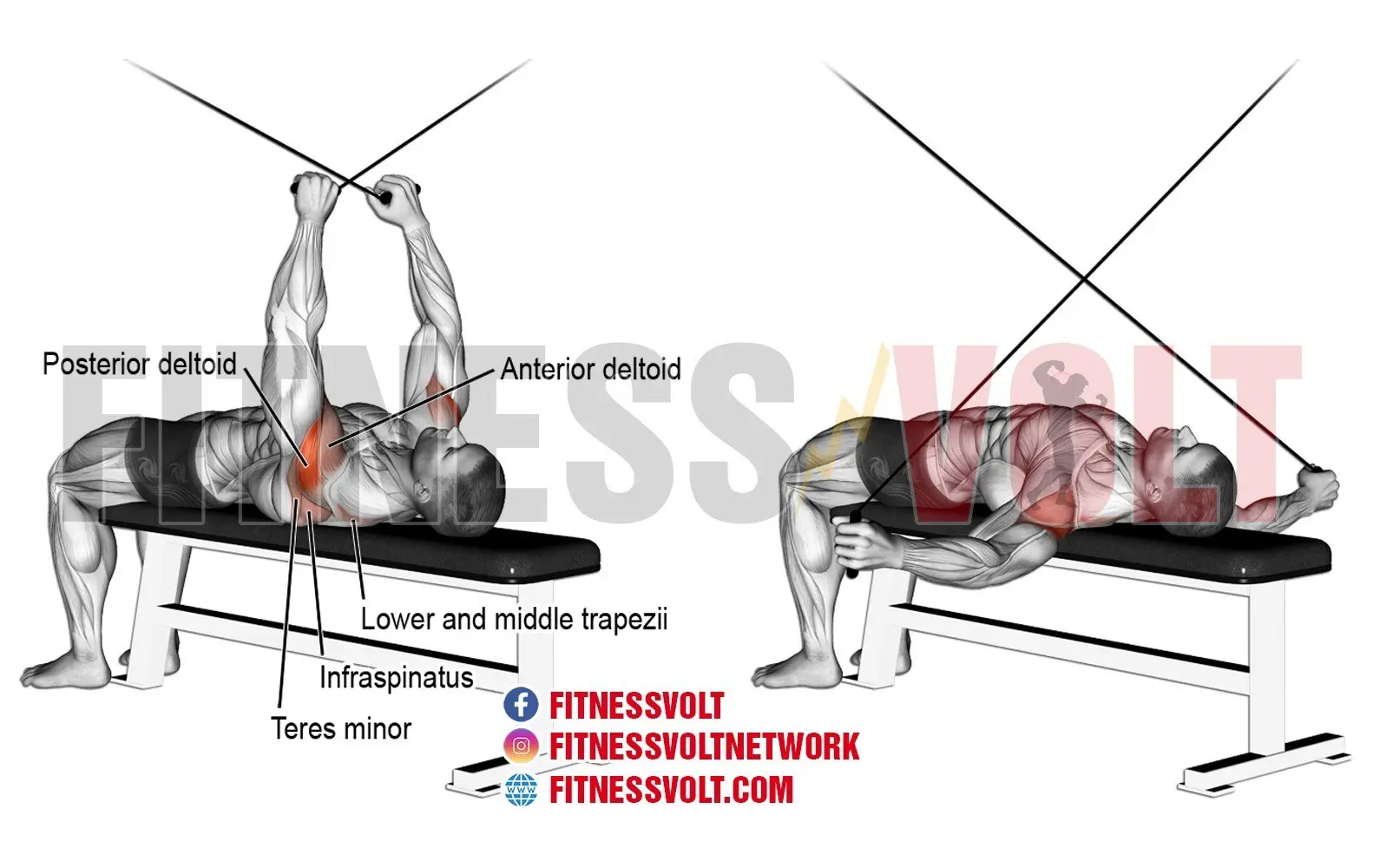
The supine cable reverse fly is a precision-engineered isolation exercise targeting the posterior deltoids and upper back muscles. This movement excels in activating the posterior muscle groups for optimal strength and development. Cable resistance provides continuous tension throughout the exercise, crucial for maximizing muscle fiber stimulation in the shoulders.
While accessible to beginners, this exercise benefits from expert guidance due to its unique setup and execution. Cables offer a more challenging stabilization requirement compared to fixed-path machines, allowing for a greater range of motion and enhanced muscle engagement.
Precise Execution Technique
- Set cable pulleys to their highest position on both sides of the machine.
- Grasp the left pulley with your right hand and the right pulley with your left hand, creating a cross pattern.
- Lie supine on the bench, aligning your shoulders with the cable pulleys.
- Initiate the movement by pulling both cables downward, extending your arms until your fists align with your head.
- Maintain control as you return your arms to the starting position, feeling the stretch in your posterior deltoids.
- Execute the prescribed number of repetitions, focusing on form and muscle engagement.
Optimization Strategies and Variations
- Experiment with a prone position on the bench using low cable pulleys for a different angle of attack.
- Maintain shoulder alignment with cable pulley bars to ensure smooth, symmetrical movement.
- Focus on the mind-muscle connection to maximize posterior deltoid activation.
- Adjust cable height and bench angle to target specific areas of the upper back and shoulders.
- Incorporate unilateral (single-arm) variations to address muscle imbalances.
Visual Guides: Mastering the Supine Cable Reverse Fly
Standard Supine Cable Reverse Fly Technique
Lying Cable Reverse Fly Variation
Frequently Asked Questions
How does the supine cable reverse fly differ from dumbbell reverse flyes?
The supine cable reverse fly offers constant tension throughout the movement, potentially leading to greater muscle activation. It also allows for a more customizable range of motion compared to dumbbell variations.
Can this exercise help improve posture?
Yes, by strengthening the posterior deltoids and upper back muscles, the supine cable reverse fly can contribute to improved posture and shoulder health, counteracting the effects of prolonged sitting and forward-rounded shoulders.
How often should I incorporate this exercise into my routine?
Include the supine cable reverse fly 1-2 times per week as part of your shoulder or pull workout. Allow 48-72 hours between sessions for adequate recovery and muscle growth.
Interested in measuring your progress? Check out our strength standards for Bench Press, Squat, Deadlift, and more exercises.