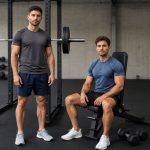
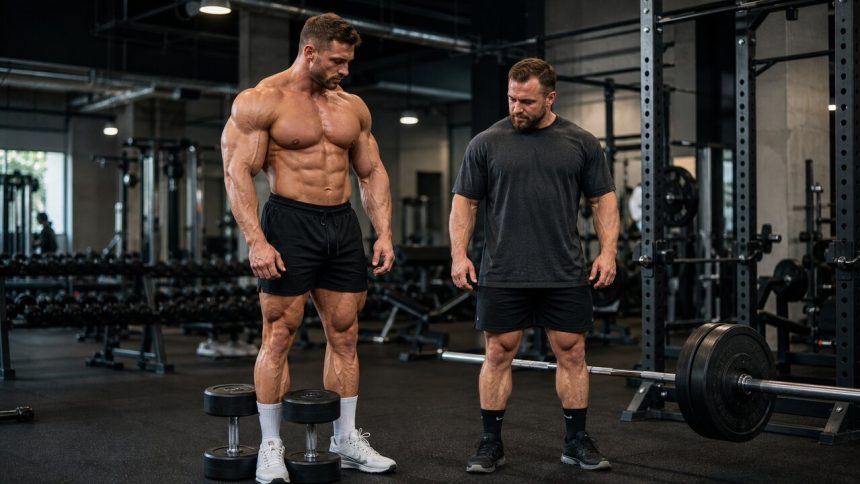
A bigger muscle usually has the potential to produce more force, but muscle size does not decide who lifts the most weight. Strength also depends on technique, practice, leverage, and how well your nervous system recruits the muscle you already have.
That is why a smaller powerlifter can outlift a larger bodybuilder on the squat, bench press, or deadlift. The bodybuilder may have more muscle. The powerlifter has spent more time practicing the exact skill of moving one heavy rep.
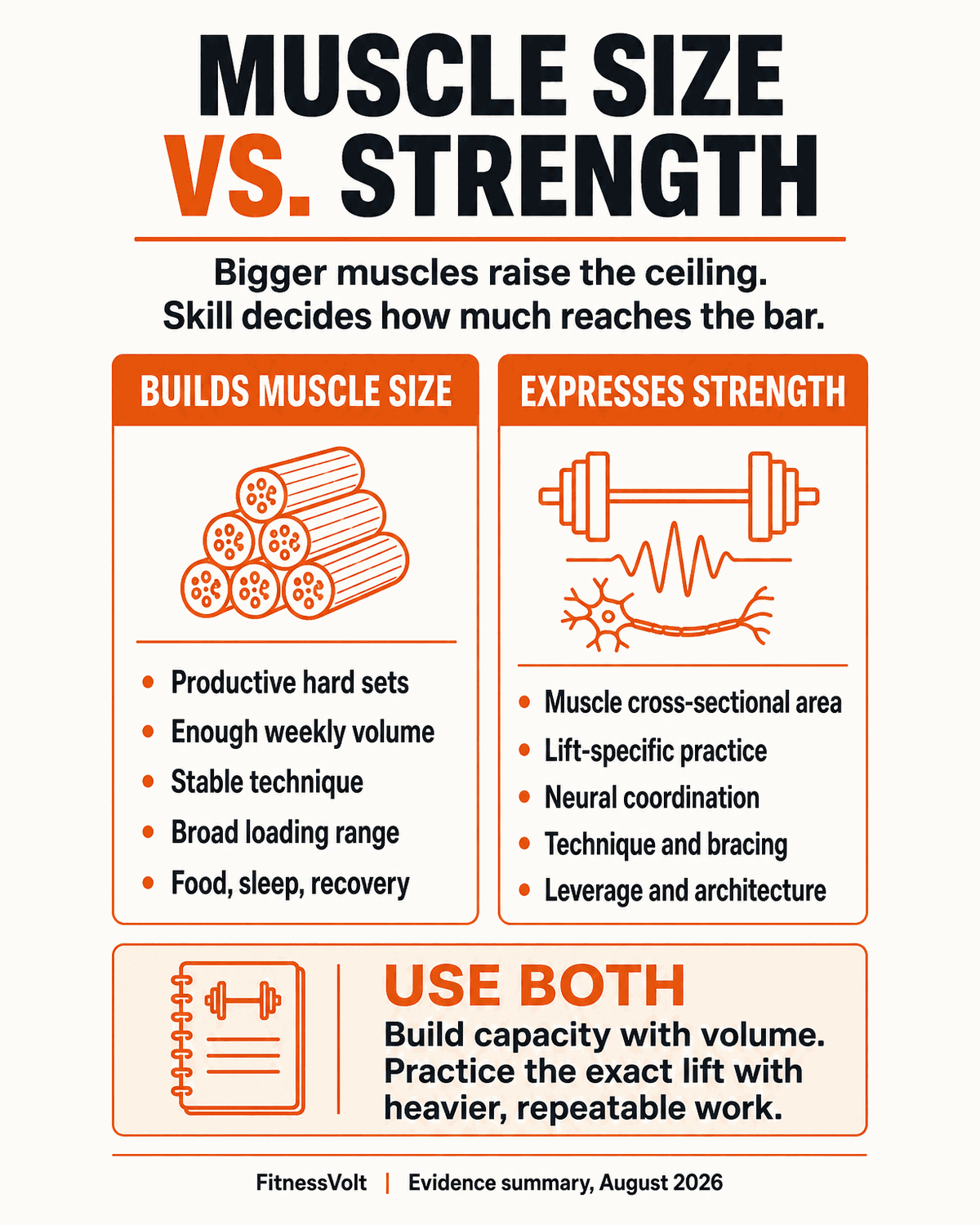
If your goal is size, you need enough hard weekly sets to make the muscle grow. If your goal is strength, you need to practice the lift with heavier weights. If you want both, train both qualities instead of expecting one style of training to do every job.
How muscle size and strength are connected
Muscle fibers produce force. Add more contractile tissue, and you raise the amount of force the muscle could produce. Research comparing trained and untrained men shows that muscle size explains a large part of the strength difference between them.5
More muscle raises your potential. Your bench press still depends on your setup, bar path, range of motion, arm length, and confidence under a heavy bar. The same rule applies to the squat and deadlift.
Researchers also measure muscle size in several ways. They may use muscle thickness, cross-sectional area, or total muscle volume. In a study of 52 recreationally active men, larger quadriceps tended to produce more force in an isometric knee-extension test. Muscle volume accounted for about 60% of the difference in strength scores, but it was not clearly better than the other size measures.6
Why a smaller lifter can be stronger
Strength is a skill
A heavy squat is not only a leg-strength test. You must create a stable setup, brace at the right time, keep the bar over your base of support, and push through the sticking point. Those skills improve with practice.
A lifter who squats every week gets better at showing leg strength in the squat. Someone with larger legs who rarely squats may lift less. A strong leg press does not guarantee a strong barbell squat because the exercises require different balance and technique.
This is why you should keep the lift you care about in your program for several weeks. FitnessVolt’s deadlift form guide shows how setup, bar distance, bracing, and lockout position can change the result even when muscle size stays the same.
Your nervous system learns to use the muscle
Beginners often gain strength before they see a large change in muscle size. Early progress comes partly from learning to recruit the available muscle and coordinate the movement.1,2
Think about the first month of learning a bench press. The bar stops wobbling, your feet stay planted, and every rep follows a more repeatable path. You did not build all of that strength from new muscle in four weeks. You became better at the task.
Leverage changes every lift
Limb length, joint shape, tendon attachment, and muscle shape change the mechanics of a lift. Two lifters with similar muscle size can therefore produce different numbers on the same exercise.
This does not make one person “naturally strong” in every movement. Long arms may help a deadlift and make a bench press harder. A short torso may change how a squat feels. Judge progress by comparing your own lifts under the same rules rather than comparing bodies from a photo.
Choose the training style that matches your goal
| Goal | Main work | Good starting point | Track this |
|---|---|---|---|
| Build muscle | Enough hard weekly sets through a comfortable range of motion | Most sets in the 6 to 15 rep range with 1 to 3 good reps left | Reps, load, body measurements, photos, and recovery |
| Get stronger | Frequent practice of the target lift with heavier loads | Most main-lift sets in the 1 to 6 rep range with long rests | Estimated 1RM, rep records, and technique at the same load |
| Build both | One heavier session and one moderate-rep session for the same movement pattern | Heavy main lift first, then stable exercises for extra volume | One strength measure and one size measure |
These are starting points, not laws. Hard sets can build muscle across a wide range of loads. Heavier training has an advantage when you want to improve a heavy one-rep max.7,9 FitnessVolt’s Rep Range Calculator can turn an estimated max into practical starting weights.
How to train when muscle size is the priority
Pick exercises that let you train the target muscle hard without losing your position. Use most of your work in the 6 to 15 rep range. The last few reps should feel challenging. Add reps before making large jumps in weight.
For larger quads, a simple session might include:
- Back squat: 3 sets of 6 to 8 reps
- Leg press: 3 sets of 10 to 12 reps
- Leg extension: 2 sets of 12 to 15 reps
Repeat a similar quad stimulus later in the week if you recover well. Add a rep when you can keep the same range and control. Add weight after you reach the top of the rep range. Do not add more sets just because one workout did not produce a big pump.
Training volume matters. In trained men, more weekly sets produced more muscle growth in an eight-week study, while strength gains were similar across the tested volumes.11 More work can help, but only when you can recover and repeat it.
How to train when strength is the priority
Put the target lift first, while you are fresh. Use sets of 1 to 6 reps with a weight that lets you repeat the same setup and bar path. Rest 2 to 5 minutes between hard sets. The goal is to practice heavy lifting, not to turn every session into a max test.
For a stronger bench press, a simple session might include:
- Bench press: 4 sets of 3 to 5 reps
- Paused bench or close-grip bench: 3 sets of 5 to 8 reps
- Row and triceps work: 3 sets of 8 to 12 reps each
The main lift builds skill under a heavy load. The assistance work builds the muscle that supports it. Use FitnessVolt’s One Rep Max Calculator to follow your estimated max from repeatable submaximal sets. Save true max attempts for planned test days.
How to train for size and strength together
You do not need separate bodybuilding and powerlifting lives. Use a heavy day and a volume day for the lift or muscle group you care about.
For example:
- Monday: bench press for 4 sets of 3 to 5, followed by moderate-rep back and triceps work.
- Thursday: dumbbell or incline press for 4 sets of 8 to 12, followed by chest and shoulder work.
This setup keeps the heavy skill in your week while giving the muscles enough volume to grow. Keep most accessory sets 1 to 3 reps from failure so they do not ruin the next heavy session. FitnessVolt’s guide to building a training program can help place those sessions into a full week.
Do low reps build strength while high reps build size?
That rule is too simple. Heavier weights are best for practicing maximal strength because a one-rep max is a heavy task. Moderate and lighter weights can still build muscle when sets are hard enough.7,8,10
The practical split is straightforward:
- Use heavier sets to practice producing force against heavy loads.
- Use moderate-rep sets to add muscle-building volume without repeatedly testing heavy loads.
- Keep both when you want both results.
Common muscle and strength myths
| Myth | Better answer | What to do |
|---|---|---|
| A bigger person must be stronger | More muscle raises potential, but skill and leverage affect the lift | Compare the same exercise, range, bodyweight class, and rules |
| A pump proves muscle growth | A pump is temporary and does not measure long-term progress | Track load, reps, measurements, and photos under similar conditions |
| High reps cannot build strength | They can build muscle and work capacity, but heavy practice transfers better to a heavy max | Use moderate reps for volume and heavier reps for the lift you want to test |
| A stalled 1RM means no muscle was gained | Fatigue, technique, and test practice can hide a size gain | Follow a strength measure and a size measure for several weeks |
How to measure progress
Use different scorecards for different goals.
For strength: track the same lift, setup, range of motion, and equipment. Record an estimated 1RM or a rep record at a fixed weight. FitnessVolt’s Strength Standards can place the number in a bodyweight and experience context.
For size: use body measurements, photos, and performance in a repeatable rep range. Take measurements at the same time of day and under similar hydration and food conditions. A one-day pump or bodyweight jump is not new muscle.
What matters most
More muscle gives you a higher strength ceiling, but it does not guarantee a bigger lift today. Technique, nervous-system skill, leverage, and practice decide how much of that potential you can use in a specific exercise.
Train for the result you want. Build muscle with enough hard volume. Build strength by practicing the target lift with heavier weights. Train both with one heavy exposure and one moderate-rep exposure each week. Then judge size and strength with separate measurements instead of expecting one number to explain both.
Sources
- Moritani, T., & deVries, H. A. (1979). Neural factors versus hypertrophy in the time course of muscle strength gain. American Journal of Physical Medicine, 58(3), 115-130. PMID: 453338.
- Carroll, T. J., Riek, S., & Carson, R. G. (2002). The sites of neural adaptation induced by resistance training in humans. The Journal of Physiology, 544(Pt 2), 641-652. PMID: 12381833.
- Maden-Wilkinson, T. M., et al. (2020). What makes long-term resistance-trained individuals so strong? Journal of Applied Physiology, 128(4), 1000-1011. PMID: 31873069.
- Balshaw, T. G., et al. (2021). The human muscle size and strength relationship. Medicine & Science in Sports & Exercise, 53(10), 2140-2151. PMID: 33935234.
- Schoenfeld, B. J., et al. (2017). Strength and hypertrophy adaptations between low- and high-load resistance training. Journal of Strength and Conditioning Research, 31(12), 3508-3523. PMID: 28834797.
- Morton, R. W., et al. (2016). Neither load nor systemic hormones determine resistance training-mediated hypertrophy or strength gains. Journal of Applied Physiology, 121(1), 129-138. PMID: 27174923.
- Lopez, P., et al. (2021). Resistance training load effects on muscle hypertrophy and strength gain. Medicine & Science in Sports & Exercise, 53(6), 1206-1216. PMID: 33433148.
- Carvalho, L., et al. (2022). Muscle hypertrophy and strength gains after training with different volume-matched loads. Applied Physiology, Nutrition, and Metabolism, 47(4), 357-368. PMID: 35015560.
- Schoenfeld, B. J., et al. (2019). Resistance training volume enhances muscle hypertrophy but not strength in trained men. Medicine & Science in Sports & Exercise, 51(1), 94-103. PMID: 30153194.