Berberine is not nature’s Ozempic, and lifters should not treat it like a non-prescription GLP-1 drug. The supplement has human research around glucose, lipids, waist circumference, and body weight, but it does not copy semaglutide’s drug pathway, approval standard, dose control, or medical oversight. The smarter question is whether it fits a monitored cut without hurting training, digestion, or safety.
The nickname is catchy, but it hides the part lifters care about: performance. A supplement that slightly helps appetite or metabolic markers is not a win if it causes GI issues, interacts with medication, or makes protein and training consistency worse.
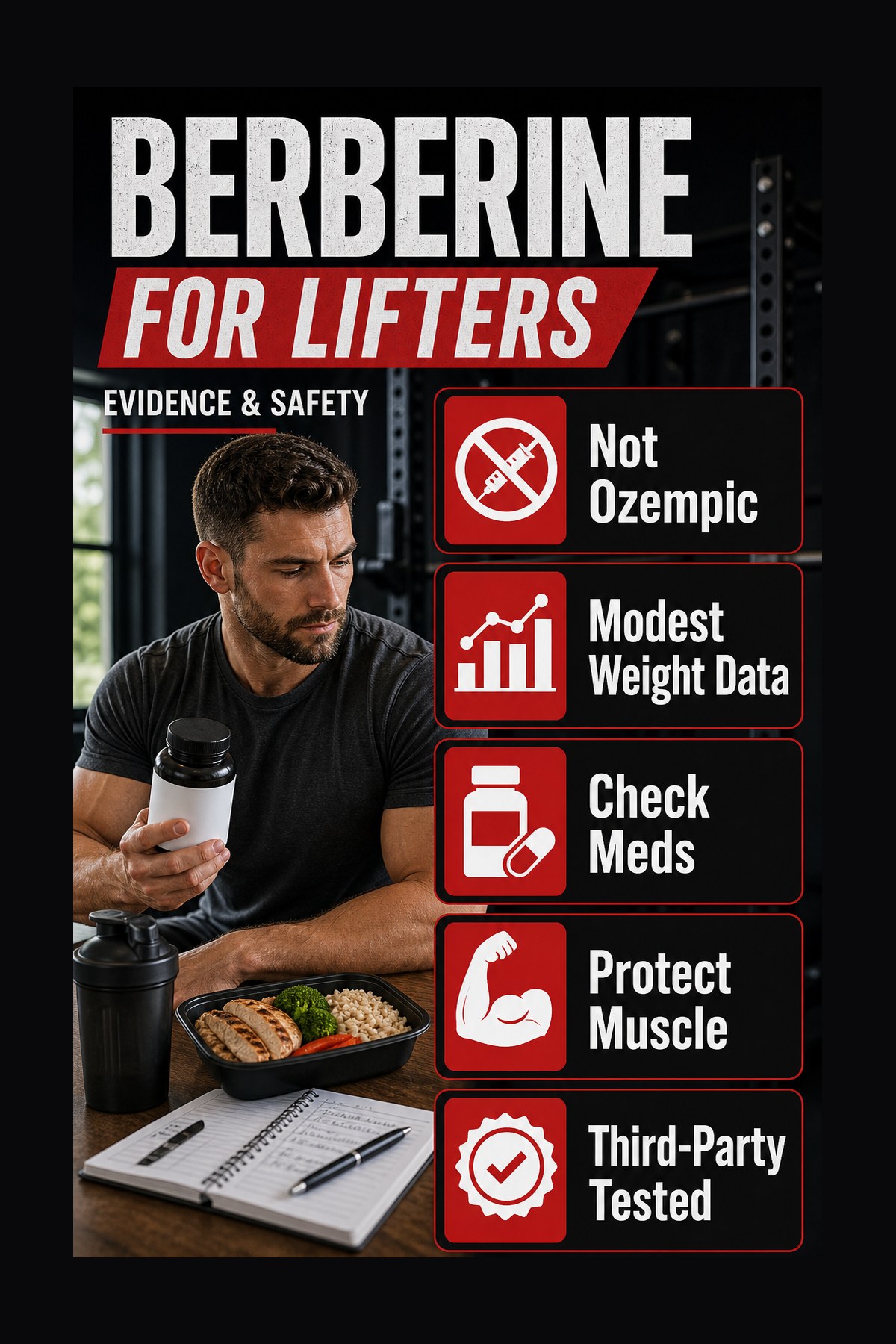
Berberine vs Ozempic: The Honest Comparison
Ozempic is a prescription semaglutide product approved for type 2 diabetes. Wegovy is semaglutide approved for chronic weight management in specific patients. Berberine is a dietary supplement. Those categories matter because drugs and supplements do not face the same premarket safety, efficacy, dosing, and manufacturing controls.
| Point | Berberine | Ozempic/Wegovy |
|---|---|---|
| Category | Dietary supplement | Prescription GLP-1 receptor agonist drug |
| Primary evidence | Smaller trials and meta-analyses on metabolic markers | Large clinical drug trials and FDA labeling |
| Mechanism | Multiple proposed pathways, including AMPK-related effects | GLP-1 receptor agonism, appetite and glucose regulation |
| Weight effect | Modest average changes in studies | Drug-level weight-loss evidence for indicated patients |
| Oversight | No FDA approval for safety/effectiveness before marketing | Prescription-only, labeled warnings and dosing |
That does not make berberine useless. It means the comparison should be scaled correctly. FV already has a broader guide to berberine for weight loss and a separate berberine supplements roundup. This piece is the lifter filter.
What The Evidence Shows
Meta-analyses have reported reductions in body weight, BMI, waist circumference, glucose, lipids, and CRP in some populations using berberine. The important limitation is that those findings do not make berberine equivalent to semaglutide, and they do not prove a predictable body-composition result for trained lifters.
A 2020 systematic review and meta-analysis reported significant reductions in body weight, BMI, waist circumference, and CRP with berberine intake. More recent reviews continue to describe metabolic effects, but the clinical picture remains more complicated than a viral nickname.
The Muscle-Retention Problem
Lifters should judge any weight-loss tool by what happens to lean mass, strength, and recovery. If appetite drops and protein drops with it, scale weight can move while gym performance worsens. That is not a berberine-only issue. It is a dieting issue.
The ISSN protein position stand gives lifters a practical anchor: most exercising people can use 1.4 to 2.0 grams of protein per kilogram per day, with 20 to 40 grams per serving as a common target. If berberine makes you less hungry, that target needs more planning, not less.
A Two-Week Test That Is Actually Trackable
Do not add berberine while changing everything else. Keep protein, calories, training, steps, and sleep as stable as possible for two weeks. Track whether anything improves enough to justify continued use.
| Metric | Baseline | After Adding Berberine |
|---|---|---|
| 7-day average body weight | Record before starting | Look for trend, not daily noise |
| Waist measurement | Measure at the same time weekly | Use with scale trend, not alone |
| Protein intake | Hit the same daily floor | Do not let appetite suppression cut protein |
| Top working sets | Track load and reps | Watch for performance drop-offs |
| Digestion and sleep | Note normal baseline | Stop if GI stress or sleep disruption appears |
Who Should Skip It
Skip berberine unless your clinician clears it if you use glucose-lowering medication, blood thinners, blood-pressure medication, antibiotics, immunosuppressants, or prescription weight-loss drugs. Pregnant or breastfeeding readers should avoid it unless a qualified clinician specifically advises otherwise.
This is not fearmongering. It is the difference between supplement content and responsible supplement content. FDA consumer guidance states that dietary supplements can involve health risks and that FDA is not authorized to approve supplements for safety and effectiveness before they are marketed.
Label Rules Before Buying
Look for transparent dose, third-party testing where available, a real manufacturer, and no disease-treatment claims. Avoid proprietary blends that hide the amount of berberine. Avoid products that imply prescription-drug outcomes without prescription-drug oversight.
- Transparent amount: The label should state the berberine dose per serving.
- No miracle claims: Disease-treatment language is a red flag.
- Third-party testing: Prefer brands that document quality checks.
- Simple stack: Avoid stimulant-heavy blends if you cannot tell what is doing what.
- Medication review: Ask a clinician or pharmacist if you take prescriptions.
How Lifters Should Think About It
Berberine belongs near the bottom of the fat-loss hierarchy. Protein, calories, fiber, steps, sleep, and training quality come first. If those are inconsistent, a supplement will mostly add noise.
For many readers, a better first move is improving meal structure with protein and fiber. FV’s fiber supplement guide for athletes can help if high-protein dieting is causing digestion issues or low fiber intake.
Dose Ranges Are Not a Prescription
Berberine studies often use divided daily doses, commonly in the range of hundreds of milligrams per serving. That does not mean every reader should copy a study protocol. Supplements differ in quality, medical histories differ, and medication interactions can matter. Use study dosing as context, not as a personal prescription.
If a label tries to sell much higher dosing through urgency or dramatic before-and-after claims, that is a red flag. Stronger is not automatically smarter, especially with a compound that can affect digestion and metabolic markers.
What To Check Before and After
If a clinician clears you to try berberine, use objective markers where possible. Body weight alone is not enough for lifters because water, glycogen, and food volume can mask what is happening to fat and lean mass.
| Check | Why It Matters | Action If It Worsens |
|---|---|---|
| Training log | Shows strength and recovery trend | Stop adding variables and reassess calories |
| Waist plus weight trend | Separates noise from direction | Do not chase daily scale swings |
| Protein intake | Protects lean-mass goals | Plan meals before supplements |
| GI tolerance | Common practical limiter | Stop if symptoms are persistent or severe |
| Medication list | Interaction risk can change the decision | Ask a clinician or pharmacist |
Better First Moves for Most Lifters
Most lifters should fix the boring levers first. A protein target, fiber target, step baseline, sleep window, and consistent training block will usually tell you more than adding a supplement to a messy routine. If those fundamentals are already dialed in, berberine becomes easier to evaluate honestly.
The practical order is simple: build the diet, run the training, track the outcome, then decide whether a supplement is still worth testing. Reversing that order makes the supplement look more important than it is.
FAQ
Is berberine actually like Ozempic?
No. Berberine is a supplement with metabolic research. Ozempic is a prescription semaglutide drug for type 2 diabetes, and Wegovy is semaglutide for chronic weight management in indicated patients. The nickname is marketing shorthand, not a scientific equivalence.
Can berberine help with weight loss?
Some meta-analyses report modest improvements in body weight, BMI, and waist circumference. That does not guarantee a meaningful result for every lifter, and it does not replace a calorie target, protein intake, or training plan.
Should lifters take berberine while bulking?
Usually no, unless there is a clinician-guided reason. If appetite or digestion changes, it may make a calorie surplus harder. Most lifters should focus on food quality, training, and bloodwork rather than adding berberine during a bulk.
Can I take berberine with Ozempic or Wegovy?
Do not combine them without medical guidance. Both can affect glucose and digestion, and prescription GLP-1 drugs already require clinician oversight. A pharmacist or physician should check the full medication and supplement list.
What should I monitor if I try it?
Track body weight trend, waist, protein intake, training performance, digestion, sleep, and any medication-related symptoms. Stop and seek medical guidance if you experience concerning side effects.
The Red-Flag Stop List
Stop and get medical guidance if berberine use overlaps with dizziness, unusual weakness, persistent GI distress, symptoms of low blood sugar, medication changes, or a sudden drop in training performance. Those signals matter more than whether the scale moved one pound.
For lifters, the red flag is not only a side effect. It is also a behavior change. If the supplement makes you skip meals, undershoot protein, avoid carbs before hard sessions, or ignore prescribed medication guidance, the supplement has become a liability.
Bottom Line
Berberine is not nature’s Ozempic. It may have a place for some people, but lifters should treat it as a cautious, trackable supplement decision, not a shortcut. If strength, protein, digestion, or safety gets worse, the supplement is failing the lifter test.
Sources
- Asbaghi O, et al. Effects of berberine supplementation on obesity indices, liver enzymes and inflammatory markers: a systematic review and meta-analysis. Clinical Nutrition ESPEN. 2020.
- U.S. Food and Drug Administration. Information for Consumers on Using Dietary Supplements. Updated October 21, 2022.
- U.S. Food and Drug Administration. Ozempic prescribing information. 2025.
- U.S. Food and Drug Administration. Wegovy prescribing information. 2025.
- Jager R, et al. International Society of Sports Nutrition Position Stand: protein and exercise. Journal of the International Society of Sports Nutrition. 2017.