
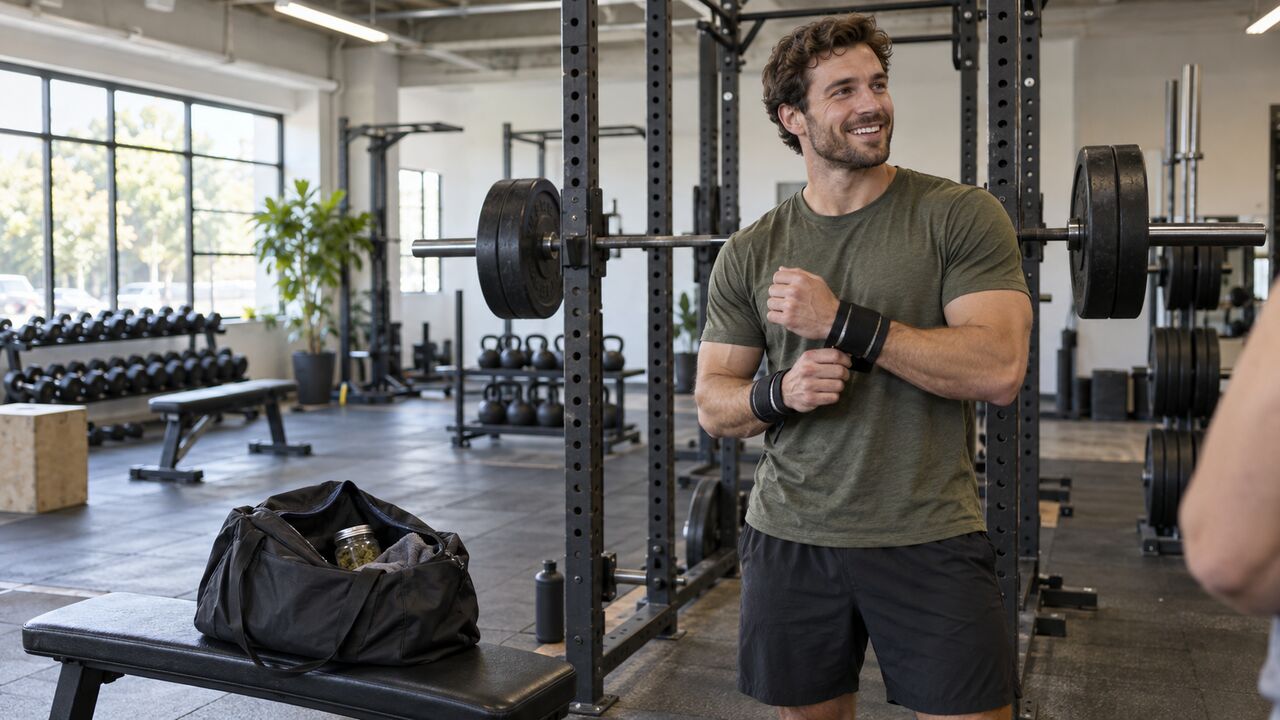
A workout can feel more enjoyable after cannabis and still be a worse workout. That distinction matters. THC can change mood, pain perception, coordination, heart rate, and the sense of effort. CBD does not cause the same high, but claims that it speeds recovery run well ahead of the research.
For most lifters and runners, cannabis is not a performance aid. Using THC before training can make a hard effort feel less predictable and can raise the cost of mistakes during heavy, fast, or technical exercise. A 2024 crossover study found that regular cannabis users enjoyed aerobic exercise more after cannabis, yet they also reported greater exertion.[4]
This guide separates THC from CBD, acute use from regular use, and subjective enjoyment from measurable performance. FitnessVolt evaluated systematic reviews, controlled trials, cardiovascular guidance, and current World Anti-Doping Agency rules. The evidence supports a cautious conclusion: cannabis may change how exercise feels, but it has not earned a place in a performance or recovery plan.
Does Cannabis Improve Exercise Performance?
No reliable evidence shows that cannabis improves strength, endurance, power, or recovery. The clearest risk appears when THC is used shortly before exercise. A systematic and umbrella review found acute use was associated with a reduced ability to maintain effort, lower maximal work capacity, faster heart and breathing rates, greater myocardial oxygen demand, and more postural sway.[1]
That does not mean every person will perform worse every time. Products differ, doses differ, and regular users may respond differently from occasional users. It means the expected benefit is unproven while several performance and safety costs are plausible.
| Question | THC-dominant cannabis | CBD |
|---|---|---|
| Can it improve performance? | No convincing evidence; acute use can impair sustained or maximal effort | No convincing evidence of a meaningful performance boost |
| Can it change the workout experience? | Yes; some regular users report more enjoyment, but also more exertion | Possibly, but controlled evidence remains limited |
| Can it speed recovery? | Recovery claims rely mostly on perception and survey data | Small trials have not shown a consistent recovery advantage |
| Main training concern | Coordination, judgment, heart rate, reaction time, and masked discomfort | Uncertain benefit, product contamination, and medication interactions |
| Competition status | Prohibited in competition under WADA rules | Not prohibited by WADA, but contaminated products can trigger a positive test |
Why THC Can Make Training Less Predictable
THC acts on cannabinoid receptors in the brain and throughout the body. The effects can include altered attention, timing, balance, short-term memory, anxiety, pain perception, and cardiovascular response. Those changes matter more in a squat rack or on a busy road than they do on a couch.
A 2017 systematic review found little evidence that cannabis helps exercise performance and raised concerns about cardiovascular and neurological effects.[2] A later review reached a similar conclusion: whole cannabis and THC studies generally show neutral or harmful effects, while athlete-specific trials remain too limited for a precise dose-response rule.[3]
Exercise already raises heart rate and cardiac workload. Cannabis can add another cardiovascular stimulus. The American Heart Association advises clinicians and patients to consider the cardiovascular effects of cannabis, particularly in people with cardiovascular disease or risk factors.[8] If cannabis has caused palpitations, dizziness, chest discomfort, panic, or fainting, combining it with hard exercise is a poor experiment.
If you track training by effort, use FitnessVolt’s RPE calculator and chart while sober first. Cannabis changes perception, so an effort rating collected while high may not be comparable with your normal sessions.
Feeling Better Is Not the Same as Performing Better
The strongest argument users make is often experiential: music sounds better, a run feels less boring, and movement feels more absorbing. Researchers have started testing that experience instead of dismissing it.
In the 2024 crossover study, 42 regular cannabis users completed aerobic exercise after using a THC-dominant or CBD-dominant flower product and also completed a non-cannabis session. They reported more positive mood, enjoyment, and runner’s-high symptoms after cannabis. They also reported greater exertion. Pain was low and did not differ between sessions.[4]
The study did not prove that cannabis made participants faster, stronger, or safer. It enrolled regular users aged 21 to 39 and used commercial products in an ad libitum protocol, so the findings do not transfer cleanly to occasional users, older adults, heavy lifting, road cycling, swimming, or competition.
If enjoyment is the problem, change the training environment before adding an intoxicant. A better route, a training partner, shorter intervals, or a program that matches your ability can solve boredom without altering coordination. Our training program guide shows how to adjust volume, intensity, and progression without turning every workout into a test.
What About Regular Cannabis Use?
Acute and chronic use answer different questions. Acute studies ask what happens soon after a dose. Chronic studies compare regular users with non-users over time. A 2020 systematic review found only four eligible chronic-use studies and no consistent difference in VO2 max or physical work capacity.[5]
That result does not prove regular use is harmless. The review found too little research to judge recovery, endurance, training adaptation, or long-term athlete outcomes. People who tolerate cannabis well enough to remain active may also differ from people who stopped using it. Observational comparisons cannot remove that selection problem.
The practical reading is narrow: current studies do not show a reliable chronic performance benefit or penalty in healthy adults, but the evidence base is small. It does not cancel the short-term impairment that can follow a THC dose before training.
Does CBD Help Soreness or Recovery?
CBD marketing leans on anti-inflammatory language, yet exercise recovery depends on more than one blood marker. The useful outcomes are soreness, strength restoration, sleep, fatigue, and readiness for the next session.
In a randomized crossover trial, 24 trained women completed 100 eccentric leg extensions and received CBD at 5 mg per kilogram or placebo before and after the session. CBD did not reduce inflammation, muscle damage, subjective fatigue, or the loss of performance measured over 48 hours.[6] A 2024 systematic review found the overall evidence limited and inconsistent, with small samples and varied dosing.[7]

CBD might help an individual relax or sleep, but that personal response is not proof of faster tissue recovery. Start with the basics you can measure: enough calories and protein, regular sleep, sensible weekly volume, hydration, and an active recovery session that does not add more fatigue.
The Safety Problem Changes With the Workout
An easy stationary-bike ride in a private room carries a different risk from a heavy clean, an outdoor run near traffic, or open-water swimming. The more a session depends on balance, reaction time, route judgment, spotting, or precise technique, the less room you have for impairment.
| Training situation | Why THC raises concern | Safer decision |
|---|---|---|
| Heavy barbell lifts | A missed cue or slow reaction can trap or injure the lifter | Train sober and use proper safeties or a competent spotter |
| Olympic lifts, gymnastics, climbing | Timing, balance, and coordination decide whether the rep is safe | Do technical work sober |
| Road running or cycling | Traffic, terrain, and other people demand quick decisions | Do not combine intoxication with public-road exercise |
| Swimming | Impaired judgment can turn a small problem into a drowning risk | Avoid cannabis before swimming |
| Rehab or return from injury | Reduced pain may hide a useful warning signal | Follow the rehab plan and track symptoms sober |
Do not drive to or from training after using an intoxicating product. Do not mix cannabis with alcohol or sedating drugs before exercise. People who are pregnant, under the legal age, prone to panic or psychosis, or living with cardiovascular disease need individualized medical guidance rather than a gym experiment.
Competition Rules: CBD Is the Exception, Not a Free Pass
The World Anti-Doping Agency lists natural and synthetic cannabinoids as prohibited in competition. THC is included. Cannabidiol is the stated exception.[9] The list is updated at least annually, so athletes must check the current rule rather than relying on an old screenshot.
WADA also warns that CBD oils and tinctures can contain THC or other cannabinoids that may produce a positive test. A label saying “CBD” does not transfer the risk away from the athlete. Product testing lowers uncertainty, but it cannot create a guarantee.

Tested athletes should ask their federation or anti-doping organization about the in-competition period, local rules, medical-use procedures, and product risk. Legal access in your state or country does not change a sport’s anti-doping code.
A Practical Decision Checklist
- Separate THC from CBD. They do not have the same intoxicating effects or competition status.
- Separate enjoyment from output. A workout can feel better while pace, power, judgment, or consistency gets worse.
- Match the risk to the session. Avoid THC before heavy, technical, outdoor, aquatic, or contact training.
- Do not use pain relief to override an injury signal. Stop when technique changes or pain becomes sharp, unstable, or progressive.
- Protect the drive home. Plan transportation before using an intoxicating product.
- Check the current rules. Tested athletes carry responsibility for prohibited substances found in a sample.
Bottom Line
Cannabis has not been shown to improve athletic performance. THC before exercise can raise heart rate, alter perceived effort, and impair skills that keep lifting, running, cycling, and swimming safe. Some regular users report more enjoyment, but the same research also found greater exertion.
CBD is less impairing, yet the recovery case remains weak. Treat it as an uncertain wellness product, not a substitute for sleep, nutrition, training control, or medical care. Competitive athletes face an extra problem: CBD products can carry prohibited cannabinoids even though CBD itself is permitted under WADA rules.
Sources
- Charron, J., Carey, V., Marcotte L’Heureux, V., Roy, P., Comtois, A. S., and Ferland, P. M. (2021). Acute effects of cannabis consumption on exercise performance: a systematic and umbrella review. The Journal of Sports Medicine and Physical Fitness, 61(4), 551-561. DOI: 10.23736/S0022-4707.20.11003-X.
- Kennedy, M. C. (2017). Cannabis: exercise performance and sport. A systematic review. Journal of Science and Medicine in Sport, 20(9), 825-829. PMID: 28392338.
- Burr, J. F., Cheung, C. P., Kasper, A. M., Gillham, S. H., and Close, G. L. (2021). Cannabis and athletic performance. Sports Medicine, 51(Suppl 1), 75-87. DOI: 10.1007/s40279-021-01505-x.
- Gibson, L. P., Giordano, G. R., Bidwell, L. C., Hutchison, K. E., and Bryan, A. D. (2024). Acute effects of ad libitum use of commercially available cannabis products on the subjective experience of aerobic exercise. Sports Medicine, 54(4), 1051-1066. DOI: 10.1007/s40279-023-01980-4.
- Kramer, A., Sinclair, J., Sharpe, L., and Sarris, J. (2020). Chronic cannabis consumption and physical exercise performance in healthy adults: a systematic review. Journal of Cannabis Research, 2(1), 34. DOI: 10.1186/s42238-020-00037-x.
- Crossland, B. W., et al. (2022). Acute supplementation with cannabidiol does not attenuate inflammation or improve measures of performance following strenuous exercise. Healthcare, 10(6), 1133. DOI: 10.3390/healthcare10061133.
- Bezuglov, E., et al. (2024). The effect of cannabidiol on performance and post-load recovery among healthy and physically active individuals: a systematic review. Nutrients, 16(17), 2840. DOI: 10.3390/nu16172840.
- Page, R. L. II, et al. (2020). Medical marijuana, recreational cannabis, and cardiovascular health: a scientific statement from the American Heart Association. Circulation, 142(10), e131-e152. PMID: 32752884.
- World Anti-Doping Agency. (2026). The Prohibited List: S8 Cannabinoids. Accessed September 16, 2026.