
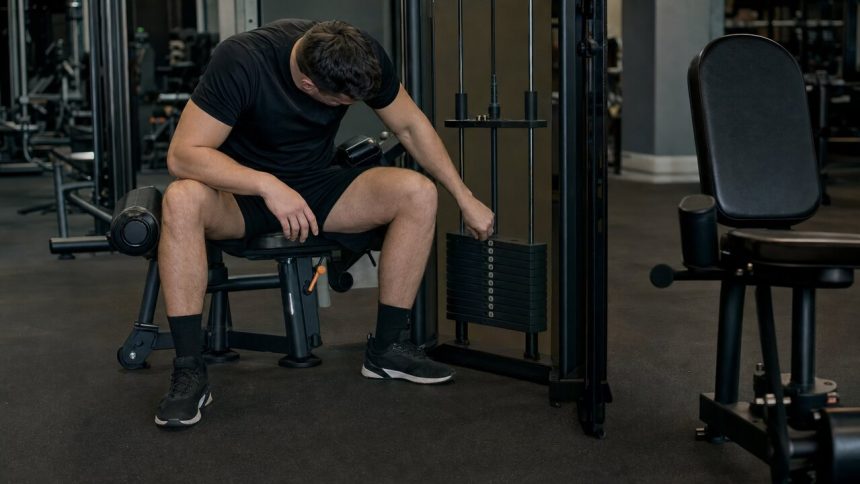
Drop sets feel productive because they turn one hard set into a long fight with the same muscle. That does not make them magic. The current research says they can build muscle about as well as traditional sets, while often taking less time. The tradeoff is higher local fatigue and a bigger recovery bill. Use them to finish a safe exercise, not to turn every lift into a survival test.
A drop set starts with a hard set, then reduces the resistance with almost no rest so you can continue the same movement. For most lifters, the useful version is one or two drops on the final set of a stable machine or isolation exercise. Keep your regular straight sets for the lifts where you want to add reps or load week to week.
Evidence checked July 2026: this guide draws on the 2023 and 2026 systematic reviews, the Fink and Angleri intervention studies, and FitnessVolt’s related specialist pages. If changing the load is inconvenient, read our guide to mechanical drop sets that change leverage instead. This guide owns the broad method and programming question. It does not repeat the author-specific experiment in the six-week drop-set experience report.
What the Evidence Supports
- Muscle growth: Drop sets can grow muscle, but pooled research has not shown a reliable hypertrophy advantage over straight sets when programs are compared.
- Time efficiency: They pack more hard repetitions into one exercise slot because there is little rest between phases.
- Fatigue: The same density that saves time can raise perceived effort and make later work worse.
- Best fit: Stable, easy-to-adjust exercises such as leg extensions, hamstring curls, cable curls, lateral raises, and machine presses.
What Is a Drop Set?
You perform a challenging set, reduce the load with almost no rest, and continue the same movement. The lighter load lets the target muscle keep working after the original load has become limiting. You do not need to hit momentary failure to use the method. End a phase when the next repetition would require a clear loss of control or range of motion.
For example, a cable curl can begin with a challenging set, followed by a small reduction and a second controlled phase. A double drop adds one more reduction. That is enough complexity for most programming. A five-stage run down the rack can be fun, but it can also turn one accessory exercise into the part of the session that wrecks everything after it.
Do Drop Sets Build More Muscle Than Straight Sets?
They can build muscle. The more useful answer is that they are a different way to organize hard work, not a superior law of hypertrophy.
Angleri and colleagues found similar increases in quadriceps cross-sectional area after 12 weeks of traditional, crescent-pyramid, and drop-set training in well-trained men when volume was equalized. The 2023 systematic review by Sodal, Kristiansen, Larsen, and van den Tillaar reached the same broad conclusion: both methods increased muscle size, with no significant difference between them.
The 2026 Havers review combined 12 studies with 274 participants. Compared with traditional sets, drop sets produced higher perceived exertion and blood lactate during the session, but the pooled long-term outcomes did not differ significantly for hypertrophy, strength, or muscular endurance. That gives you a practical reason to use the method when time matters, not a reason to expect it to outgrow straight sets.
That is good news if your schedule is tight. You do not need a special intensity technique to grow. You can use one when it helps you train a muscle hard without adding another long rest interval. If you have time, recover well, and can progress your straight sets, conventional work remains a strong default.
| Question | What the evidence says | What to do |
|---|---|---|
| Can drop sets build muscle? | Yes. Fink and Angleri reported growth after drop-set programs, and both 2023 and 2026 reviews found no clear disadvantage. | Use them as a valid hypertrophy tool. |
| Are they reliably better than straight sets? | No clear pooled advantage when compared with traditional training. | Do not replace all straight sets expecting faster gains. |
| Can they save time? | Usually, because the phases have minimal rest. | Use them on one late-session accessory exercise. |
| What feels different? | Havers et al. found higher perceived exertion and blood lactate during drop-set sessions. | Reduce other hard work if recovery or performance slips. |
| 2026 Havers review, 12 studies, n=274 | Standardized mean difference versus traditional sets | Plain-English reading |
|---|---|---|
| Perceived exertion | 1.62 (95% CI 0.33 to 2.91) | Higher during drop-set sessions. |
| Blood lactate | 0.67 (95% CI 0.20 to 1.14) | Higher during drop-set sessions. |
| Heart rate | 0.45 (95% CI -0.12 to 1.02) | No significant pooled difference. |
| Hypertrophy | 0.04 (95% CI -0.29 to 0.36) | No significant pooled difference. |
| Strength | -0.04 (95% CI -0.34 to 0.26) | No significant pooled difference. |
| Muscular endurance | 0.53 (95% CI -0.20 to 1.26) | No significant pooled difference. |
The Five Drop-Set Methods Worth Knowing
| Method | How it works | Best use | Main tradeoff |
|---|---|---|---|
| Traditional | Reduce the same load once, then continue. | Cable and machine isolation work. | You need the next load ready. |
| Double drop | Make two successive load reductions. | A single end-of-session finisher. | Fatigue rises quickly. |
| Mechanical | Keep the load but switch to a mechanically easier variation. | When equipment changes are impossible. | Exercise selection matters. Use the dedicated mechanical guide for sequences. |
| Machine | Move the selector pin down one or two plates. | Leg extensions, curls, chest press, rows, lateral raise machines. | Easy setup can tempt you to overuse it. |
| Load reduction or run-the-rack | Use the next lighter dumbbells or plates, then continue. | Curls, lateral raises, triceps extensions. | Transitions can be slow in a busy gym and form can drift. |
How to Set Up a Productive Drop Set
- Choose a stable movement. Start with a machine, cable, or dumbbell isolation exercise. A leg extension or cable pressdown is easier to control than a barbell back squat.
- Place it late in the workout. Finish your normal productive work first. You want your best coordination and effort available for the movements that matter most.
- Start with a controllable working load. Pick a resistance that lets you use the intended range of motion. Do not chase a dramatic four-rep opener.
- Reduce the load once. On a selectorized machine, one or two plates may be enough. Move quickly, but do not rush a bad setup.
- Stop before form changes. End the phase when you cannot complete another repetition through the planned range with the same control. Swinging a curl or shortening a leg-extension rep does not buy useful volume.
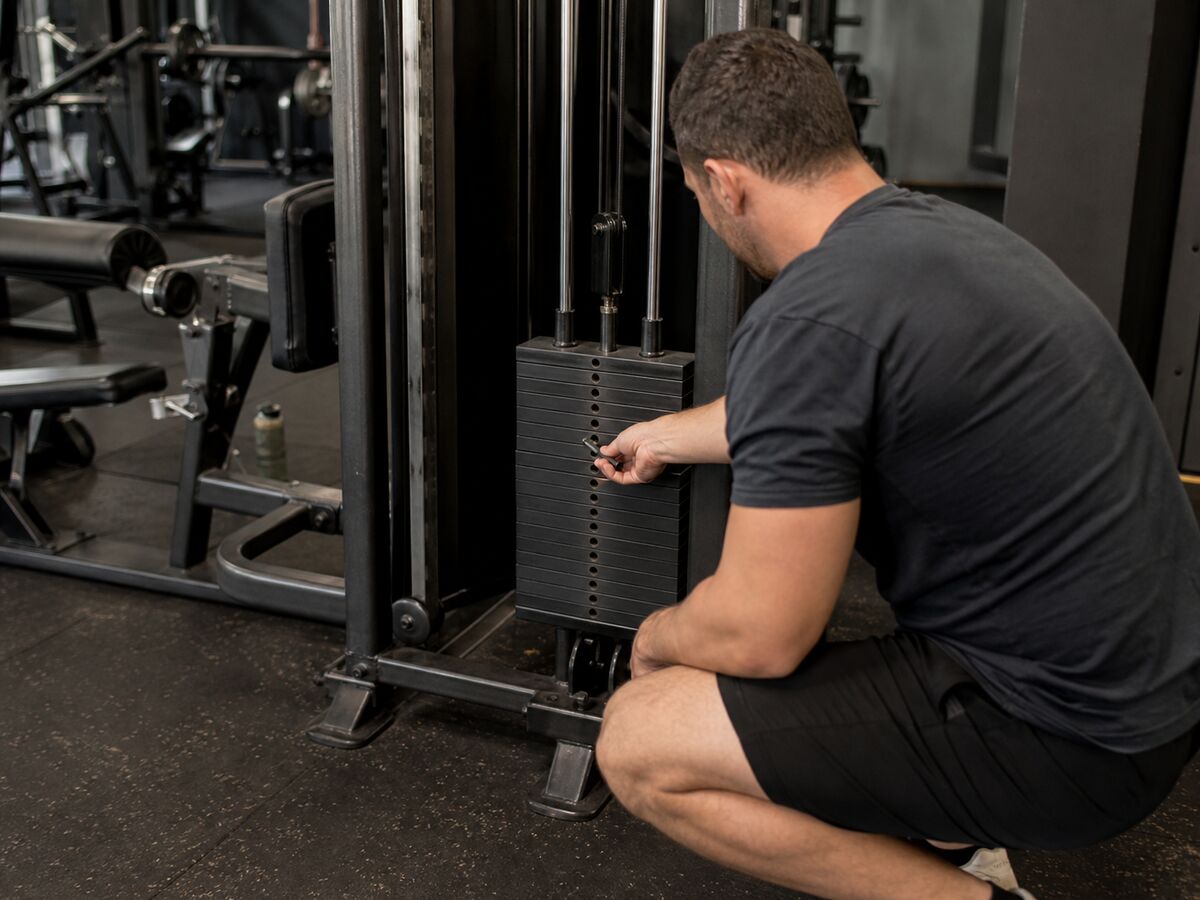
Use a two-drop version only after you can recover from a single drop. The aim is enough quality work that you can come back and progress next week.
Who Should Use Drop Sets, and Who Should Skip Them?
| Best For | Skip If |
|---|---|
| A busy intermediate lifter who already has a stable program and needs a compact way to add hard accessory work. | You are new to lifting and still learning to judge effort, technique, and simple progression. |
| A lifter using selectorized machines who can lower the weight in seconds. | You are using an unstable or technical compound lift where fatigue changes your position, bracing, or safety. |
| Someone prioritizing one muscle group for a short block and recovering well between sessions. | Your sleep, appetite, joints, or performance are already slipping, or you are returning from pain or injury without professional guidance. |
Skip barbell squats, conventional deadlifts, Olympic lifts, and hard free-weight presses for most drop-set work. The load reduction does not erase the coordination and bracing demands. If you want more work on those patterns, add a back-off straight set, use a machine variation, or save the drop set for a safer accessory.
Programming Limits That Keep Drop Sets Useful
Count a multi-drop effort as one extended set when you plan your session. That is not a claim that every phase has the same training value. It is a practical way to avoid pretending that one brutal sequence is three clean, repeatable work sets.
Coaching guardrails, not research prescriptions:
- Start with one drop-set exercise per workout.
- Begin with one extended set and add a second drop only if your next sessions remain productive.
- Give the muscle extra recovery time if soreness or performance is unusually high.
- Use a short emphasis block, then return to straight sets or reduce the frequency if progress stalls.
- Pull back if your first straight set on the next session loses repetitions at the same load, your joint pain rises, or you dread the workout.
Those are coaching guardrails, not laboratory thresholds. The research does not establish a universal number of drops, a perfect load reduction, or a fixed time cap. Your logbook and recovery decide whether the method earns another block.
Copy-Ready Drop-Set Workouts
Upper-body finisher
After your regular pressing and rowing work, perform one chest-supported machine row for a challenging, controlled phase. Reduce the stack and complete a second controlled phase. Rest normally afterward. If the second phase pulls your torso off the pad, stop. Swap the row for a cable curl if your upper back already has plenty of work.
Leg-day finisher
After squats or leg presses, use a leg-extension machine for a controlled first phase, lower the stack, then complete a second phase without changing your hip or pad position. Skip this if your knees are irritated after your main work. A hamstring curl drop set is often the friendlier choice for that session.
Shoulders and arms finisher
Perform cable lateral raises for a controlled first phase, move the pin down one setting, then complete a second phase without swinging. Follow with a normal rest period before your triceps work. If your traps take over, the first load was too heavy. A one-rep-max estimate can help you set loads for main lifts, but accessory drop sets work better when you choose a controllable range.
Common Drop-Set Mistakes
Mistake: turning every set into a drop set. Fix: keep your first work sets straight so you can measure reps and load. Use one extended set as the exception.
Mistake: starting with a load that is too heavy. Fix: choose a load you can control for 8 to 15 reps. A fast, ugly first phase ruins the rest of the sequence.
Mistake: treating pain as productive fatigue. Fix: end the sequence if you feel sharp joint pain, numbness, or a change in movement that you cannot correct by reducing the load.
Mistake: using a drop set to hide a plateau. Fix: check sleep, total weekly work, nutrition, and whether your regular sets have progressed. If every set drifts toward failure, use our guide to how often to train to failure before adding more intensity work.
Bottom Line
Drop sets are a compact way to make an isolation or machine exercise hard after the initial load becomes limiting. They can help you fit productive hypertrophy work into a shorter session, but they do not replace progressive straight-set training and they are not a shortcut around recovery. Start with one machine or cable drop set at the end of a workout, track how it affects your next session, and earn more complexity only if your performance stays solid.
Sources
- Fink, J., Schoenfeld, B. J., Kikuchi, N., and Nakazato, K. (2018). Effects of drop set resistance training on acute stress indicators and long-term muscle hypertrophy and strength. Journal of Sports Medicine and Physical Fitness, 58, 597-605. DOI: 10.23736/S0022-4707.17.06838-4. PMID: 28474868.
- Angleri, V., Ugrinowitsch, C., and Libardi, C. A. (2017). Crescent pyramid and drop-set systems do not promote greater strength gains, muscle hypertrophy, and changes on muscle architecture compared with traditional resistance training in well-trained men. European Journal of Applied Physiology, 117(2), 359-369. DOI: 10.1007/s00421-016-3529-1. PMID: 28130627.
- Sodal, L. K., Kristiansen, E., Larsen, S., and van den Tillaar, R. (2023). Effects of Drop Sets on Skeletal Muscle Hypertrophy: A Systematic Review and Meta-analysis. Sports Medicine – Open, 9, 66. DOI: 10.1186/s40798-023-00620-5. PMID: 37523092.
- Havers, T., Micke, F., Geisler, S., and Held, S. (2026). Acute and Chronic Effects of Drop-Set Training: A Meta-Analysis and Systematic Review. Sports Medicine – Open, 12, 38. DOI: 10.1186/s40798-026-01012-1. PMID: 41920484. PMCID: PMC13043944.