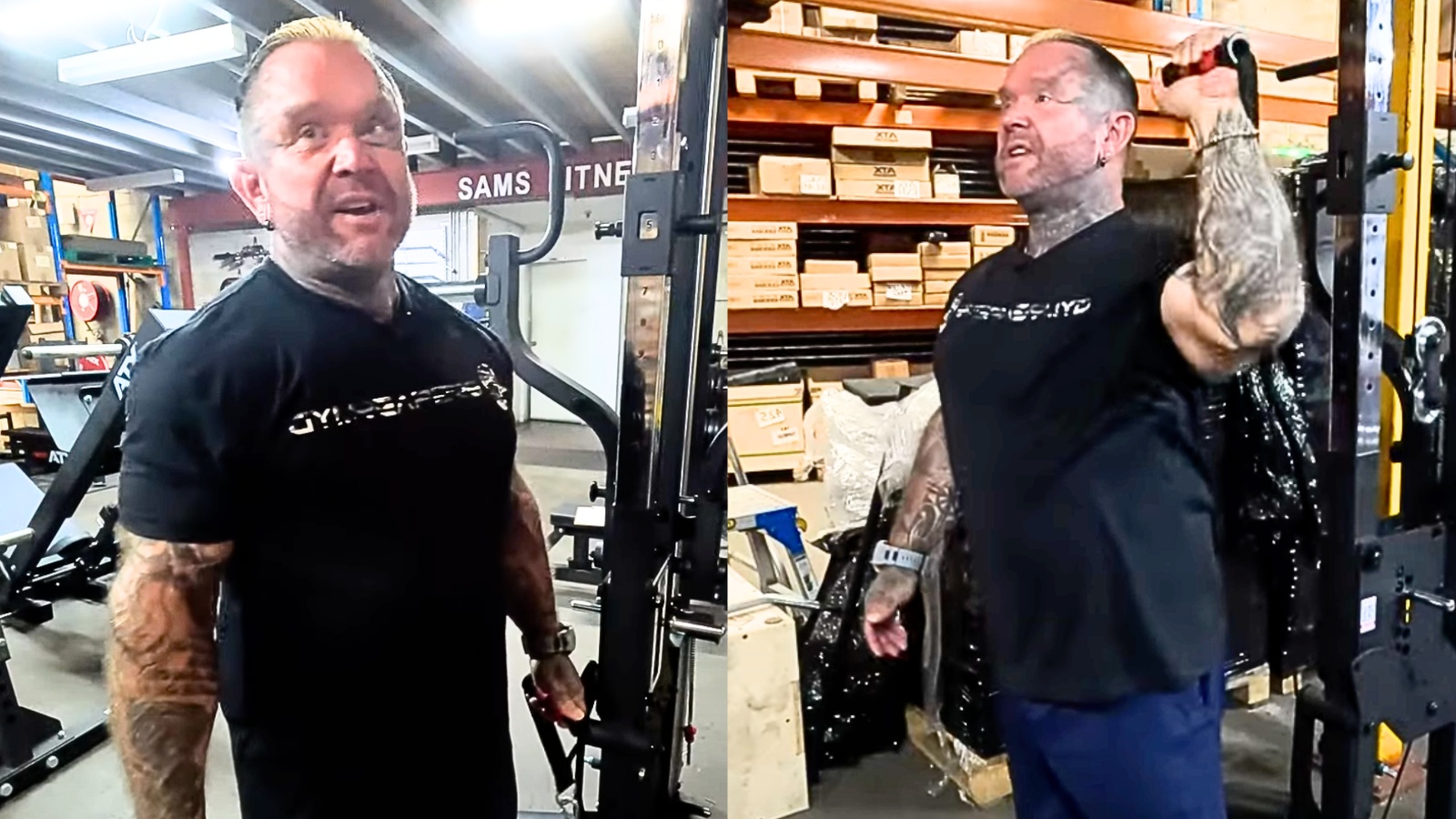
Bodybuilding veteran Lee Priest‘s grasp of exercise mechanics gave him an edge throughout his career. He recently broke down the key differences between straight sets, supersets, tri-sets, and giant sets in training on April 29, 2025.
Priest began bodybuilding at just 13 years old, and his potential was evident from the second he stood onstage. While he never claimed a Mr. Olympia title, Priest battled against mass monsters of the Open class with a shorter stature. The Men’s 212 bodybuilding division didn’t exist during Priest’s tenure, yet that didn’t stop him from holding his own against athletes who outsized him.
It remains to be seen whether Priest will commit to a bodybuilding comeback. The topic was widely discussed within the community after he renewed his IFBB Pro card for the 2025 bodybuilding season. However, Priest said if he seriously considered a return, it would be in a few years since he’s still dealing with atrophy issues in his triceps and chest.
Lee Priest Breaks Down Differences Between Straight Sets, Supersets, Tri-Sets, and Giant Sets
In a recent YouTube video, Priest outlined the differences between straight sets, supersets, tri-sets, and giant sets.
Here’s a quick breakdown:
- Straight Sets — One Exercise Performed for a Single Set
- Supersets — Two Exercises Performed Consecutively
- Tri-Sets — Three Exercises Performed Consecutively
- Giant Sets — Four or More Exercises Performed Consecutively
When using supersets, tri-sets, or giant sets, Priest emphasized that these involve no breaks in between exercises, making them a time-efficient option with greater calorie-burning potential than straight sets.
“A normal set is just one exercise. Supersets are two exercises back to back. A tri-set is three movements one after another, and a giant set is at least four to five movements taking no break.
But then, once you’ve done that, three movements or four movements, even though you’ve done four movements together, that’s one set. So you’d have to do that four times.”
Priest explained that when he incorporates supersets, he aims to go as heavy as possible, although that can change when it comes to tri-sets or giant sets.
“It’s a good way if you’re limited on time and you haven’t got a lot of time, but you want to get some exercises in, just do them straight one after another. It’s pretty good, you don’t need to go as heavy.
Normally, supersetting, I still try to go as heavy as I can. If you’re doing a tri or giant set, depending on what body parts you’re doing, you might have to lighten the weight a little bit. By the time you get to the fourth or fifth movement, the muscle is going to be burning.”
Priest shared that it’s best to superset exercises that target the upper body or lower body alone rather than trying to tackle both at the same time.
“You could be supersetting doing your laterals and as soon as you finish your laterals just turn around and do a bicep curl. It’s the same sort of thing it doesn’t really matter. As long as you’re doing the upper body you’re keeping the blood in the upper body area.”
“Normally, I don’t mix upper body with legs because if you’re doing legs, you got to get a lot of blood into your legs. It’s too hard to move the blood back and forth, and you want to keep the blood in the upper body. Chest and back together you can do that, shoulders and arms. It’s good if you’re limited on time,” Priest shared.
Priest has strong opinions on exercise selection. He recently took issue with hip thrusts, revealing that it’s one of the only exercises he advocates against. He believes various squatting exercises can produce greater benefits than hip thrusts.
From training to insights into the Open class, Priest continues to enlighten the bodybuilding community. He believes all of these set types have merit in one way or another, depending on how individuals incorporate them into their routines.