The Mike Tyson deck-of-cards squat workout looks almost too simple to take seriously. Put cards on the floor, squat down, pick them up, move forward, repeat.
Then the math catches up with your legs.
This old-school bodyweight leg workout is commonly linked to Tyson’s no-equipment training stories because it turns a deck of playing cards into a brutal squat-counting system. You do not need a barbell, rack, machine, or even much space. You need a deck of cards, enough floor room to lay out a line, and the patience to keep squatting when the numbers start climbing.
The catch is that this is not a normal “draw a card and do that many reps” workout. The Tyson-style version uses the cards as physical markers. Each new card position forces more squats because you have to place cards down one at a time and pick them back up one at a time. Ten cards becomes 100 squats. Fifteen cards becomes 225. Twenty cards becomes 400.
That is why this workout is so interesting. It feels like a game at first, then turns into a lower-body conditioning test very quickly.
Mike Tyson Deck-of-Cards Squat Workout – Quick Answer
The Mike Tyson deck-of-cards squat workout is a no-equipment bodyweight squat routine where you lay cards in a line and squat repeatedly to move them forward. The simplest version uses 10 cards and adds up to 100 squats. It trains leg endurance, conditioning, mental toughness, and squat consistency without weights.
Use it as a lower-body finisher, hotel-room workout, boxing-style conditioning session, or bodyweight leg day when you want something harder than a few casual sets of air squats.
How the Deck-of-Cards Squat Workout Works
The Tyson-style deck-of-cards squat workout uses cards as both markers and repetition counters. Instead of drawing random cards, you place a fixed number of cards in a straight line, then squat down to move them one position at a time.
Here is the basic 10-card version:
- Place 10 playing cards in a straight line on the floor.
- Stand over the first card.
- Squat down, pick up the first card, and stand up.
- Step forward to the second card.
- Squat down to place the first card on top of the second card.
- Stand up, then squat down again to pick up one card.
- Stand up, then squat down again to pick up the second card.
- Step forward to the third card and repeat the same place-and-pick-up pattern.
- Continue until all 10 cards are collected.
The rep pattern becomes odd numbers: 1, 3, 5, 7, 9, and so on. Add the first 10 odd numbers and you get 100 squats.
That is the beauty of the workout. You are not staring at a timer or guessing when the set is over. The cards tell you exactly where you are.
Why 10 Cards Equals 100 Squats
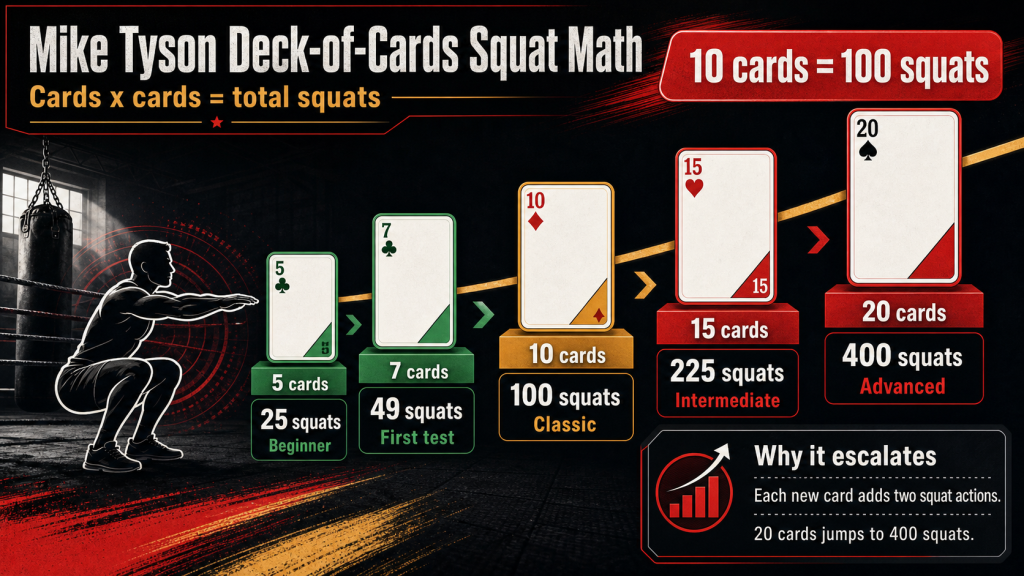
The workout works because every new card position adds two more squat actions than the last one. At card one, you do one squat. At card two, you do three. At card three, you do five. By card 10, you do 19 squats at that station.
Here is the quick math:
| Cards Used | Total Squats | Best For |
| 5 cards | 25 squats | Beginner practice |
| 7 cards | 49 squats | Warm-up or first test |
| 10 cards | 100 squats | Classic starter challenge |
| 15 cards | 225 squats | Intermediate leg conditioning |
| 20 cards | 400 squats | Advanced conditioning |
The formula is simple: cards x cards = total squats. Ten cards equals 10 x 10, or 100 squats. Twenty cards equals 20 x 20, or 400 squats.
That makes the routine brutally scalable. Adding just five cards can more than double the work.
Why This Workout Hits Different Than Normal Squats
Normal bodyweight squats are predictable. You set a rep goal, do the reps, and stop. The deck-of-cards squat workout changes the psychology because each station gets harder, and you can see the remaining cards in front of you.
The routine challenges four things at once:
- Leg endurance: Your quads and glutes have to repeat the same movement under rising fatigue.
- Conditioning: Continuous squatting pushes your heart rate up fast, especially after the first few stations.
- Mobility: You must keep bending low enough to touch the cards without rounding into a sloppy hinge.
- Focus: Losing count is easy during high-rep training. The cards solve that problem.
That last part is underrated. A deck of cards gives you a built-in counting system. When your legs are burning, you do not need to remember whether you are on rep 63 or 68. You just move the next card.
The 10-Card Mike Tyson Squat Workout
The 10-card version is the best place to start. It gives you the classic 100-squat challenge without pushing most people into reckless volume.
Setup:
- Use 10 cards.
- Place them in a straight line, 12 to 18 inches apart.
- Stand tall over the first card.
- Squat to pick up or place one card at a time.
- Rest only when form starts breaking.
Coach Tip: Keep your chest up, knees tracking over your toes, and heels planted. If touching the floor forces your back to round, place the cards on a low box or step instead.
Watch the basic squat pattern first if you are unsure about depth, knee tracking, or torso position:
For most fit readers, 10 cards will feel manageable for the first few stations and nasty by the end. The final three cards are where the workout earns its name.
The Beginner Version: 5 to 7 Cards
Beginners should not start with 20 cards just because the workout sounds cool. Start with five cards for 25 total squats or seven cards for 49 total squats.
Use this version if:
- You are new to bodyweight squats.
- Your knees or hips need a slower ramp-up.
- You cannot maintain the same squat depth for 100 reps.
- You want a quick lower-body warm-up before a full workout.
The goal is not to survive ugly reps. The goal is to make every squat look similar from the first card to the last.
If five cards feels easy, move to seven. If seven feels easy, move to 10. Do not jump straight from 10 to 20 unless your legs and lungs are ready for a huge workload increase.
The 20-Card Fighter-Leg Challenge
The 20-card version adds up to 400 squats. That is no longer a warm-up. It is a serious lower-body conditioning session.
Use the 20-card version only if you can already perform 100 bodyweight squats with consistent depth, clean knee tracking, and no joint pain. The challenge is not just muscular. Your breathing, bracing, and mental rhythm all matter.
Here is the smart approach:
- Warm up for five to eight minutes.
- Complete the first 10 cards smoothly.
- Rest two to three minutes.
- Complete cards 11 to 15.
- Rest again if needed.
- Finish cards 16 to 20 only if your form still looks clean.
You can still call it the 20-card challenge if you break it into blocks. Conditioning work should be hard, not careless.
What Muscles Does the Deck-of-Cards Squat Workout Train?
The deck-of-cards squat workout primarily trains the quadriceps, glutes, hamstrings, calves, adductors, core, and lower-back stabilizers. Because the reps pile up quickly, it also becomes a muscular-endurance and conditioning workout.
The repeated squat pattern hits:
- Quads: Knee extension and repeated lowering control.
- Glutes: Hip extension as you stand up from each squat.
- Hamstrings: Hip control and knee stability.
- Calves: Ankle stiffness and balance during repeated reps.
- Core: Bracing while bending down and standing tall.
- Upper back: Posture control so you do not fold over the cards.
The squat is one of the most studied and useful lower-body patterns because it trains hip, knee, and ankle coordination together. That is exactly why this simple card method works so well.
How To Make the Workout More Athletic
The basic version is enough for most people. Stronger athletes can make the workout more athletic without turning it into random chaos.
Add a Jump Rope Round
After every five cards, perform 60 seconds of jump rope. This gives the workout a stronger boxing-conditioning feel and links nicely with Tyson’s larger bodyweight training circuit.
Add a Push-Up Pairing
After every card station, do three to five push-ups. This turns the session into a full-body bodyweight circuit. For a harder upper-body option, pair it with our Mike Tyson push-up workout.
Use Tempo Squats
Lower for three seconds, pause briefly near the bottom, then stand. This makes even five to seven cards feel much harder without adding more reps.
Use Split Squats for Fewer Cards
Advanced trainees can use reverse lunges or split squats, but keep the card count low. Five cards per leg is already plenty.
Common Mistakes That Ruin the Workout
The deck-of-cards squat workout is simple, but simple does not mean impossible to mess up.
Starting With Too Many Cards
The numbers climb faster than they look. Ten cards is 100 squats. Fifteen is 225. Respect the math.
Rounding the Back to Reach the Floor
If you cannot reach the cards without collapsing your chest, elevate the cards. Put them on a yoga block, low step, or sturdy book stack.
Letting the Knees Cave
Knees should track in the same direction as the toes. If they cave inward under fatigue, stop the set or reduce the number of cards.
Turning Every Rep Into a Half Squat
Depth should remain consistent. If the first card is a deep squat and the tenth card is a tiny knee bend, the workout turned into counting theater.
Doing It Every Day
High-rep squat work can create serious soreness. Use this once or twice per week at first, especially if you also train legs with weights.
Who Should Skip This Workout?
Skip the Mike Tyson deck-of-cards squat workout if you have current knee, hip, ankle, or lower-back pain, or if bodyweight squats already cause discomfort. The floor reach also makes it a poor fit for anyone who cannot hinge or squat low without rounding their back.
This routine is also not ideal if your main goal is maximum leg strength. Heavy squats, lunges, split squats, and progressive resistance training are still better for that. The card workout shines as conditioning, muscular endurance, and mental toughness training.
If you are unsure, start with five cards and stop while your reps still look good.
Where It Fits in a Weekly Training Plan
Use the deck-of-cards squat workout as a finisher or a standalone conditioning day, not as a replacement for all lower-body training.
Here are three smart placements:
- After upper body: 5 to 10 cards as a lower-body finisher.
- On conditioning day: 10 to 15 cards, followed by mobility work.
- During travel: 7 to 10 cards in a hotel room when you have no equipment.
That travel angle is one reason this pairs well with our hotel-room workout guide. You can do it almost anywhere, and the cards take up less space than a resistance band.
How It Compares With a Normal Deck-of-Cards Workout
A normal deck-of-cards workout usually assigns exercises to suits. For example, hearts might be squats, diamonds might be push-ups, clubs might be sit-ups, and spades might be burpees. You draw a card and do the number shown.
The Tyson-style squat version is different. It is not random. It is progressive. Every new card increases the work at that station.
That makes it better for a focused squat challenge, while a standard deck workout is better for variety and full-body conditioning.
If you want a full-body session, use the standard version. If you want your legs to remember the workout tomorrow, use the Tyson squat version.
FAQ
How many squats are in the Mike Tyson deck-of-cards workout?
The common 10-card version includes 100 total squats. The total equals the number of cards squared, so five cards equals 25 squats, 15 cards equals 225 squats, and 20 cards equals 400 squats.
Is the Mike Tyson squat workout good for building muscle?
It can build leg endurance and may help newer trainees add some muscle, but it is not the best choice for maximum hypertrophy. For muscle growth, use progressive resistance exercises like squats, split squats, lunges, and leg presses alongside bodyweight conditioning.
Can beginners do the deck-of-cards squat workout?
Beginners can do a scaled version with five to seven cards. That gives you 25 to 49 total squats, which is much more realistic than starting with 100 or more reps.
How often should I do it?
Start with once per week. If your knees, hips, and recovery feel good, you can use it twice per week. Avoid daily high-rep squat challenges unless you are already conditioned for that volume.
Do I need a full deck?
No. In fact, you should not start with a full deck. A full 52-card line would be 2,704 squats using this method, which is unnecessary for almost everyone.
Wrapping Up
The Mike Tyson deck-of-cards squat workout is brilliant because it makes hard work impossible to ignore. The setup is simple, the math is clean, and the challenge scales fast.
Start with five to 10 cards. Keep every squat honest. Add cards only when your legs, lungs, and joints can handle the next jump.
It is not magic, and it will not replace a complete leg program. But as a no-equipment lower-body challenge, fighter-style finisher, or hotel-room conditioning session, it is one of the most memorable ways to turn a few cards into a serious workout.
Read also: Train Like Mike Tyson: The Savage Bodyweight Circuit That Built a Legend
References:
- Myer GD, Kushner AM, Brent JL, Schoenfeld BJ, Hugentobler J, Lloyd RS, Vermeil A, Chu DA, Harbin J, McGill SM. The back squat: A proposed assessment of functional deficits and technical factors that limit performance. Strength and Conditioning Journal. 2014;36(6):4-27. doi: 10.1519/SSC.0000000000000103.
- Hertel G, Hochrein A, Suren C, Minzlaff P, Banke IJ, Willers J, von Eisenhart-Rothe R, Prodinger PM. Injury incidence and specific injury patterns in app-based bodyweight training (Freeletics): results of an international survey with 3668 participants. BMC Sports Science, Medicine and Rehabilitation. 2022;14:145. doi: 10.1186/s13102-022-00525-y. PMID: 35883184.
- Atakan MM, Li Y, Kosar SN, Turnagol HH, Yan X. Evidence-based effects of high-intensity interval training on exercise capacity and health: A review with historical perspective. International Journal of Environmental Research and Public Health. 2021;18(13):7201. doi: 10.3390/ijerph18137201. PMID: 34281138.