

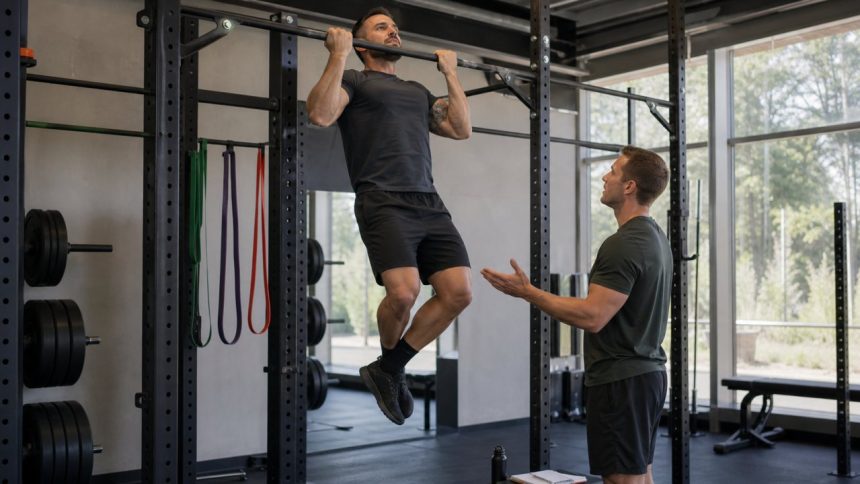
Pull-ups and chin-ups are simple in the way a heavy barbell is simple: the rules are obvious, but execution is not. Hang from a bar, pull your body up, control the descent, repeat. The challenge is that your grip, shoulder position, body weight, range of motion, and pulling strength all have to cooperate.
The old Body Mechanics article rightly treated pull-ups and chin-ups as serious back builders. This update makes the choice clearer. Pull-ups are usually done with an overhand grip. Chin-ups use an underhand grip. Both train the lats, upper back, arms, grip, and trunk, but the emphasis and difficulty can shift enough that smart lifters should choose the version that matches the goal.
What is the difference between a pull-up and a chin-up?
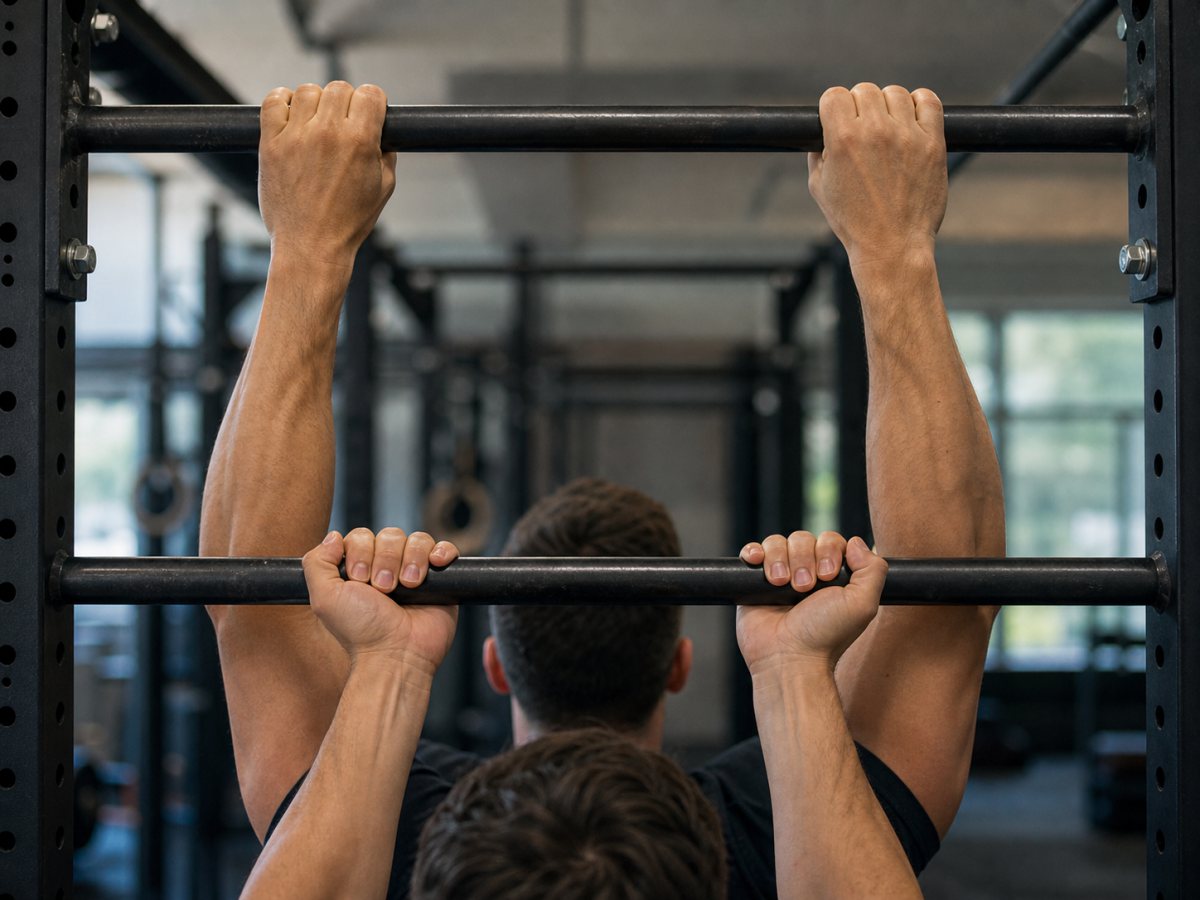
A pull-up usually uses a pronated, overhand grip with palms facing away. A chin-up uses a supinated, underhand grip with palms facing you. Many lifters find chin-ups easier because the grip can allow stronger elbow flexor contribution. Pull-ups may feel more lat- and upper-back dominant for some people, especially with a slightly wider grip.
The difference is real, but it is not a different universe. Both are vertical pulling exercises. Both can build a stronger back. Both can irritate shoulders or elbows if volume, grip, and range are poorly matched.
Which muscles do pull-ups and chin-ups work?
Pull-ups and chin-ups train the latissimus dorsi, teres major, rhomboids, middle and lower trapezius, rear delts, biceps, brachialis, brachioradialis, forearms, and trunk. The lats and upper back drive the body toward the bar, while the arms help flex the elbows and the core limits swinging.
Youdas and colleagues found a general pattern of sequential activation during pull-up and chin-up variations, with lower trapezius and pectoralis major contributing early and biceps and latissimus dorsi contributing later in the cycle. That is a useful reminder: vertical pulling is coordinated, not just “lats plus biceps.”
Are chin-ups better for biceps?
Chin-ups often feel better for biceps because the underhand grip puts the elbow flexors in a strong pulling position. That does not mean chin-ups replace curls for every biceps goal, and it does not mean pull-ups fail to train the arms. It means chin-ups are a smart choice when you want a vertical pull that also gives the arms a strong stimulus.
If elbows get cranky, rotate grips. Neutral-grip pull-ups, rings, assisted reps, and pulldowns can keep vertical pulling in the program without forcing the same wrist and elbow position every week.
Are pull-ups better for back width?
Pull-ups can be excellent for back width, but grip alone does not build lats. Range of motion, scapular control, progressive volume, body position, and effort matter more than arguing over a few inches of hand placement. A clean shoulder-width or slightly wider pull-up beats a sloppy ultra-wide rep every time.
Research on grip width and pull-up performance suggests grip changes force and performance characteristics. The practical takeaway is simple: use a grip that lets you pull hard, control the bottom, reach a consistent top, and recover your elbows and shoulders.
What are the biggest form mistakes?
The biggest mistakes are starting every rep from a loose dead hang with no control, craning the neck over the bar, kicking the legs to finish strict reps, cutting the range short, and doing too much volume too soon. Pull-ups punish impatience because body weight is a fixed load. If you weigh 210 pounds, every strict rep is a serious pull.
Use a quiet body. Brace the trunk, squeeze the glutes lightly, start by controlling the shoulders, pull the elbows toward the ribs, and lower with intent. You do not have to pause forever at the bottom, but you should own the position before the next rep.
How many reps and sets should you do?
Use the rep range that matches your current strength. If you can do 1 to 3 strict reps, use singles, clusters, and assisted back-off sets. If you can do 5 to 10, use multiple submaximal sets. If you can do 12 or more, add load, slow tempo, pauses, or harder variations.
Here is a simple programming map:
| Goal | Plan | Rule |
|---|---|---|
| First pull-up | 3 to 5 assisted sets, 2 to 4 days weekly | Never grind every rep |
| Muscle gain | 3 to 5 sets near, not always to, failure | Add volume gradually |
| Strength | Weighted sets of 3 to 6 | Keep reps crisp |
| Skill | Frequent easy singles | Practice without fatigue |
Should you use bands or machines?
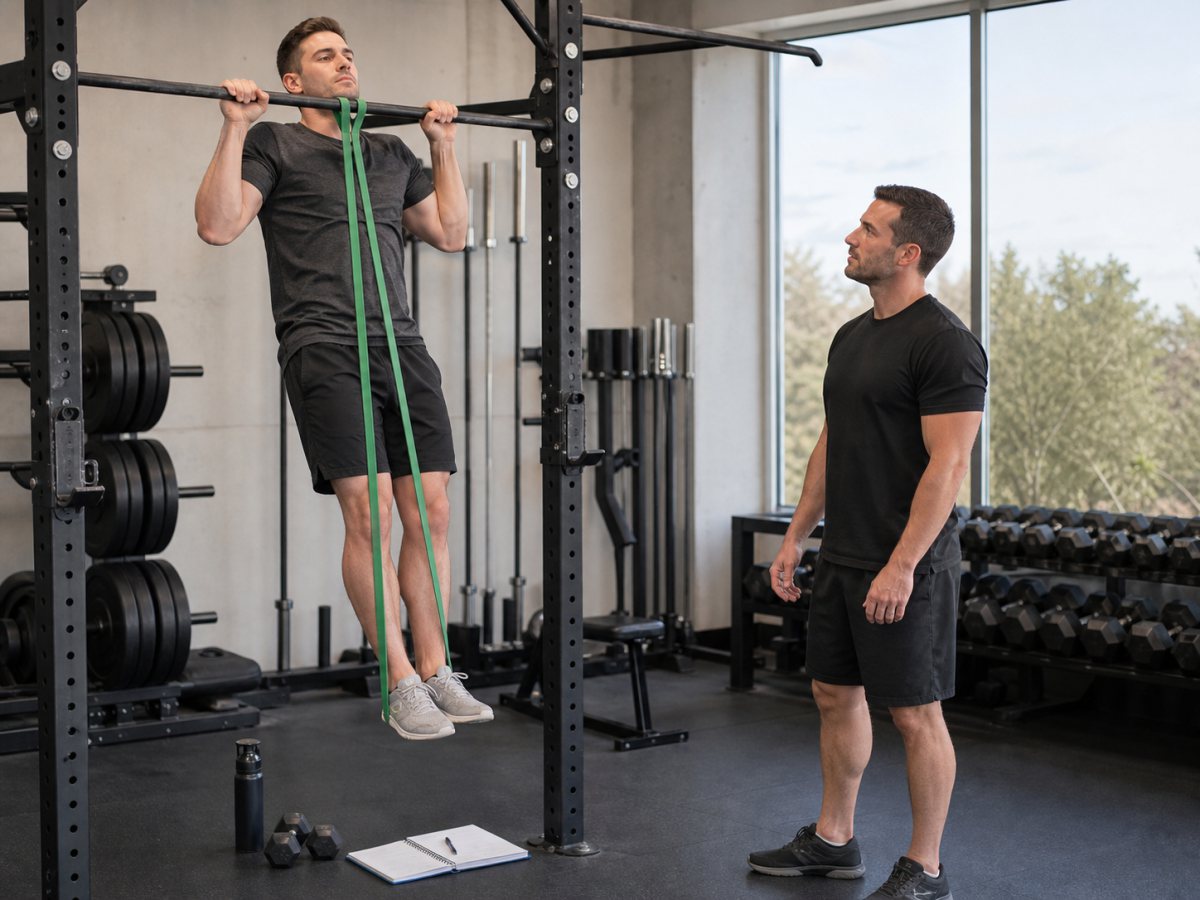
Bands and assisted machines are useful when they help you practice better reps. They are less useful when they turn the bottom of the rep into a bounce or remove the hard part you need to train. Choose the least assistance that lets you perform full, controlled reps.
Assisted work also lets heavier beginners build volume without treating every set as a max. Pair it with rows and lat-focused work from our back exercises library and bodyweight back exercises guide.
What equipment do you need?
You need a stable bar, enough overhead clearance, and a setup that does not wobble. Doorway bars can work for light practice if installed correctly, but heavier or weighted pull-ups demand better equipment. Our pull-up bar guide covers options for home training.
Rings are another excellent option because they allow the hands to rotate naturally. That can feel better on elbows and shoulders, but it also adds stability demand. Start conservatively.
FitnessVolt pull-up rule of thumb
Choose the grip that lets you train hard with healthy joints, full range, and repeatable control. Pull-ups, chin-ups, and neutral-grip variations all belong in the toolbox. Progress them like any other lift: more clean reps first, then harder variations or added load.
The best vertical pull is the one you can repeat, recover from, and progress. Grip matters, but quality reps matter more.
How do you protect your shoulders?
Protect your shoulders by controlling the bottom position, avoiding aggressive bouncing, and choosing grips your joints tolerate. A dead hang can be useful for some lifters, but others need a slightly active shoulder position to avoid irritation. Rings and neutral grips often feel better because the hands can rotate naturally.
If pull-ups cause front-shoulder pain, do not keep forcing the same grip and range. Try assisted reps, neutral grips, pulldowns, ring rows, or a shorter pain-free range while you build strength and control. The goal is not to avoid hard work. It is to make the hard work repeatable.
How do you add weight safely?
Add weight only after bodyweight reps are clean. A useful benchmark is 8 to 10 strict reps with full control and no kicking. Then start with a small load, such as 5 to 10 pounds, and keep reps crisp. Weighted pull-ups are strength work, not a circus act.
Use small jumps and lower total volume at first. Weighted vertical pulls can stress elbows and shoulders quickly, especially if you also do heavy rows, curls, and deadlifts. If elbows ache, reduce load, rotate grips, and keep some assisted or pulldown volume in the plan.
How do pull-ups fit with back training?
Pull-ups are a vertical pull. A complete back program usually also needs horizontal rows, hip-hinge work, rear-delt or upper-back work, and enough lower-back recovery to keep the whole chain strong. Pull-ups alone are excellent, but they are not the whole back plan.
Pair pull-ups with rows for balanced development. Use pulldowns when you need more volume without the same fatigue cost. Use strict reps when strength is the goal, and use controlled higher-rep assisted sets when hypertrophy is the goal. The bar is just one tool.
How do you stop swinging?
Swinging usually comes from loose body tension, rushed reps, or too much fatigue. Start each rep by bracing the trunk and lightly squeezing the glutes. Keep the legs slightly in front or stacked under you, not flailing behind. Pull smoothly and lower under control. If the body starts to swing, pause between reps or reduce the set length.
Do not confuse kipping with strict pulling. Kipping has a place in some sport contexts, but it is not the same stimulus as strict pull-ups. If your goal is back and arm strength, strict reps are the main currency. Earn those first, then choose other styles only if they match your sport or goal.
What if you are too heavy for pull-ups?
Body weight changes the difficulty of pull-ups, but it does not disqualify you. Heavier lifters often need more assisted volume, more rows, and more patience. That is normal. A 240-pound beginner is doing a much heavier first pull-up than a 140-pound beginner. Compare progress against your own baseline, not someone else’s body weight.
Use bands, machines, pulldowns, and inverted rows to build strength while body composition changes if fat loss is also a goal. The first strict pull-up may take months. That is not slow progress. That is the reality of moving your full body through space.
How should advanced lifters progress?
Advanced lifters can progress with added weight, pauses at the top, slower eccentrics, chest-to-bar reps, rings, towel grips, or higher total weekly volume. Choose one progression at a time. Weighted pull-ups plus high-volume curls plus heavy rows plus deadlifts can overwhelm elbows quickly.
Use blocks of training. Spend a phase building strict bodyweight volume, a phase building weighted strength, and a phase reducing joint stress with neutral grips or pulldowns. Rotating stress keeps vertical pulling productive for years instead of turning it into an elbow problem.
Sources
- Youdas, J. W., et al. (2010). Surface electromyographic activation patterns and elbow joint motion during a pull-up, chin-up, or rotational exercise. Journal of Strength and Conditioning Research.
- Sanchez-Moreno, M., et al. (2020). Effect of the pronated pull-up grip width on performance and power-force-velocity profile. Journal of Strength and Conditioning Research.
- Doma, K., et al. (2013). Kinematic and electromyographic comparisons between chin-ups and lat-pull down exercises. Sports Biomechanics.
- Ronai, P., & Scibek, E. (2016). Electromyographical comparison of a traditional, suspension device, and towel pull-up. Journal of Fitness Research.






Pull up is prominent for being one of the most challenging bodyweight exertions. It always gives a vigorous provocation by disregarding the strength levels. Similarly, if a fitness devotee wants to build the best physical frame, then he has to place chin-up in his exercise program. Unfortunately, many performers take both the movements as the same thing. They don’t realize the uniqueness of each activity. The difference in the grip, and the difference in the consequence can never keep pull up and chin-up in the same line-up. Pull up is a grip strengthener, whereas chin-up is treated as a catalyst for the growth of the biceps. Better you should understand the significance of each vibration, and do them with the right fitness equipment- to avoid injury and train the muscles quickly.