
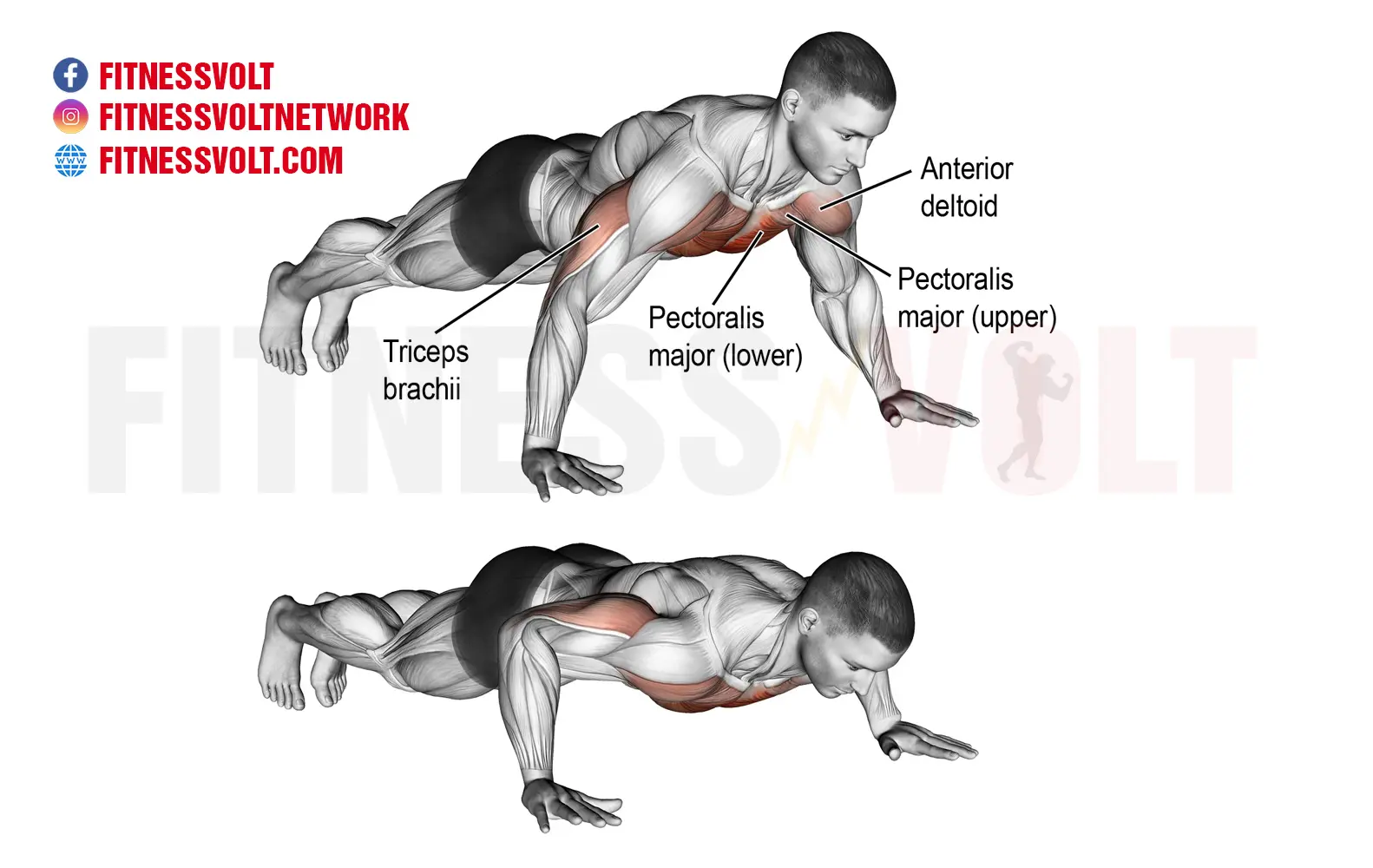
Push-ups, ancient in origin, have withstood the test of time as a highly effective and versatile exercise. Widely adopted by military training and athletic programs worldwide, they are a testament to functional strength. Push-ups primarily strengthen the Pectoralis Major (Chest), with the triceps and front deltoids acting as secondary muscles. For those finding the standard push-up challenging, the movement can be performed on the knees as a progression. Perfect for situations without gym access, its variations are endless, and it remains a potent exercise for building a well-defined chest.
Muscles Targeted:
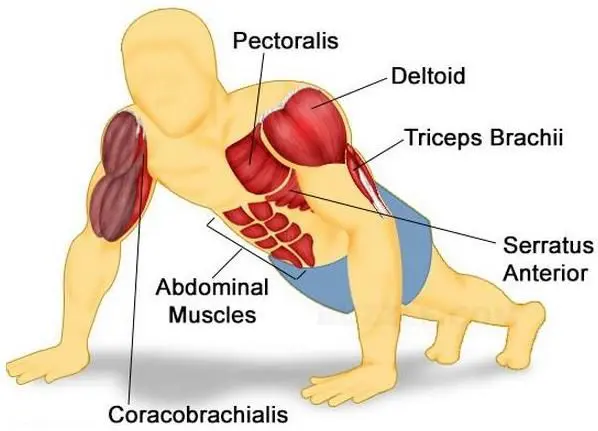
- Pectoralis major (chest): The primary driver in the upward motion.
- Deltoids (shoulders): Stabilize and assist in the lifting phase.
- Triceps brachii (back of the arms): Key players in extending the elbow.
- Core muscles (abdominals, obliques, and lower back): Engaged throughout to maintain stability and alignment.
Equipment Needed
While the classic push-up requires just your body and a firm surface, here are some optional additions:
- A mat: Adds comfort, especially on hard surfaces.
- Push-up handles or bars: These can reduce wrist strain and offer a deeper range of motion.
How To Do Push-Up
Proper Hand Placement
Hand placement plays a pivotal role:
- Shoulder-width apart: Standard grip, balanced muscle engagement.
- Wide grip: Emphasizes the outer chest.
- Diamond (hands close together): Puts more stress on the triceps and inner chest.
It’s essential to distribute weight evenly across your hands and maintain a neutral wrist position to prevent strain.
Starting Position
Begin in a plank position, maintaining a straight line from your head to your heels. It’s crucial to activate your core and glutes to maintain this alignment.
Execution
- Breathing: Inhale as you lower and exhale robustly as you ascend.
- Movement: Descend with control, ensuring your elbows form a 45-degree angle with your body. Push through your palms to ascend.
- Head and neck: Prioritize a neutral spine. Your gaze should be a few inches ahead of your fingertips.
- Depth: Aim to get your chest close to the ground, but be mindful of your shoulder health.
Watch how to do the push-up
Watch how to do advanced push-up variations
Common Mistakes & How to Avoid Them
- Elbows flaring: Keep them angled toward your feet.
- Arching or sagging the back: Engage the core consistently.
- Bouncing: Control is key; avoid using momentum.
- Limited range of motion: Ensure you’re moving through the full motion for maximal benefits.
Variations & Progressions
- Knee push-ups: A great starting point for beginners.
- Incline and decline push-ups: Change the angle to modify the muscle focus.
- Advanced techniques: One-arm, plyometric, and other styles challenge even seasoned athletes.
Benefits of Push-ups
From strengthening a variety of muscle groups to enhancing functional strength, push-ups are stellar. They also increase bone density in the wrists and arms. Plus, the cost-effective nature of push-ups – no gym membership required – allows for great flexibility.
Contraindications & Safety Tips
Individuals with wrist, shoulder, or back concerns should approach push-ups with caution. Prioritize form over reps and seek professional guidance if unsure.
- Choose from the several push-up variations to increase the difficulty of the exercise.
- You can do the push-up on your knees or on the wall if you don’t have sufficient strength.
- Do not arch or round your back during the exercise.
- The pushup works the chest primarily but the triceps and front deltoids get worked secondarily.
Conclusion
Remember, champions, while the push-up is basic, its benefits are profound. Whether you’re at home, in a hotel, or at a park, this exercise is a versatile addition to your fitness toolkit. Stay consistent, perfect that form, and embrace the power of the push-up.
Article Updates Timeline:
Our editorial team experts constantly update the articles with new information & research, ensuring you always have access to the latest and most reliable information.
January 20, 2024
Updated By
Dr. Malik
August 16, 2023
Updated By
Andrew Peloquin NFPT-CPT
April 22, 2019
Written By
Dr. Malik
Interested in measuring your progress? Check out our strength standards for Archer Push Ups, and more exercises.