

10 Best Front Cone Hops (Or Hurdle Hops) Alternatives for Quad Power
Front Cone Hops (Or Hurdle Hops) are done standing. Ranked closest by our scoring: the Scissors Jump, the Split Jump and the Alternate Leg Diagonal Bound.
Updated Ranked by our 12-factor similarity model How it works
Original Exercise: Front Cone Hops (Or Hurdle Hops)
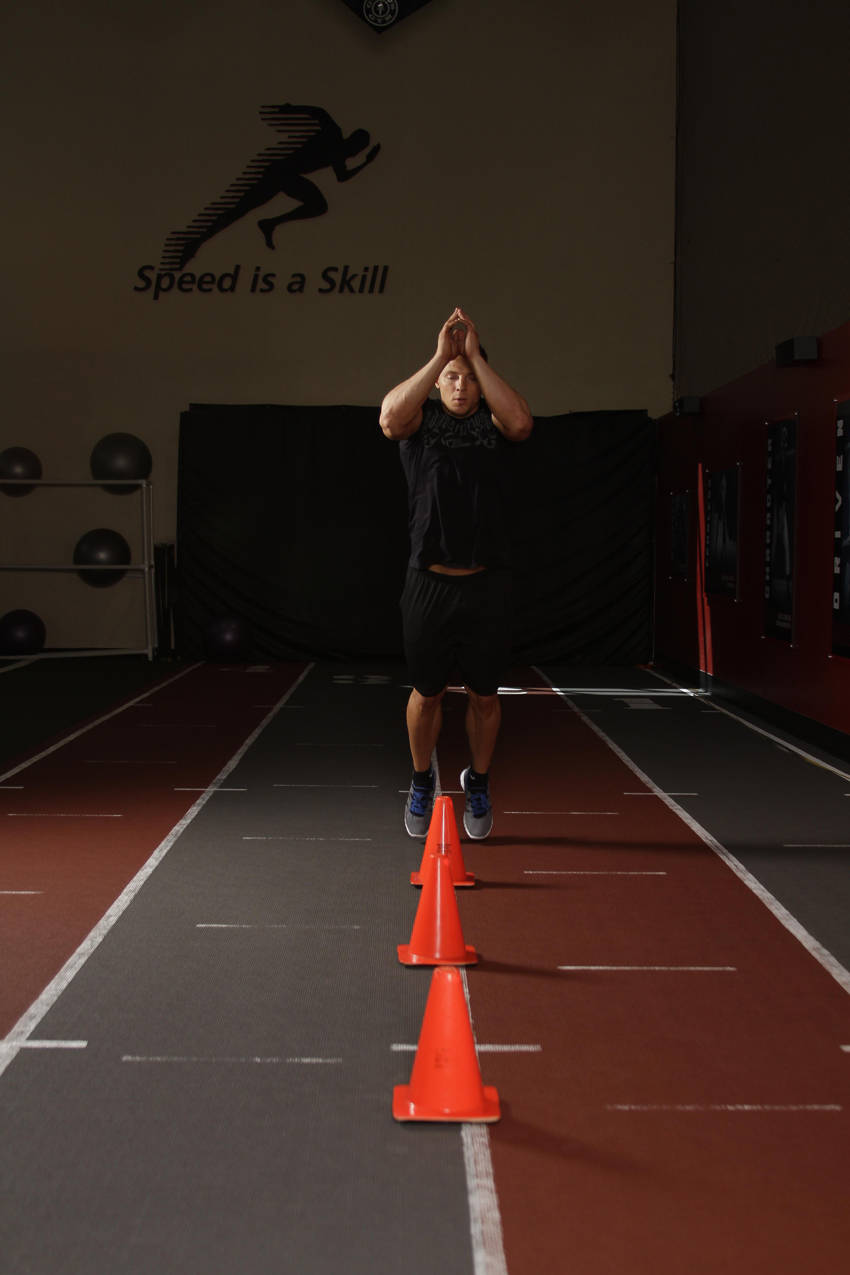
- Primary muscle
- Quads
- Equipment
- Other
- Difficulty
- Advanced
- Type
- Compound
Secondary muscles: Abductors, Adductors, Calves, Glutes, Hamstrings
How to perform Front Cone Hops (Or Hurdle Hops)
- Set up a row of cones or other small barriers, placing them a few feet apart.
- Stand in front of the first cone with your feet shoulder width apart. This will be your starting position.
- Begin by jumping with both feet over the first cone, swinging both arms as you jump.
- Absorb the impact of landing by bending the knees, rebounding out of the first leap by jumping over the next cone.
- Continue until you have jumped over all of the cones.
Ranked Front Cone Hops (Or Hurdle Hops) Alternatives
10 substitutes, ranked by how closely each one matches Front Cone Hops (Or Hurdle Hops) on movement pattern, muscles worked, equipment and body position. The higher the score, the less you change. Open "How to perform this exercise" on a card for the steps; every card title links to that exercise's own alternatives page.
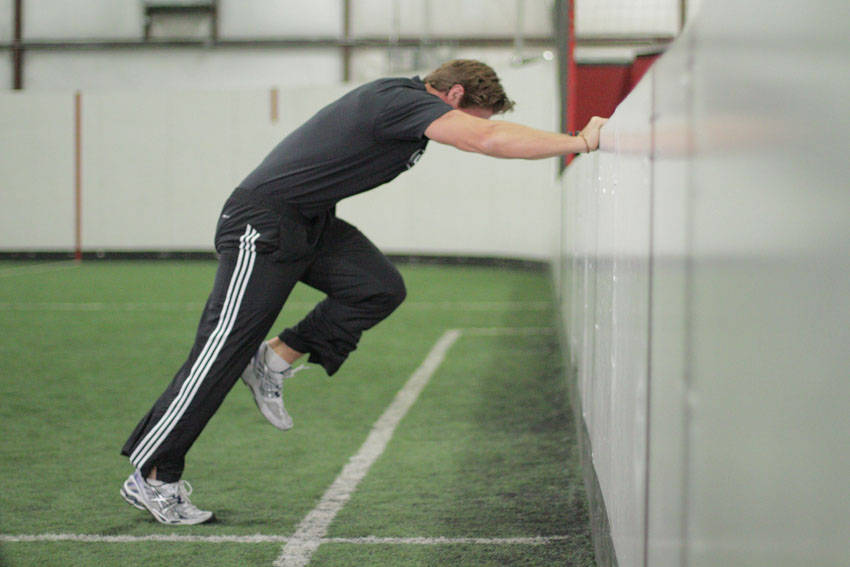
1. Linear Acceleration Wall Drill
79% match- Hamstrings
- Bodyweight
- Intermediate
- Compound
A looser match: it works the hamstrings rather than the quads.
How to perform this exercise
- Lean at around 45 degrees against a wall. Your feet should be together, glutes contracted.
- Begin by lifting your right knee quickly, pausing, and then driving it straight down into the ground.
- Switch legs, raising the opposite knee, and then attacking the ground straight down.
- Repeat once more with your right leg, and as soon as the right foot strikes the ground hammer them out rapidly, alternating left and right as fast as you can.
Sets and reps: 3 or 4 sets of 6 to 10 reps on each side.
Why this matches
- Primary muscle: hamstrings, not quads
- Equipment: bodyweight only, the same as Front Cone Hops (Or Hurdle Hops)
- Body position: standing, the same as Front Cone Hops (Or Hurdle Hops)
- Balance: easier to stay steady on than Front Cone Hops (Or Hurdle Hops)
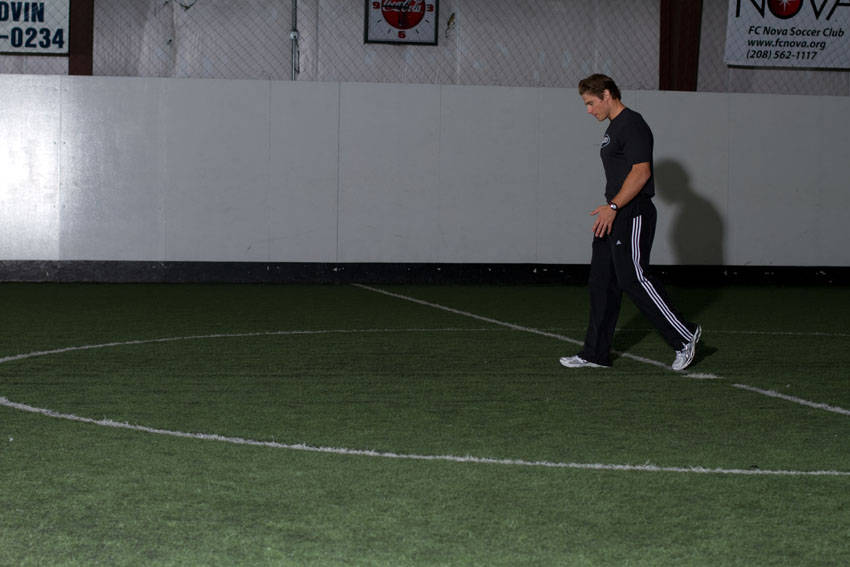
2. Moving Claw Series
70% match- Hamstrings
- Bodyweight
- Intermediate
- Compound
How to perform this exercise
- This move helps prepare your running form to help you excel at sprinting. As you run, be sure to flex the knee, aiming to kick your glutes as the hip extends.
- Reload the quad as the leg moves back forward, attacking the ground on the next step.
- Ensure that as you run, you block with the arms, punching through in a rapid 1-2 motion.
Sets and reps: 3 or 4 sets of 6 to 10 reps on each side.
Why this matches
- Primary muscle: hamstrings, not quads
- Equipment: bodyweight only, the same as Front Cone Hops (Or Hurdle Hops)
- Body position: standing, the same as Front Cone Hops (Or Hurdle Hops)
Best match 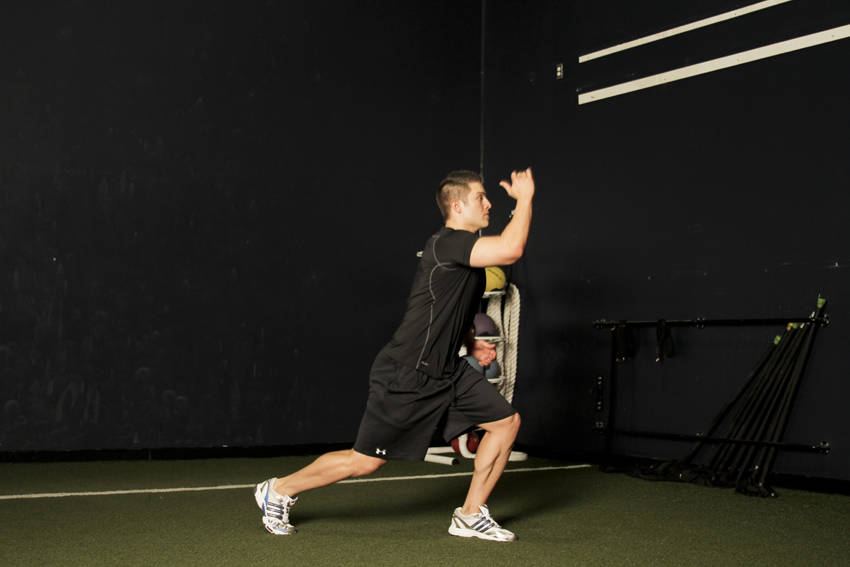
3. Scissors Jump
65% match- Quads
- Bodyweight
- Advanced
- Compound
It still works the quads, through a different movement.
How to perform this exercise
- Assume a lunge stance position with one foot forward with the knee bent, and the rear knee nearly touching the ground.
- Ensure that the front knee is over the midline of the foot. Extending through both legs, jump as high as possible, swinging your arms to gain lift.
- As you jump as high as you can, switch the position of your legs, moving your front leg to the back and the rear leg to the front.
- As you land, absorb the impact through the legs by adopting the lunge position, and repeat.
Sets and reps: 3 or 4 sets of 6 to 10 reps on each side.
Why this matches
- Primary muscle: quads, the same as Front Cone Hops (Or Hurdle Hops)
- Equipment: bodyweight only, the same as Front Cone Hops (Or Hurdle Hops)
- Body position: standing, the same as Front Cone Hops (Or Hurdle Hops)
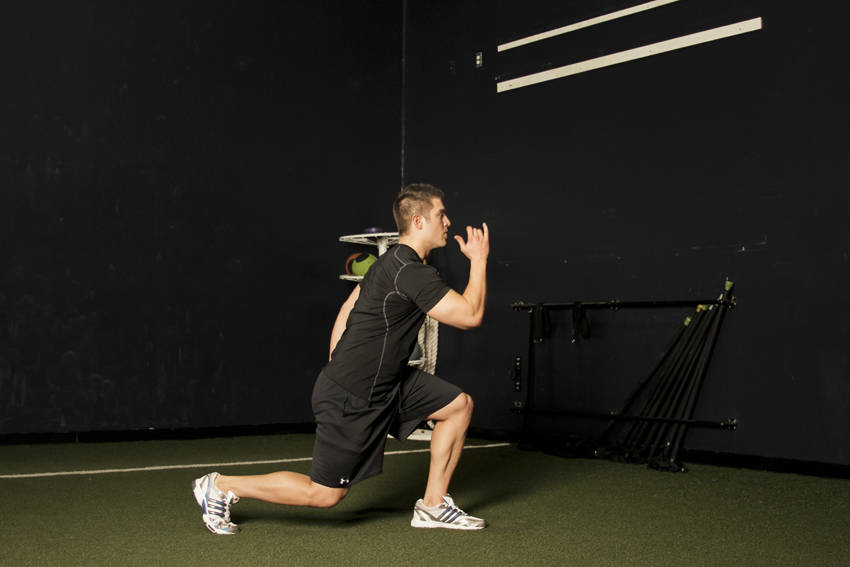
4. Split Jump
65% match- Quads
- Bodyweight
- Intermediate
- Compound
How to perform this exercise
- Assume a lunge stance position with one foot forward with the knee bent, and the rear knee nearly touching the ground.
- Ensure that the front knee is over the midline of the foot.
- Extending through both legs, jump as high as possible, swinging your arms to gain lift.
- As you jump, bring your feet together, and move them back to their initial positions as you land.
- Absorb the impact by reverting back to the starting position.
Sets and reps: 3 or 4 sets of 6 to 10 reps on each side.
Why this matches
- Primary muscle: quads, the same as Front Cone Hops (Or Hurdle Hops)
- Equipment: bodyweight only, the same as Front Cone Hops (Or Hurdle Hops)
- Body position: standing, the same as Front Cone Hops (Or Hurdle Hops)
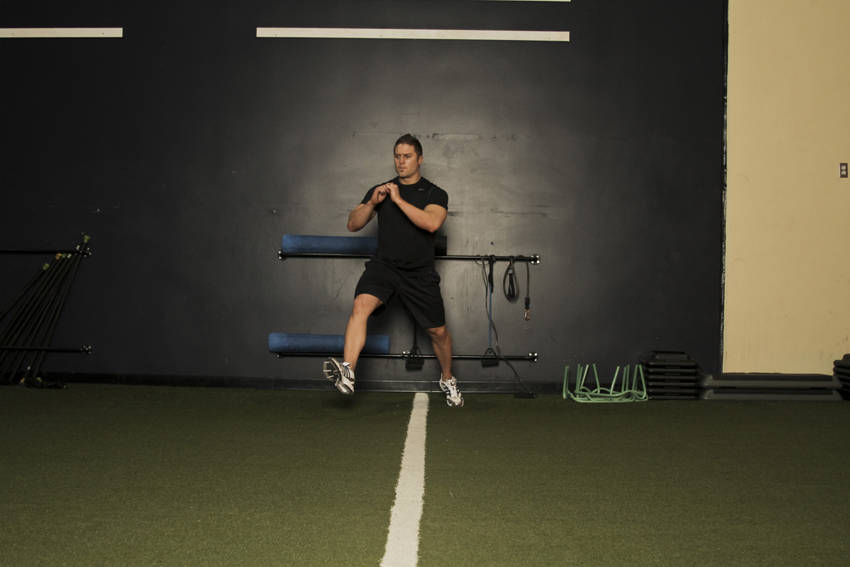
5. Alternate Leg Diagonal Bound
64% match- Quads
- Bodyweight
- Intermediate
- Compound
How to perform this exercise
- Assume a comfortable stance with one foot slightly in front of the other.
- Begin by pushing off with the front leg, driving the opposite knee forward and as high as possible before landing. Attempt to cover as much distance to each side with each bound.
- It may help to use a line on the ground to guage distance from side to side.
- Repeat the sequence with the other leg.
Sets and reps: 3 or 4 sets of 6 to 10 reps on each side.
Why this matches
- Primary muscle: quads, the same as Front Cone Hops (Or Hurdle Hops)
- Equipment: bodyweight only, the same as Front Cone Hops (Or Hurdle Hops)
- Body position: standing, the same as Front Cone Hops (Or Hurdle Hops)
6. Kick Out Sit
63% match- Hamstrings
- Bodyweight
- Intermediate
- Compound
How to perform this exercise
- Sit on the edge of a bench or chair with your feet flat on the ground and your knees bent at a 90-degree angle.
- Lean back slightly and place your hands on the edge of the bench or chair for support.
- Engaging your hamstrings, lift your feet off the ground and extend your legs straight out in front of you.
- Pause for a moment at the top, then slowly bend your knees and bring your feet back towards your body.
- Repeat for the desired number of repetitions.
Sets and reps: 3 or 4 sets of 6 to 10 reps on each side.
Why this matches
- Primary muscle: hamstrings, not quads
- Equipment: bodyweight only, the same as Front Cone Hops (Or Hurdle Hops)
- Body position: standing, the same as Front Cone Hops (Or Hurdle Hops)
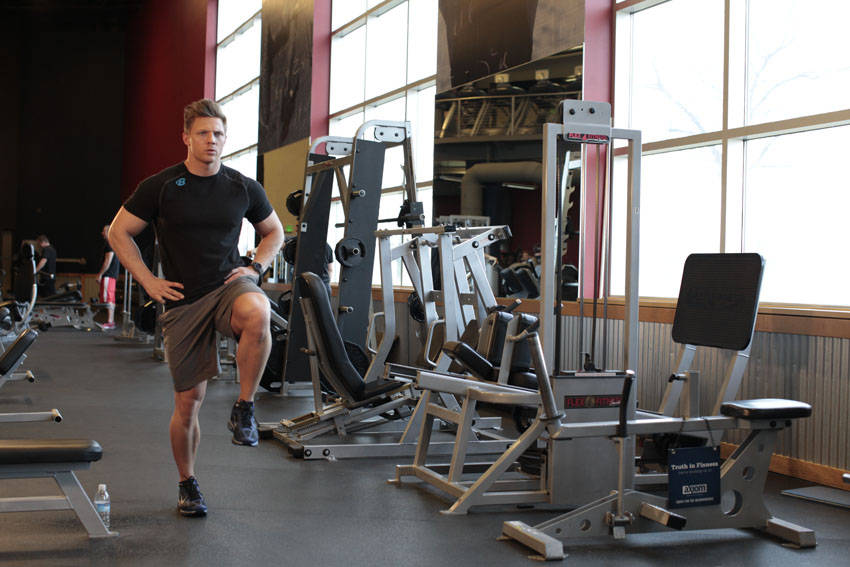
7. Bodyweight Walking Lunge
61% match- Quads
- Bodyweight
- Intermediate
- Compound
How to perform this exercise
- Begin standing with your feet shoulder width apart and your hands on your hips.
- Step forward with one leg, flexing the knees to drop your hips. Descend until your rear knee nearly touches the ground. Your posture should remain upright, and your front knee should stay above the front foot.
- Drive through the heel of your lead foot and extend both knees to raise yourself back up.
- Step forward with your rear foot, repeating the lunge on the opposite leg.
Sets and reps: 3 or 4 sets of 6 to 10 reps on each side.
Why this matches
- Primary muscle: quads, the same as Front Cone Hops (Or Hurdle Hops)
- Equipment: bodyweight only, the same as Front Cone Hops (Or Hurdle Hops)
- Body position: standing, the same as Front Cone Hops (Or Hurdle Hops)
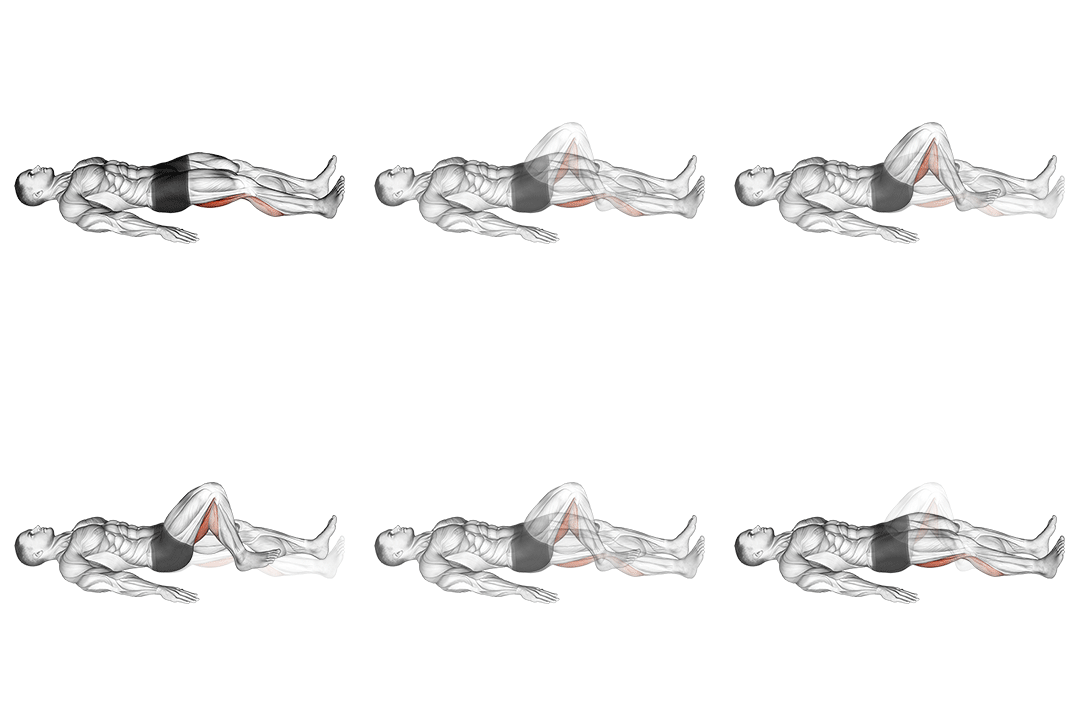
8. Self Assisted Inverse Leg Curl
59% match- Hamstrings
- Bodyweight
- Intermediate
- Isolation
How to perform this exercise
- Lie flat on your back on a mat or bench with your legs extended.
- Place your hands by your sides or under your glutes for support.
- Bend your knees and lift your feet off the ground, bringing your thighs towards your chest.
- Pause for a moment at the top, then slowly lower your legs back to the starting position.
- Repeat for the desired number of repetitions.
Sets and reps: 3 sets of 10 to 15 reps.
Why this matches
- Primary muscle: hamstrings, not quads
- Equipment: bodyweight only, the same as Front Cone Hops (Or Hurdle Hops)
- Body position: kneeling, not standing
- Hamstrings
- Bodyweight
- Beginner
- Isolation
How to perform this exercise
- Lie flat on your back with your legs extended and your arms by your sides.
- Bend your knees and place your feet flat on the ground, hip-width apart.
- Lift your hips off the ground, engaging your glutes and hamstrings.
- Slowly curl your legs towards your glutes, keeping your hips lifted.
- Pause for a moment at the top, then slowly extend your legs back to the starting position.
- Lower your hips back down to the ground.
- Repeat for the desired number of repetitions.
Sets and reps: 3 sets of 8 to 12 reps, and add reps before you add load.
Why this matches
- Primary muscle: hamstrings, not quads
- Equipment: bodyweight only, the same as Front Cone Hops (Or Hurdle Hops)
- Body position: kneeling, not standing
10. Single Leg Platform Slide
58% match- Hamstrings
- Bodyweight
- Intermediate
- Compound
How to perform this exercise
- Start by standing with one foot on a platform or slide board.
- Bend your knee slightly and slide the foot on the platform backward, extending your leg.
- Keep your core engaged and maintain a straight posture throughout the movement.
- Slowly return to the starting position by sliding your foot back to the initial position.
- Repeat the movement for the desired number of repetitions, then switch legs.
Sets and reps: 3 or 4 sets of 6 to 10 reps on each side.
Why this matches
- Primary muscle: hamstrings, not quads
- Equipment: bodyweight only, the same as Front Cone Hops (Or Hurdle Hops)
- Body position: standing, the same as Front Cone Hops (Or Hurdle Hops)
Front Cone Hops (Or Hurdle Hops) FAQ
What muscles does Front Cone Hops (or Hurdle Hops) work?
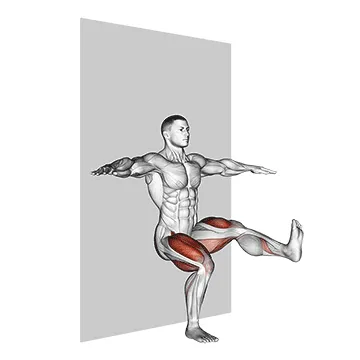
Front cone hops primarily target the quadriceps through rapid knee extension, with the glutes and calves contributing to hip and ankle extension. The hamstrings act eccentrically to decelerate the limb during landing and the movement relies on fast stretch-shortening cycle mechanics (triple extension) for power output.
Find Alternatives for Any Exercise
Search the exercise database and filter the ranked substitutes by the equipment you own.
Similarity scores compare exercise metadata such as movement pattern, muscles, equipment and body position. They are not a safety rating or a check that you own the equipment. Learn about our methodology