Most ab workouts are just endurance contests with better lighting. They tell you whether your midsection can burn, not whether your trunk can keep position when a lift gets heavy, a carry gets uneven, or your hips want to twist.
This 10-minute core test is different. It checks four jobs your core actually has to do: keep the ribs and pelvis stacked, resist side bending, control rotation, and stay tall under uneven load.
The result is not a pass/fail stamp on your fitness. It is a map. If one station breaks down, you know exactly what to train next instead of adding more random crunches and hoping the problem disappears.
What the Test Measures
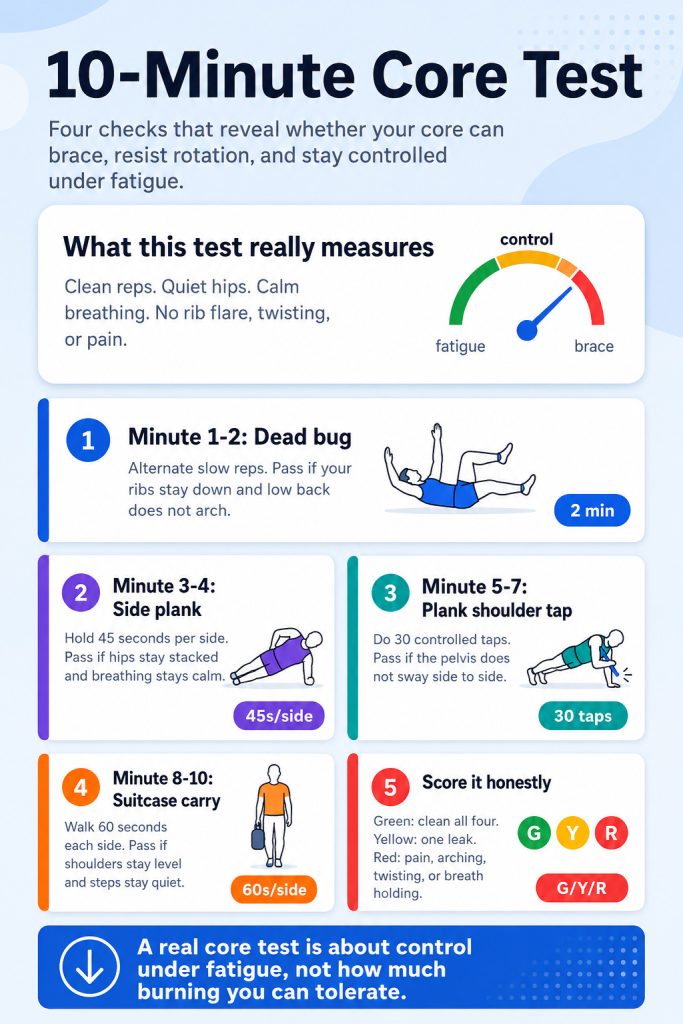
The 10-minute core test uses dead bugs, side planks, plank shoulder taps, and suitcase carries. Together, they check whether you can brace, breathe, resist motion, and maintain posture without pain or sloppy compensation.
Core stability research is not saying crunches are useless. It is saying the trunk has broader jobs than spinal flexion. Reviews by Willardson and Hibbs describe core training as a way to support force transfer, posture, and sport or lifting performance when it is programmed intelligently.
The Test
| Time | Move | Pass standard | Fail signal |
|---|---|---|---|
| 0:00-2:00 | Dead bug | Slow alternating reps, ribs down | Low back arches or ribs flare |
| 2:00-4:00 | Side plank | 45 seconds per side | Hips sag, rotate, or cramp |
| 4:00-7:00 | Plank shoulder tap | 30 slow taps | Pelvis rocks side to side |
| 7:00-10:00 | Suitcase carry | 60 seconds per side | Shoulders tilt or steps get loud |
How to Score It Without Lying to Yourself
A green score means all four stations stayed clean. Yellow means one station leaked but you had no pain. Red means pain, form collapse, breath holding, or a side-to-side difference large enough that it changes the exercise.
Do not rush reps to beat the clock. Speed hides weakness. The whole point is to expose the moment your body tries to solve a core problem with momentum, hip shifting, rib flare, or shoulder tension.
Station 1: Dead Bug
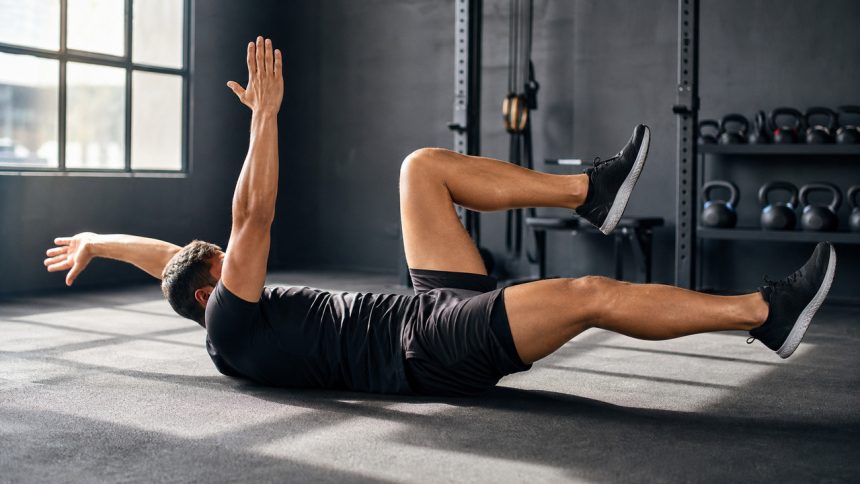
The dead bug is the anti-extension check. Lie on your back, exhale enough to bring the ribs down, and move one arm and the opposite leg without letting the low back pop off the floor.
If you fail here, do not run to harder exercises. Shorten the lever by tapping heels instead of extending the leg. Add a full exhale before each rep. Own the easy version before pretending the hard one is doing something useful.
Station 2: Side Plank
The side plank checks whether the trunk can resist lateral collapse. Stack the ribs over the pelvis and keep the neck relaxed. If the shoulder does all the work, the test stops being a core test and becomes a patience test.
If one side is weaker, train that side first. Match the stronger side to the weaker side’s quality instead of letting the stronger side rack up junk volume.
Station 3: Plank Shoulder Tap
The shoulder tap is the anti-rotation check. Start with feet wider than your hips. Tap slowly. If the pelvis swings, widen the stance, slow down, or put your hands on a bench.
The wall bear hold is a smart regression if taps are too messy. It teaches the same quiet trunk idea without demanding as much shoulder loading.
Station 4: Suitcase Carry
The suitcase carry is where the test becomes more real. Pick up one dumbbell or kettlebell and walk without leaning away from it. Quiet steps matter. A loud, rushed carry usually means the weight is steering you.
If carries expose your weak link, use shorter walks and lighter loads. Build posture first, then load. FitnessVolt’s 3-set core plan can help turn this test into training.
Two-Week Fix Plan
| Weak station | Train this | Prescription |
|---|---|---|
| Dead bug | Heel taps and exhale holds | 3 sets of 6 slow reps per side |
| Side plank | Short side plank repeats | 4 x 15-25 seconds per side |
| Shoulder tap | Incline shoulder taps or bear holds | 3 sets of 20 clean taps |
| Suitcase carry | Light carries | 4 x 20-40 meters per side |
Retest after two weeks. If the same station still fails, make the exercise easier and cleaner. If a different station fails, your weak link moved, which is useful progress.
What This Test Does Not Tell You
It does not tell you whether you have visible abs. Nutrition, body fat, and muscle size decide that. It does not diagnose back pain. It also does not replace progressive training.
If you want a shorter low-impact finisher, use FitnessVolt’s 6-minute Pilates core finisher. If anti-extension is your weak point and your shoulders are ready, the ab wheel guide is a later progression, not step one.
Beginner and Advanced Versions
The test should be strict, but it should not be impossible. Beginners can use easier positions and still get useful information. Advanced lifters can make the test harder, but only if the original version is clean.
| Station | Beginner version | Advanced version |
|---|---|---|
| Dead bug | Heel taps with arms still | Full dead bug with pause |
| Side plank | Knees bent | Long-lever side plank |
| Shoulder tap | Hands on bench | Narrower stance on floor |
| Suitcase carry | Light dumbbell, short distance | Heavier kettlebell, longer carry |
Do not make a test harder just to make it look serious. A cleaner easier test tells you more than an ugly advanced one.
How to Turn the Test Into a Workout
After testing, use the same four stations as a simple training circuit. Pick the two stations that were weakest and train them first. Then finish with the two stations you already control well.
A clean session looks like this: dead bug for 3 sets of 6 reps per side, side plank for 3 sets of 20 to 40 seconds per side, shoulder taps for 3 sets of 16 to 30 taps, and suitcase carries for 4 short walks per side. Rest enough that the next set looks better, not worse.
That is the difference between testing and training. The test exposes the leak. The workout gives you low-drama reps to close it.
How to Program It During a Normal Training Week
Put this core work where it will not sabotage the main lift. For most lifters, that means after upper-body sessions, after easier lower-body sessions, or on short accessory days. Avoid turning it into a max-effort finisher before heavy squats or deadlifts.
Two sessions per week is enough for most people. Session one can focus on dead bug and side plank control. Session two can focus on shoulder taps and carries. Keep the sets clean enough that the last rep looks like the first.
How This Carries Over to Lifting
A better core does not automatically add 50 pounds to your squat, but better trunk control can make your lifts cleaner. Dead bugs teach rib and pelvis position. Side planks teach you not to fold sideways. Shoulder taps teach you to resist twisting. Suitcase carries make bracing show up while you are moving.
That matters most when fatigue hits. Many lifters can brace well for the first rep. Fewer can keep that brace when breathing gets messy, the set gets long, or one side starts working harder than the other.
Where Crunches Fit
Crunches are not banned. They are just incomplete. If your goal is to train spinal flexion or get a local ab pump, crunches can belong in a program. The mistake is treating them as the whole core plan.
A smarter week might include this test-style stability work twice, then a small amount of direct ab work at the end of a session. That gives you both control and hypertrophy work without pretending one exercise category solves everything.
FAQ
Is this test beginner-friendly?
Yes, if scaled. Use shorter side planks, incline shoulder taps, and light carries.
Should my abs burn?
Some fatigue is fine, but burning is not the goal. Clean position is the goal.
How often should I retest?
Every two to four weeks is enough. Train the weak station between tests.
What if I feel back pain?
Stop the test. Pain changes the meaning of the result and may need professional assessment.
Sources
- Willardson, J. M. (2007). Core stability training: applications to sports conditioning programs. Journal of Strength and Conditioning Research, 21(3), 979-985.
- Hibbs, A. E., Thompson, K. G., French, D., Wrigley, A., & Spears, I. (2008). Optimizing performance by improving core stability and core strength. Sports Medicine, 38(12), 995-1008.
- Saeterbakken, A. H., Andersen, V., Behm, D. G., et al. (2021). The role of trunk training for physical fitness and sport-specific performance. Frontiers in Sports and Active Living, 3, 625098.