
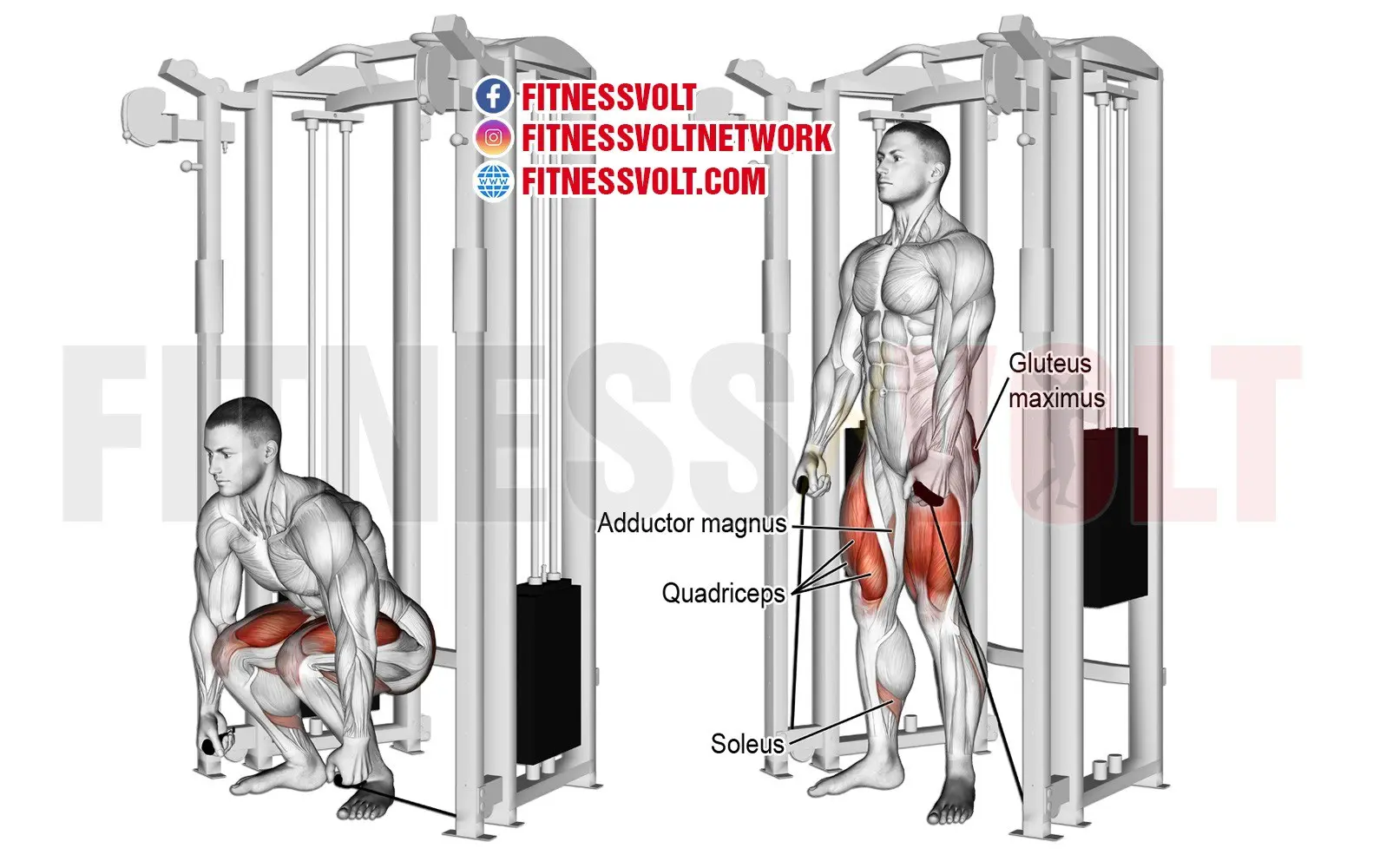
The cable squat is an effective alternative to the barbell squat which will build sufficient muscle and strength in the legs. Now, it’s a compound movement so you’re working several muscles rather than isolating just one, and these muscles include quads, glutes, hamstrings, calves, and core.
But anyone can perform this exercise effectively as cables are great for stabilizing the body during a movement, and they also keep tension on the muscle which is very important for muscle hypertrophy. So, if you’re looking for a good squat variation which is safe and effective, then the cable squat is the perfect exercise.
Exercise Instructions
- Attach two pulleys at the lowest setting on a cable machine. Make sure the cable pulley attachments are located close to each other. Do not use a cable machine with a large distance in between the pulleys.
- Then, stand between both pulleys, bend over with your back straight, and grab both handle attachments.
- Position your feet slightly wider than a shoulder-width distance apart. Keep your knees in line with your heels and don’t let your knees move forward over your feet.
- Now, perform the squat by pushing through your heels until you’re standing erect. Do not lock out your knees at the top. Exhale during this portion of the exercise.
- Then, lower your body down until your upper legs are at or slightly below parallel to the floor.
- Repeat for the desired number of reps.
Variations & Tips:
- Make sure to use a cable machine where the pulleys are located close to each other. You don’t want to use a machine where the cables are far away from each other as this will not work.
- The cable squat is the exact same movement as a standard squat except you’re holding the cables by your sides.
- You only need to squat just below parallel or right at parallel for an effective leg workout.
- Do not let your knees pass your feet during the squat. Your knees should be in line with your heels.
- Push with your heels to perform the squat as this will protect your knees from injury.
- The cable squat works the quads and glutes as primary muscles but it also works the hamstrings, calves, and core as secondary muscles.
Watch: How to do the cable squat
Interested in measuring your progress? Check out our strength standards for Barbell Hack Squat, Dumbbell Hang Clean, Power Clean, and more exercises.