
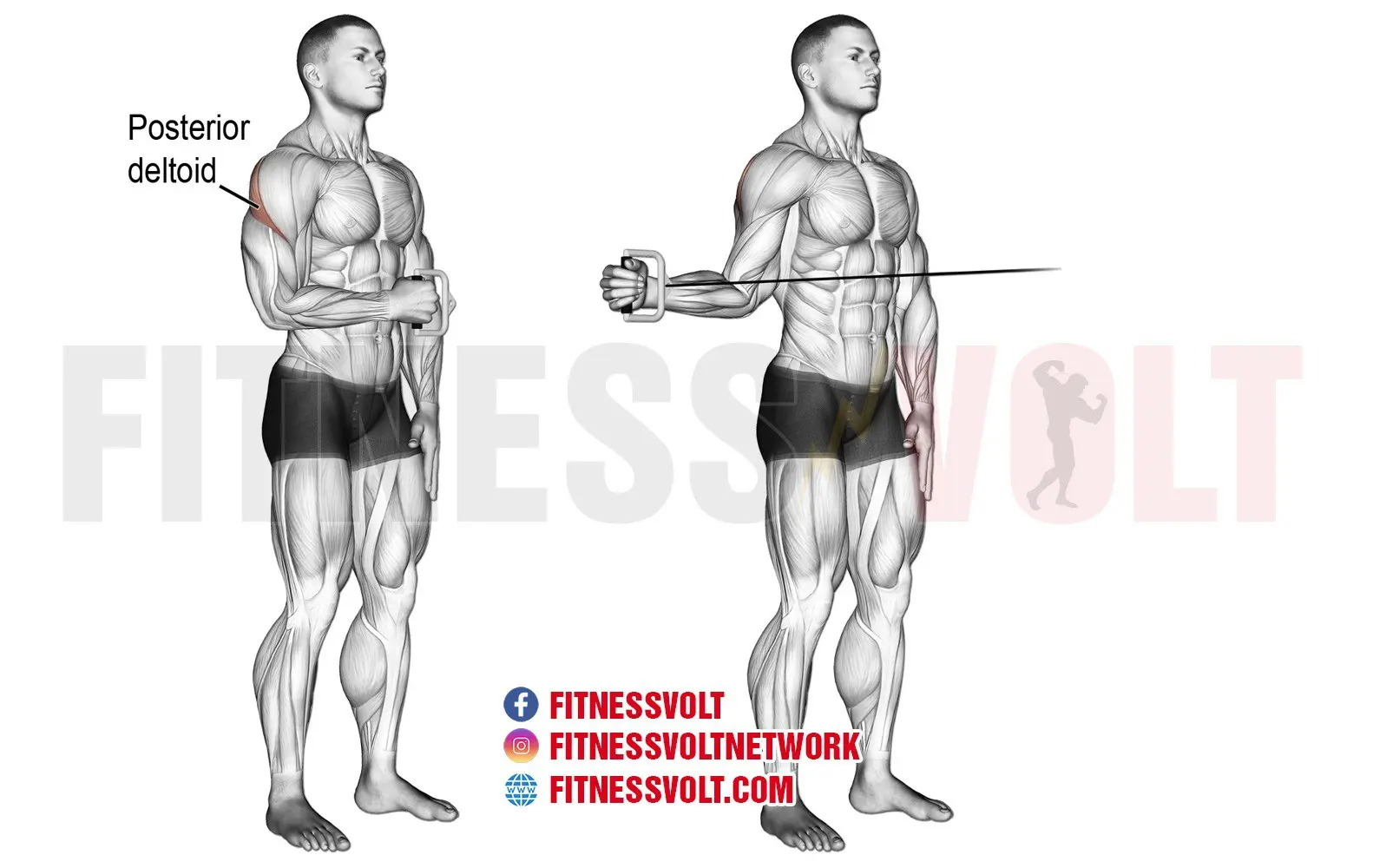
The cable external shoulder rotation trains the muscles that rotate the upper arm away from the body, mainly the infraspinatus and teres minor. Use it as precise, light-load accessory work. Shoulder pain, weakness, or instability requires assessment beyond an exercise tutorial.
Set the pulley at elbow height, keep the upper arm close to your side, and rotate the forearm away from the cable while the torso stays still. The cable provides resistance across the range. That loading characteristic can make the movement easy to control, but it does not establish a muscle-growth advantage over every other tool.
| Muscle | Role |
|---|---|
| Infraspinatus | Produces external rotation and helps stabilize the head of the humerus. |
| Teres minor | Assists external rotation, with its contribution changing as arm position changes. |
| Posterior deltoid | Can assist, especially when the load is too heavy or the upper arm moves away from the torso. |
| Supraspinatus and other cuff muscles | Contribute to shoulder-joint stability rather than acting as the main external rotators in this setup. |
| Scapular muscles | Hold the shoulder blade in a workable position while the upper arm rotates. |
In a study of 14 healthy participants performing external rotation at 90 degrees of shoulder abduction with different levels of arm support, the infraspinatus contributed strongly to rotation while several other shoulder muscles took larger stabilization roles. That arm position differs from the arm-at-side version taught here, so the result helps explain muscle roles without making this setup a universal rehabilitation prescription. See the study on PubMed.
How to Do Cable External Rotation
Face perpendicular to a cable set near elbow height and use a load that allows the upper arm and torso to remain still. The movement is small: rotate through the shoulder until another joint or the trunk begins to compensate, then return slowly.
- Set the pulley: Place a single handle at approximately elbow height.
- Stand side-on: The working arm should be farther from the weight stack so the cable crosses in front of your body.
- Position the elbow: Bend it to about 90 degrees and keep the upper arm close to your side. A small folded towel between the elbow and ribs can help you monitor position.
- Brace: Stand tall with the ribs over the pelvis and the shoulder relaxed rather than shrugged.
- Rotate: Move the forearm away from the cable while the elbow stays near the same spot.
- Stop at your controlled limit: End the rep before the torso turns, the wrist bends, or the shoulder rolls forward.
- Return slowly: Let the forearm move back across the body under control without allowing the weight stack to pull you around.
Watch the movement
Setup Checklist
Before the first repetition, check the pulley, elbow, torso, range, and load. A useful setup keeps the cable close to horizontal and lets the shoulder rotate while the wrist, ribs, and pelvis remain quiet.
| Checkpoint | What to look for | Adjust if needed |
|---|---|---|
| Cable height | Cable tracks roughly level with the forearm and elbow | Move the pulley up or down |
| Elbow position | Upper arm stays close to the torso | Add a towel roll or reduce load |
| Torso | Chest and pelvis remain facing forward | Use a split stance and brace |
| Range | Shoulder rotates without the wrist or trunk taking over | Shorten the range |
| Load | Last rep looks like the first | Lower the pin one or more plates |
Common Mistakes
Extra weight often hides the rotation the exercise is meant to train. Reduce the load or range when the elbow drifts, the torso turns, the shoulder shrugs, or the wrist bends to finish the repetition.
Using too much weight
Heavy loading often turns the exercise into a torso rotation or rear-delt movement. Use enough resistance to feel the back of the shoulder working while the elbow and trunk remain still.
Pulling the elbow away from the ribs
Letting the elbow drift changes the shoulder position and adds other actions. Keep it close for this version; use a deliberately abducted variation when that is the goal.
Twisting through the waist
The forearm should move because the upper arm rotates in the shoulder socket. If your sternum turns, the load is too high or the range is too long.
Forcing the end range
Use the largest range that preserves the shoulder, elbow, wrist, and torso positions. End the rep as soon as one of them changes.
Squeezing the shoulder blades together
The shoulder blade should remain controlled, but hard retraction is not the main action. Over-pinching can turn the drill into an upper-back exercise.
How Heavy Should You Go?
External rotation is normally trained with less resistance than presses or rows. The ranges below are practical coaching starting points, not prescriptions tested by the cited studies.
| Use | Starting range | Priority |
|---|---|---|
| Technique practice or warm-up | 1 to 2 sets of 10 to 15 per side | Easy effort and precise rotation |
| Accessory strength | 2 to 4 sets of 8 to 15 per side | Progress while torso and elbow stay fixed |
| Higher-rep shoulder work | 2 to 3 sets of 15 to 25 per side | No shrugging or shortened range as fatigue builds |
Progress by adding a rep or using a slightly heavier pin only when the movement remains clean. A 2025 study in 12 healthy men found load-dependent differences in muscle activity and torque after elastic-band exercise matched for calculated external work at 90 degrees of shoulder abduction. That position differs from the arm-at-side version taught here, and the study does not establish one ideal resistance for everyone. See the study abstract.
Where It Fits in Training
Use cable external rotations early in a session as low-fatigue practice or later as shoulder accessory work. They can sit beside pressing and rowing without replacing either. Our infraspinatus exercise guide covers other external-rotation positions, while the shoulder workout guide owns complete delt programming.
For general strength training, place the exercise where you can perform precise, pain-free repetitions without reducing the quality of your main presses and pulls. A clinician-directed rehabilitation plan may use a different position, range, dose, or progression based on the diagnosis and stage of recovery.
Cable External Rotation Variations
Band, dumbbell, supported, and abducted versions change the resistance curve or arm position. Keep the arm-at-side cable version as the reference movement, then choose a variation for available equipment or a deliberately different shoulder position.
| Variation | Equipment | Main difference |
|---|---|---|
| Resistance-band external rotation | Band | Portable, with resistance increasing as the band stretches |
| Side-lying dumbbell external rotation | Dumbbell and bench | Gravity provides resistance with the arm supported by the torso |
| Supported cable external rotation | Cable and bench or pad | Support reduces the need to hold the arm position |
| External rotation at 90 degrees abduction | Cable or band | Changes the arm position and muscular contribution; use lighter loading |
| Face pull with external rotation | Cable or band | Combines a pull, scapular motion, and rotation rather than isolating rotation |
A face pull combines horizontal pulling, shoulder-blade motion, and external rotation, so it trains a broader movement than this focused drill. For options that train those combined actions, use our face pull alternatives guide.
Arm position matters. A small intramuscular EMG study of 10 healthy participants found that side-lying external rotation produced high infraspinatus and teres minor activity among the positions tested. That finding compares acute muscle activity, not long-term outcomes or injury rates. Read the study on PubMed.
When to Stop or Seek Assessment
Light muscular effort at the back of the shoulder is expected. Stop if the exercise causes sharp pain, catching, instability, numbness, or symptoms that worsen after the session. Pain after trauma, clear weakness, repeated dislocation, or persistent loss of motion needs qualified assessment rather than a generic exercise tutorial.
Cable external rotation can train a movement and its muscles. It cannot diagnose a rotator-cuff injury, correct posture on its own, or guarantee protection from shoulder problems.
Sources
- Tardo, D. T., Halaki, M., Cathers, I., and Ginn, K. A. (2013). Rotator cuff muscles perform different functional roles during shoulder external rotation exercises. Clinical Anatomy. DOI: 10.1002/ca.22128.
- Reinold, M. M., et al. (2004). Electromyographic analysis of the rotator cuff and deltoid musculature during common shoulder external rotation exercises. Journal of Orthopaedic and Sports Physical Therapy. DOI: 10.2519/jospt.2004.34.7.385.
- Saeki, J., et al. (2025). Effect of different load of shoulder external rotation exercises on changes in muscle activity and exerted torque. Frontiers in Sports and Active Living. DOI: 10.3389/fspor.2025.1527296.
Interested in measuring your progress? Check out our strength standards for Dumbbell Face Pull, Machine Reverse Fly, and more exercises.