
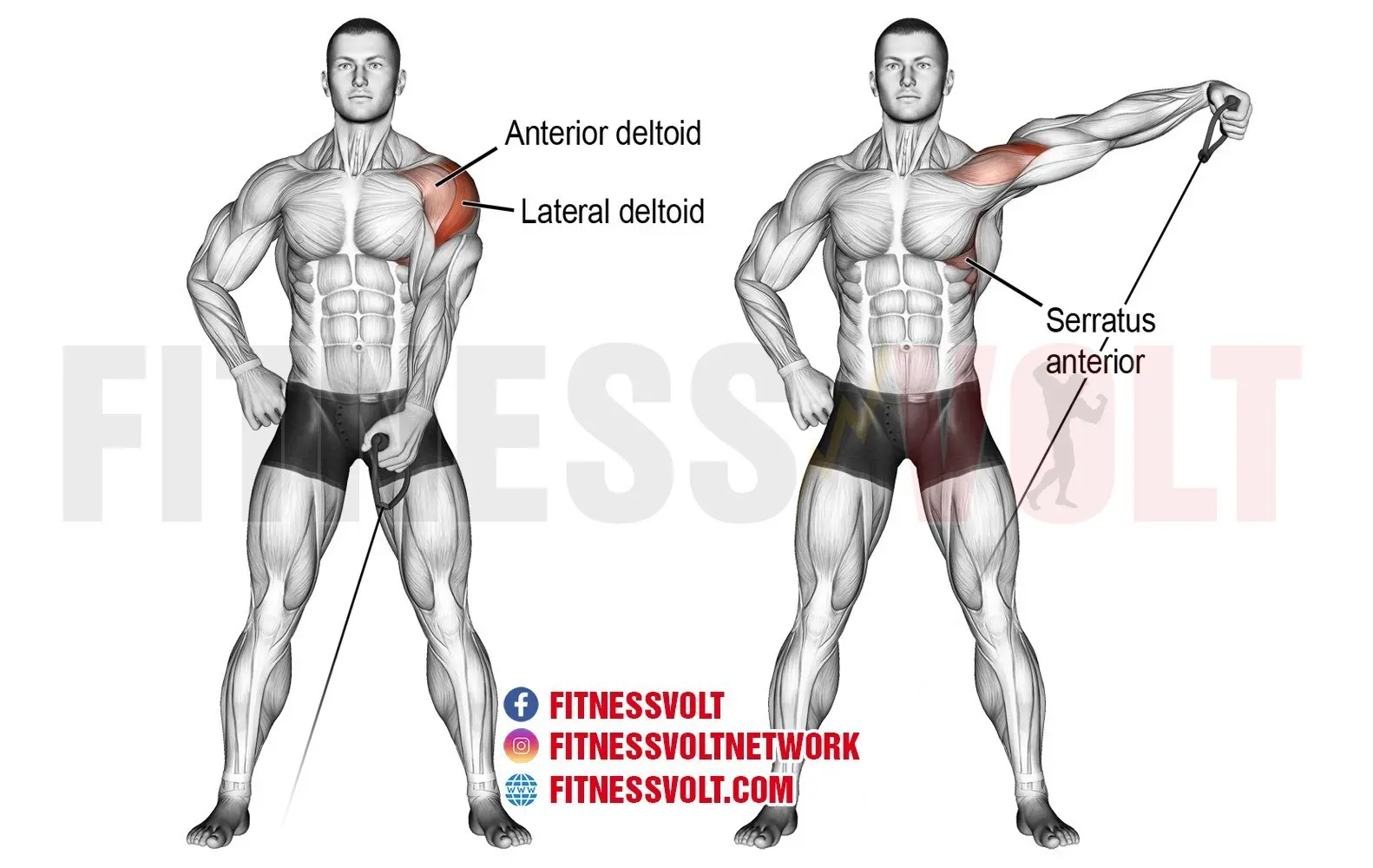
The cable one-arm lateral raise is an isolation exercise for the lateral (Outer) head of the shoulders. It’s a very effective movement for developing roundness and wideness in the deltoids so it’s always a good idea to include this exercise in your shoulder routine.
Now, using cables keeps constant tension on the muscles which is very important for muscle hypertrophy, and that’s why the cable lateral raise is so effective. But this exercise is often forgotten because dumbbell side lateral raises are a very popular alternative and a lot of people believe that only free weights should be used to build muscle and strength.
But this is untrue and you should definitely substitute the dumbbell raise for the cable raise every so often.
In this Exercise
- Target Muscles Group: Lateral Deltoid
- Type: Strength
- Mechanics: Isolation
- Equipment: Cable pulley machine
- Difficulty: Beginner
Exercise Instructions
- Attach a single grip handle to the lowest part of the cable pulley.
- Stand with your left side to the single-grip cable attachment, then bend over and grab the handle with your right arm.
- Now, stand up in the same position, keep your back straight, and feet about shoulder-width apart.
- Keep your arms slightly bent and lift the pulley up and across your body until your right hand is straight out and level with your shoulders. Exhale during the movement.
- Then slowly lower the cable pulley back down to the starting position while inhaling.
- Then turn your body so your right side is facing the cable pulley and perform the exercise with your left arm.
- Repeat by alternating your arms for each set.
Variations & Tips
- You can also perform this exercise with dumbbells.
- Perform the movement nice and slow to really work the lateral deltoid.
- Always keep your elbows slightly bent to prevent strain on the shoulder joints.
- Choose a light weight to start so you can feel the shoulder muscle working. Many people go too heavy and end up cheating which takes tension off the lateral shoulder head.
Watch: How to do the cable one-arm lateral raise
Interested in measuring your progress? Check out our strength standards for Tricep Extension, Dumbbell Lateral Raise, Cheat Curl, and more exercises.