Glute amnesia is not just a common problem; it’s a potentially serious one that is typically caused by prolonged sitting and a lack of regular physical activity. The good news is that it can be fixed.
With sedentary desk jobs dominating our livelihoods and exercise relegated to a matter of choice, modern humans have become heavier and less physically fit than our ancestors.
One potential drawback of chronic sedentarism is glute amnesia, a condition that can significantly impact your daily life. It’s characterized by weak, underactive gluteus maximus muscles and is a leading cause of lower back pain, hip and knee pain, and general weakness.
When your glutes are weak, the work that they should be doing falls on other muscles, putting extra stress on nearby joints. Like a weak link in a chain, sleepy glutes can affect your entire body.
There are several simple yet effective exercises you can do to fix this condition. In this guide, we go over everything you need to know about glute amnesia.
Recent Updates: On May 24, 2024, Fitness Volt’s Senior Editor, Vidur Saini (ACE-CPT), refined and restructured this article to improve its overall presentation and deliver a more engaging reader experience. We also added actionable expert tips that you can implement immediately.
Common Causes of Glute Amnesia
Glute amnesia is the result of a combination of factors, such as:
Prolonged Sitting
The leading cause of glute amnesia is something you are probably doing right now — sitting. When you sit in a chair, your hips are flexed, putting your glutes into a stretched position. Prolonged stretching relaxes your glutes, inhibiting and reducing their contractility, ultimately weakening them.
Additionally, keeping your glutes stretched for extended periods impairs blood flow to these critical muscles.
Sedentary Lifestyle
Even if you are a regular exerciser, you might still fall into the category of being sedentary. After all, there are 168 hours in a week, and three to five hours of exercise won’t really make much of a dent in an otherwise inactive lifestyle.
Your workouts are undoubtedly doing you good and can help you get fit, lose weight, and build muscle. However, all those hours you spend sitting mean that your glutes probably aren’t getting the regular stimulus they need to wake up and stay awake.
Poorly Designed Workout Programs
A poorly designed workout can do more harm than good — especially if you have weak, inhibited glutes. Most fitness experts agree that exercises like squats, deadlifts, lunges, and barbell hip thrusts are great for building a more muscular butt.
However, if you’re dealing with amnesiac glutes, you might find yourself essentially flogging a dead horse; you’ll never get the results you want from these exercises.
Many exercises are performed while seated or lying down, which can take your glutes out of your workout entirely. Isolation exercises like leg extensions and leg curls don’t even involve your glutes. Needless to say, if you aren’t actively using your glutes, they have no real incentive to get stronger.
Specific Injuries and Conditions
Glute amnesia isn’t always caused by bad habits or a sedentary lifestyle. Sometimes, it’s the result of an injury or underlying medical conditions. Here are some of the other causes of weak, inhibited glutes:
Nerve Damage
Injuries or conditions that affect the nerves supplying the glutes can lead to glute amnesia. A trauma that damages the nerves or conditions like piriformis syndrome can partially or entirely block the nerve signals that control the glutes, making it harder for them to work correctly. This can leave the muscles weak and inhibited.
Sciatica
Sciatica is more than just a pain in the back; it can cause glute amnesia, too. This condition involves irritation or compression of the sciatic nerve, leading to pain that radiates down the leg. In addition to the discomfort, this may also affect the glutes, preventing them from contracting as they should.
Muscle Imbalances And Overuse Injuries
Muscle imbalances elsewhere in the body can throw your whole system out of whack. Tight hip flexors or overworked lower back muscles can reduce glute contractility and cause weakness. In the same way, overuse injuries from repetitive motions or sports can lead to localized fatigue and weakness in the glutes, setting the stage for glute amnesia.
Medical Conditions and Surgeries
Medical conditions and surgeries involving the hip or lower back can also lead to glute amnesia. For example, lengthy post-surgical bedrest can significantly reduce glute activity. If you don’t use ’em, you’ll lose ’em! At the same time, chronic conditions like arthritis may impede the function of these essential muscles.
10 Best Muscle Activation Exercises for Glute Amnesia
While glute amnesia, general atrophy, and weakness of this critical muscle group are common, it’s not irreparable. However, it’ll take more than the latest butt-shaping workout to alleviate the problem. Instead, you first need to wake your glutes up so that any subsequent workouts can work their magic.
With that in mind, here are the best muscle activation exercises for curing your amnesiac glutes.
1. Single Leg Standing
| Sets & Reps: | 3 x 30-60 seconds per leg |
| Equipment Needed: | None |
| Target Muscles: | Gluteus medius, gluteus minimus, core stabilizers |
Standing on one leg might seem like an odd way to fire up your glutes, but it’s very effective and challenging. Standing on one leg forces your glutes to work as stabilizers to keep your pelvis level. You won’t feel much glute activity at first, but after 20-30 seconds, expect to experience a deep burn in your hard-worked glutes.
“Maintain a slight posterior pelvic tilt to further engage the gluteal muscles and prevent overarching of the lower back,” recommends Saini.
Steps:
- Stand in front of a mirror with your feet together and shoulders relaxed. Brace your core.
- Bend one leg and lift your foot off the ground.
- Using the mirror for guidance, keep your hips and shoulders level and stationary.
- Hold until you feel your glutes starting to work.
- Switch sides and repeat.
Coach Tips:
- Keep your supporting knee slightly bent for better balance.
- You can lift your non-supporting knee forward or your foot backward as preferred.
- Use a handrail for support if necessary, but try to rely on it less as your balance improves.
2. Standing Hip Drive
| Sets & Reps: | 3 x 10-15 per leg |
| Equipment Needed: | Wall or sturdy surface |
| Target Muscles: | Gluteus maximus, hamstrings |
This exercise offers a simple way to fire up your glutes, one side at a time. Best of all, there is no need to get down on the floor for this glute activation drill, making it ideal for warm-ups and people with mobility issues.
Saini suggests driving your hips forward and consciously squeezing your glutes at the movement’s peak to maximize muscle activation and enhance mind-muscle connection.
Steps:
- Stand a short distance from a smooth wall. Plant one foot firmly on the floor. Brace your core.
- Bend your opposite leg and place your knee against the wall so it’s slightly lower than hip height. Use your arms for balance if required.
- Next, extend your weight-bearing leg and drive your knee into the wall. Feel the tension radiating down your leg from your glute.
- Hold this position for 10-15 seconds and then relax.
- Switch sides and repeat.
Coach Tips:
- Do this exercise anytime you need to wake up your glutes, e.g., after long periods of sitting.
- Think about driving your heel down and back to maximize glute engagement.
- Do not hold your breath, as doing so can make you feel dizzy and could elevate your blood pressure.
3. Gluteus Medius Wall Lean
| Sets & Reps: | 3 x 15-20 per leg |
| Equipment Needed: | Wall |
| Target Muscles: | Gluteus medius, gluteus minimus |
While the first exercise was all about hip extension and firing up your gluteus maximus, this movement focuses on hip abduction and targets your gluteus minimus and medius. Like the standing hip drive, this exercise is performed on your feet. It provides an ideal way to wake up your glutes and minimize the damaging effects of prolonged sitting.
Steps:
- Stand sideways next to a smooth wall and lean your hips against it. Plant your outermost foot firmly on the floor and bend your supporting knee slightly. Flex your inner leg and lift your non-weight-bearing leg off the floor.
- Push outward with your supporting foot and drive your hip into the wall.
- Hold this position for 10-15 seconds and then relax.
- Switch sides and repeat.
Coach Tips:
- Do this exercise for the same duration on both legs.
- Go barefoot if your ankles tend to roll outward.
- Place a pad between your hips and the wall if necessary.
4. Booty Band Half Squats
| Sets & Reps: | 3 x 10-15 |
| Equipment Needed: | Booty band (resistance band) |
| Target Muscles: | Gluteus maximus, quadriceps, hamstrings |
Almost every glute workout of any merit involves squats. However, until your glutes are firing correctly, you probably aren’t ready for ass-to-the-grass squats. In fact, ATG squats could cause more harm than good to glute amnesiacs. This preparatory exercise will help wake up your glutes and prepare your lower body for more demanding squat variations.
Drive through your heels as you come up from the squat position to emphasize glute activation and minimize quad dominance, cues Saini.
Steps:
- Put a booty band around your legs, just above or just below your knees. Step out into a shoulder-width stance, toes turned slightly outward. Push your knees out against the resistance offered by the band. Brace your core.
- Bend your knees, push your hips back, and squat down to about 45 degrees of knee flexion. Maintain the outward pressure against the band.
- Stand back up and repeat.
Coach Tips:
- Place the band above your knees to make this exercise easier.
- Increase squat depth as your strength and mobility improve.
- Do not allow your knees to travel inward — keep them stable.
5. Clamshells Against a Wall
| Sets & Reps: | 3 x 15-20 per leg |
| Equipment Needed: | Wall |
| Target Muscles: | Gluteus medius, gluteus minimus |
External hip rotation is one crucial but often overlooked function of the gluteal muscles. While you might not do this movement often, it’s critical for hip and knee joint health. If you tend to walk with your knees or toes pointing inward, a lack of external rotation strength could be the cause. Clamshells against a wall are a great way to wake up those sleeping external hip rotators.
A comparative study published in the Journal of Orthopaedic and Sports Physical Therapy found that side-lying hip abduction is the best exercise for gluteus medius. (1)
Saini recommends adding a mini band around your thighs just above your knees for an added challenge.
Steps:
- Lie on your side with your back flat against a wall. Bend your legs and place the soles of your feet against the wall, too.
- Without leaning forward or backward, lift your uppermost knee up and out toward the wall.
- Slowly return to the starting position and repeat.
- Switch legs and do the same number of reps on both sides.
Coach Tips:
- Rest your head on your hand or outstretched arm for comfort.
- Place a folded mat under your hips.
- Do not let your hips or back move away from the wall.
6. Bird-Dogs
| Sets & Reps: | 3 x 10-12 per side |
| Equipment Needed: | None |
| Target Muscles: | Gluteus maximus, core stabilizers, shoulder stabilizers |
The bird-dog is a one-stop shop for activating your glutes, strengthening your lower back, and engaging your core. It’s so valuable that it should be compulsory in your routine. Daily bird-dogs can help alleviate many of the problems associated with prolonged sitting, including the dreaded glute amnesia.
You must maintain a neutral spine throughout the movement by engaging your core muscles. It prevents excessive lower back arching and ensures optimal glute activation.
Steps:
- Kneel on all fours so that your hands are directly below your shoulders and your knees are beneath your hips. Brace your core and rotate your arms outward to “screw” your hands into the floor and stabilize your shoulders.
- Extend your left arm and right leg out until they are parallel to the floor. Pause briefly, feeling your glutes, lower back, upper back, shoulders, and core all working together.
- Lower your arm and leg, and repeat.
- Switch sides and do the same number of reps on the opposite side.
Coach Tips:
- You can also do this exercise with an alternating arm and leg action if preferred.
- Move slowly to avoid using momentum instead of your muscles to perform the exercise.
- Take care not to lift your arm or leg too high, as doing so could hyperextend your hips, lower back, or shoulders, which could cause joint pain.
7. Glute Bridge
| Sets & Reps: | 3 x 10-15 |
| Equipment Needed: | None (can progress to barbell) |
| Target Muscles: | Gluteus maximus, hamstrings |
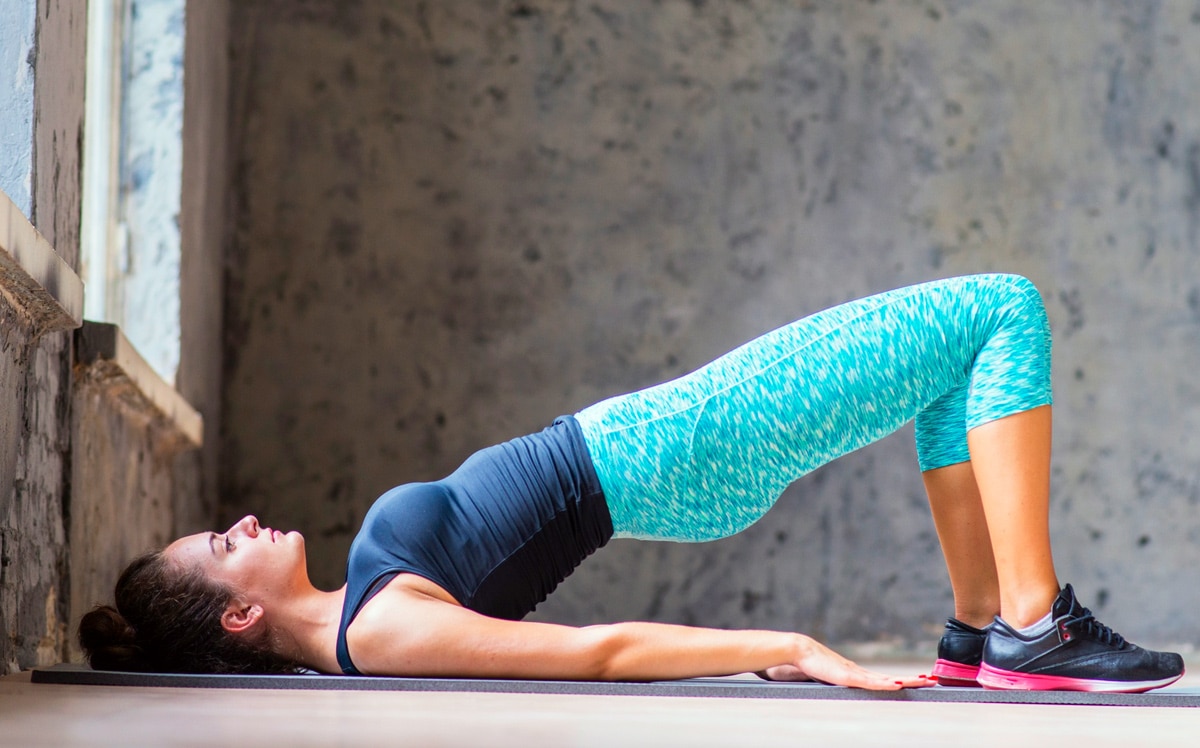
Most people are familiar with glute bridges but do them for reps to work their hips and hamstrings. This version is isometric or static, so you can concentrate on improving your mind-muscle connection and learn to switch your glutes on at will. Doing this exercise before lunges, squats, and step-ups will make these traditional leg exercises much safer and more effective.
Coach Tips:
- Lie on your back with your legs bent and feet flat. Brace your core.
- Push your feet into the floor and lift your hips up so your knees, hips, and shoulders form a straight line.
- Contract your glutes as hard as possible and hold this position for 15-30 seconds.
- Lower your hips back to the floor.
Coach Tips:
- Use a booty band to increase hip abductor engagement.
- Take care not to lift your hips too high, as that can cause hyperextension of the spine.
- Contract your glutes as hard as you can, picturing them as tightly clenched fists.
Read also glute bridge alternatives
8. Lateral Band Walk
| Sets & Reps: | 3 x 10-15 steps each direction |
| Equipment Needed: | Resistance band |
| Target Muscles: | Gluteus medius, gluteus minimus |
Lateral band walks are the dynamic wake-up call your glutes need before activities like running, jumping, squatting, and lunging. Because it involves movement, this is an excellent exercise for warm-ups. It’s especially useful for anyone who plays sports that require lateral movements, e.g., soccer, tennis, football, hockey, etc.
“Pick a resistance band according to your experience level,” says Saini. “Beginners should start with a lighter band, whereas more advanced athletes can challenge themselves with the heaviest band.”
Steps:
- Put a booty band around your legs, just above or just below your knees. Bend your legs slightly and adopt an athletic stance.
- Step out to the side against the resistance offered by the band. Bring your feet together and step out again.
- Continue stepping in one direction for the desired number of reps, and then return the way you came.
Coach Tips:
- Hold your arms out in front of you to help keep your chest up.
- Keep your feet apart throughout to maintain tension on your glutes.
- Place the band higher on your legs to make this exercise easier.
9. Frog Pumps
| Sets & Reps: | 3 x 15-20 |
| Equipment Needed: | None |
| Target Muscles: | Gluteus maximus, hamstrings |
Frog pumps combine hip extension with external rotation to provide a time-efficient way to increase engagement throughout the entire gluteal region. This exercise is quite challenging, which is why it’s near the end of our list of glute activation exercises. Only attempt this movement if your glutes are already coming back online.
Saini proposes placing a yoga block or similar object under your feet to elevate your heels, increase your range of motion, and maximize glute activation.
Steps:
- Lie on your back with your legs bent and the soles of your feet together. Press your knees apart.
- Drive the outside of your feet into the floor and lift your hips as high as possible without hyperextending your lower back.
- Lower your hips back to the floor and repeat.
Coach Tips:
- Keep your core braced throughout to minimize stress on your lower back.
- Take care not to hyperextend your hips or lower back; stay within a safe, comfortable range of motion.
- Bend your legs more or less to see what position feels most effective and comfortable.
10. Bodyweight Single-Leg Romanian Deadlift
| Sets & Reps: | 3 x 8-12 per leg |
| Equipment Needed: | None |
| Target Muscles: | Gluteus maximus, hamstrings, core stabilizers |
Standing on one leg forces you to use your deep core muscles to stabilize your pelvis. That’s what makes single-leg exercises so good for strengthening your glutes. This exercise also involves a pronounced hip hinge, further increasing glute activation. Done using just your body weight, this is an effective and challenging way to wake up and strengthen your entire glute complex.
The same study mentioned above also concluded that single-limb deadlift exercises led to the greatest activation of the gluteus maximus. (1)
Steps:
- Stand with your feet together, knees slightly bent for balance. Shift your weight over onto one side.
- Hinging from your hips, lean forward and extend your other leg out behind you for balance.
- Reach down to the floor in front of you.
- Consciously contracting your glutes, pull your upper body upright and lower your outstretched leg.
- Continue for the desired number of reps and then switch sides.
Coach Tips:
- Avoid rounding your lower back.
- Lean against a handrail or similar for support if required.
- Keep both feet on the floor, one in front of the other, for increased stability. This is called a B-stance single-leg Romanian deadlift.
Integrating Glute Activation Exercises into Your Routine
It’s not enough to do the occasional glute activation exercise and expect your glute amnesia to be cured. Prolonged sitting and inactivity mean that your glutes need a much louder wake-up call if you want to return them to their high-functioning best.
Here are some practical tips for integrating glute activations into your daily routine:
Include Glute Activation Exercises in Your Warm-Ups:
Warm-ups prepare your body for the more demanding work to come. By incorporating glute activation exercises such as glute bridges or clamshells, you’re targeting those sleepy muscles and getting them ready to fire.
Utilize Supersets With Glute Activation Exercises:
For a targeted glute pump, try supersetting or pairing a glute engagement exercise with a traditional lower body exercise. For example, try doing booty band half squats before Romanian deadlifts. This will prime your glutes for the second exercise, boosting your workout performance.
Use Glute Activation Exercises in Place of Your Current Lower Body Workout:
If your glutes are feeling particularly sleepy, why not dedicate an entire workout to them? Replacing your regular lower body routine with a glute-focused workout will give your backside the attention it needs. Remember, a well-defined butt doesn’t just look good; it performs better too!
Do Daily Glute Activation Mini-Workouts:
You don’t have to spend hours in the gym to wake up your glutes. A quick daily mini-workout will provide the stimulus needed to keep those muscles awake and alert. Think of it as your daily cup of coffee for your glutes — energizing and essential!
Perform Glute Activation Exercises to Break Up Long Periods of Sitting:
Sitting too long puts your glutes to sleep, but exercises like standing leg lifts or even squeezing your glutes while at your desk can reverse that trend. Make it a habit to break up those periods of sitting with a bit of glute activation. It’s a small change that could pay dividends for your overall posture and performance.
Look for Ways to Incorporate Glute Activation Exercises into Your Day:
Be inventive! Who says glute activation has to be confined to the gym? Try standing on one leg while waiting for your coffee to brew to incorporate glute awakening exercises into your day. Keep an eye out for these chances to give your glutes a gentle nudge, reminding them they have work to do!
Glute Anatomy
Have you ever wondered what that muscle is you’re sitting on? It’s your glutes! But this muscle is more than just a cushion; it’s also the engine that powers almost every significant movement you make. However, it doesn’t work alone. Let’s dive into the anatomy of these mighty muscles and discover what makes them so crucial.

Gluteus Maximus
The gluteus maximus, or glutes for short, is not only the largest muscle in the human body but also one of the strongest. However, because of glute amnesia, this is not always the case. You’re currently sitting on your glutes, as they’re located on the back of your hips. The glutes are a multifunctional muscle with several essential functions, including hip extension, external rotation, abduction, adduction, and stabilization.
The ability of the gluteus maximus to perform these varied functions is due to its large size and the way its fibers are oriented. Different parts of the muscle can be recruited for different actions, making it an incredibly versatile and essential muscle in various physical activities and postures.
Gluteus Medius
Located near the iliac crest of the pelvis, above and beneath the gluteus maximus, the gluteus medius is a small but no less vital member of the glute family. It functions alongside the gluteus maximus and has several of the same functions:
- Hip abduction
- Hip rotation
- Pelvis stabilization
Weak gluteus medius can cause your knees to cave in when you walk, run, lunge, or squat, putting even more stress on what is already a severely overworked joint.
Gluteus Minimus
Gluteus minimus is the smallest of the three glute muscles. However, don’t think its diminutive size means it’s not important. The gluteus minimus is located toward the back of the hip and works with the other glutes to affect the hip. Its functions are:
- Hip abduction
- Hip medial rotation
- Pelvis stabilization
Bonus Glute Muscle: Tensor Fascia Latae
The tensor fascia latae, or TFL, is considered part of the glute complex, even though it doesn’t share the same name. The TFL is a biaxial muscle, meaning it crosses two joints — the hip and the knee. As such, it can affect both of these joints. As part of the glute group, TFL plays an essential role in the following:
- Hip internal rotation
- Hip abduction
- Pelvis stabilization
Glute amnesia can affect all these muscles, but because they usually work together, you can stimulate and wake up all of the components of the glute complex with the 10 simple exercises mentioned above.
FAQs
1. How can I avoid developing glute amnesia?
As glute amnesia is mainly the result of prolonged sitting and sedentarism, the best way to prevent it is to sit less and be more physically active. Standing desks are a great option, as are frequent breaks from sitting. Walking, taking the stairs, and specific glute exercises will help, too.
However, it’s important to note that dysfunctional glutes don’t only happen because of lack of use. There are several medical conditions that can affect glute contractility, and traumatic injury can also be a cause, e.g., nerve damage from an automobile accident.
2. How long does it take to see results from these exercises?
How quickly you experience results from your glute amnesia training will depend on how often you work out and how deconditioned your glutes were in the first place. However, you should start to notice the benefits after four to six weeks.
3. What are some signs that I might have glute amnesia?
Possible signs you’re suffering from glute amnesia include:
- Recurrent lower back pain
- Difficulty performing lower body exercises such as lunges, squats, and deadlifts
- You feel glutes exercises in your back or hamstrings and not your butt
- You find it hard to tense your glutes voluntarily
- Your glutes are not responding to your workouts
- Your glutes are weak, soft, or small
If you experience several of these symptoms, you may be suffering from glute amnesia. The good news is that this is a highly treatable condition that responds well to exercise and training.
4. Are there any risks involved in these exercises?
While there is a risk to any exercise, these glute activation drills are very safe. For example, performed correctly, there should be very little stress on your hips, knees, or back, and the movements themselves are easy to learn.
The main risks come from overextending your hips and spine or rounding your lower back. Doing too much too soon could also cause problems. Avoid these pitfalls, and the risk of injury with any of these exercises is very low.
5. What should I do if I have existing injuries or health conditions?
While it’s often safe to train around or through mild injuries and some health conditions, it’s usually best to get advice from a medical professional before you do. They may want you to modify your workout to avoid making what ails you worse. You should also consult your doctor if any of the exercises cause pain or exacerbate a medical condition. It’s always better to be safe than sorry.
Closing Thoughts
Glute amnesia sounds like a made-up condition, but in reality, it’s a common problem that’s far more widespread than most realize. Caused mainly by prolonged sitting and an inactive lifestyle, this weakening of the glutes can cause serious trouble for our physical well-being.
Overcoming glute amnesia takes more than adding more exercises to your leg workout. While incorporating glute activation training into your fitness routine is crucial, long-term progress requires lifestyle changes.
So, stand up, get moving, and prioritize your glutes. You’ve got the knowledge and the tools — now’s the time to take action. Because a life led on your feet, fully engaged and fully powered, is a life well-lived.
References
Fitness Volt is committed to providing our readers with science-based information. We use only credible and peer-reviewed sources to support the information we share in our articles.
- Distefano, L. J., Blackburn, J. T., Marshall, S. W., & Padua, D. A. (2009). Gluteal muscle activation during common therapeutic exercises. The Journal of orthopedic and sports physical therapy, 39(7), 532–540. https://doi.org/10.2519/jospt.2009.2796