
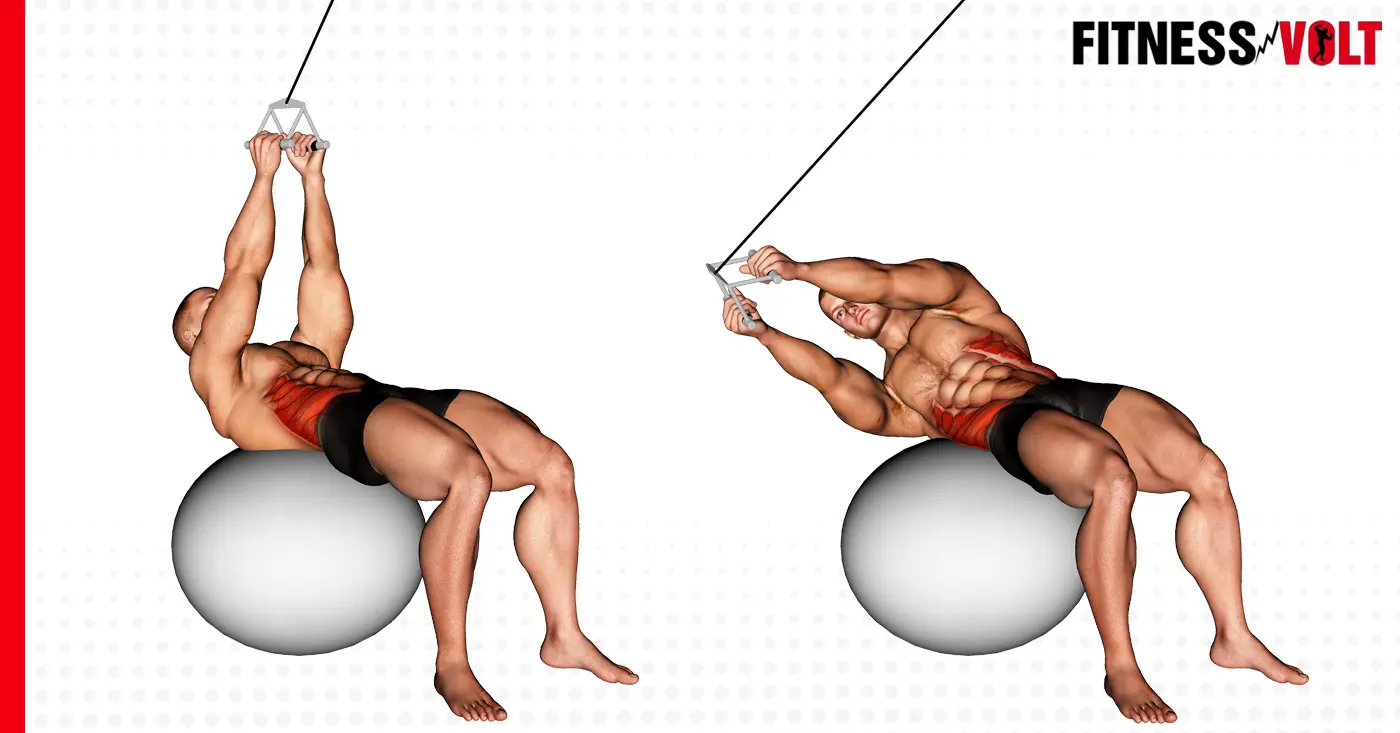
Cable Russian Twists (on stability ball) are a unique exercise that you won’t see performed in your gym too often. Heck, maybe you’ve never done it yourself. But it does have benefits and is a great variation for working the core muscles, shoulders, and stability.
And because it’s a functional exercise, it’ll help you to perform better overall in your physical activity of choice. We’ve created a guide on how to do it with some exercise tips, variations, and how to include it in your training regime.
Here’s a guide to Cable Russian Twists (on stability ball)…
Muscles Worked
Cable Russian Twists (on stability ball) improve core and total-body stability and have carryover to functional/athletic movements and everyday activities. And because this exercise involves rotation and anti-rotation against resistance, the obliques are heavily involved. But what other muscles assist during this movement? Find out below.
Obliques
Oblique muscles take the lead when it comes to rotational movements like Russian twists. That’s because these muscles on the outer and lateral portion of the trunk function to twist and laterally bend the midsection.
Rectus abdominis
The centermost core muscles such as the abdominals and deep ab muscles come along for the ride as they stabilize and help to move the torso.
Transverse abdominis
Often called the “deep” core muscles, transverse abdominis make it possible for your trunk to handle intense activity by creating stabilization and a rigid midsection. It’s also important for protecting your lower back from overarching.
Read: Build a Stronger Core with Shovel Lifts
How To Do Cable Russian Twists (on stability ball)
The cable Russian twist does require more balance and stability than most exercises. Therefore, it’s not an exercise that you want to use very heavy weight with. So, choose a weight that’ll allow you to perform at least 15 reps using a full range of motion. Here are step-by-instructions for this exercise.
- Attach a single-grip handle to the cable pulley high enough to where you can fully extend your arms and the pulley is in line with your fists or higher.
- Place the ball next to the pulley and lie on it to where your chest is in line with the pulley.
- Grip the handle with the closest hand, and extend your arm directly over your chest, then place your other hand on top to get a firm grip.
- Keep your hips high, tighten your midsection, and rotate away from the machine using your core muscles. Your arms should remain straight and extended in the same position throughout the exercise. You’re only using your core to rotate your body.
- Slowly return to the starting position, resisting the weight from pulling you back too quickly.
- Complete the desired number of reps and then repeat on the other side.
Here’s a video example…
Cable Russian Twists (on stability ball) Tips
- This is not a maximal strength-building exercise and therefore, it’s recommended not to use heavy weight. A lighter to moderate weight will allow you to get the best out of this exercise.
- Use a slow and controlled movement to ensure that the target muscles are fully engaged and active.
- Make sure the ball is fully inflated to ensure your safety and the effectiveness of the movement.
- Don’t allow your hips and lower body to sink down during the exercise. You want to maintain a neutral and strong body position on the ball.
4 Variations
Here are four excellent variations of this exercise that you should absolutely include in your training.
- Traditional weighted Russian twist
- Pallof press
- Cable wood chops
- Full contact twists
Find all of the information about these russian twists variations here.
How To Incorporate Cable Russian Twists (on stability ball) Into Your Training Routine
This is a great exercise to do alongside your other core exercises, but it really doesn’t matter when or how you decide to incorporate it. But we do suggest that you do it after your compound lifts, or on a day when you’re not training too heavy, as it could be considered an accessory exercise. It’s never a bad idea to dedicate a day to accessory exercises or to include one or two after your main exercises.
We explained that the cable Russian twist is not a maximal strength exercise but that doesn’t mean you should stay with the same weight every time you do it. You can add a little weight as you get stronger and progress. Progressive overload is a key component of making improvement and progressing and this exercise is no exception.
Sets/reps
We recommended doing 2-3 sets of 8-20 reps, varying your rep ranges on a weekly basis. Make sure that you can use proper form and execute the exercise using a full range of motion. If you cannot comfortably perform at least eight reps without breaking your technique, then the weight is too heavy.
Wrapping Up
Cable Russian Twists (on stability ball) have their place in any exercise regime. They work the core, shoulders, and total-body stability and is truly an underrated exercise. But we’re confident that you now have the knowledge to successfully utilize it to improve your overall fitness.
Interested in measuring your progress? Check out our strength standards for Side Crunch, Crunches, Russian Twist, and more exercises.