
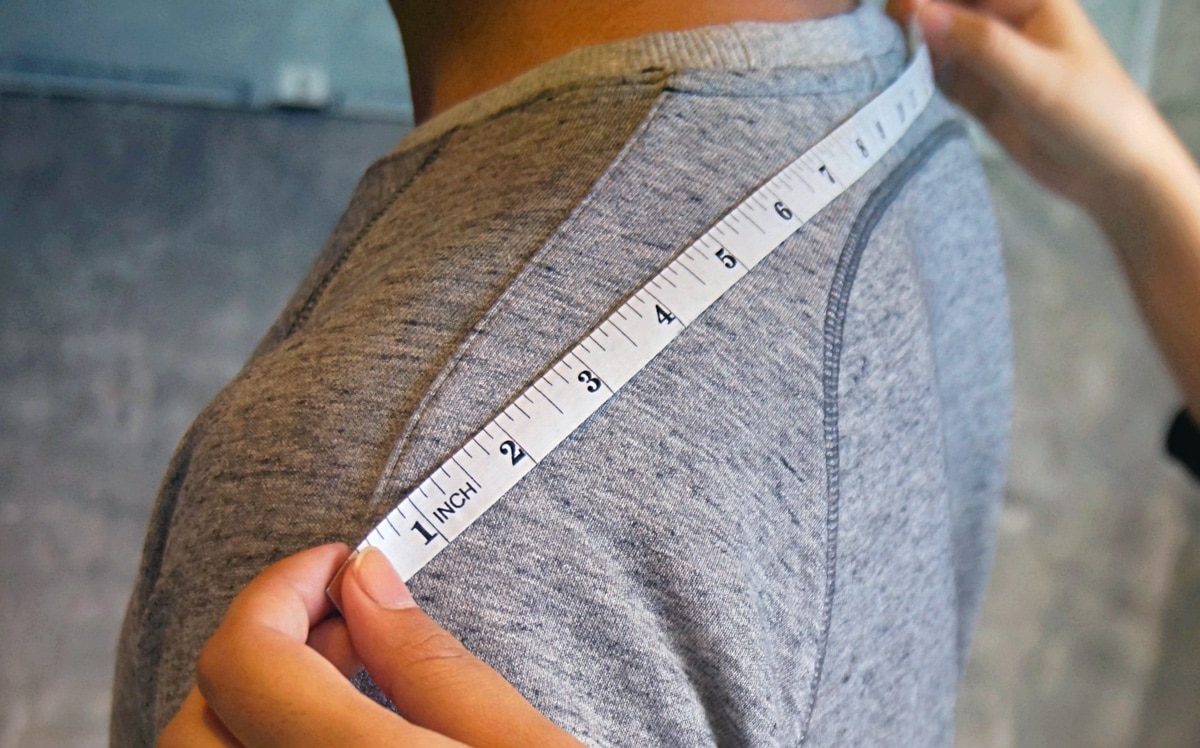
Average adult shoulder width was 41.1 cm (16.2 inches) for men and 36.7 cm (14.4 inches) for women in the U.S. NHANES III survey conducted in 1988–1994. These figures describe biacromial breadth: the straight-line distance between the bony points of the shoulders. They are historical reference values, not current population estimates or targets for your physique. [1]
A tape wrapped around your shoulders measures something different. So does a tailor’s tape curved across your upper back. Before comparing your result with an average, identify which measurement you have.
Shoulder width, circumference, and clothing measurements
| Measurement | What it measures |
|---|---|
| Biacromial breadth | Straight-line distance between the left and right acromion landmarks, using an appropriate measuring instrument. |
| Outer-shoulder width | Width across the outside of the shoulders, including soft tissue over the deltoids. |
| Shoulder circumference | A tape loop around the shoulders and upper torso. |
| Garment shoulder measurement | A clothing-specific seam-to-seam or body measurement, following the maker’s instructions. |
Only biacromial breadth belongs in a comparison with the CDC tables below, and only when the landmarks and measurement method match. Outer-shoulder width has different endpoints, circumference is not a width, and clothing methods and allowances vary.
For clothes, follow the retailer’s size guide. For tracking training, a repeatable circumference measurement may be useful. Neither should be presented as a laboratory measurement of bone-to-bone shoulder breadth.
What is the average shoulder width for men?
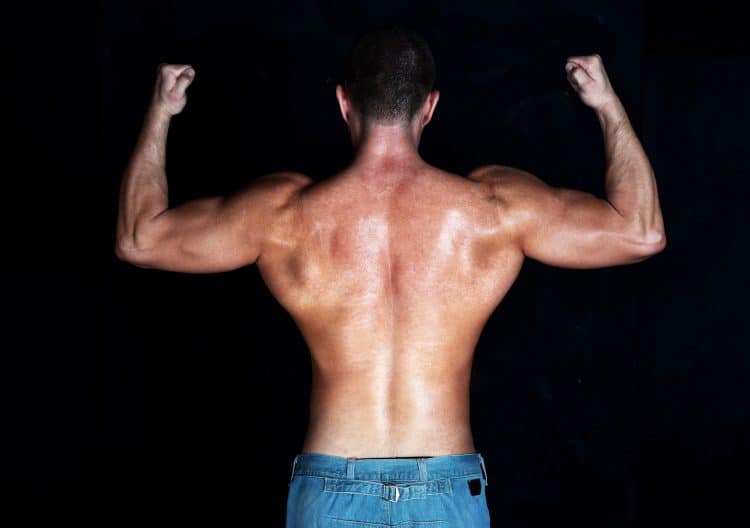
The CDC report includes 7,476 men aged 20 and older with biacromial-breadth measurements. The weighted mean was 41.1 cm (16.2 inches). The age-group means below come from Table 54. [1]
| Age (years) | Mean (cm) | Mean (inches) |
|---|---|---|
| 20–29 | 41.5 | 16.3 |
| 30–39 | 41.5 | 16.3 |
| 40–49 | 41.3 | 16.3 |
| 50–59 | 41.0 | 16.1 |
| 60–69 | 40.5 | 15.9 |
| 70–79 | 39.7 | 15.6 |
| 80+ | 39.0 | 15.4 |
These are comparisons between age groups measured during the survey, not a record of the same men’s shoulders changing over time. They cannot predict how much an individual’s measurement will change with age.
What is the average shoulder width for women?
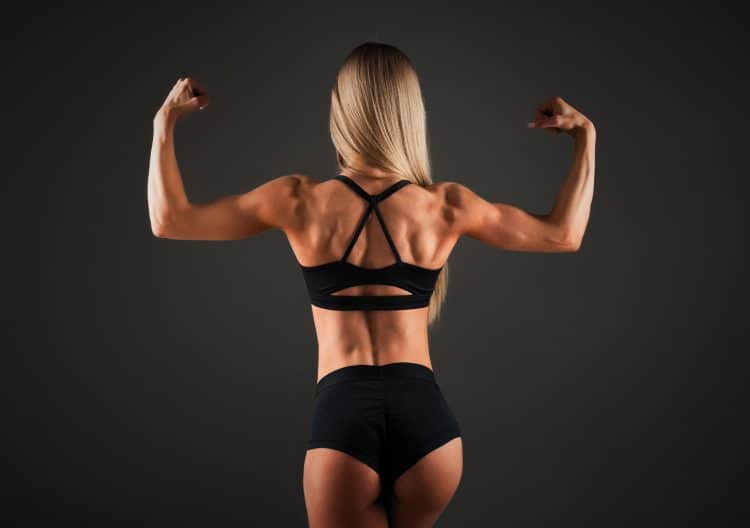
Among 8,411 women aged 20 and older, the weighted mean was 36.7 cm (14.4 inches). Table 55 supplies the age-group means below. [1]
| Age (years) | Mean (cm) | Mean (inches) |
|---|---|---|
| 20–29 | 36.9 | 14.5 |
| 30–39 | 37.0 | 14.6 |
| 40–49 | 36.9 | 14.5 |
| 50–59 | 36.9 | 14.5 |
| 60–69 | 36.4 | 14.3 |
| 70–79 | 35.7 | 14.1 |
| 80+ | 34.8 | 13.7 |
Both tables preserve the source’s centimeter values. Inches are calculated by dividing centimeters by 2.54 and rounding to one decimal place. Being above or below a mean does not establish that your shoulders are unhealthy, too broad, or too narrow.
What is the average shoulder circumference?
The breadth tables do not provide a shoulder-circumference average. A circumference result from a military sample or a small experiment also cannot be assumed to represent all adults.
For example, a 2016 study measured shoulder circumference while investigating body-size perception in women with anorexia nervosa and healthy comparison participants. It was a virtual-reality body-image experiment, not a representative survey of women’s shoulder size. Its sample measurements should not become a universal “ideal” or “normal” circumference. [2]
For a training log, comparing your own consistently taken measurements is more useful than comparing a tape loop with the bone-breadth figures above.
How to measure your shoulders
For comparison with biacromial-breadth data
Biacromial measurement uses the acromion landmarks on the left and right shoulder blades, not the outside edges of the shoulder muscles. A trained measurer identifies those landmarks and measures the straight-line distance with a suitable anthropometric instrument. A flexible tape following the curve of your back is not an equivalent substitute. Ask a qualified measurer to demonstrate the protocol if you need a research-compatible result.
For shoulder circumference
Use this as a repeatable home tracking method, not as the CDC breadth protocol:
- Stand comfortably with your arms relaxed. Ask someone to help so you do not have to twist to read the tape.
- Pass a flexible tape around the widest part of your shoulders and upper torso. Keep the loop level, in contact with the body without compressing the skin.
- Keep the same relaxed posture each time; do not flare your lats, flex, or deliberately expand your chest.
- Record the circumference and repeat the reading to check consistency. Use the same tape position and similar conditions on later dates.
A change can reflect several things, including muscle, body fat, posture, and measurement error. Circumference alone does not tell you how much muscle you gained.
For clothing or a rough width estimate
Follow the garment maker’s instructions about where the tape starts and ends, whether it curves over the back, and whether to measure your body or an existing garment. Label the result accordingly.
A wall-and-pencil estimate across the outside of your shoulders is only a rough outer-width estimate. Twisting to mark your own endpoints changes your position. Do not compare that result with biacromial-breadth norms or describe it as an exact clavicle measurement.
Shoulder width and bodybuilding proportions
Shoulder circumference can help document physique changes, but it does not isolate deltoid size or measure body fat. Bone breadth, outer width, and circumference answer different questions.
What does a 1.6 shoulder-to-waist ratio mean?
A circumference-based shoulder-to-waist ratio is shoulder circumference divided by waist circumference, using the same units. For example, 46-inch shoulders and a 32-inch waist give 46 ÷ 32 = 1.4375, or about 1.44. Use a consistent waist measurement site when tracking changes.
The often-cited 1.6 ratio is a bodybuilding aesthetic convention, not a health threshold or a requirement for men or women. It does not describe bone-to-bone shoulder width. At a 32-inch waist, a 1.6 ratio would correspond mathematically to a 51.2-inch shoulder circumference; that calculation is not a recommendation to pursue that measurement.
The existing Shoulder-to-Waist Ratio Calculator covers the circumference calculation. Treat its aesthetic targets as optional preferences, not diagnostic results.
What about the Grecian ideal?
Grecian-ideal formulas are another way bodybuilding enthusiasts describe preferred proportions. The Grecian Ideal Calculator uses wrist size to estimate selected measurements. A wrist-based formula cannot determine your health, guarantee attainable measurements, or account for every person’s frame and training history.
Can you increase shoulder width?
Resistance training can develop the muscles around your shoulders; it is not a method for widening the adult skeleton to match a chart. If muscle growth is your goal, train the deltoids through suitable pressing, lateral-raise, and rear-deltoid movements within a program you can recover from. Our existing shoulder exercise guide explains exercise options.
Progress comes from an appropriate training stimulus and consistency, not a requirement to use drop sets, supersets, or a constantly changing routine. A review of advanced resistance-training methods does not establish that those techniques are compulsory for growth. [3]
Choose loads and movements you can control, allow recovery between demanding sessions, and eat enough to support your training. A coach can help adapt the program to your experience and goals. Do not use a below-average shoulder measurement as a reason to force painful exercises or chase a particular ratio.
Can you reduce shoulder width?
Do not expect exercise or dieting to narrow your adult bone structure. Changes in muscle size and body fat can change circumference or appearance, but they are not the same as changing biacromial breadth.
You do not need twice-daily fasted cardio or a blanket ban on upper-body training because your shoulders are wider than average. Clothing fit and your preferred training emphasis are personal choices. If a change in shoulder shape is painful, sudden, or related to injury, seek an individual assessment rather than trying to correct it using a population table.
FAQs
How many inches is a broad shoulder?
There is no universal cutoff. First specify the measurement: a 16-inch biacromial breadth and a 16-inch garment measurement are not interchangeable. The tables describe averages in a historical U.S. sample, not a broad-versus-narrow grading system.
Are shoulder width and shoulder length the same thing?
Not reliably. Clothing instructions may use those terms differently. A curved tape measurement across the back is not the same as straight-line biacromial breadth, and neither measures the length of a single clavicle.
Can I measure shoulder width without a tape measure?
An appropriate anthropometric instrument can measure biacromial breadth, but you still need the correct landmarks and method. A ruler and wall marks can provide a rough outer-width estimate; they do not reproduce the survey protocol.
References
Fitness Volt is committed to providing our readers with science-based information. We use only credible and peer-reviewed sources to support the information we share in our articles.
- McDowell MA, Fryar CD, Ogden CL. Anthropometric reference data for children and adults: United States, 1988–1994. Vital Health Stat 11(249). 2009. Tables 54–55.
- Keizer A, van Elburg A, Helms R, Dijkerman HC. A Virtual Reality Full Body Illusion Improves Body Image Disturbance in Anorexia Nervosa. PLoS ONE. 2016;11(10):e0163921.
- Krzysztofik M, Wilk M, Wojdała G, Gołaś A. Maximizing Muscle Hypertrophy: A Systematic Review of Advanced Resistance Training Techniques and Methods. Int J Environ Res Public Health. 2019;16(24):4897.