
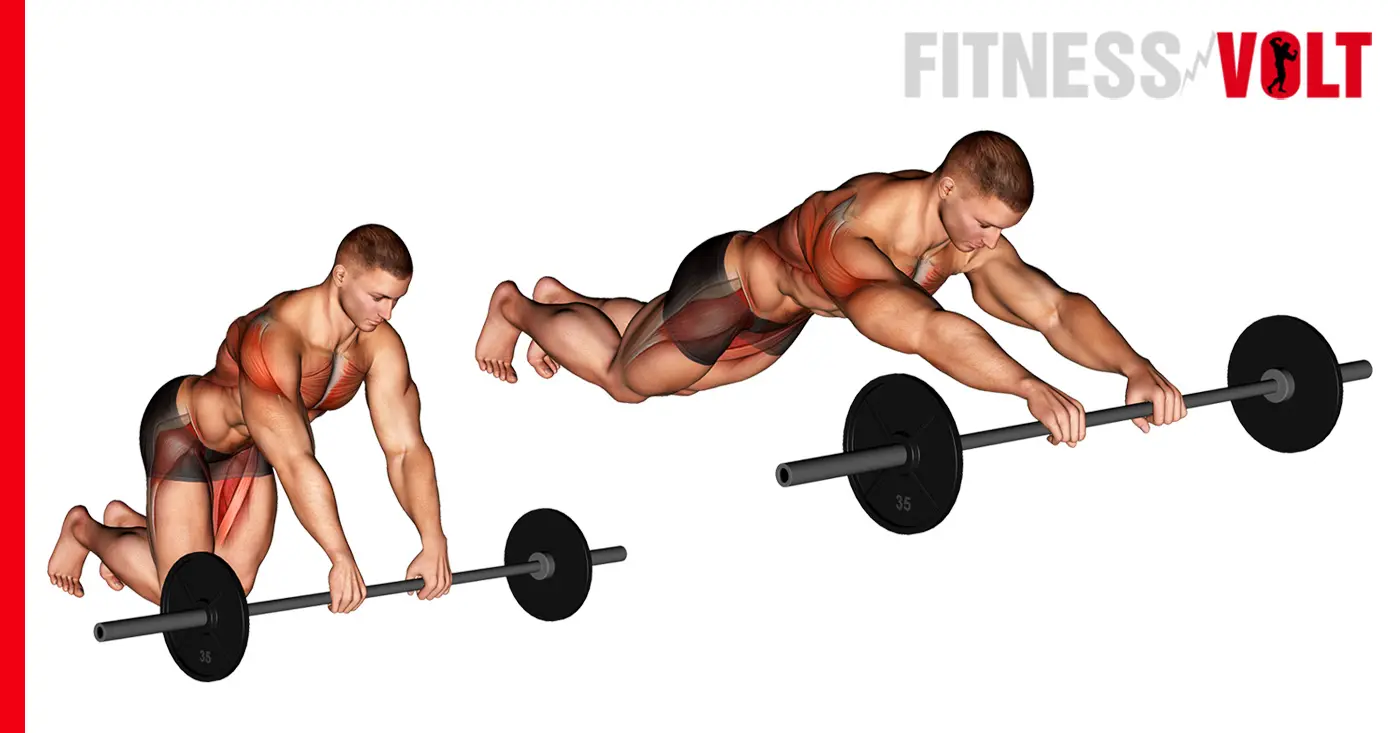
The barbell rollout is undoubtedly one of the most underrated exercises. However, we can tell you from experience that it’s also one of the most effective for building the core and other muscles as well. It’s a great strengthening exercise that definitely deserves a role in your workouts and we’re going to cover this movement so that you can effectively incorporate it into your training regime.
Here’s a guide to the barbell rollout…
Muscles Worked
The barbell rollout is typically utilized to build the muscles of the core or midsection. However, it works several muscles of which we’ve detailed below.
Iliopsoas
The iliopsoas musculotendinous unit (IPMU) or iliopsoas is a collection of muscles that include major and minor psoas and the iliacus. Asserting its superior role in movement of the thigh, iliopsoas is the strongest hip flexor muscle.
The iliopsoas is essential for standing, walking, and running while the iliacus and major psoas function according to different postural changes.
Core
A total core activator, barbell rollouts engage the external abdominals and obliques as well as the deeper stabilizer muscles. Done right, this movement should build core strength and improve ab and oblique development.
Deltoids
All three heads of the deltoids take on a strong role in stabilizing the arms to perform the rollout. The front delts lift the arms forward while the rear delts help to stabilize the upper body.
Pectoralis Major Sternal Head
Because of the nature of barbell rollouts you could consider it a hybrid ab and chest workout. That’s because the pectoralis muscles help to move the arm up and down as well.
How To Do The Barbell Rollout
The barbell rollout is not typically a beginner exercise
- Load the barbell with either a 25 or 45lb plate on each side.
- Get into a kneeling position and grip the bar about shoulder-width.
- Keep your core tight and back straight then push the barbell out until you’re in a superman position. Keep your arms completely straight during the entire movement. Don’t drop your hips down.
- Use your core to pull the weight back toward your knees and repeat.
Barbell Rollout Tips:
- Make sure to keep your back straight or even slightly rounded as not doing so will limit optimal abdominal activity.
- Do not allow your hips or butt to sink down.
- Use your core to eccentrically control the weight while in the extended, rolled out position and make sure your abs are contracting to pull the weight back in. Using your arms to pull the weight back defeats the purpose of the exercise.
- If you can’t complete the entire range of motion, roll out as far as you can and keep trying to progress further and further.
3 Rollout Variations
There are a few variations of this movement that you can do without having to use a barbell, which makes it a pretty versatile exercise.
Ab roller/wheel
The ab wheel device is no doubt the most popular variation. It does much of the same thing but it takes up a lot less space. Although, it may require a little more balance and stability which is definitely a good thing especially if you’re trying to train your core muscles.
Bodyweight sliding variation
You can replicate the barbell rollout by placing something that’ll slide across the floor under your hands. Dryer sheets, paper towels, tupperware caps, moving sliders are all great options.
Some people will also walk their hands forward and walk them back as an alternative but the sliding variation is excellent, and this is a very effective method also used for other exercises as well.
Using a stability ball
A stability or exercise ball is a very useful tool that is also recommend for beginners because it’s easier. However, that doesn’t mean it’s easy though because it does require additional stabilization and balance to do it effectively.
Here’s a great video example with instructions…
How To Incorporate The Barbell Rollout Into Your Training Routine
The barbell rollout is a pretty intense exercise when done right. That’s why we recommend either doing it after your primary lifts in a workout session or as part of your core training routine. Just make sure that you are adequately warmed up before performing this exercise since it does involve stretching of the core muscles.
Sets/reps
- 3 sets x 8-15 reps is a good range to stick within
One great way to include the barbell rollout in your training is to do supersets which involves doing two exercises back to back. So, for example, you’d do hanging leg raises and then jump right into the barbell rollout. You could take a short rest break and then repeat this for 3 total sets.
The rollout also makes for a great circuit training exercise which involves doing a series of exercises for rounds.
Wrapping Up
The barbell rollout has earned its place in any core training routine. It takes a little practice but once you become proficient at it, get ready because the gains are coming. We hope that you found this guide helpful and now it’s time to get to training!
Interested in measuring your progress? Check out our strength standards for Roman Chair Side Bend, Side Crunch, Crunches, and more exercises.