
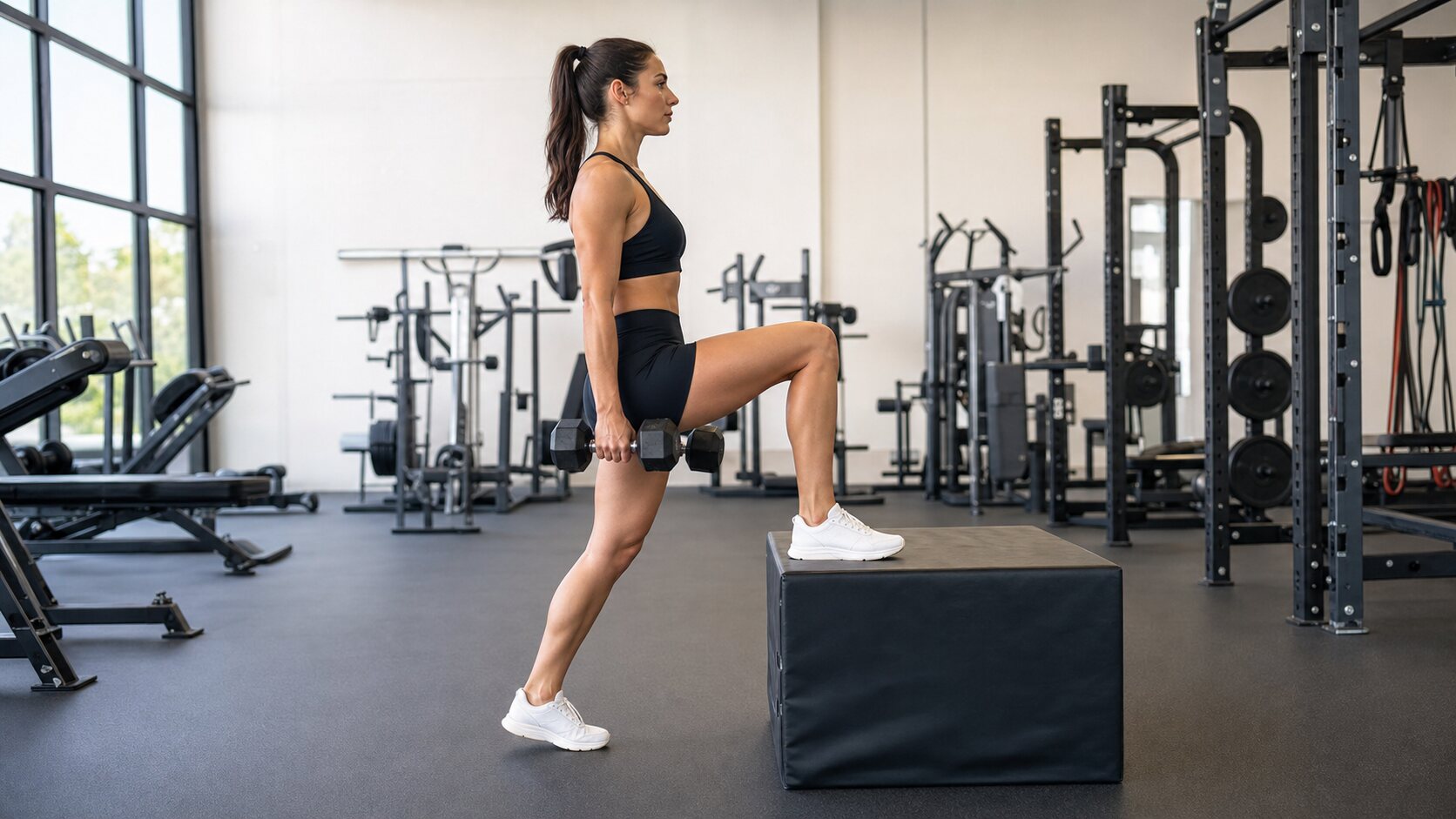
The dumbbell step-up is a unilateral lower-body exercise in which one foot stays on a stable box or bench while that leg lifts the body. It primarily trains the quadriceps and gluteus maximus, with the adductors, hamstrings, calves, and trunk muscles helping with force transfer and control.
The height of the box matters. Choose a height that lets you place the entire lead foot on top, keep the pelvis level, and stand up without jumping from the trailing leg. A taller box is not automatically better.
Dumbbell Step-Up Muscles Worked
| Muscle group | Role | What changes its demand |
|---|---|---|
| Quadriceps | Extend the lead knee as you rise and control knee flexion on the way down. | Box height, knee angle, load, and descent control. |
| Gluteus maximus | Extends the lead hip and helps bring the body over the box. | Hip flexion at the start, box height, and torso position. |
| Adductors | Assist hip extension and help control the thigh and pelvis. | Stance, depth, and frontal-plane control. |
| Hamstrings | Assist hip extension and help stabilize the knee. | Joint angles and how much the trail leg contributes. |
| Calves | Stabilize the ankle and contribute as you finish the step. | Ankle position, balance, and whether the heel stays planted. |
| Core and hip stabilizers | Keep the trunk and pelvis from rotating or tipping. | Unilateral loading, dumbbell position, and fatigue. |
Step-ups train one side at a time, but that does not mean only one muscle works. The lead hip and knee extend together, while the ankle and trunk stabilize the body. For more single-leg options, see our guide to unilateral leg exercises.
How to Do the Dumbbell Step-Up
- Choose a stable platform. Start lower than knee height. The surface should not wobble, slide, or tip.
- Set your feet. Stand close enough to place the whole lead foot on the box. Let the dumbbells hang at your sides with the wrists neutral.
- Brace and load the lead leg. Keep your ribs stacked over your pelvis. Shift pressure into the foot on the box without lifting the rear heel early.
- Step up. Drive the lead foot into the box and extend that hip and knee. The trailing foot should assist as little as needed rather than launching you upward.
- Finish under control. Stand tall without leaning back. You may bring the trailing foot to the box or keep it hovering, depending on the variation.
- Step down deliberately. Reach the trailing foot toward the floor and let the lead leg control the descent. Do not drop from the box.
- Complete the side. Perform the planned reps before switching legs, or alternate sides if the setup remains consistent.
Dumbbell Step-Up Demonstration
How High Should the Box Be?
| Box choice | Best use | Watch for |
|---|---|---|
| Low box | Learning balance, controlling the descent, or training with limited hip and ankle range. | Turning the movement into a quick tap instead of a deliberate step. |
| Moderate box | Most strength and muscle-building sets. | Pushing hard from the rear foot or losing full-foot contact. |
| High box | Experienced lifters using a specific range and manageable load. | Pelvic tucking, rounding, bouncing, or pulling with the trail leg. |
Use movement quality, not a fixed percentage of your height, as the deciding rule. At the bottom, you should be able to keep the entire lead foot planted and create force without shifting onto the toes. If the pelvis rolls under, the torso collapses, or the rear leg must jump, lower the box.
Research on step height is limited and often uses older or clinical populations, so it should not be turned into a universal height prescription. The practical test is whether you can repeat the same controlled rep on both sides.
Front-Leg Drive vs. Trail-Leg Push-Off
The trail leg will rarely be completely passive, but it should not do most of the work. A forceful push from the floor makes the rep easier while reducing the demand on the leg on the box.
- Move a little closer to the box so you do not need a running start.
- Keep the rear foot light and think about pressing the platform away with the lead foot.
- Pause briefly with the lead foot loaded before each rep.
- Use a lower box or lighter dumbbells if the rear calf launches you upward.
- For a strict version, keep the working foot on the box for the entire set and touch the other foot lightly to the floor between reps.
Knee, Hip, and Pelvic Control
Your knee can move forward during a step-up. It does not need to stay behind your toes. What matters is that the knee follows a comfortable path over the foot, the whole foot remains supported, and the load and height match your tolerance.
A slight forward torso angle is normal as you bring your center of mass over the lead foot. Keep that lean controlled from the hip instead of rounding through the lower back. From the front, aim to keep the pelvis level and prevent the knee from collapsing sharply inward.
Step-ups are not automatically suitable for every person with knee pain. Joint demand changes with platform height, load, speed, symptoms, and technique. A biomechanics study in 21 older adults found different hip, knee, and ankle demands in forward and lateral step-ups, which is useful for understanding variation but not a universal safety verdict. See the study on PubMed.
Common Dumbbell Step-Up Mistakes
- Using an unstable chair: A household chair can slide or tip. Use a solid bench, step, or box rated for exercise.
- Placing only the toes on the box: Full-foot support improves control and gives you a more reliable base.
- Jumping from the floor: Reduce the box height or load until the lead leg can drive the movement.
- Dropping through the descent: Lowering is part of the exercise. Reach down quietly and keep tension in the lead leg.
- Choosing height for ego: A box that forces compensation changes the exercise and makes progression hard to measure.
- Letting the pelvis twist: Keep both hip points facing forward. A lighter load often fixes this faster than another cue.
- Alternating too quickly: Speed can hide side-to-side differences and turn a strength set into a conditioning drill.
Loading Options and Progressions
- Bodyweight step-up with light fingertip support
- Unsupported bodyweight step-up
- Suitcase step-up with one dumbbell
- Dumbbells held at both sides
- Front-rack dumbbell step-up
- Higher load or modestly higher box, but not both at once
A single dumbbell creates an extra anti-rotation challenge. Hold it on the same side as the working leg or the opposite side, but keep the setup consistent across sets. Two dumbbells make loading easier to track and usually reduce the balance demand.
Useful Step-Up Variations
Step-Up Jump
This is a power exercise, not simply a faster strength rep. Learn controlled step-ups first, then use a lower box and light or no external load.
Lateral Step-Up
Stand side-on to the platform and step laterally. This changes the joint demands and requires more frontal-plane control. In the study of older adults cited above, lateral step-ups placed relatively more demand on the knee extensors and ankle plantar flexors, while forward step-ups placed more demand on the hip extensors. That finding should be kept within its population.
Supported Step-Up
Hold a rack upright with one hand and load the other hand with a dumbbell. The support reduces the balance constraint, which can help you focus on the working leg and controlled descent.
For a larger substitution list, use the dedicated guide to dumbbell step-up alternatives rather than turning this technique page into another roundup.
Sets and Reps
The examples below are coaching starting points, not step-up prescriptions tested by the cited biomechanics studies. Choose a range you can repeat with the same box height, lead-leg drive, and controlled descent.
| Goal | Sets and reps | Execution priority |
|---|---|---|
| Learn the movement | 2 to 3 sets of 6 to 10 per side | Low box, bodyweight or light load, stable tempo. |
| Build muscle | 3 to 4 sets of 8 to 15 per side | Controlled descent and one to three good reps in reserve. |
| Build strength | 3 to 5 sets of 5 to 8 per side | Moderate box, heavier load, no trail-leg jump. |
| Conditioning | 2 to 4 timed sets | Use a low box and light load; stop before control deteriorates. |
Count reps per leg. If one side is less controlled, begin with that side and match its reps on the stronger side. Add load only after the same box height, range, and descent are repeatable.
Where Step-Ups Fit in a Workout
Use dumbbell step-ups as a primary unilateral lift or after a bilateral squat or deadlift. They also fit well in at-home leg workouts when you have a stable platform and enough load to make the target rep range challenging.
Step-ups can build strength and muscle, but they do not need to replace squats, lunges, or hinges. Choose the exercise that fits your goal, equipment, skill, and joint tolerance. The most useful version is the one you can load and repeat without changing the movement every rep.
When to Stop or Modify
Lower-body muscular effort is expected. Stop if you feel sharp knee, hip, ankle, or back pain, or if the platform shifts. Reduce the height and load before testing the movement again. People managing an injury, recent surgery, instability, or persistent pain should get individualized guidance rather than relying on a blanket claim that step-ups are knee-friendly.
Build a Stronger Step-Up With Repeatable Mechanics
A strong dumbbell step-up starts with a stable box, full-foot contact, and a height you can control. Drive through the leg on the box, keep the pelvis and knee organized, and own the descent. Progress the load or height gradually, and judge the exercise by repeatable mechanics rather than how high you can step.
Interested in measuring your progress? Check out our strength standards for dumbbell step-up, Dumbbell Hang Clean, Dumbbell Thruster, and more exercises.