The hardest workout to recover from is the one you never start.
That is the trap with bigger workouts. A 60-minute session sounds serious, so anything smaller can feel pointless. Then work runs late, your commute eats the evening, the gym window disappears, and the whole day becomes a zero.
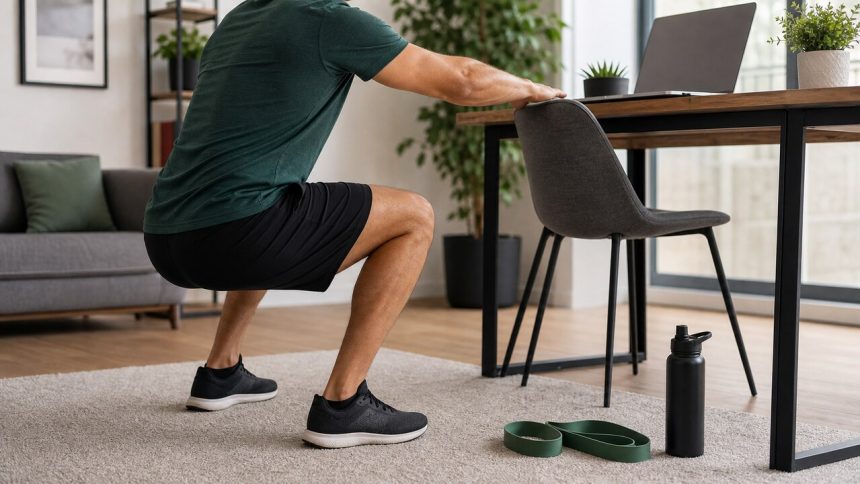
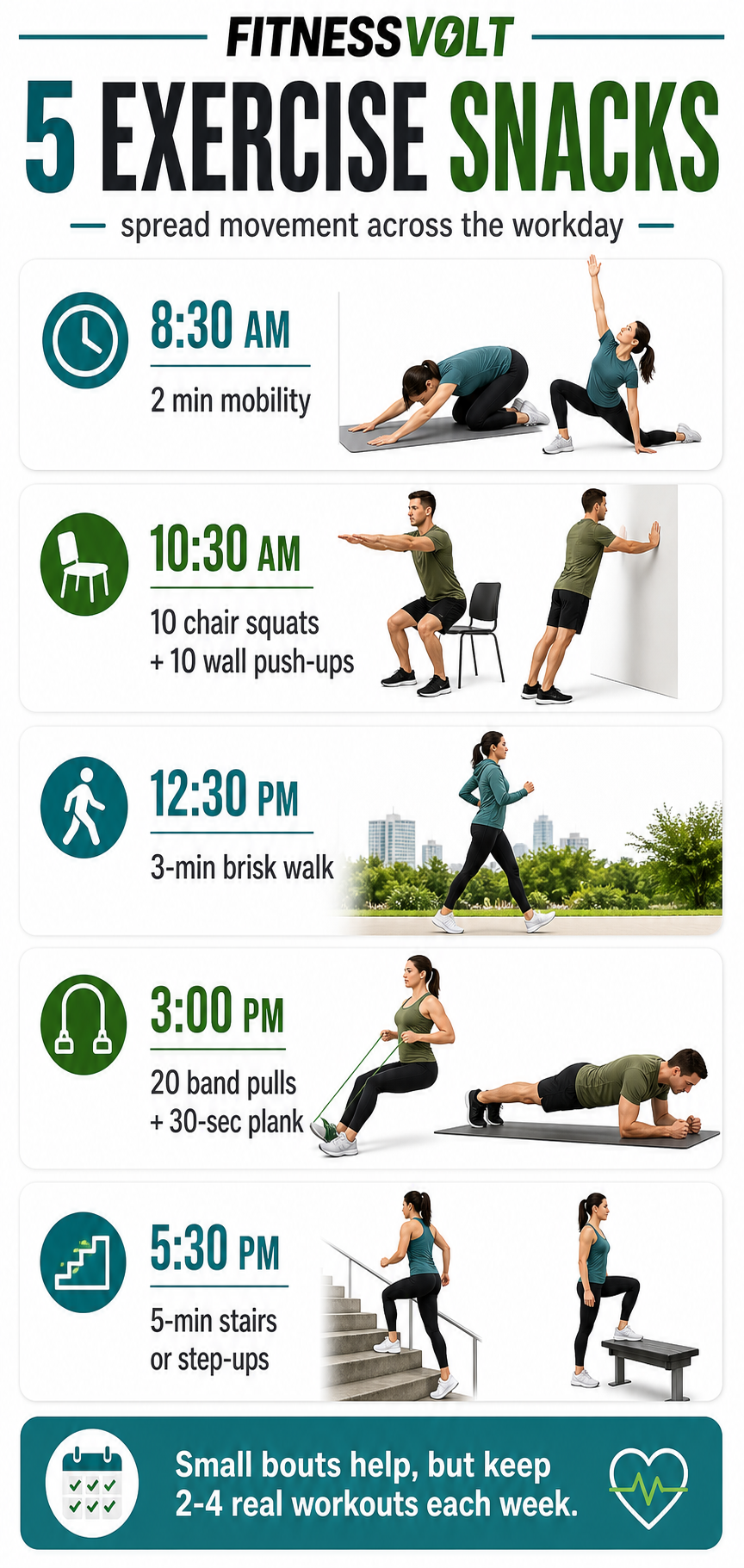
Exercise snacks fix that all-or-nothing problem. They are short, focused movement breaks spread across the day: two minutes of mobility, a quick set of chair squats, a brisk stair climb, a band pull-apart block, or a short walk after lunch. The goal is not to pretend that five minutes is the same as a full strength session. The goal is to stop letting imperfect days become motionless days.
Used well, exercise snacks are a bridge between normal life and consistent training. They reduce sitting time, build practice with basic movements, and give busy people a way to accumulate useful work before the day gets away from them.
What Are Exercise Snacks?
Exercise snacks are short bouts of movement, usually 1 to 10 minutes, performed several times across the day. A good snack has a clear target: mobility, strength practice, light cardio, posture, or core control. They can support fitness and reduce sedentary time, but they should complement structured workouts rather than replace progressive strength and conditioning.
Why Forget Bigger Workouts as the Only Plan?
Bigger workouts are useful when you can do them consistently. The mistake is treating them as the only form of fitness that counts. For readers with desk jobs, childcare, travel, shift work, or unpredictable schedules, the better plan is often a base layer of small daily movement plus two to four real workouts per week.
The U.S. physical activity guidelines still support the big rocks: adults should aim for regular aerobic activity and muscle-strengthening work. Exercise snacks do not erase that target. They make the path to it less brittle by turning spare minutes into movement reps.
Exercise snacks are useful because they lower the barrier to movement. A 2- to 8-minute snack can interrupt long sitting periods, practice basic strength patterns, or raise breathing briefly. They are not a full substitute for structured training, but they make consistency easier on days when a normal workout is not realistic.
What Counts as an Exercise Snack?
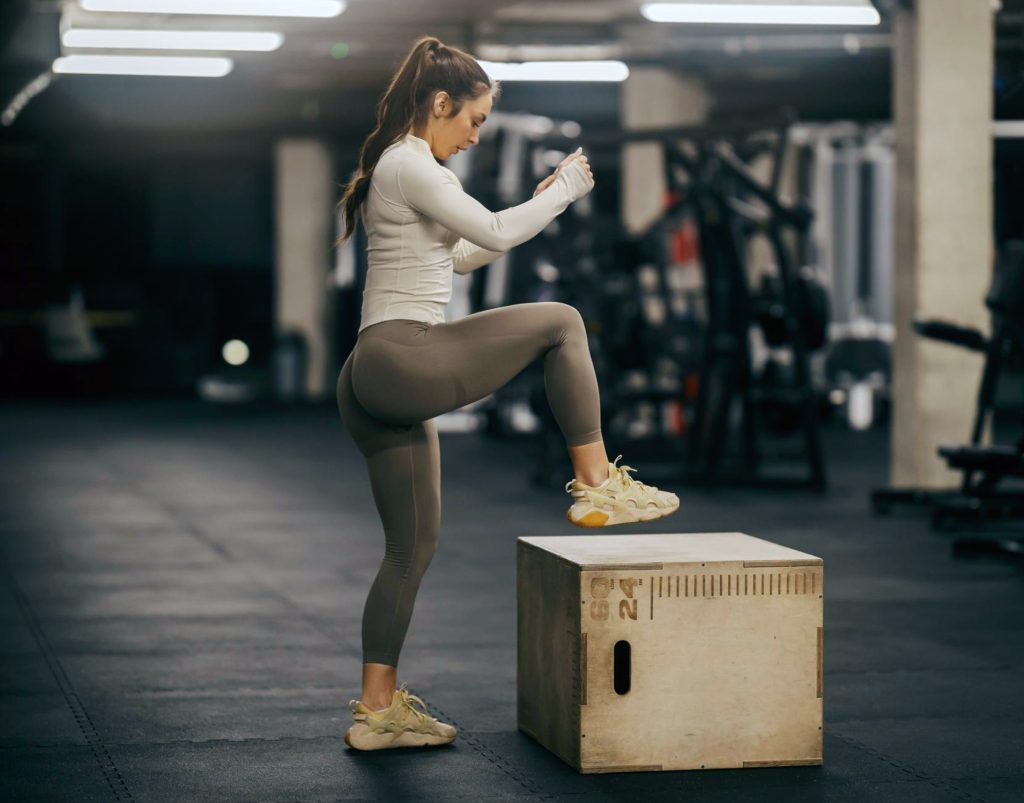
A movement break counts if it is intentional, brief, and repeatable. Walking to the printer is movement, but it is not much of a training stimulus. Ten controlled sit-to-stands, a three-minute brisk walk, or one stair-climbing bout is different because you choose the dose, effort, and purpose.
Think of each snack as a mini prescription. Pick the goal first, then choose the movement.
| Goal | Snack | Dose | Best time |
|---|---|---|---|
| Mobility | Hip flexor stretch plus thoracic rotations | 2 minutes | After a long seated block |
| Strength practice | Chair squats and wall push-ups | 10 reps each | Midmorning or midafternoon |
| Cardio | Brisk walk, stairs, or step-ups | 3 to 5 minutes | After meals or between meetings |
| Posture | Band pull-aparts or doorway rows | 15 to 25 reps | After computer-heavy work |
| Core | Dead bug, side plank, or standing Pallof hold | 30 to 60 seconds per side | Before training or during a break |
If you already like short routines, FitnessVolt’s 15-minute anti-desk workout can be used as a longer version of the same idea.
How Hard Should an Exercise Snack Be?
Most snacks should feel like a 5 to 8 out of 10 effort, not an all-out test. You should finish feeling more awake, warmer, and a little challenged. You should not be sweating through work clothes, aggravating joints, or needing 20 minutes to recover.
A simple rule: leave two clean reps in reserve on strength snacks and stop cardio snacks while your breathing is elevated but controlled. If the snack ruins your next meeting, lifting session, or sleep, it was too hard for the context.
Research on brief vigorous stair-climbing bouts suggests that very small doses can improve cardiorespiratory fitness in inactive young adults when repeated consistently. That does not mean everyone should sprint stairs at work. It means short bouts can be meaningful when the dose, population, and progression make sense.
A useful exercise snack should be short enough to repeat and hard enough to feel intentional. For most people, that means 2 to 8 minutes at moderate effort, or one controlled set that stops before form breaks. Save true all-out intervals for planned training sessions, not random work breaks.
Try This 3-Day Exercise Snack Schedule
You do not need a perfect schedule. You need a default that fits the day you actually live. Start with three snacks, then add a fourth or fifth only if recovery, joints, and work demands tolerate it.
| Day | Morning | Midday | Afternoon | Evening |
|---|---|---|---|---|
| Office day | 2-min neck, chest, and hip mobility | 10 chair squats + 10 wall push-ups | 3-min brisk walk | 20 band pull-aparts + 30-sec plank |
| Home day | 5-min easy mobility flow | 8 reverse lunges per side + 8 incline push-ups | 5-min stairs or step-ups | Dead bug, 6 slow reps per side |
| Travel day | 10 sit-to-stands + 20 calf raises | 5-min walk after lunch | Wall slides + suitcase carry | Easy stretch before bed |
For strength-focused readers, use snacks to practice patterns, not to bury yourself. Save your hardest progressive work for full sessions like a dumbbell plan or a structured method such as the 5-5-5 dumbbell method.
Do Exercise Snacks Help With Sitting Too Much?
They can, especially when they interrupt long sedentary blocks. Controlled research has shown that breaking up prolonged sitting with short activity breaks can improve post-meal glucose and insulin responses in some settings. The reader takeaway is practical: do not sit for four hours and then expect one hard workout to erase every effect of the day.
A two- to five-minute movement break after meals is a strong starting point. Walk around the office, climb one flight of stairs at a controlled pace, or do slow sit-to-stands. The magic is not one special exercise. It is the repeatable interruption of long stillness.
Exercise snacks are a practical way to break up prolonged sitting. Short activity breaks after meals or between desk blocks may support better glucose handling in some populations and help people accumulate more movement. The safest default is light to moderate movement repeated often, not random maximal effort.
Can Exercise Snacks Build Muscle?
They can help beginners build skill, coordination, and a small amount of strength, but they are limited for muscle growth unless they become progressively harder over time. Ten wall push-ups twice a day is excellent if you currently do zero. It is not enough forever if your goal is serious hypertrophy.
Use snacks as movement practice. For muscle, you still need enough weekly sets, effort, recovery, and progression. If posture is your weak link, start with FitnessVolt’s posture exercises and turn one or two into repeatable snacks.
Exercise snacks can support muscle-building habits, especially for beginners, but they are not a complete hypertrophy program. To build appreciable muscle, snacks must eventually progress in load, reps, range of motion, or difficulty. Most lifters should use them alongside full resistance-training sessions.
Accessibility and Joint-Friendly Swaps
The best exercise snack is the one you can repeat without pain. If squats bother your knees, use sit-to-stands from a higher chair. If floor push-ups are too much, use a wall or desk. If stairs bother your feet, use a flat walk. If standing is not an option, try seated marches, seated band rows, ankle pumps, and controlled overhead reaches.
Keep the first week almost too easy. Your goal is to build the cue: meeting ends, you move; lunch ends, you walk; afternoon slump hits, you do one short posture block. Once the cue is automatic, increase the dose slowly.
Common Mistakes
The first mistake is turning every snack into a challenge. That usually burns people out. The second is picking random movements with no goal. The third is ignoring your real workout plan and pretending scattered movement solves everything.
Use this hierarchy:
- Daily base: three to five short snacks that reduce sitting and keep you moving.
- Weekly training: two to four structured workouts for strength, muscle, cardio, or sport.
- Recovery rule: no snack should make your joints feel worse the next day.
If your main goal is more daily movement, pair this with a walking plan like FitnessVolt’s coverage of 2-minute exercise snacks or the walking workout guide.
FAQ
How many exercise snacks should I do per day?
Start with three: one in the morning, one after lunch, and one in the afternoon. Add more only if they feel easy to recover from and do not interfere with structured workouts.
How long should an exercise snack be?
Most should last 2 to 8 minutes. A single set can also count if it is intentional, such as 10 chair squats, 10 wall push-ups, or a 60-second carry.
Can exercise snacks replace the gym?
Not for most goals. They can maintain momentum and improve daily movement, but strength, muscle gain, and higher-level conditioning still need planned progression.
What is the best exercise snack for beginners?
Try 10 sit-to-stands from a chair, 10 wall push-ups, and a two-minute walk. It is simple, scalable, and does not require changing clothes.
Are exercise snacks safe for older adults?
They can be, but the movement must match the person. Use stable support, controlled tempos, and low-impact options. Anyone with chest pain, dizziness, unexplained shortness of breath, or a medical condition should ask a clinician before adding harder bouts.
Sources
- U.S. Department of Health and Human Services. (2018). Physical Activity Guidelines for Americans, 2nd edition. Office of Disease Prevention and Health Promotion. Accessed May 11, 2026.
- Jenkins, E. M., Nairn, L. N., Skelly, L. E., Little, J. P., and Gibala, M. J. (2019). Do stair climbing exercise “snacks” improve cardiorespiratory fitness? Applied Physiology, Nutrition, and Metabolism, 44(6), 681-684. doi:10.1139/apnm-2018-0675.
- Dunstan, D. W., Kingwell, B. A., Larsen, R., Healy, G. N., Cerin, E., Hamilton, M. T., Shaw, J. E., Bertovic, D. A., Zimmet, P. Z., Salmon, J., and Owen, N. (2012). Breaking up prolonged sitting reduces postprandial glucose and insulin responses. Diabetes Care, 35(5), 976-983. doi:10.2337/dc11-1931.
- Bull, F. C., Al-Ansari, S. S., Biddle, S., Borodulin, K., Buman, M. P., Cardon, G., Carty, C., Chaput, J. P., Chastin, S., Chou, R., Dempsey, P. C., DiPietro, L., Ekelund, U., Firth, J., Friedenreich, C. M., Garcia, L., Gichu, M., Jago, R., Katzmarzyk, P. T., Lambert, E., Leitzmann, M., Milton, K., Ortega, F. B., Ranasinghe, C., Stamatakis, E., Tiedemann, A., Troiano, R. P., van der Ploeg, H. P., Wari, V., and Willumsen, J. F. (2020). World Health Organization 2020 guidelines on physical activity and sedentary behaviour. British Journal of Sports Medicine, 54(24), 1451-1462. doi:10.1136/bjsports-2020-102955.