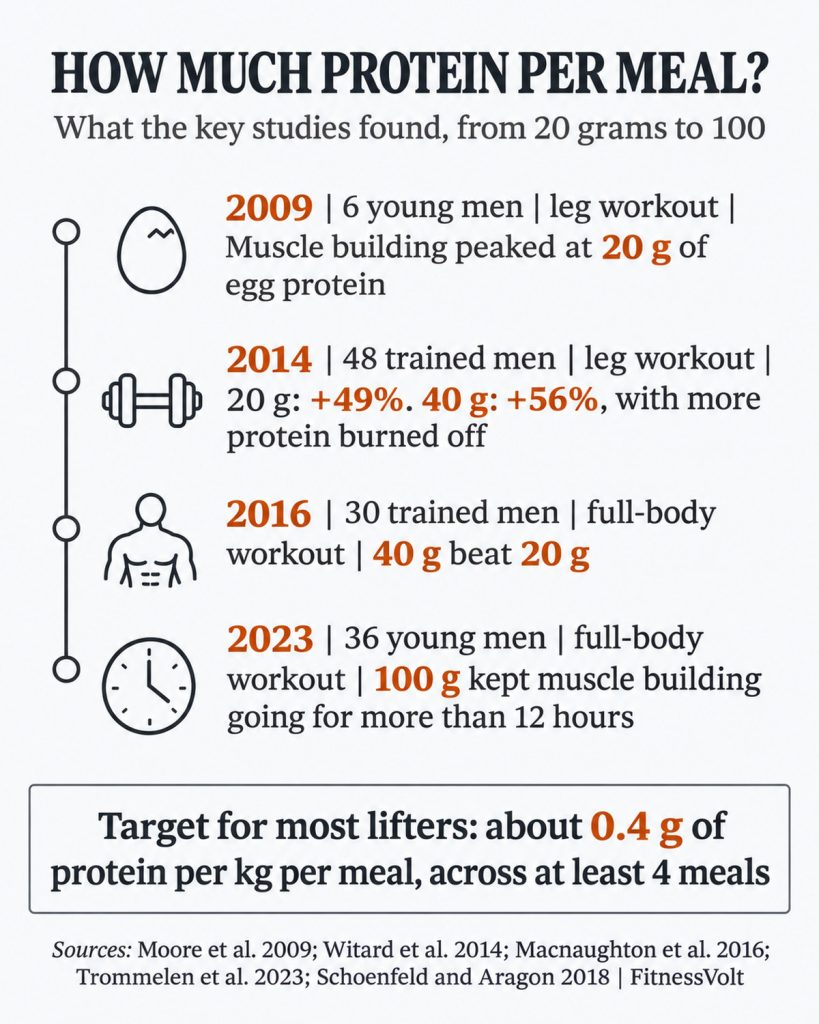
Your body can absorb almost all the protein you eat in one meal, and a 2023 study found that it keeps putting a large dose to work for more than 12 hours. The old rule that anything past 20 to 30 grams gets wasted came from short studies that stopped measuring too soon.
For a lifter, the useful answer is a number per meal, scaled to body weight: about 0.4 grams of protein per kilogram, across at least four meals. Your number by body weight is in the table further down. A bigger serving isn’t wasted, but it matters less than your daily total.
Absorbing protein and using it are different things
The question usually comes out as “how much protein can I absorb?”, and that part has a simple answer. Absorption means protein passing from your gut into your bloodstream, and by that definition, as a 2018 review in the Journal of the International Society of Sports Nutrition noted, the amount you can absorb is virtually unlimited.
What most people want to know is how much of a meal’s protein goes into building muscle, and how much gets burned for energy or turned into urea. The 20-to-30-gram idea comes from that second question, and that is the part the newer research revises.
Where the 20-gram limit came from
Two widely cited studies, from 2009 and 2014, measured muscle protein synthesis, the process that builds and repairs muscle, for about four hours after a single dose of protein.
In the 2009 study, young men drank 0, 5, 10, 20 or 40 grams of egg protein after a leg workout on separate days. Muscle protein synthesis rose with each dose and peaked at 20 grams, and at 20 and 40 grams the body also burned more of the amino acid leucine for energy. The 2014 study found a similar pattern with whey in trained men: 40 grams raised muscle protein synthesis only a little more than 20 grams did, and more of it was burned off and turned into urea. The authors concluded that 20 grams was enough to max out muscle building in those conditions.
Together they produced the familiar rule. Both used fast-digesting protein on its own, after workouts that trained only the legs, and measured for about four hours.
Real meals behave differently. The 2018 dosing review noted that whey is absorbed at roughly 10 grams an hour, while cooked egg protein is absorbed at about 3 grams an hour, so a 20-gram omelet takes around seven hours to fully absorb. Slower protein, and protein eaten with other food, releases amino acids over a longer stretch, which is one reason the review’s authors argued that results from fast whey taken on its own may not apply to real meals.
The studies that moved the line
In 2016, researchers tested 30 trained men after a whole-body workout instead of a leg session. This time, 40 grams of whey raised muscle protein synthesis more than 20 grams did, 0.059% against 0.049% per hour. Whether the men had more or less lean mass made no difference to the result.
The biggest change came in 2023. In a randomized, double-blind trial, 36 healthy young men did a full-body workout of four sets of 10 on the leg press, leg extension, chest press and lat pulldown, then drank a placebo, 25 grams or 100 grams of milk protein, 12 men per group. The researchers tracked the protein through the body for 12 hours using labeled amino acids. The 100-gram dose produced a bigger and longer protein-building response than 25 grams, still going at 12 hours. Muscle kept taking up amino acids from the large dose at a steady rate right to the end of the measurement.
The authors wrote that the size and duration of the body’s response to protein “is not restricted and has previously been underestimated,” and noted that earlier tracer studies had used no more than 45 grams and measured for six hours or less. It is one study in young men who drank the protein after training, and it measured protein synthesis over hours rather than muscle growth over months. Within those limits, it shows that a large serving is not mostly wasted.
Get the daily total right first
The per-meal question only matters once the daily total is right. A 2018 meta-analysis pooled 49 studies with 1,863 people who did resistance training for weeks or months. Extra protein increased gains in strength and muscle size, but the benefit for lean mass leveled off at a total of about 1.62 grams per kilogram of body weight a day. Extra protein helped trained lifters more than beginners.
For an 80 kg lifter, that’s about 130 grams a day. Hit that, and how you split it across meals becomes the fine-tuning.
How to spread it across the day
With the daily total fixed, the split still changes the result. In a 2013 study, 24 trained men were split into three groups of eight, and each group drank 80 grams of whey over the 12 hours after a workout on a different schedule: eight servings of 10 grams every 90 minutes, four servings of 20 grams every three hours, or two servings of 40 grams every six hours. All three raised muscle protein synthesis, but four servings of 20 grams did best across the day, producing 31% to 48% more than the other two schedules.
So the target has two parts: a dose per meal and a total per day. The 2018 dosing review concluded that to maximize muscle building, lifters should aim for about 0.4 grams of protein per kilogram of body weight per meal, across at least four meals, to reach at least 1.6 grams per kilogram a day. At the upper end of the range it cited, 2.2 grams per kilogram a day, that becomes about 0.55 grams per kilogram per meal.
The International Society of Sports Nutrition’s protein position stand lands in the same place: 1.4 to 2.0 grams per kilogram a day for most people who train, and 0.25 grams per kilogram, or 20 to 40 grams, per serving.
Your per-meal protein target
Find your body weight in the first column. The middle column is the target for most meals. The last column is for lifters pushing the daily total toward 2.2 grams per kilogram.
| Body weight | Most meals (0.4 g/kg) | Upper end (0.55 g/kg) |
|---|---|---|
| 60 kg (132 lb) | 24 g | 33 g |
| 70 kg (154 lb) | 28 g | 39 g |
| 80 kg (176 lb) | 32 g | 44 g |
| 90 kg (198 lb) | 36 g | 50 g |
| 100 kg (220 lb) | 40 g | 55 g |
| 110 kg (243 lb) | 44 g | 61 g |
Our protein calculator works out a daily target from your weight and goal.
What 30 to 40 grams of protein looks like
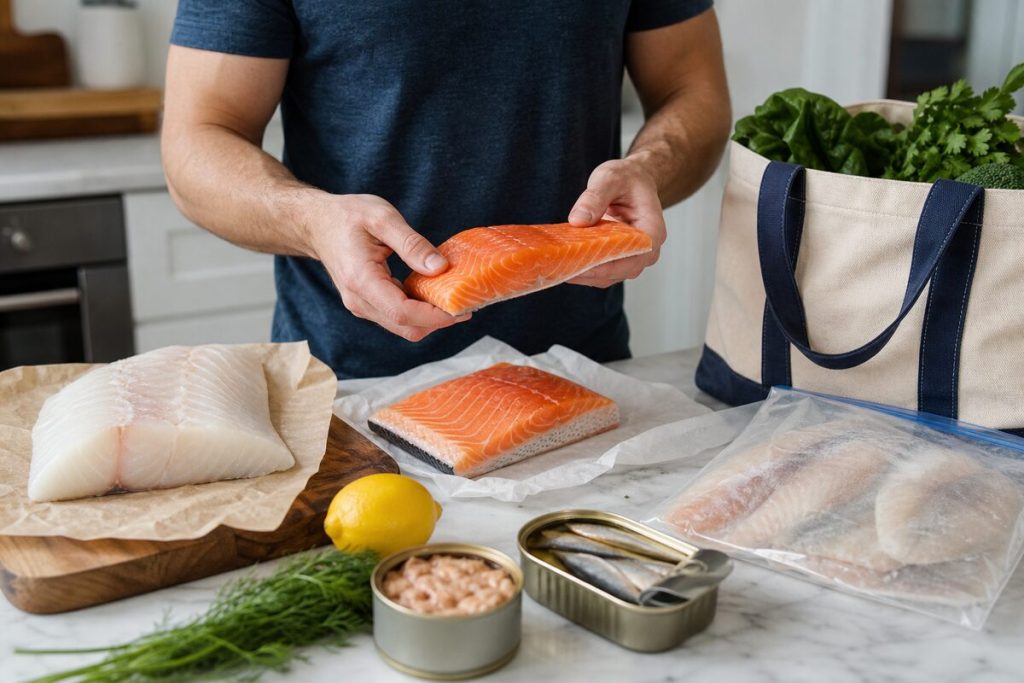
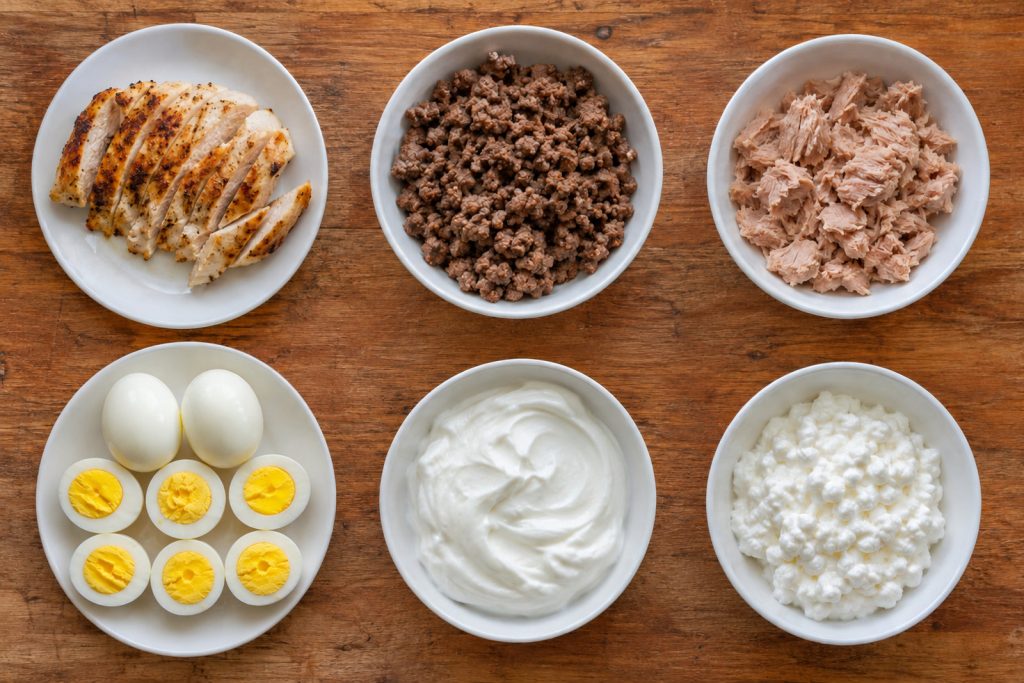
At 0.4 grams per kilogram, a lifter between about 75 and 100 kg needs 30 to 40 grams a meal. Each of these servings gets there.
| Food | Serving | Protein |
|---|---|---|
| Chicken breast, roasted | 120 g (4.2 oz) | 37 g |
| Lean ground beef (90%), cooked | 120 g (4.2 oz) | 34 g |
| Light tuna, canned in water, drained | 120 g (4.2 oz) | 31 g |
| Whole eggs | 5 large (250 g) | 31 g |
| Greek yogurt, plain nonfat | 340 g (two 6-oz cups) | 35 g |
| Cottage cheese, 2% fat | 300 g (about 1.3 cups) | 31 g |
Mixed meals add up the same way: a cup of cooked lentils has about 18 grams, so pairing it with a smaller portion of chicken or fish gets you over 30. Our chicken protein calculator, egg protein calculator and protein shake calculator work out other portion sizes.
What changes the answer for you
Age
Older muscle responds less to protein, so it needs a bigger dose to get the same response. A 2015 analysis that pooled data from several studies found that muscle protein synthesis leveled off at about 0.24 grams per kilogram per meal in men around 22, but not until about 0.40 grams per kilogram in men around 71. If you’re older, aim for the middle column or above at every meal. Our guide to the best protein powders for older adults covers easy ways to get there.
How much muscle you trained
The 2016 study used a whole-body session and found a benefit from 40 grams, while the earlier studies that found no extra benefit above 20 grams used leg-only workouts. After a full-body or high-volume session, make the post-workout meal one of the larger ones.

What about fewer, bigger meals?
If you eat in a short window or prefer two large meals, the 2023 study shows the big servings are not thrown away. The 2013 study supplies the caveat. With the same daily total, four moderate servings produced more muscle protein synthesis over 12 hours than two large ones.
For an 80 kg lifter aiming for about 130 grams a day, two meals means roughly 65 grams each. Moving to three meals brings each one down to about 43 grams, close to the upper-end column in the table above, and four meals of about 32 grams lands right on the middle column. Three or four meals is the better split. If two is all your day allows, reaching the daily total still matters more than how you divide it.
Common questions
Is protein over 30 grams in one meal wasted?
No. The 2009 and 2014 studies saw more amino acids burned at the higher doses, but the 2023 study found that 100 grams kept feeding muscle protein synthesis for more than 12 hours, with only a small rise in the amount burned.
Does the 100-gram finding apply to everyone?
It was tested in 36 young men who drank the protein after a full-body workout, so it fits that situation best. Older adults need more protein per meal to get the same response, according to the 2015 analysis, and the 2023 study didn’t include them or women.
How far apart should protein meals be?
About three to four hours. The International Society of Sports Nutrition recommends spreading protein evenly across the day at roughly that interval, and in the 2013 study, the group that drank 20 grams every three hours made more muscle protein than the groups that drank smaller doses every 90 minutes or larger ones every six hours. If you take protein at night, our piece on timing pre-sleep protein covers that slot.
Is the per-meal number different for women?
The per-kilogram targets in this article apply to everyone, since they scale with body weight. Most of the dose studies tested men, so the evidence for women is thinner.
Sources
- Trommelen, J., van Lieshout, G. A. A., Nyakayiru, J., Holwerda, A. M., Smeets, J. S. J., Hendriks, F. K., et al. (2023). The anabolic response to protein ingestion during recovery from exercise has no upper limit in magnitude and duration in vivo in humans. Cell Reports Medicine, 4(12), 101324. DOI: 10.1016/j.xcrm.2023.101324. PMID: 38118410.
- Schoenfeld, B. J., & Aragon, A. A. (2018). How much protein can the body use in a single meal for muscle-building? Implications for daily protein distribution. Journal of the International Society of Sports Nutrition, 15, 10. DOI: 10.1186/s12970-018-0215-1. PMID: 29497353.
- Moore, D. R., Robinson, M. J., Fry, J. L., Tang, J. E., Glover, E. I., Wilkinson, S. B., et al. (2009). Ingested protein dose response of muscle and albumin protein synthesis after resistance exercise in young men. American Journal of Clinical Nutrition, 89(1), 161-168. DOI: 10.3945/ajcn.2008.26401. PMID: 19056590.
- Witard, O. C., Jackman, S. R., Breen, L., Smith, K., Selby, A., & Tipton, K. D. (2014). Myofibrillar muscle protein synthesis rates subsequent to a meal in response to increasing doses of whey protein at rest and after resistance exercise. American Journal of Clinical Nutrition, 99(1), 86-95. DOI: 10.3945/ajcn.112.055517. PMID: 24257722.
- Macnaughton, L. S., Wardle, S. L., Witard, O. C., McGlory, C., Hamilton, D. L., Jeromson, S., et al. (2016). The response of muscle protein synthesis following whole-body resistance exercise is greater following 40 g than 20 g of ingested whey protein. Physiological Reports, 4(15), e12893. DOI: 10.14814/phy2.12893. PMID: 27511985.
- Areta, J. L., Burke, L. M., Ross, M. L., Camera, D. M., West, D. W., Broad, E. M., et al. (2013). Timing and distribution of protein ingestion during prolonged recovery from resistance exercise alters myofibrillar protein synthesis. Journal of Physiology, 591(9), 2319-2331. DOI: 10.1113/jphysiol.2012.244897. PMID: 23459753.
- Moore, D. R., Churchward-Venne, T. A., Witard, O., Breen, L., Burd, N. A., Tipton, K. D., et al. (2015). Protein ingestion to stimulate myofibrillar protein synthesis requires greater relative protein intakes in healthy older versus younger men. Journals of Gerontology Series A, 70(1), 57-62. DOI: 10.1093/gerona/glu103. PMID: 25056502.
- Morton, R. W., Murphy, K. T., McKellar, S. R., Schoenfeld, B. J., Henselmans, M., Helms, E., et al. (2018). A systematic review, meta-analysis and meta-regression of the effect of protein supplementation on resistance training-induced gains in muscle mass and strength in healthy adults. British Journal of Sports Medicine, 52(6), 376-384. DOI: 10.1136/bjsports-2017-097608. PMID: 28698222.
- U.S. Department of Agriculture, Agricultural Research Service. FoodData Central (SR Legacy: 171477, 171794, 171986, 171287, 170894, 172182, 172421). Accessed November 3, 2026.
- Jäger, R., Kerksick, C. M., Campbell, B. I., Cribb, P. J., Wells, S. D., Skwiat, T. M., et al. (2017). International Society of Sports Nutrition position stand: protein and exercise. Journal of the International Society of Sports Nutrition, 14, 20. DOI: 10.1186/s12970-017-0177-8. PMID: 28642676.