It’s often said that a chain is only as strong as its weakest link, but what does this mean? In simple terms, a chain will always break where it’s most vulnerable. This expression can be applied to lots of things, from relationships to organizational structures to actual metal chains!
You can also use this saying in connection with many strength training exercises.
When you do any exercise, the work is performed by several muscles – some big and some small. In many cases, the smaller muscles will fail first, i.e., the weak links in the kinetic chain.
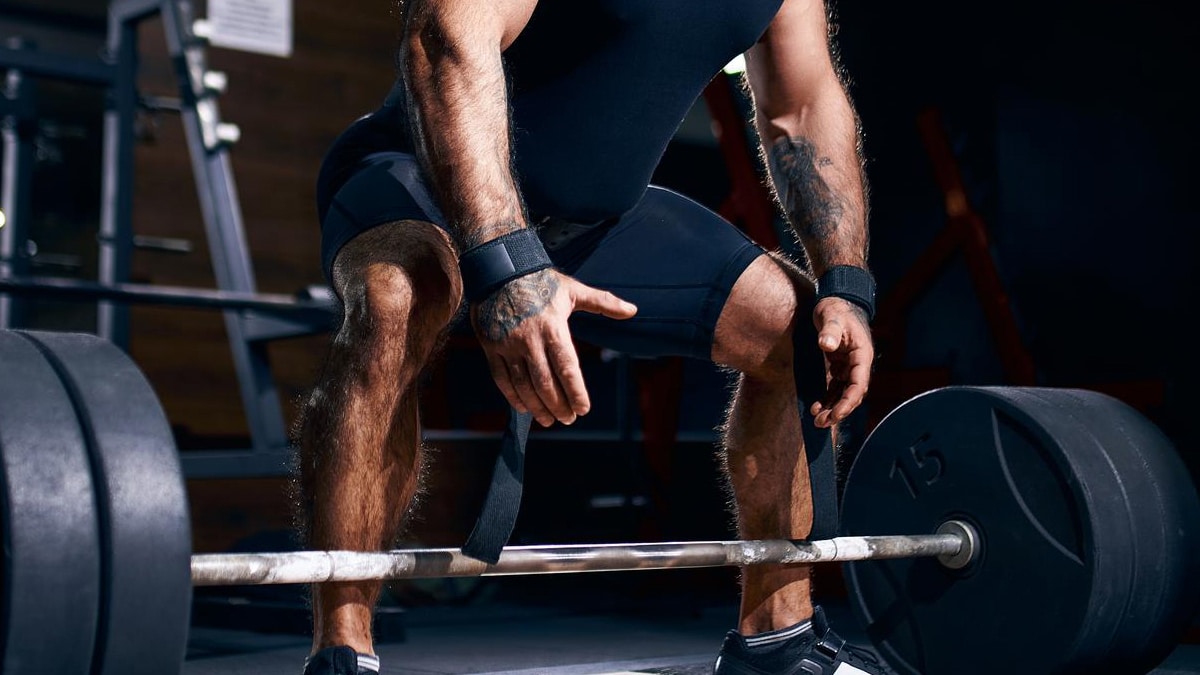
In pulling exercises, the weak link for many lifters is their grip.
During pull-ups, pulldowns, and deadlifts, their hands fail before the muscles they’re trying to train. This means that they end up using less weight or doing fewer reps or sets, making the workout less effective.
Of course, some people have an unbreakable grip, but, for many, a weak grip is a major impediment to productive training.
If your grip is weak, you need to fix that problem with some dedicated hand and forearm training. But, even then, you may still find that your grip is a limiting factor, especially if you have small hands.
The good news is that using lifting straps can help enhance your grip.
In this article, we explain why and how to use lifting straps so you can get more out of your pulling workouts.
What are Lifting Straps?
Lifting straps, also known as wrist straps, are lengths of heavy-duty webbing made from nylon, cotton, or leather. Worn around the wrists, lifting straps increase the friction between your hands and the bar/handle you are holding to reinforce your grip.
Lifting straps are generally used during pulling exercises that challenge the grip. Examples include:
While lifting straps are pretty simple, they can be tricky to use and may take some practice to master. However, their effect is only as good as your ability to use them correctly. As such, if you want to use lifting straps, you may need to practice to get the most from them.
Types of Lifting Strap
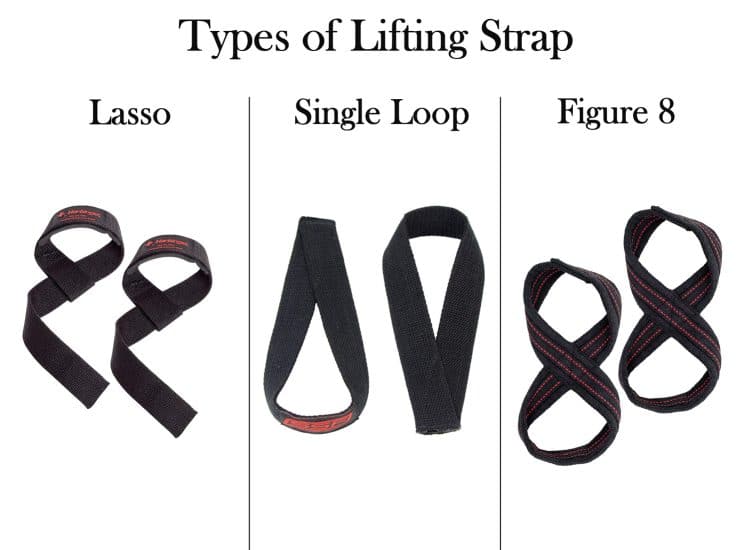
There are a couple of different types of lifting straps to choose from – figure eights, loops, and lasso.
Figure eights are very easy to use. Just put your hand through one fixed loop, wrap the middle of the strap once around the bar, and then put your hands through the other fixed loop. There is nothing more to it than that.
Loops work the same way as figure eights; however, you just place the middle of the strap over or under your bar and put your hand through. You can turn a loop into a figure eight by twisting it once before rethreading your hand.
While loops and figure eights make your grip virtually unbreakable, they also mean you can’t release the bar or handle very easily, and the weight tends to hang from your wrists, which can be painful. This style of strap is popular with strongman competitors.
The lasso type is a little harder to use, but, on the plus side, they are infinitely more customizable than figure eights and fixed loops. And, with practice, you’ll find they’re much more comfortable to use than the other types. Plus, with lassos, you still need to use your hands to grip the bar, so your forearms will get a bit of a workout, albeit less so because the straps take some of the strain.
Because they are a) more widely available and b) harder to use, in this article, we’ll explain how to use the lasso type. Figure eights and loops are very self-explanatory.
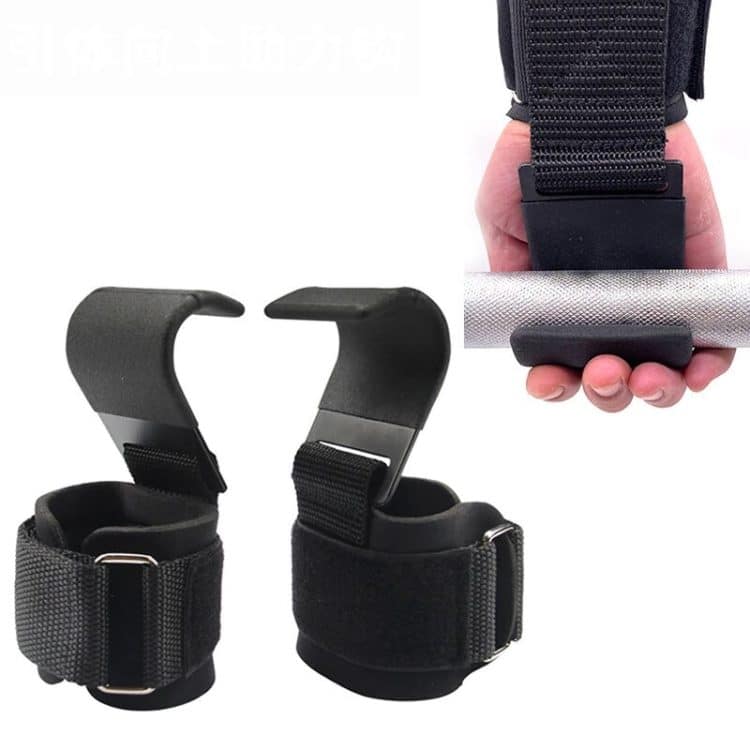
Some people prefer to forgo lifting straps altogether and use hooks instead. These are hooks fixed to strong wrist wraps. While these devices definitely work, they almost entirely remove your hands from the exercise you are performing and passively support the weight. Generally speaking, they are not as beneficial as lifting straps.
The Benefits of Using Lifting Straps
Some lifters need to wear lifting straps, while others wear them because they think they look cool or have seen other gym users with them.
You don’t HAVE to use straps, and if you do use them, you may not need them all the time. These are the benefits of using lifting straps.
Lift heavier weights
Exercises like deadlifts, rack pulls, shrugs, farmer’s walks, Kroc rows, and weighted pull-ups often involve very heavy weights. But, your grip strength (or lack thereof) will determine how much weight you can use.
Using straps may mean you can use heavier loads to make these exercises more challenging and productive.
Do more reps
If your grip fails before the muscles you’re training, your set will come to a premature end before those target muscles are stimulated enough to adapt and grow. Using straps means you can take your grip out of the exercise you are performing and concentrate more on the muscles you want to develop.
Fewer aches and pains
Exercises that challenge your grip can also lead to wrist and elbow pain. This is especially true if you follow a high-volume training program. Using lifting straps means you won’t have to grip the bar as tightly, taking stress off the muscles and tendons that are so often overworked.
Enhance your mind-muscle connection
Relaxing your grip during exercises like pulldowns and rows means you can really focus on pulling your shoulders down and back and leading with your elbows. This will enhance your mind-muscle connection leading to increased tension in the target muscles.
Read also: Grip Variations For Bodybuilding
The Lifting Strap Drawbacks
While there are obvious benefits to using lifting straps, there are a few drawbacks to consider too:
You’re treating the symptom and not the cause
If you’ve got a poor grip, wearing lifting straps won’t make it stronger. You’re simply masking the symptom of having weak hands and forearms. So, most people should train their grip alongside using lifting straps, with the aim of eventually not needing the straps at all.
If you use straps but never do any grip training, your hands and forearms will always be weak.
Less functional training
Using straps will make some of your training less functional. For example, suppose you are doing deadlifts for better wrestling performance. In that case, you may not be able to use all that strength you’ve built because you aren’t practicing holding and controlling heavy objects with your hands.
Whenever you lift or pull anything, you use your back, arms, AND hands. Using straps limits lower arm involvement, so the exercise won’t have such a noticeable carryover to activities outside the gym.
A less fluid workout
Stopping to put your straps on can disrupt the flow of your workouts, especially if you find the process fiddly or tricky. Sometimes it’s nice to just “grip it and rip it,” and that’s not really possible if you have to spend a few seconds putting on and adjusting lifting straps.
Just watch Benni Magnuson in these videos. In the first clip, he’s clearly very fired up but then has to stop and put on his straps before lifting. Then, without straps, he all but sprints up to the bar before a big lift, as in the second video.
With straps:
Without straps:
Increased risk of injury
Lifting straps may mean you can lift heavier weights, but that’s not always a good thing. To some extent, your hands act like “circuit breakers,” and your grip will fail if you try and lift something that’s too heavy for you. Using straps means your grip will not fail even as your form starts to break down, which could lead to serious injury.
Not competition legal for powerlifters
While this last point is not really a drawback, it is still worth mentioning. Lifting straps are legal in strongman competitions but not in powerlifting.
So, if you are training to increase your strength for an upcoming powerlifting meet, you should limit your use of straps and train as you’ll be competing. Otherwise, you could find yourself failing lifts you have done in training simply because your grip is not as strong enough.
How to Use Lifting Straps – A Step-by-Step Guide
Lifting straps SHOULD improve your workout by strengthening your grip so you can lift more weight or push your target muscles closer to failure. However, they can also be distracting if you don’t use them properly or spend too long putting them.
Follow these steps to make sure you are using your lifting straps properly. Practice using your straps with a broomstick at home so that, when you hit the gym, you know exactly how to use them and don’t look like a complete newbie.
- Thread the free end of your lifting strap through the stitched loop to form a circle. Pull the tail part way through the make the loop smaller. Leave enough space so you can easily put your hand into the loop. Repeat with the other strap.
- Put your hand through the loop, so the free end runs in the direction of your thumb. If the strap doesn’t align with your thumb, you’ve got it on the wrong hand, so just switch them over.
- Pull the strap, so it’s snug but not excessively tight around your wrist.
- Place your hands on the bar. The strap(s) should be on the opposite side to your fingers, so behind the bar if you are using an overhand grip or in front of the bar if you are using an underhand grip.
- Use your thumbs to wrap the free end of the strap around the bar. Do not wrap the strap around itself. Instead, go along the bar to avoid overlaps that will make it thicker (and harder to grip) than it needs to be.
- You’ll probably have some strap left, so just leave it hanging. Do not wad it up around the bar, as this will impede rather than enhance your grip.
- Finally, roll your wrists forward (overhand grip) or backward (underhand grip) to cinch the straps tight and remove any slack, ensuring both are tightened equally. You are now ready to lift!
- To release the strap, just open your hands, and they should pull free quite easily. After all, it’s the pressure of your hands that holds them in place.
Note: Some people prefer to use their dominant hand to put their lifting strap on their less dominant hand first. This may be easier if you have one side that’s more dexterous than the other. However, with practice, you should be able to put both straps on simultaneously.
Lifting Straps – Wrapping Up
Lifting straps are a valuable training tool, but only if you a) learn how to use them properly and b) do at least some of your sets without them, so you develop a stronger grip.
Consider saving your straps for the last couple of sets in your workout, and only if you really need them. You certainly don’t need to use them for every exercise and every set – that’s overkill!
That said, if things like weighted pull-ups, rows, and deadlifts aggravate your elbows, wearing lifting straps may help. However, you should also address the cause of whatever ails you, as ignoring injuries is rarely a good idea and could make things worse.
 You can also follow us on Twitter, Facebook, Instagram, and
YouTube for even more content.
You can also follow us on Twitter, Facebook, Instagram, and
YouTube for even more content.Tip: If you're signed in to Google, tap Follow.