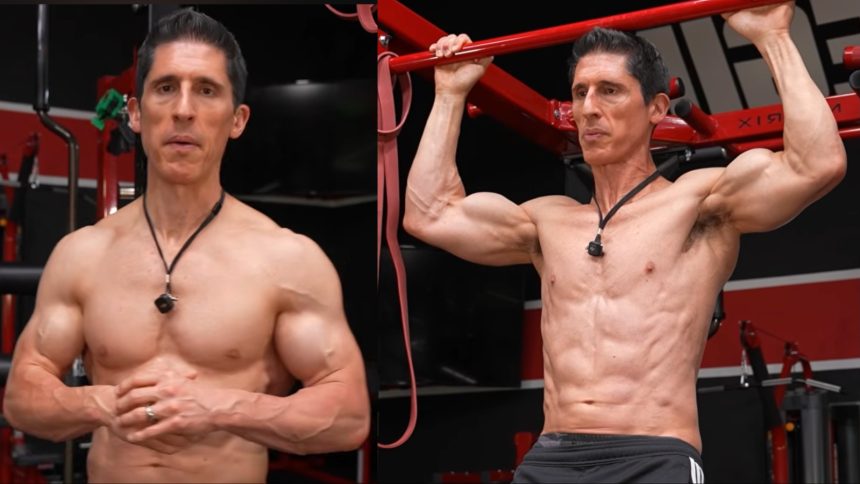
Jeff Cavaliere is sharing his four-step beginner’s guide to mastering pullups. In a YouTube video from June 8, 2026, he broke down how to use isometric holds with specific ranges of motion to perform more pullups.
“I’m going to give you a step-by-step protocol that’s going to guarantee that you do three, four, maybe even five or six more pullups at the end of just 28 days,” he said. “What you need is a chair, and this pullup bar, and that’s it.”
Jeff Cavaliere has become a household name in the fitness community. For years, his structured workouts and lean-eating frameworks have helped individuals achieve their dream physiques. With over 14.3 million YouTube subscribers, his content resonates with eager fans determined to make gym progress.
Jeff Cavaliere’s 4-Step Beginner Progression Plan for Pullups
Find his progression plan from the video below:
Step 1: Isometric Hold
The first step is to position your chin above the bar and simply hold it for as long as possible.
“Put yourself with your chin above the bar, get as close as you can to the bar, hold for as long as you can. One isometric hold with the chin up above this bar. What happens is, obviously, this becomes more of a challenge, and you start to drop.”
As your grip inevitably loosens, Cavaliere recommends slowly letting yourself down on the eccentric portion of this movement.
“But you let yourself slowly drop down, fighting this really important part of the pullup, which is the eccentric part of it. Fighting it all the way down, trying not to let yourself just drop. When you get to the bottom there, that’s one repetition.”
Step 2: Isometric Slow Elongated Eccentric
Next, position your head against the bar while hanging, allowing for an isometric hold on a different part of the eccentric.
“Get to the edge of the chair, put your head up against the bar. That’s going to be your position that you’re going to want to hold from,” he shared. “Isometrics need to be done across different angles or portions of the range of motion so you broaden the strength gains that you get from them.”
Step 3: Mid-Range Isometric
While at the mid-range, Cavaliere said to keep a slight bend in the elbows and to hold the bar:
“Third position with the arms right about here, you want some bend in the elbow, but a position basically between 90 degrees and fully extended.”
“Now we’re getting to the part of the pullup that happens to be the most difficult. This is the hard part. You can’t really get yourself through the first portion of it because you have to go from usually a dead-stop, and generate a lot of strength, force, and stability through your shoulder blades in a position where you’re weakest,” Jeff Cavaliere shared.
Step 4: Scapular Pull
Lastly, he said to use scapular pulls to help stability, so the body can perform pullups without joint compensation.
“This is the part that people never have when they start with pullups, and that is the stability of the scapulae to provide a stable platform for your glenoumeral joint to work from.”
“We get down in this dead hang position, and then pull your shoulders away from your ears and pull back just a little bit. This is a scapular pull.”
Jeff Cavaliere is a firm believer in pullups, emphasizing that they aren’t just for strength. He maintains that they can fix weaker upper bodies and can reverse years of damage from slouching, a common concern among adults today.
Pullups can be challenging to start, but Cavaliere stands by their payoff. He believes practicing isometric holds with specific ranges of motion sets the table for progress over time.
RELATED: Jeff Cavaliere Shares 9 Top Muscle-Building Mistakes in Training and How To Fix Them