
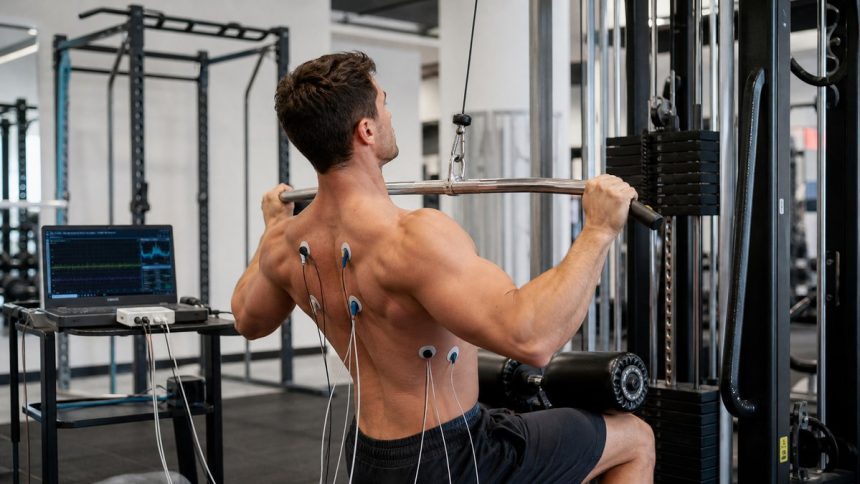
Most lifters overthink vertical pulling grips. The available EMG research does not support the idea that a super-wide pulldown grip automatically builds wider lats, or that switching from a pulldown to a pull-up changes every muscle in your back. The useful takeaway is narrower: pull-ups, chin-ups, and pulldowns all train the vertical pulling pattern, but grip, body position, and whether your body or the bar moves can shift the work toward the lats, biceps, lower traps, posterior delts, and shoulder stabilizers.
If your goal is back size, use the grip that lets you pull hard, control the shoulder blades, and progress without joint irritation. If your goal is a stronger bodyweight pull-up, practice pull-ups and chin-ups directly. If your goal is to isolate the lats with less total-body demand, the lat pulldown is still the easier tool to load and adjust.
| Question | Best practical answer | Why it matters |
|---|---|---|
| Is wide grip better for lats? | Usually no. Medium and wide pronated grips show similar lat activation in several EMG studies. | A grip around shoulder width to 1.5 times shoulder width is easier to load and control for most lifters. |
| Are chin-ups better for biceps? | Often yes for bodyweight pulling. Supination tends to make elbow flexors feel and work harder. | Use chin-ups when you want a strong back-and-biceps movement, not pure lat isolation. |
| Are pulldowns useless if you can do pull-ups? | No. Pulldowns let you manage load, volume, tempo, and technique more precisely. | They are useful for hypertrophy work, warm-ups, rehab progressions, and high-rep back training. |
| Should you do behind-the-neck pulldowns? | Most lifters should skip them. | Front pulldowns train the same target area with a better shoulder and neck position. |
What EMG Can Tell Us About Pulling Exercises
Electromyography, or EMG, measures electrical activity in a muscle during an exercise. It is useful for comparing how hard a muscle is working under controlled conditions, but it does not directly prove long-term muscle growth. Hypertrophy still depends on load, range of motion, proximity to failure, volume, recovery, and whether you can repeat the movement consistently.
That distinction matters for pull-ups and pulldowns. A study can show that two grip widths produce similar latissimus dorsi activation, but your shoulder structure, arm length, training history, and pain tolerance may still make one grip a better training choice. EMG should narrow the decision, not replace coaching judgment.
Pulldown Grip: Wide Is Not Automatically Better
The old bodybuilding cue says wide-grip pulldowns build wider lats. The research is less dramatic. In a 2014 study of 15 trained men, narrow, medium, and wide pronated pulldown grips produced broadly similar activation in the latissimus dorsi, trapezius, and infraspinatus. Narrow and medium grips also allowed slightly heavier six-rep-max loads than the wide grip.
A newer 2025 EMG study tested seven lat pulldown variations in trained men and found that grip type and forearm orientation did not significantly change latissimus dorsi recruitment. The lats remained the main target across variations, while accessory muscles such as the posterior deltoid, middle trapezius, infraspinatus, and biceps shifted more with body angle and hand position.
For most lifters, that points to a simple rule: choose a pulldown grip you can control through a deep stretch, a strong elbow drive, and a clean finish near the upper chest. A slightly wider-than-shoulder-width pronated grip is a reliable default, but a neutral or medium grip can be just as productive if it feels better on your shoulders and elbows.

Pull-Ups and Chin-Ups Are Not Just Pulldowns Upside Down
The pull-up is a closed-chain exercise: your hands stay fixed while your body moves. The pulldown is open-chain: your body stays fixed while the bar moves. That changes the stability demand, total-body tension, and how easily you can adjust load. A pull-up asks you to control your ribs, pelvis, shoulder blades, grip, and bodyweight at the same time. A pulldown lets you sit down, brace your thighs, and choose an exact load.
That is why the pulldown vs. pull-up decision should not be reduced to “which one activates the lats more.” Pull-ups are usually better for bodyweight strength, athletic transfer, and full-body pulling skill. Pulldowns are usually better for targeted volume, beginner progressions, and lifters who need to train around bodyweight limitations or cranky joints.
Chin-ups add another layer. Supinating the hands often makes the biceps and other elbow flexors contribute more, especially because most lifters can use a stronger range of motion and get the chest closer to the bar. That does not make chin-ups a worse back exercise. It makes them a different tool: more arm-friendly for some lifters, more elbow-irritating for others, and often easier to progress than strict pronated pull-ups.
Best Grip by Training Goal
There is no single best vertical pulling grip. There is a best grip for the job you are asking the exercise to do.
| Goal | Best starting option | Programming note |
|---|---|---|
| Lat-focused pulldown hypertrophy | Medium pronated or neutral grip | Pull elbows down and slightly in, pause near the upper chest, and keep the ribs from flaring. |
| Bodyweight back strength | Pronated pull-up | Use full reps, controlled eccentrics, and assistance only as needed to keep clean range of motion. |
| Back plus biceps | Chin-up or supinated pulldown | Expect more elbow-flexor contribution. Rotate in neutral grips if elbows get irritated. |
| Shoulder-friendly volume | Neutral-grip pulldown or assisted neutral pull-up | Neutral handles often feel better for lifters with limited shoulder external rotation. |
| Lower-trap and scapular control | Strict pull-up with a controlled dead hang | Start each rep by setting the shoulder blades instead of kicking or craning the neck. |
Behind-the-Neck Pulldowns Are a Poor Trade
Behind-the-neck pulldowns show up in older bodybuilding routines, but they are rarely worth the tradeoff. Research comparing pulldown paths has not shown a clear lat-building advantage that justifies forcing the shoulder into a more vulnerable externally rotated position while the neck drifts forward.
If you can do behind-the-neck pulldowns comfortably, that still does not make them necessary. A front pulldown, a neutral-grip pulldown, a single-arm cable pulldown, or a controlled pull-up gives you a more repeatable setup with less pressure to contort the neck and shoulders. For most lifters, the front-of-body version is the better long-term bet.
How to Make Pulldowns Hit Your Lats Better
Grip changes matter less than execution. If pulldowns feel like a biceps exercise, fix the setup before chasing a new attachment.
- Set the thighs firmly under the pads. A loose setup turns the movement into a half-row and makes you lean back to finish reps.
- Start with the shoulder blades moving down. Think “shoulders away from ears,” then drive the elbows down.
- Pull to the upper chest, not the stomach. A big backward lean changes the line of pull and turns the exercise into a hybrid row.
- Control the stretch. Let the arms reach overhead without losing rib position or shrugging aggressively.
- Use straps only when grip limits the target. If your forearms fail before your back on high-rep sets, straps can help keep tension where you want it.
For more technique detail, use our full lat pulldown guide and the close-vs-wide breakdown in our lat pulldown grip comparison.
Common Mistakes That Change the Muscle Emphasis
Many lifters blame the grip when the real issue is the rep. These mistakes can turn a lat-focused vertical pull into a messy arm-and-momentum exercise:
- Starting every rep with an elbow bend. If the elbows bend before the shoulder blades move, the biceps take over early.
- Leaning back farther on each rep. A slight torso angle is fine. Turning the pulldown into a row changes the exercise.
- Cutting the top short. The overhead stretch is one of the main reasons pulldowns and pull-ups work well for the lats.
- Pulling behind the neck to feel more range. That extra sensation usually comes from joint position, not a better lat stimulus.
- Using a grip that irritates the elbows. Pain changes mechanics. Switch to a neutral handle or reduce load before forcing volume.
If a grip feels strong, repeatable, and pain-free, it is probably a better hypertrophy choice than a theoretically superior grip that makes you shorten reps or lose control.
How to Program Pull-Ups and Pulldowns Together
You do not need to choose one exercise forever. A strong back program often uses both: pull-ups or chin-ups for skill and strength, pulldowns for extra volume and cleaner fatigue management.
Here are three practical setups:
- Strength-first back day: Start with weighted or assisted pull-ups for 3-5 sets of 3-8 reps. Follow with pulldowns for 2-4 sets of 8-15 reps.
- Hypertrophy-first back day: Start with pulldowns for 3-4 hard sets of 8-12 reps. Use assisted pull-ups later for controlled bodyweight volume.
- Beginner progression: Use pulldowns to build strength, then add negatives, band-assisted pull-ups, and full pull-ups as skill improves. Our pull-up and chin-up guide covers those progressions step by step.
If you cannot do pull-ups yet, you are not missing a secret muscle-building signal. Train the same muscles with pulldowns, rows, and lat pulldown alternatives while you build the strength and body control to own the full movement.
The Bottom Line
Use EMG research to kill the grip myths, then train the movement hard. Wide pulldowns are not magic for lat width. Chin-ups train the back and biceps together. Pull-ups are a strong choice, but they are not automatically superior for every lifter. The best vertical pulling choice is the one that matches your goal, lets you progress, and keeps your shoulders and elbows feeling strong.
For most lifters, that means a medium pronated or neutral pulldown for repeatable back volume, pull-ups or chin-ups for bodyweight strength, and enough rowing and lower-trap work to keep the shoulders balanced. If you want more lower-trap-specific training, see our guide to the best lower trap exercises.
Sources
- Andersen V, Fimland MS, Wiik E, Skoglund A, Saeterbakken AH. 2014. Effects of grip width on muscle strength and activation in the lat pull-down. Journal of Strength and Conditioning Research. doi: 10.1097/JSC.0000000000000232. Accessed July 8, 2026.
- La Greca S, et al. 2025. Electromyographic Analysis of Back Muscle Activation During Lat Pulldown Exercise: Effects of Grip Variations and Forearm Orientation. Journal of Functional Morphology and Kinesiology. doi: 10.3390/jfmk10030345. Accessed July 8, 2026.
- Doma K, Deakin GB, Ness KF. 2013. Kinematic and electromyographic comparisons between chin-ups and lat-pull down exercises. Sports Biomechanics. doi: 10.1080/14763141.2012.760204. Accessed July 8, 2026.
- Youdas JW, et al. 2010. Surface electromyographic activation patterns and elbow joint motion during a pull-up, chin-up, or Perfect-Pullup rotational exercise. Journal of Strength and Conditioning Research. doi: 10.1519/JSC.0b013e3181f1598c. Accessed July 8, 2026.
- Snarr RL, Hallmark AV, Nickerson BS, Esco MR. 2017. Electromyographical Comparison of a Traditional, Suspension Device, and Towel Pull-Up. Journal of Human Kinetics. doi: 10.1515/hukin-2017-0068. Accessed July 8, 2026.
- Sperandei S, Barros MAP, Silveira-Junior PCS, Oliveira CG. 2009. Electromyographic analysis of three different types of lat pull-down. Journal of Strength and Conditioning Research. doi: 10.1519/JSC.0b013e3181b8d30a. Accessed July 8, 2026.