

10 Best Single-leg Lateral Hop Alternatives for Quad Strength
The Single-leg Lateral Hop is done standing. Ranked closest by our scoring: the Single-leg Hop Progression, the Single-leg Stride Jump and the Single Leg Push-off.
Updated Ranked by our 12-factor similarity model How it works
Original Exercise: Single-leg Lateral Hop
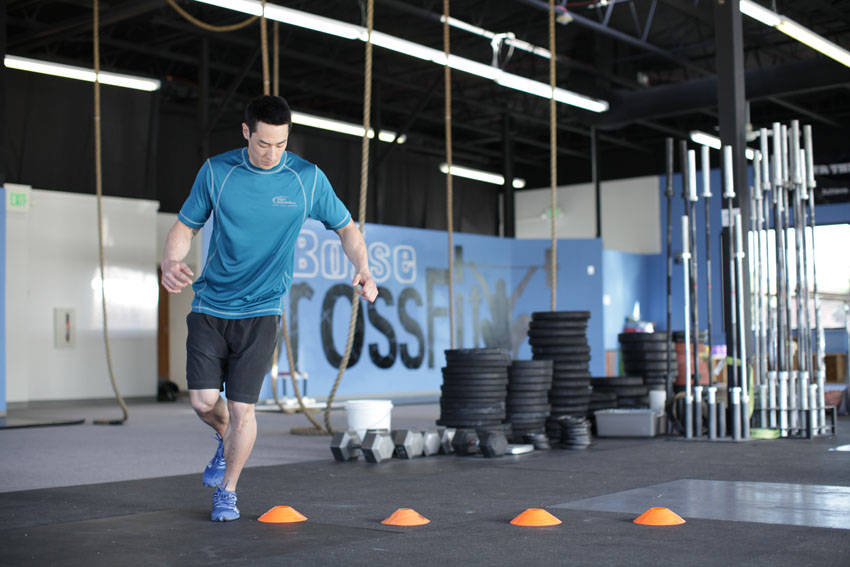
- Primary muscle
- Quadriceps
- Equipment
- Other
- Difficulty
- Advanced
- Type
- Compound
Secondary muscles: Abductors, Adductors, Calves, Hamstrings
How to perform Single-leg Lateral Hop
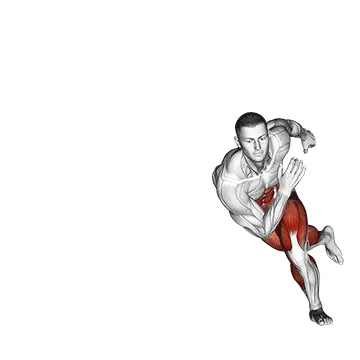
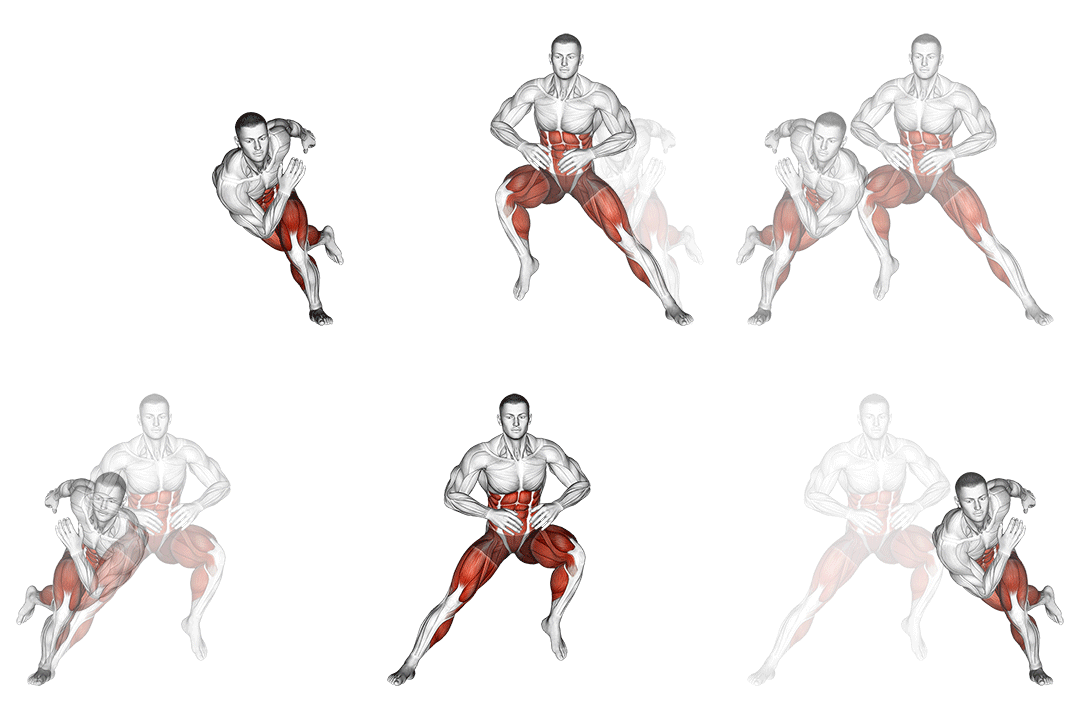
- Stand to the side of a cone or hurdle. To get into the start position, stand on one leg with your knee slightly bent.
- To begin, execute a counterjump to hop sideways over the cone.
- Land on your jumping leg, and immediately rebound out of it by jumping back to the start position.
- Continue hopping back and forth.
Ranked Single-leg Lateral Hop Alternatives
10 substitutes, ranked by how closely each one matches the Single-leg Lateral Hop on movement pattern, muscles worked, equipment and body position. The higher the score, the less you change. Open "How to perform this exercise" on a card for the steps; every card title links to that exercise's own alternatives page.
Best match 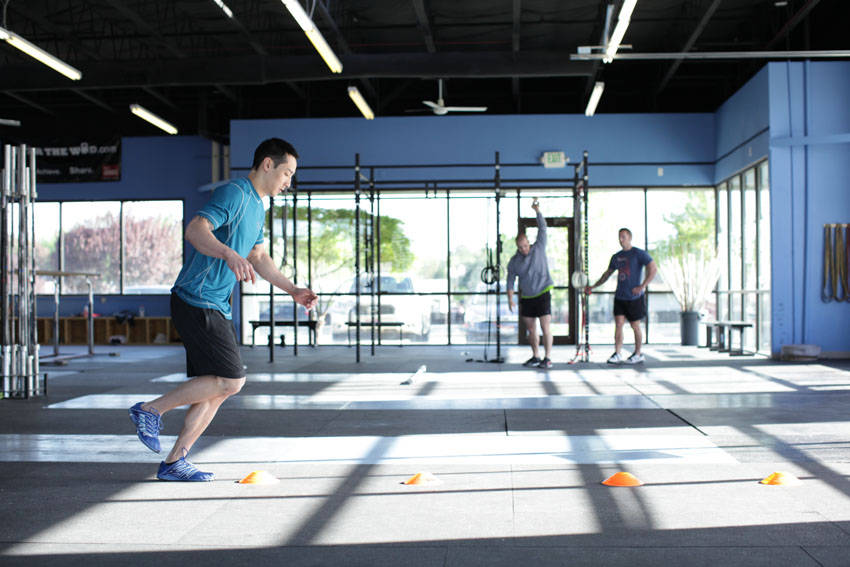
1. Single-leg Hop Progression
95% match- Quadriceps
- Other
- Advanced
- Compound
A straight swap when you want to keep working the quadriceps.
How to perform this exercise
- Arrange a line of cones in front of you. Assume a relaxed standing position, balanced on one leg. Raise the knee of your opposite leg. This will be your starting position.
- Hop forward, jumping and landing with the same leg over the cone.
- Use a countermovement jump to hop from cone to cone.
- At the end, turn around and go back on the other leg.
Sets and reps: Work for 30 to 60 seconds, rest as long as you worked, and repeat 6 to 10 times.
Why this matches
- Primary muscle: quadriceps, the same as the Single-leg Lateral Hop
- Equipment: bodyweight only, the same as the Single-leg Lateral Hop
- Body position: standing, the same as the Single-leg Lateral Hop
2. Single-leg Stride Jump
94% match- Quadriceps
- Other
- Advanced
- Compound
How to perform this exercise
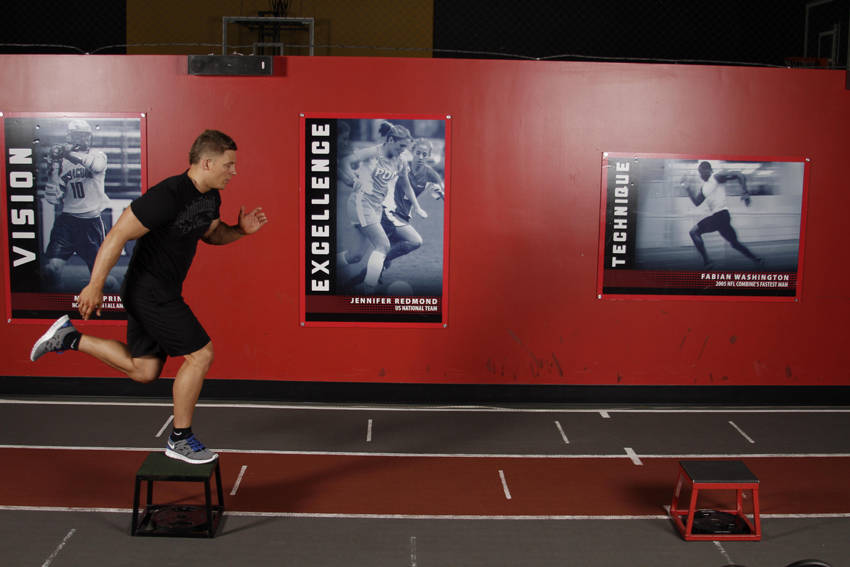
- Stand to the side of a box with your inside foot on top of it, close to the edge.
- Begin by swinging the arms upward as you push through the top leg, jumping upward as high as possible. Attempt to drive the opposite knee upward.
- Land in the same position that you started, using your inside leg to decelerate the impact.
Sets and reps: Work for 30 to 60 seconds, rest as long as you worked, and repeat 6 to 10 times.
Why this matches
- Primary muscle: quadriceps, the same as the Single-leg Lateral Hop
- Equipment: bodyweight only, the same as the Single-leg Lateral Hop
- Body position: standing, the same as the Single-leg Lateral Hop
3. Single Leg Push-off
90% match- Quadriceps
- Other
- Intermediate
- Compound
Pick this when you want an easier version that still works the quadriceps.
How to perform this exercise
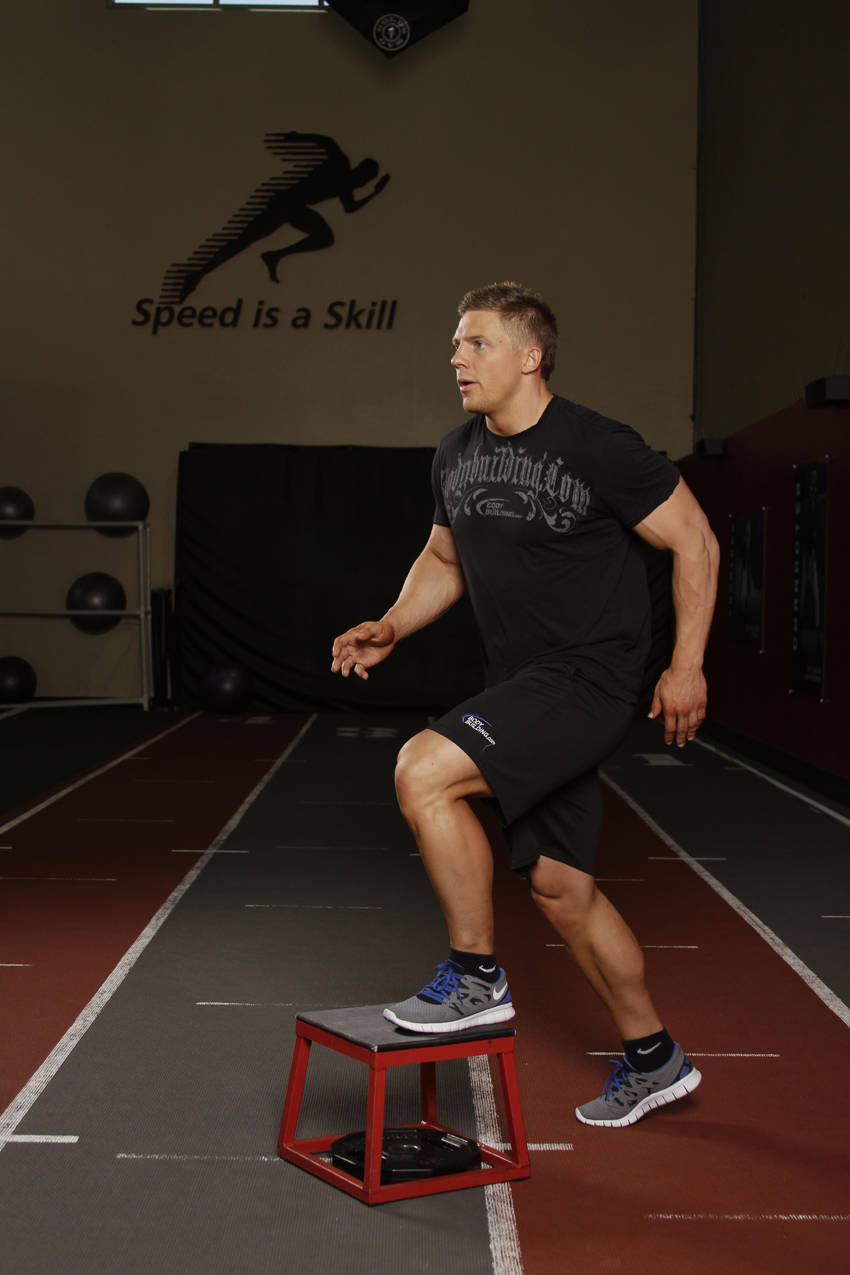
- Stand on the ground with one foot resting on the box, heel close to the edge.
- Push off with your foot on top of the box, trying to gain as much height as possible by extending through the hip and knee.
- Land with the same foot on top of the box, returning your other foot back to the start position.
Sets and reps: Work for 30 to 60 seconds, rest as long as you worked, and repeat 6 to 10 times.
Why this matches
- Primary muscle: quadriceps, the same as the Single-leg Lateral Hop
- Equipment: bodyweight only, the same as the Single-leg Lateral Hop
- Body position: standing, the same as the Single-leg Lateral Hop
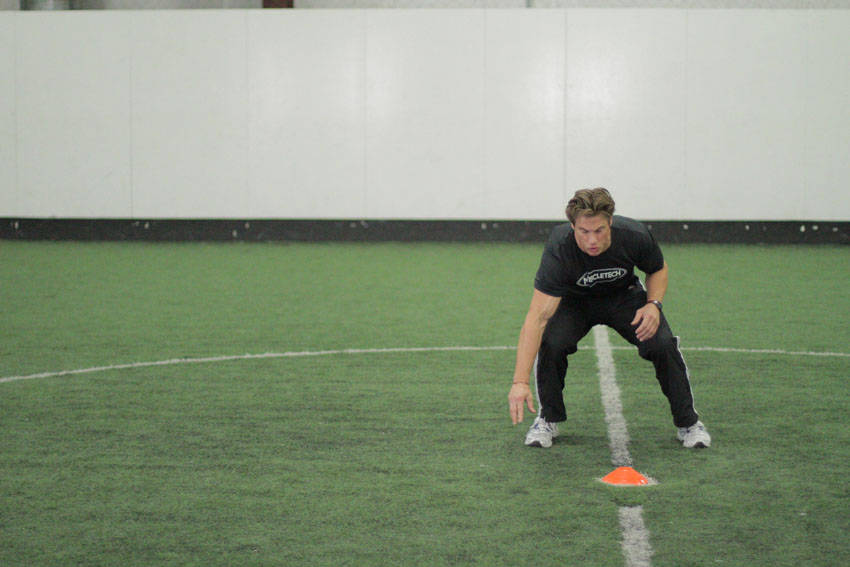
4. Side Standing Long Jump
82% match- Quadriceps
- Bodyweight
- Intermediate
- Compound
How to perform this exercise
- Begin standing with your feet hip width apart in an athletic stance. Your head and chest should be up, knees and hips slightly bent. This will be your starting position.
- Leaning to your right, extend through your hips, knees, and ankles to jump into the air. Block with the arms to lead the movement, jumping as far to your right as you can.
- Land facing the same direction with your feet hip width apart, absorbing the impact through your lower body.
Sets and reps: Work for 30 to 60 seconds, rest as long as you worked, and repeat 6 to 10 times.
Why this matches
- Primary muscle: quadriceps, the same as the Single-leg Lateral Hop
- Equipment: bodyweight only, the same as the Single-leg Lateral Hop
- Body position: standing, the same as the Single-leg Lateral Hop
- Balance: easier to stay steady on than the Single-leg Lateral Hop
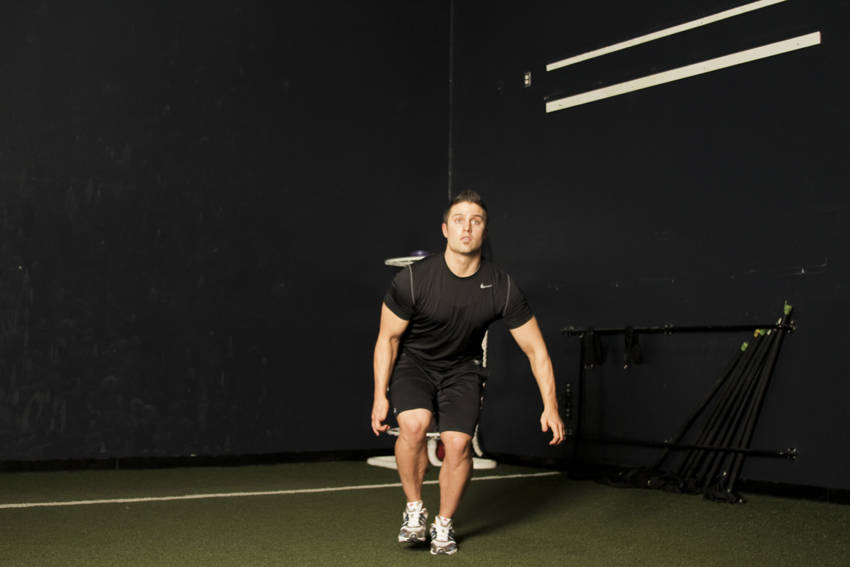
5. Single Leg Butt Kick
76% match- Quadriceps
- Bodyweight
- Beginner
- Compound
How to perform this exercise
- Begin by standing on one leg, with the bent knee raised. This will be your start position.
- Using a countermovement jump, take off upward by extending the hip, knee, and ankle of the grounded leg.
- Immediately flex the knee and attempt to touch your butt with the heel of your jumping leg.
- Return the leg to a partially bent position underneath the hips and land. Your opposite leg should stay in relatively the same position throughout the drill.
Sets and reps: Work for 30 to 60 seconds, rest as long as you worked, and repeat 6 to 10 times.
Why this matches
- Primary muscle: quadriceps, the same as the Single-leg Lateral Hop
- Equipment: bodyweight only, the same as the Single-leg Lateral Hop
- Body position: standing, the same as the Single-leg Lateral Hop
- Balance: easier to stay steady on than the Single-leg Lateral Hop

6. Side Hop-sprint
76% match- Quadriceps
- Other
- Intermediate
- Compound
How to perform this exercise
- Stand to the side of a cone or hurdle.
- Begin this drill by hopping sideways over the obstacle, rebounding out of your landing to hop back to where you started.
- Hop for a prescribed number or repetitions as quickly as possible, and finish this drill by sprinting a short distance upon landing the last hop.
Sets and reps: Work for 30 to 60 seconds, rest as long as you worked, and repeat 6 to 10 times.
Why this matches
- Primary muscle: quadriceps, the same as the Single-leg Lateral Hop
- Equipment: bodyweight only, the same as the Single-leg Lateral Hop
- Body position: standing, the same as the Single-leg Lateral Hop
- Balance: easier to stay steady on than the Single-leg Lateral Hop
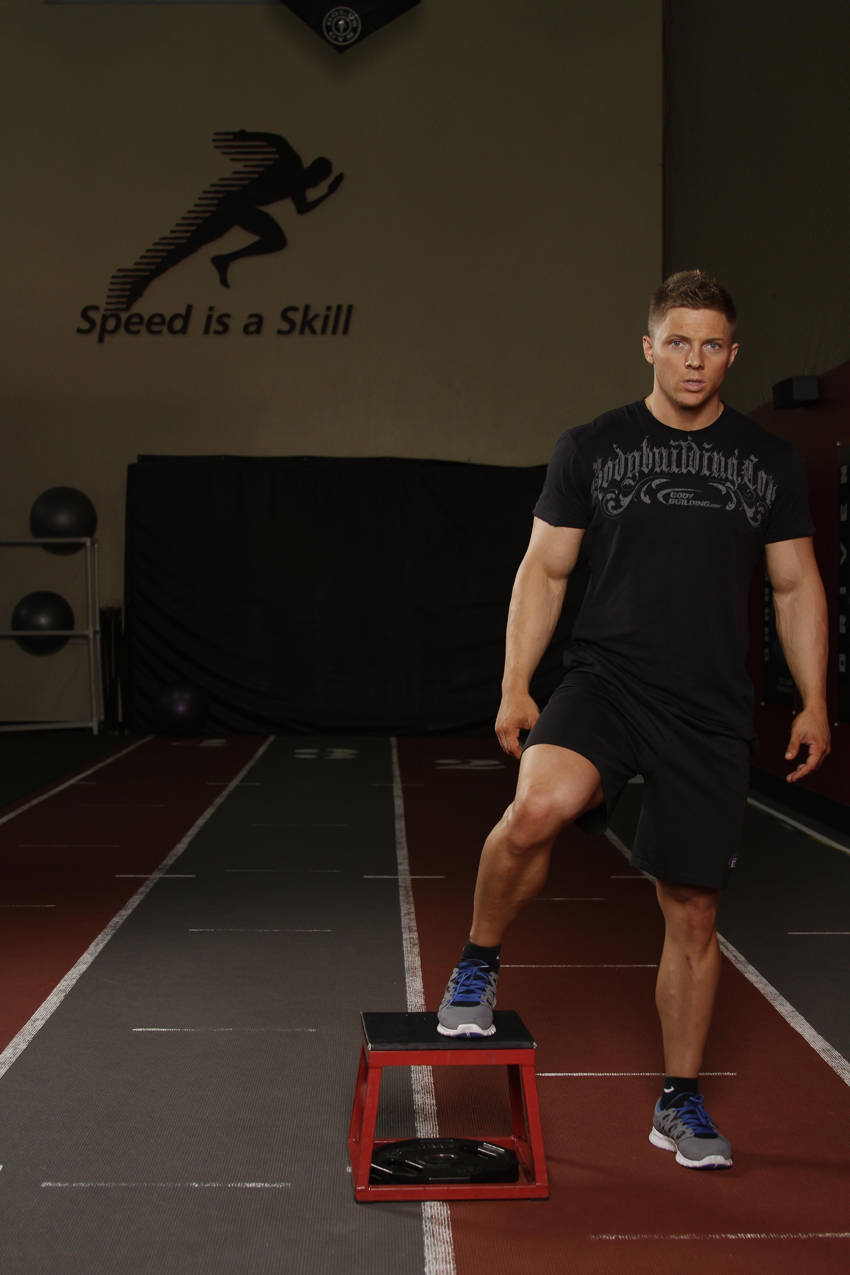
7. Side To Side Box Shuffle
73% match- Quadriceps
- Other
- Intermediate
- Compound
How to perform this exercise
- Stand to one side of the box with your left foot resting on the middle of it.
- To begin, jump up and over to the other side of the box, landing with your right foot on top of the box and your left foot on the floor. Swing your arms to aid your movement.
- Continue shuffling back and forth across the box.
Sets and reps: Work for 30 to 60 seconds, rest as long as you worked, and repeat 6 to 10 times.
Why this matches
- Primary muscle: quadriceps, the same as the Single-leg Lateral Hop
- Equipment: bodyweight only, the same as the Single-leg Lateral Hop
- Balance: easier to stay steady on than the Single-leg Lateral Hop
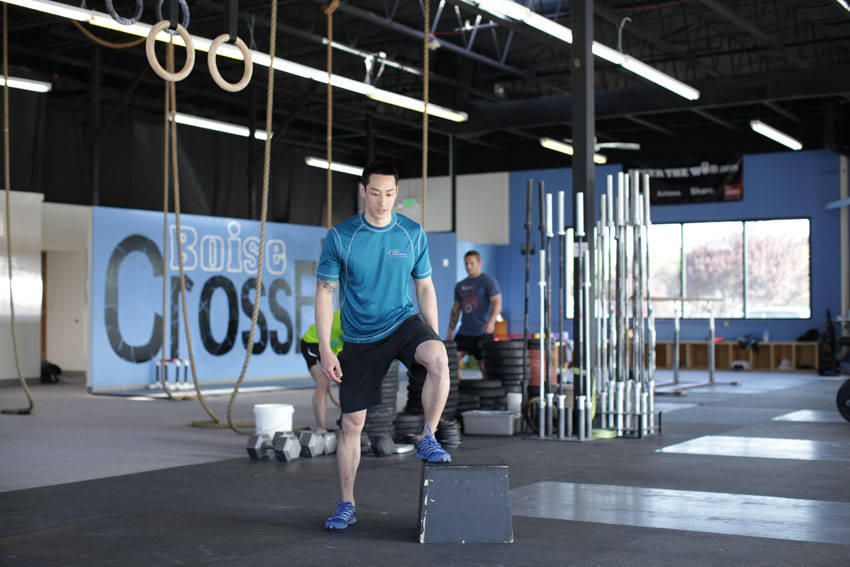
8. Stride Jump Crossover
73% match- Quads
- Other
- Intermediate
- Compound
How to perform this exercise
- Stand to the side of a box with your inside foot on top of it, close to the edge.
- Begin by swinging the arms upward as you push through the top leg, jumping upward as high as possible. Attempt to drive the opposite knee upward.
- Land in the opposite position that you started, on the opposite side of the box. The foot that was initially on the box will now be on the ground, with the opposite foot now on the box.
- Repeat the movement, crossing back over to the other side.
Sets and reps: Work for 30 to 60 seconds, rest as long as you worked, and repeat 6 to 10 times.
Why this matches
- Primary muscle: quads, not quadriceps
- Equipment: bodyweight only, the same as the Single-leg Lateral Hop
- Body position: standing, the same as the Single-leg Lateral Hop
9. Skater Hops
72% match- Cardio
- Bodyweight
- Advanced
- Compound
How to perform this exercise
- Stand with your feet shoulder-width apart.
- Bend your knees slightly and jump to the right, landing on your right foot.
- As you land, swing your left leg behind your right leg and tap the ground with your left toes.
- Immediately jump to the left, landing on your left foot.
- As you land, swing your right leg behind your left leg and tap the ground with your right toes.
- Continue alternating sides, jumping and tapping the ground with each leg.
- Repeat for the desired number of repetitions.
Sets and reps: Work for 30 to 60 seconds, rest as long as you worked, and repeat 6 to 10 times.
Why this matches
- Primary muscle: your heart and lungs, not quadriceps
- Equipment: bodyweight only, the same as the Single-leg Lateral Hop
- Body position: standing, the same as the Single-leg Lateral Hop
10. Single-cone Sprint Drill
69% match- Quadriceps
- Other
- Intermediate
- Compound
How to perform this exercise
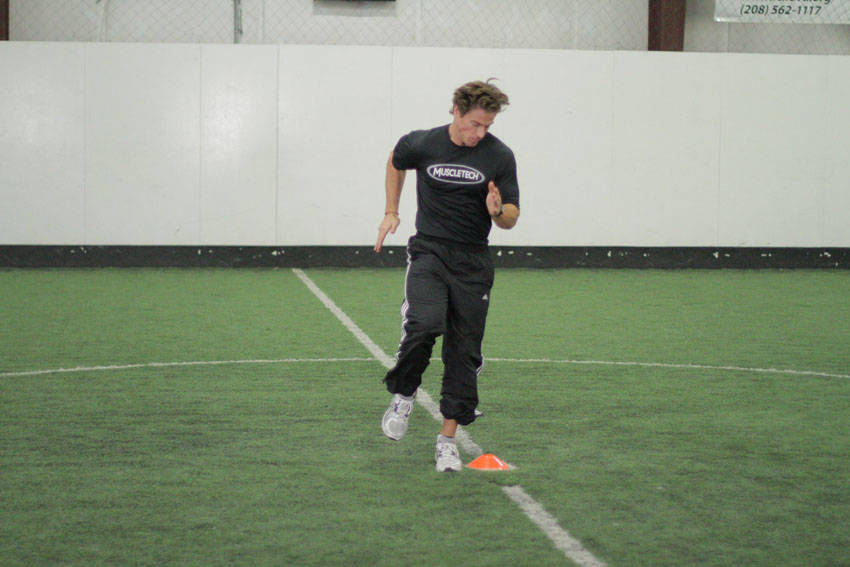
- This drill teaches quick foot action. You need a single cone. Begin standing next to the cone with one arm back and one arm forward.
- Chop the feet as quickly as possible, blocking with the arms. Circle the cone, keep your knees up, with violent foot action.
- Rest after three trips around the cone.
Sets and reps: Work for 30 to 60 seconds, rest as long as you worked, and repeat 6 to 10 times.
Why this matches
- Primary muscle: quadriceps, the same as the Single-leg Lateral Hop
- Equipment: bodyweight only, the same as the Single-leg Lateral Hop
- Body position: standing, the same as the Single-leg Lateral Hop
- Balance: easier to stay steady on than the Single-leg Lateral Hop
Why You Might Need a Single-leg Lateral Hop Alternative
You may need substitutes because of knee or ankle pain, lack of lateral space, poor balance, or training phase. Single-leg lateral hops generate high ground reaction forces and require rapid eccentric control; that can aggravate tendons or joints. Substitutes let you manage load and maintain quad recruitment by using slower eccentrics or reduced range of motion. Cue: when regressing, step laterally onto a box with a controlled 2–3 second descent, keeping tibia inclined forward to load the quadriceps and limiting frontal-plane knee collapse.
Single-leg Lateral Hop FAQ
What muscles does Single-leg Lateral Hop work?
The exercise primarily targets the quadriceps for knee extension and eccentric control. It also recruits the gluteus medius/maximus for lateral force and stability, the adductors/abductors for frontal-plane control, and the calves and core for ankle stiffness and trunk stability; cue: absorb the landing with bent knee and hips to distribute load through the quads.
What is the best bodyweight alternative to Single-leg Lateral Hop?
A lateral lunge is an effective bodyweight substitute because it trains unilateral quad loading and lateral mobility. Cue: step wide, sit the hips back, keep the chest tall, and drive through the heel to return, which emphasizes quadriceps and glute activation without high-impact stress.
Find Alternatives for Any Exercise
Search the exercise database and filter the ranked substitutes by the equipment you own.
Similarity scores compare exercise metadata such as movement pattern, muscles, equipment and body position. They are not a safety rating or a check that you own the equipment. Learn about our methodology