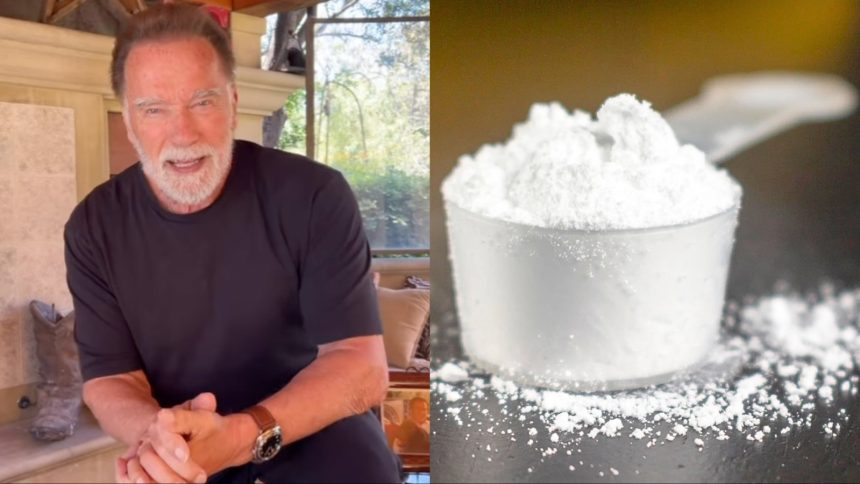
Bodybuilding icon Arnold Schwarzenegger is clearing the air on creatine. In his July 29 Arnold’s Pump Club newsletter, he outlined the three real risks of creatine.
“What Are The Real Risks Of Creatine? – The answer is a bit of a letdown, but in the best way possible: for a healthy adult, creatine is about as low-risk as supplements get, while offering legitimate research-based benefits.”
Arnold Schwarzenegger boasts decades of experience in the fitness and bodybuilding industry. Throughout the 1970s, he built his legacy with seven Mr. Olympia titles. He routinely faced off against all-time greats, like Lou Ferrigno and Frank Zane.
Creatine is among the most widely used and studied supplements on the market. Schwarzenegger has long advocated for its use, but he is laying out risks that might get overlooked if you’re not paying close attention.
Arnold Schwarzenegger Shares Top Creatine Risks to Look Out For
In the newsletter, Schwarzenegger explained that while creatine has a better safety profile than most supplements, what’s in the tub is more important than what’s plastered on the label.
“Risk 1: What’s in the tub. Supplements get regulated after they hit the shelf, not before, so what’s in the container can drift from what’s on the label. When researchers test sports supplements, an uncomfortable number of products come back dirty.”
He pointed out that banned substances and undeclared drugs have been found in creatine products, according to multiple studies.
“One review found that up to 50% of products tested positive for banned substances, and a larger review of 50 studies covering more than 3,000 supplements found over 28% contained undeclared drugs, including anabolic steroids.”
“And many creatine products don’t even have any creatine and instead are stuffed with other, sometimes illegal, performance-enhancing ingredients. Or, they use forms of creatine — like Creatine HCL — that aren’t backed by decades of published research.”
To eliminate any doubt, Schwarzenegger encouraged buying third-party-tested creatine:
“Creatine monohydrate is a single, affordable ingredient, which puts it near the safe end of the shelf. You erase most of the risk with one habit: buy a third-party-tested tub.”
Additionally, the former seven-time Mr. Olympia warned that larger doses of creatine could increase the risk of stomach discomfort.
“Risk 2: Your stomach, if you mega-dose. The side effect that shows up is stomach trouble, but it depends on how much you take, not creatine itself. At 3-5 grams, most people have no issues. But in a trial of 59 people, a single 10-gram serving increased the risk of GI issues. Split that same 10 grams into two 5-gram doses, and it was no different from placebo.”
Lastly, Schwarzenegger revealed that those who have existing kidney disease should hold off on taking creatine and consult with a doctor first.
“Risk 3: The one group that should pause. If you have an existing kidney disease, talk with your doctor. Not because creatine has been shown to damage kidneys — a thorough review of the literature found no compelling evidence of that in healthy or clinical populations.”
Elevated creatinine levels can occur from taking creatine, but Schwarzenegger said that doesn’t necessarily mean kidney damage:
“It’s because creatine can affect creatinine levels, which are the blood marker doctors use to monitor kidney function. That rise is a normal byproduct of taking creatine, not a sign of damage.
But if your kidneys are already compromised, you don’t want to blur the gauge you’re steering by. That’s a conversation for your doctor if you have a health condition, not a warning for everyone else.”
“The Austrian Oak” has opened up about other creatine concerns, like whether it causes cancer. Looking at 25,000 adults, scientists found that taking creatine was associated with a significantly lower risk of developing cancers.
Schwarzenegger continues to help guide the next wave of athletes on the horizon. While creatine is an effective supplement, there are still risks associated with its use.