
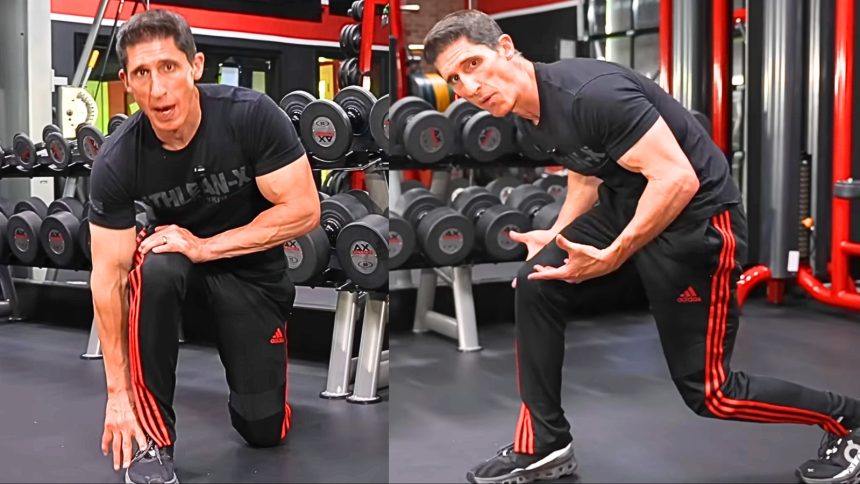
Fitness coach Jeff Cavaliere is sharing how to master one of the top leg exercises. In a July 27 YouTube video, he revealed the most common lunging mistakes to avoid and how to fix them.
Cavaliere has built a massive online empire, helping gymgoers reach their goals. Whether it’s fat loss, a specific exercise to build muscle, or a dieting framework, his content is supported by science, along with on-the-ground experience. This journey has led him to break down how to incorporate the lunge effectively for safer leg gains.
Jeff Cavaliere’s Crash Course for Proper Lunging
In the video, Cavaliere explained that the two most popular lunging directions are forward and backward. However, he warned against forward-stepping lunges because of the stress it puts on the knees.
“It starts with the direction that we’re lunging. Now, the two popular directions we can lunge in, forward or backwards, the most popular happens to be the most stressful to your knee joint because every time we step forward, we are placing a lot of undue stress on that patellofemoral joint in the knee and also the patellar tendon that doesn’t have to be there if we simply redirect our step backwards.”
How individuals push out of a lunge can also affect the muscles they intend to target:
“The next thing is also what is the effect on the legs that you’re trying to grow? When we step, the issue is not just how we land, but how we push out of the lunge. When we push out of the lunge from this position, we oftentimes compensate instantly.”
Cavaliere noted that the reverse lunge naturally positions the hips throughout each repetition.
“We slide the hips back, and then we stand up, rather than having to keep the knee bent and come straight up out of there and step backwards. When we do the reverse lunge, that all happens naturally,” Jeff Cavaliere said.
While it is possible to fix some biomechanical flaws with the forward lunge, he explained that it still won’t eliminate undue stress on the knees.
“If you wanted to step forward, you have to at least continue in a walking direction. You’ve seen The Rock do this variation here, where you step forward, and rather of having to compensate backwards, you just simply rise up and step through and take your next step. That will help fix a lot of those biomechanical flaws, but it still doesn’t take away that negative effect of the stresses on the knee joint.”
Sprinter Lunge
Lunging variations affect different muscle groups. For the glutes and hamstrings, Cavaliere said the sprinter lunge is ideal.
“If instead I were to lean forward a little bit by hinging at the waist, what this does is it creates something called a sprinter lunge. We’re looking like we’re in the starting blocks of a sprinter position here. This is going to load up the backside glute and hamstring more effectively.”
He cautioned that body position changes can influence which muscles are targeted during lunges.
“Be aware of the fact that changing your position, be it upright or leaning forward, is going to dramatically change the focus on the muscles you’re trying to target with the exercise.”
How to Load Lunges
To load lunges safely, Cavaliere encouraged any implement or weight that works best. For the posterior chain, he prefers holding dumbbells.
“If you were to try to do a posterior chain-focused version of this, where you’re leaning forward more, and you were going to do it with some type of object, even a kettlebell or dumbbell in a goblet or rack position here, then leaning forward is going to become very, very difficult.”
“Choose the implement that works best. Anything posterior, you’re best off holding a pair of dumbbells. No matter what I do, my arms are going to be independent of the rest of my body.”
Lunges have even found a place in reigning two-time Mr. Olympia Derek Lunsford’s routine. He recently explained how they helped him build his lower body, and urged others not to skip them.
“Whether you do dumbbell walking lunges or barbell on your back walking lunges, either way, it’s a very tiring and exhausting exercise.”
Cavaliere believes the forward lunge should be executed carefully due to the stress it places on the knees. Overall, he stands by the reverse lunge as an effective, safer leg-building option.
RELATED: How Many Calories Do You Burn Doing Lunges?