
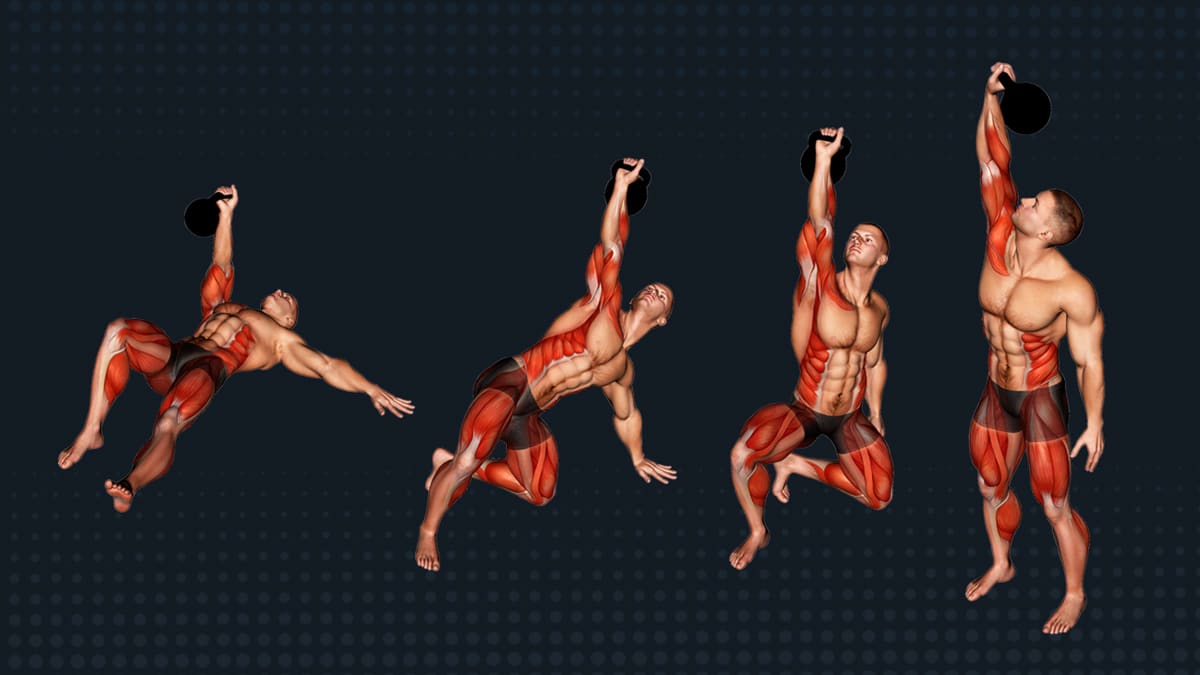
The kettlebell Turkish get up is a functional exercise that requires and improves total-body stability. It also works most muscles of the body as you’re starting from a lying down position and ending standing on your feet. You need strength, coordination, total body stability, flexibility, mobility, and positional awareness to complete this movement. We consider this one of the best techniques to learn for all-around fitness.
Turkish Get Muscles Worked
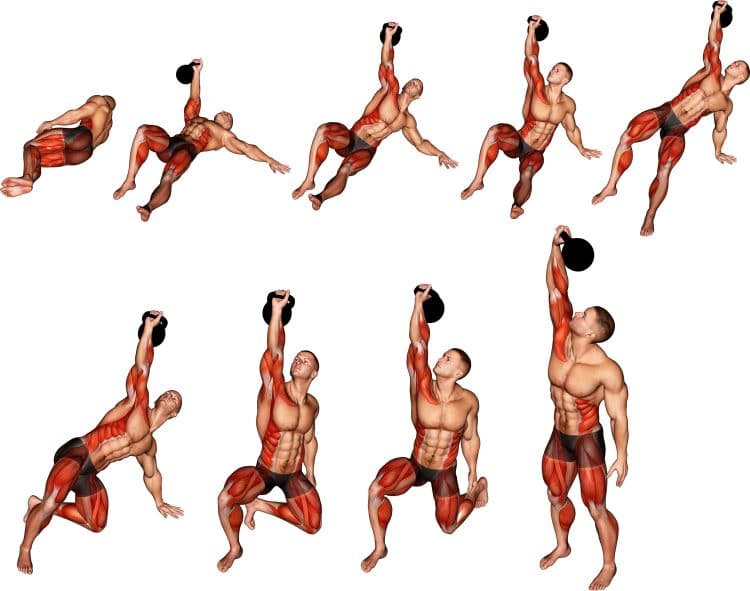
The kettlebell Turkish get up is pretty much a total body movement. We’ve included brief descriptions of the muscles involved.
Gluteus Maximus
The butt is more than one muscle, the gluteus maximus, medius and minimus. The maximus is our largest muscle and it forms most of the butt and hips shape. It’s role in the human anatomy is to extend and externally rotate the thigh. Think when you need to stand up from sitting or climb a flight of stairs.
Quadriceps
The quadriceps is large because it has four muscles that cover the front of the thigh – rectus femoris, vastus lateralis, vastus medialis, and vastus intermedialis. It’s also one of the strongest muscles. The quads are activated when dropping down into a squat and standing back up.
The kettlebell Turkish get up squat style primarily targets the quads and other leg muscles.
Hamstrings
The Turkish get up is a full lower body exercise, also working the muscles that sit on the other side of the quadriceps on the back portion of the thighs also known as the hamstrings. They’ll counteract the role of your quads by extending the hips and flexing the knees.
Core muscles
You need core strength to do kettlebell get ups but they’ll also make you stronger in that area as well. Everything from the six pack muscles to the deeper transverse abdominis, obliques and spinal erectors are engaged to get you from a lying to standing position while balancing a kettlebell overhead.
Deltoids
The kettlebell Turkish get up is a killer shoulder workout requiring the deltoids to hold and stabilize the weight overhead.
How To Do The Kettlebell Turkish Get Up (Squat Style)
This isn’t a simple exercise like a biceps curl or even a basic squat. There are many more elements involved as you start from your back and end up on your feet. We’ve included step-by-step instructions to help you understand how to properly execute this technique.
Choosing your kettlebell weight
Before you start training, it’s important to find a proper weight. This will be easier to do for more experienced exercisers. However, if you’re trying the kettlebell Turkish get up for the first time, grab a very light kettlebell to learn the movement before you use a more challenging weight.
Step-by-step instructions
- Grab your weight and sit on the floor.
- Holding the kettlebell in front of your body, lie down, press the kettlebell into full arm extension above your chest using an overhand grip and bend the same side leg so your foot is on the ground and the other is extended. For example, if your right arm is extended while holding the kettlebell, bend your right leg and place your foot on the floor. The other leg should remain extended. Keep your eyes on the kettlebell throughout the movement.
- Keep your core tight, shift your body toward the non-working arm and roll onto the left elbow.
- Bring the arm into full extension by placing your palm on the ground.
- Press through your foot and bend the other leg so both feet are planted on the ground, then stand up while keeping the arm holding the kettlebell extended overhead.
- Maintaining the same body position and squat back down.
- Place the palm of the non-working arm back on the floor, extend the leg opposite the arm holding the weight (keep the same side leg bent), sit your butt on the floor and lean into the non-working arm/elbow.
- Lie back down while keeping the arm extended above your chest.
- Repeat the exercise for the desired number of reps.
Here’s a video tutorial.
Kettlebell Turkish get up tips/what not to do
- Remember to alternate sides. For example, do a set holding the weight in the left hand, and then do the same for the right side. This is important to prevent imbalances as the kettlebell Turkish get up is an asymmetrical movement by nature (1).
- Start with a light weight and ensure you’ve performed each part of the movement properly before you add more weight.
- It’s very important that you keep the core muscles tight, back neutral, and glutes activated throughout the entire movement. This will help to keep you stable, make the movement more efficient and prevent injuries.
- The movement should be performed slow and controlled. This is not the movement to rush because it takes away from the functionality benefits of the exercise.
- Your eyes should remain in the direction of the kettlebell from start to finish.
- The arm holding the kettlebell should be fully extended from the start of the movement to the very end.
Kettlebell Turkish Get Up Benefits
There are many benefits to be had by introducing this movement into your training regime.
Stability and flexibility
Stability and flexibility are essential components of functionality and health. Without either you can forget about making progress, becoming well-rounded, and having longevity.
This is especially true for the shoulder joint that is an area often prone to injury and a lot of times that’s because it’s not as stable or strong compared to other joints in the body. Exposing the joint to strength-promoting movements carefully and with good form will make it stronger and more stable, and therefore enhance your training experience and prevent pain and injuries.
Athletic and functional carryover
The Turkish get up and its variations closely replicate real life scenarios whether you play sports, have a career that requires you to get down and dirty and have to do daily tasks.
As we get older, it tends to become harder to be as functionally strong and capable. It’s best to maintain this for as long as you can and that means you should be performing similar movements regularly. Keeping up with and even improving motor skills is a vital component of well-being.
Test yourself
A lot of us would be surprised just how incapable we really are when it comes to performing such complex movements. The kettlebell Turkish get up (squat style) is not only something most of us should try but it’s fun to challenge others with these types of functional exercises too.
Try these Barbell, Dumbbell, and Kettlebell Complexes to Get Ripped Fast.
Kettlebell Turkish Get Up Drawback/s
There aren’t many drawbacks, however, we should mention the possible cons of the kettlebell Turkish get up (squat style).
You need to have a decent level of fitness
If you lack mobility, flexibility, coordination, and shoulder stability, then this exercise could be hard or impossible to do. It does require at least a decent level of fitness and there are many different elements involved. With that being said, most people can work up to it and practice partial movements or not use any weight to progress into the Turkish get up and its kettlebell variations.
Kettlebell Turkish Get Up Variations
Here are a few variations that you can try for some variety.
1. Kettlebell windmill
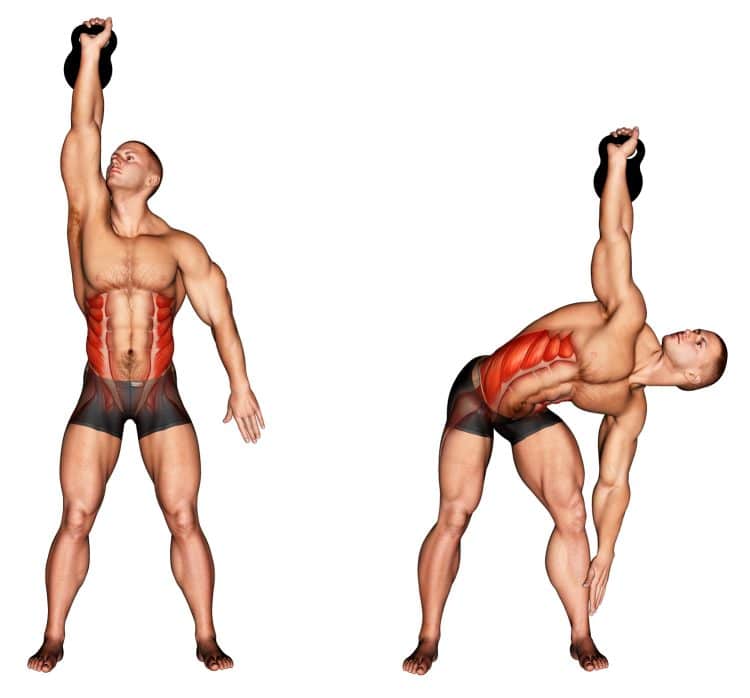
Why do we love this exercise? Because it’s so beneficial overall. Before you do the Turkish get up and its variations, this is a good place to start because it requires a similar technique but is done from a standing rather than lying position.
Learn how to do it and more here.
2. Turkish get up
The basic Turkish get up is a different variety than the squat style version we’ve talked about here today. It’s not majorly different compared to the squat style version but they are not the same.
Learn more about it and how to do it with our full Turkish get up guide.
How To Incorporate The Kettlebell Turkish Get Up Into Your Training Regime
The order in which you include this technique isn’t as important as just taking some time to throw it into your routine. Although, you don’t want to carelessly throw it in as this could cause injuries. But rather, take the time to practice and perfect it.
You can do it alongside any workout program or as part of a specialized functional training regime.
It would make a great addition to kettlebell only workouts, and if you train to be more athletic and stronger from the ground, this is something you should be doing.
No Frills Fitness: One Kettlebell and Bodyweight Full-Body Workout
Sets and reps
As for sets and reps, well this depends on the person and their goals.
At a minimum, we recommend doing at least one set of a few reps. Use a light kettlebell and make sure you are doing the exercise properly. Then, when you’re confident, you can ramp it up to 2-3 sets and use a more challenging kettlebell.
The reps aren’t as important although you do not want to go too light or heavy either.
Determine the appropriate number of reps based on what you want to achieve.
Get Up!
It’s time to get up with the kettlebell Turkish get up (squat style). It’s one of the best functional movements you can do including all of its variations and it’s definitely worth learning.
Whether you’re an athlete or seek longevity and a long-lasting functional body, it’s important that you do things that require the entire body to work together to achieve a specific outcome and this is a technique we’d recommend.
Interested in measuring your progress? Check out our strength standards for Renegade Row, Diamond Push Ups, Log Press, and more exercises.