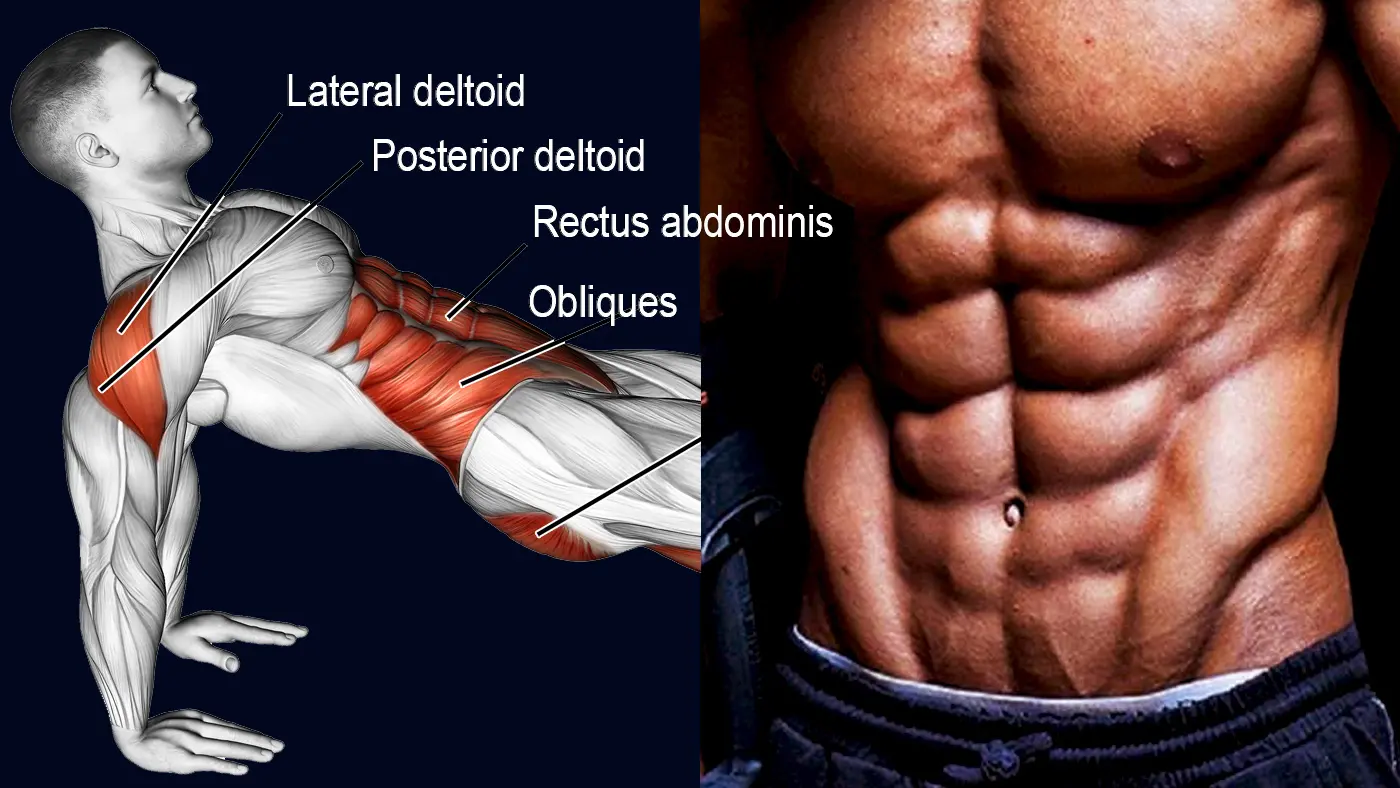
Your obliques do more than twist your torso. They help you resist unwanted rotation, control side bending, transfer force between your upper and lower body, and keep your trunk steady while you carry, run, lift, or throw. A useful oblique workout should train several of those jobs instead of repeating ten versions of a crunch.
The strongest exercise menu combines a side plank, Pallof press, suitcase carry, dumbbell side bend, cable wood chop, bicycle crunch, cross-body mountain climber, hanging oblique knee raise, medicine-ball rotational toss, and heel taps. Pick three or four movements that cover different functions, split them across two weekly sessions, and start with six to nine direct working sets in total.
We built this list from primary research on lateral trunk work, loaded carries, axial rotation, abdominal anatomy, and resistance-training prescription. Surface electromyography helps show which muscles work during a task, but it cannot tell us which exercise will produce the most long-term growth. Your technique, load, weekly volume, and progression still matter.
What do the obliques do?
The external and internal obliques run in different fiber directions along the sides of your abdomen. Urquhart and colleagues’ anatomical study found regional differences within these muscles, which helps explain why no single movement trains every oblique function. Together, they flex and rotate the trunk, assist side bending, manage abdominal pressure, and resist motion when your spine needs stability.
Think of oblique training as five related skills:
- Lateral stability: keeping your torso from sagging sideways during a side plank.
- Anti-rotation: resisting a cable that tries to turn you during a Pallof press.
- Loaded gait: staying upright while a suitcase carry pulls you toward one side.
- Controlled rotation: turning through a cable wood chop or medicine-ball toss without wrenching your lower back.
- Trunk flexion: bringing your ribs and pelvis closer during bicycle crunches or heel taps.
Direct oblique work can improve strength and muscular endurance, but it does not remove fat from the sides of your waist. In a six-week randomized trial by Vispute and colleagues, five weekly abdominal sessions improved curl-up endurance without reducing abdominal fat or waist measurements. Fat loss still depends on an overall calorie deficit, while these exercises build the muscle and control beneath it.
Which oblique exercise should you choose?
Choose by the movement you need, the equipment you have, and the position you can control without pain. Most lifters need one stability exercise, one loaded or anti-rotation exercise, and one controlled dynamic exercise. The table gives you a starting point without pretending that one movement wins every category.
| Exercise | Main challenge | Equipment | Starting dose | Best fit |
|---|---|---|---|---|
| Side plank | Lateral stability | Mat | 2-3 x 15-30 sec/side | Home training and core endurance |
| Pallof press | Anti-rotation | Cable or band | 2-3 x 8-12/side | Teaching trunk control |
| Suitcase carry | Loaded lateral stability | One dumbbell or kettlebell | 2-3 x 20-40 m/side | Strength that carries into lifting and daily tasks |
| Dumbbell side bend | Loaded side flexion | One dumbbell | 2-3 x 10-15/side | Simple progressive overload |
| Cable wood chop | Controlled rotation | Cable | 2-3 x 8-12/side | Gym-based rotational strength |
| Bicycle crunch | Flexion plus rotation | Mat | 2-3 x 8-15/side | Bodyweight abdominal training |
| Cross-body mountain climber | Dynamic trunk control | Floor space | 2-3 x 10-20/side | Core conditioning |
| Hanging oblique knee raise | Hanging flexion plus rotation | Pull-up bar | 2-3 x 6-10/side | Advanced bodyweight work |
| Medicine-ball rotational toss | Rotational power | Medicine ball and solid wall | 3-5 x 3-6/side | Athletes who already control rotation |
| Heel taps | Short-range side flexion | Mat | 2-3 x 12-20/side | Beginners and home workouts |
What are the 10 best oblique exercises?
The best list covers several trunk functions and offers a clear path from supported bodyweight work to loaded carries and explosive rotation. Use the order below as a menu, not a circuit you must complete in one session. Quality drops when fatigue turns controlled trunk work into rushed bending and swinging.
1. Side Plank
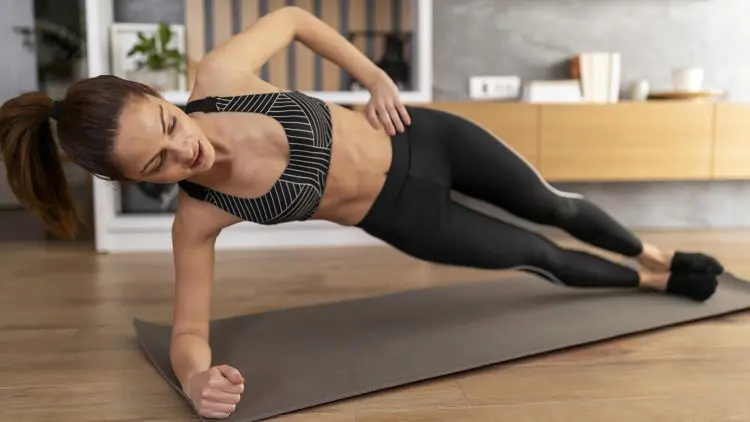
The side plank trains your obliques to stop the torso from bending toward the floor. In a laboratory study by Kinney and colleagues, the lateral plank produced substantial internal and external oblique activity in 63 adults. A separate side-bridge study by Youdas and colleagues also found external oblique activation above the threshold its authors used for strengthening work. These findings support the exercise as a practical stability choice, not a guarantee of superior muscle growth.
Best for: bodyweight lateral stability and home training. Modify it if: the supporting shoulder, elbow, or wrist becomes the limiting factor.
- Lie on one side with your elbow under your shoulder and your legs stacked.
- Brace as if preparing for a light punch, then lift your hips.
- Keep your ribs, hips, knees, and ankles in one line.
- Hold for 15-30 seconds, lower with control, and switch sides.
- Form cues: Push the floor away, keep your top hip stacked, and avoid rolling your chest toward the mat.
- Regression: Bend both knees to 90 degrees and support yourself from your knees.
- Progression: Extend the top arm, raise the top leg, or add a light plate at the hip.
If you can hold 30 seconds with clean alignment, add load or choose a harder variation instead of chasing minute-long sets. The side plank hip abduction guide shows one progression that adds a hip challenge.
2. Pallof Press
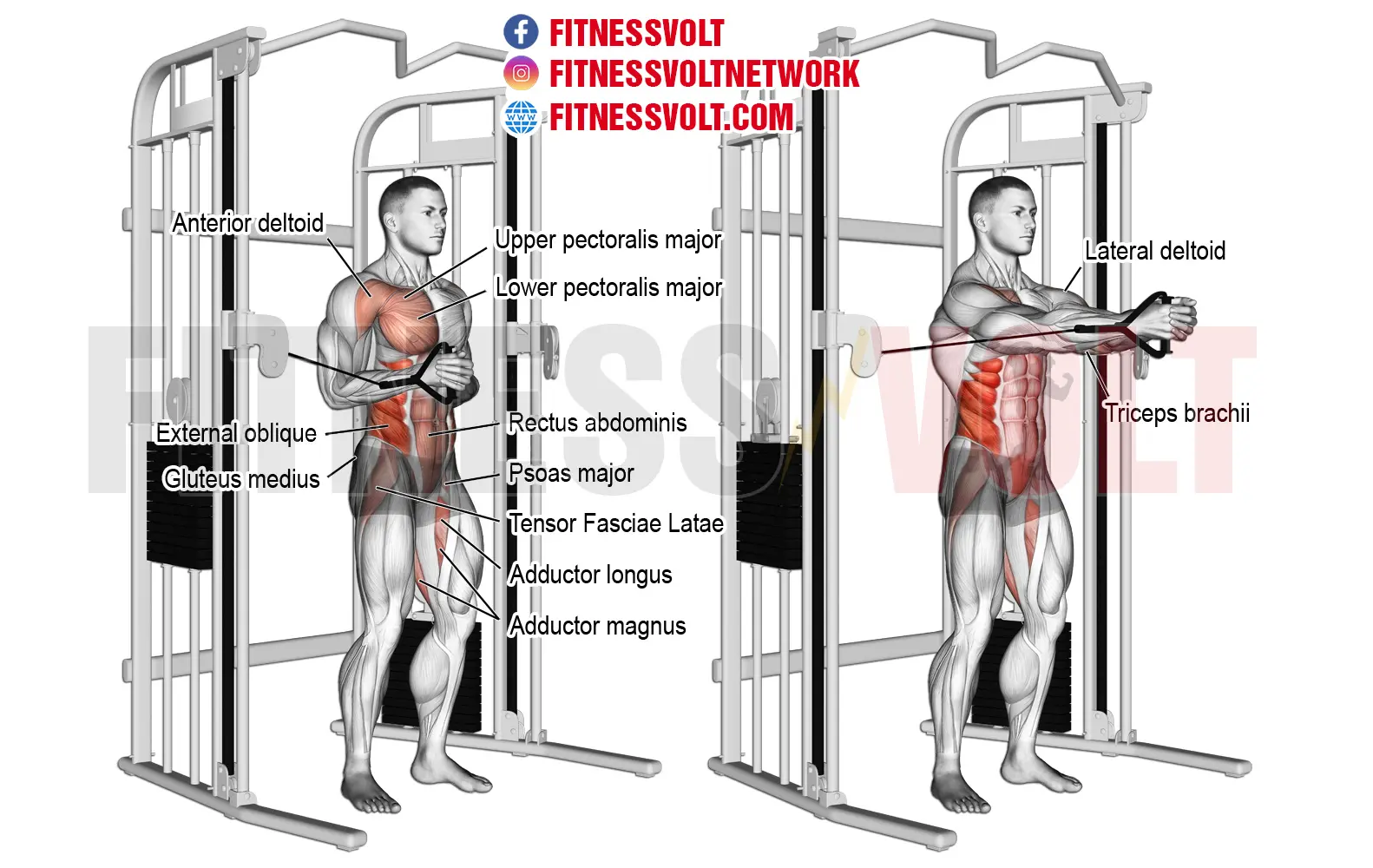
The Pallof press is an anti-rotation drill. Your arms move, but your trunk stays square while the band or cable tries to turn you. It suits beginners because you can scale tension in small steps, and it gives experienced lifters a precise way to train bracing without loading the spine through repeated rotation.
Best for: learning anti-rotation control. Modify it if: kneeling or standing positions irritate your knees, hips, or back.
- Set a cable or band at mid-chest height and stand sideways to the anchor.
- Hold the handle against your sternum with both hands.
- Step away until you feel steady tension, soften your knees, and brace.
- Press your hands straight forward without letting your torso turn.
- Pause for one second, return the handle, and complete 8-12 reps per side.
- Form cues: Keep your belt buckle and sternum facing forward. Exhale through the press without letting your ribs flare.
- Regression: Move closer to the cable stack or use a lighter band.
- Progression: Use a split stance, half-kneeling position, longer pause, or overhead press path.
The cable should challenge your position without dragging you off balance. If your arms cannot travel straight, reduce the load and own the range.
3. Suitcase Carry
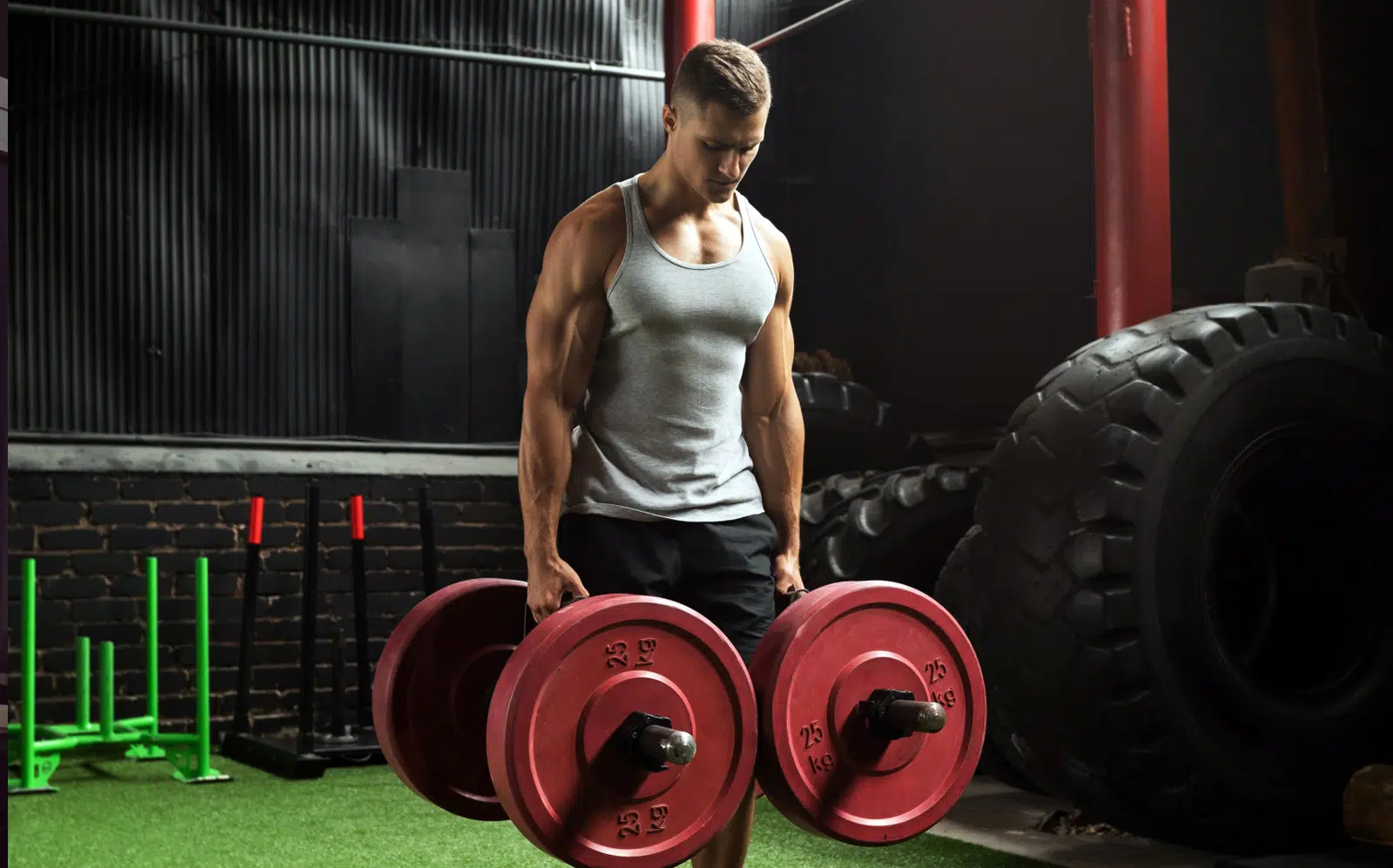
The suitcase carry asks your obliques to keep you upright while one weight pulls your torso sideways. A 2024 study by Ellestad and colleagues compared loaded carries and static holds. Participants used an average single-dumbbell load of 25.3 kilograms for the suitcase conditions, and the moving carry produced distinct ipsilateral trunk activation compared with the hold.
Best for: loaded stability that transfers to walking, lifting, and carrying groceries. Modify it if: grip fatigue or gait changes before your trunk feels challenged.
- Pick up one dumbbell or kettlebell and stand tall with the weight at your side.
- Brace, keep both shoulders level, and look straight ahead.
- Walk 20-40 meters with short, natural steps.
- Set the weight down with control, switch hands, and repeat.
- Form cues: Keep the weight close to your leg and avoid leaning away from it. Walk as if balancing a glass on your head.
- Regression: Use a lighter load or march in place beside a rack for support.
- Progression: Add distance, load, or a slow march before trying unstable surfaces.
End the set when you start hiking one hip, shortening one step, or drifting sideways. Distance only counts while your gait stays even.
4. Dumbbell Side Bend
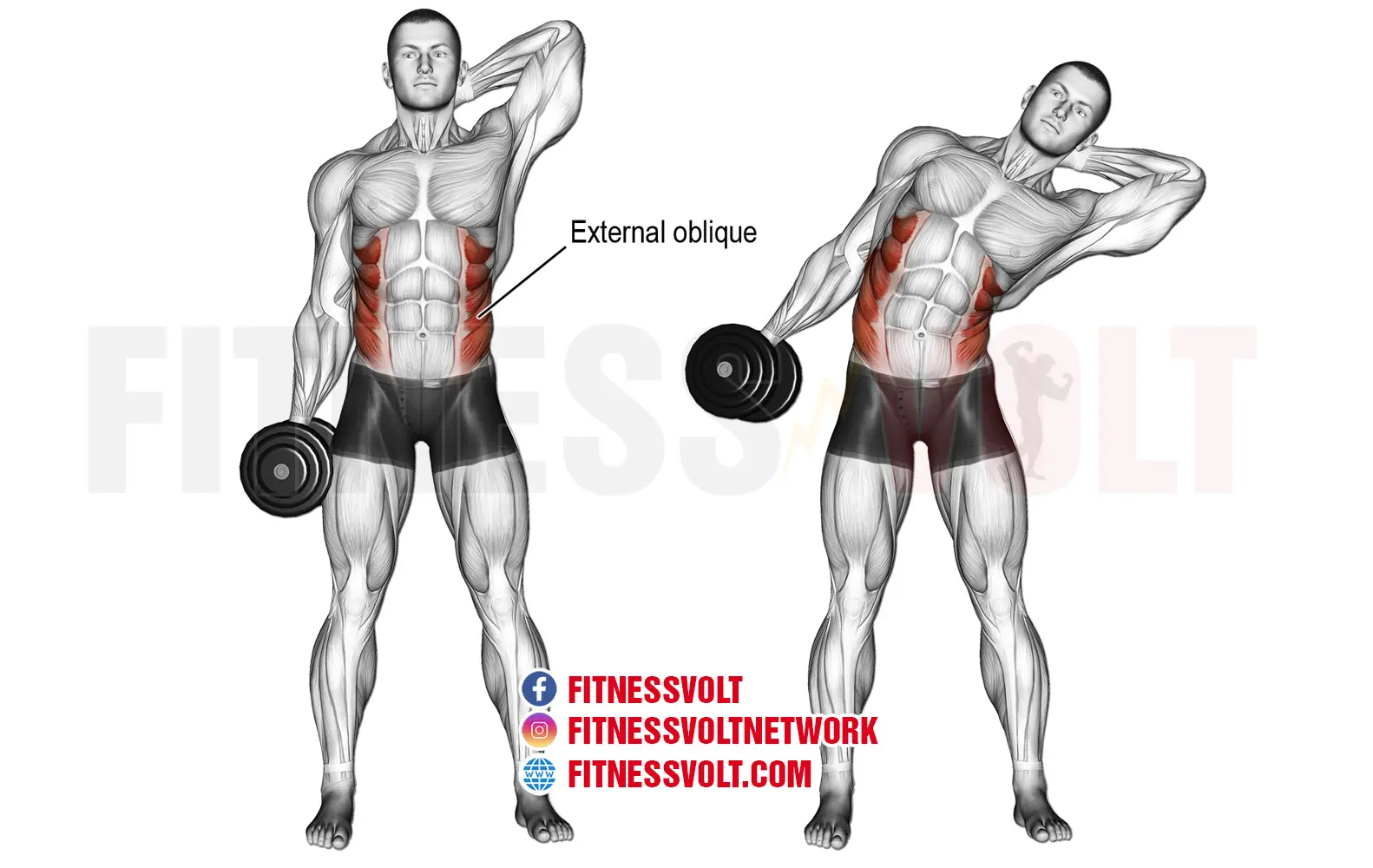
The dumbbell side bend loads lateral trunk flexion through a range you can measure and progress. One dumbbell works better than two for most lifters because a second weight counterbalances the first. Start light enough to move through your torso instead of shifting your hips.
Best for: lifters who want direct, loadable side-flexion work. Modify it if: loaded bending reproduces back pain or sends symptoms into the hip or leg.
- Stand with your feet around hip-width apart and hold one dumbbell at your side.
- Brace and slide the dumbbell a short distance down the outside of your thigh.
- Stop before your hips shift or your chest rotates.
- Use the opposite-side obliques to return to upright.
- Complete 10-15 reps, then switch hands.
- Form cues: Move in one plane, keep both feet planted, and use a two-second lowering phase.
- Regression: Practice the path without weight or shorten the range.
- Progression: Add a small amount of load once all reps match.
Do not turn this into a deep stretch contest. A modest pain-free range gives you room to load the movement without chasing a position you cannot control.
5. Cable Wood Chop
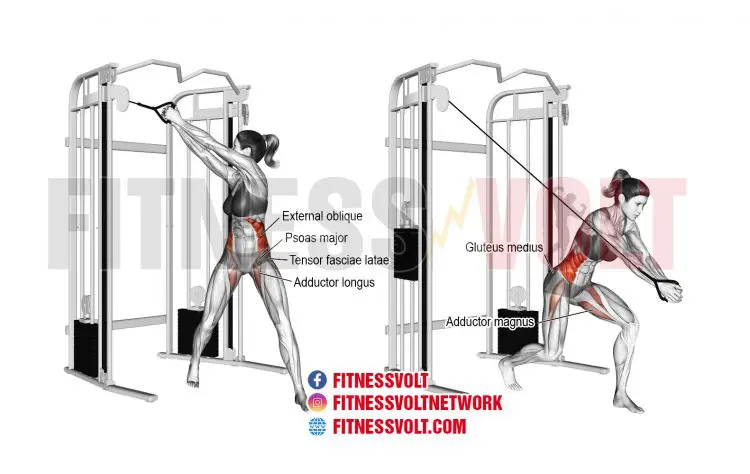
The cable wood chop trains controlled rotation against constant resistance. Your hips and upper back should share the turn while your midsection transfers force between them. That makes it a better rotational drill than cranking through the lower back while the legs stay frozen.
Best for: gym-based rotational strength. Modify it if: rotation feels pinchy in the lower back or you cannot keep the cable path smooth.
- Set a cable above shoulder height and stand sideways to the stack.
- Hold the handle with both hands and step away until the cable stays taut.
- Rotate your chest and hips together as you pull the handle down and across.
- Finish near the opposite hip without rounding your shoulders.
- Return under control and complete 8-12 reps per side.
- Form cues: Turn through the hips and upper back, let the rear foot pivot, and keep your arms connected to your torso.
- Regression: Use a resistance band or reduce the range and load.
- Progression: Add load, use a half-kneeling stance, or reverse the path from low to high.
Rotation speed changed trunk torque and muscle activation in an isokinetic study by Fan and colleagues. Learn the path at a controlled pace before adding speed. See our cable wood chop exercise guide for more setup detail.
6. Bicycle Crunch
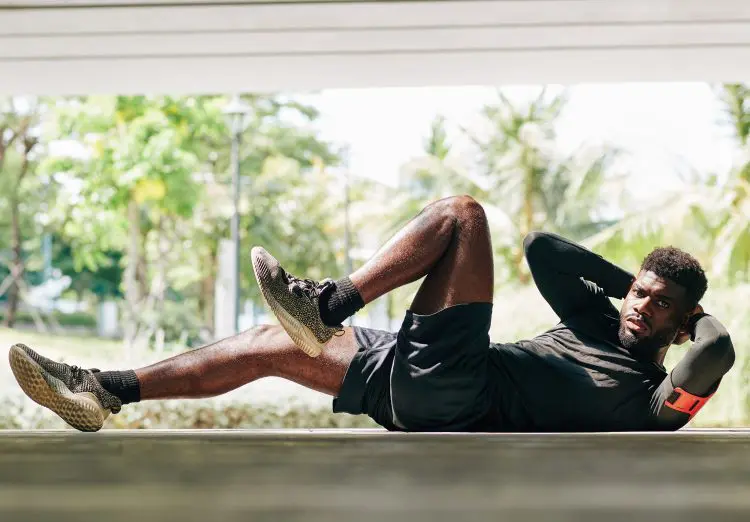
The bicycle crunch combines trunk flexion with cross-body rotation. It works well when you bring a shoulder toward the opposite hip and move at a pace that keeps your lower back controlled. Fast pedaling often shortens the range and shifts the effort toward the hip flexors.
Best for: bodyweight abdominal work with a rotational element. Modify it if: holding your head up strains your neck or extending the legs pulls your lower back off the floor.
- Lie on your back with your hips and knees bent to about 90 degrees.
- Place your fingertips behind your ears and lift your shoulder blades.
- Rotate your left shoulder toward your right knee as the left leg extends.
- Return through the center and switch sides.
- Complete 8-15 controlled reps per side.
- Form cues: Keep your elbows wide, rotate from the ribs, and avoid pulling on your head.
- Regression: Keep both feet on the floor and alternate cross-body crunches.
- Progression: Extend each leg closer to the floor or pause at the rotated position.
Use the bicycle crunch exercise tutorial if you need a closer look at the setup and common mistakes.
7. Cross-Body Mountain Climber
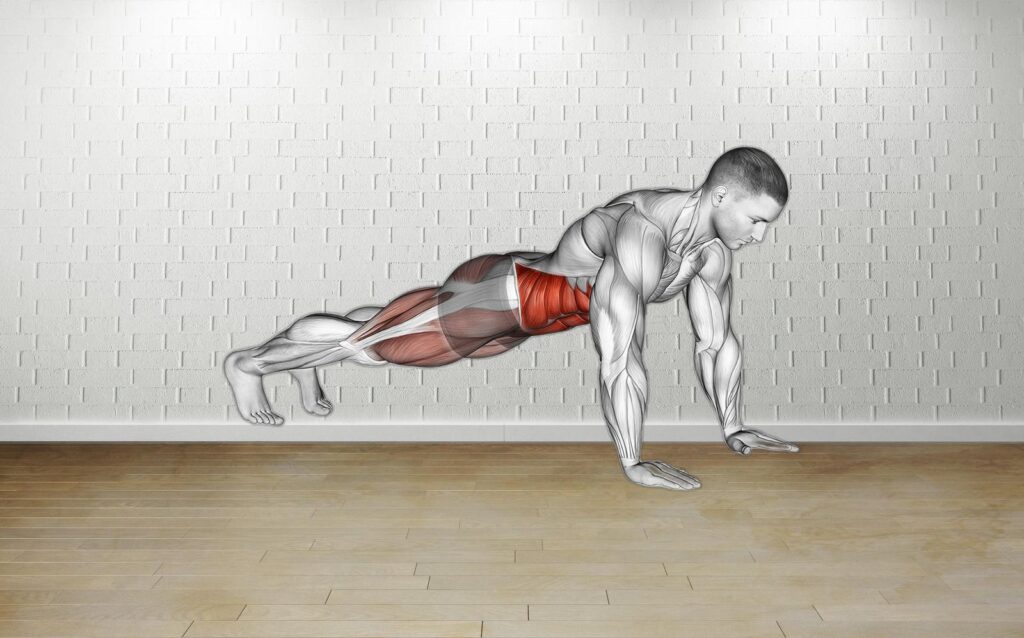
The cross-body mountain climber adds alternating hip flexion and rotation to a high-plank position. It can train trunk control under a faster breathing rate, but speed should come after alignment. Treat it as a core-conditioning drill, not a race for the highest rep count.
Best for: short bodyweight conditioning sets. Modify it if: your wrists or shoulders cannot tolerate a high plank.
- Start in a high plank with your hands under your shoulders.
- Brace and bring your right knee toward your left elbow.
- Return the foot to the floor without lifting your hips.
- Repeat with your left knee toward your right elbow.
- Complete 10-20 reps per side.
- Form cues: Press the floor away, keep your steps quiet, and make the knee travel under your torso.
- Regression: Place your hands on a bench or move one knee at a time with a pause.
- Progression: Increase cadence while preserving hip height, or use sliders under your feet.
Stop the set when your hips rise and fall with every rep. At that point, extra speed adds motion without adding useful trunk control.
8. Hanging Oblique Knee Raise
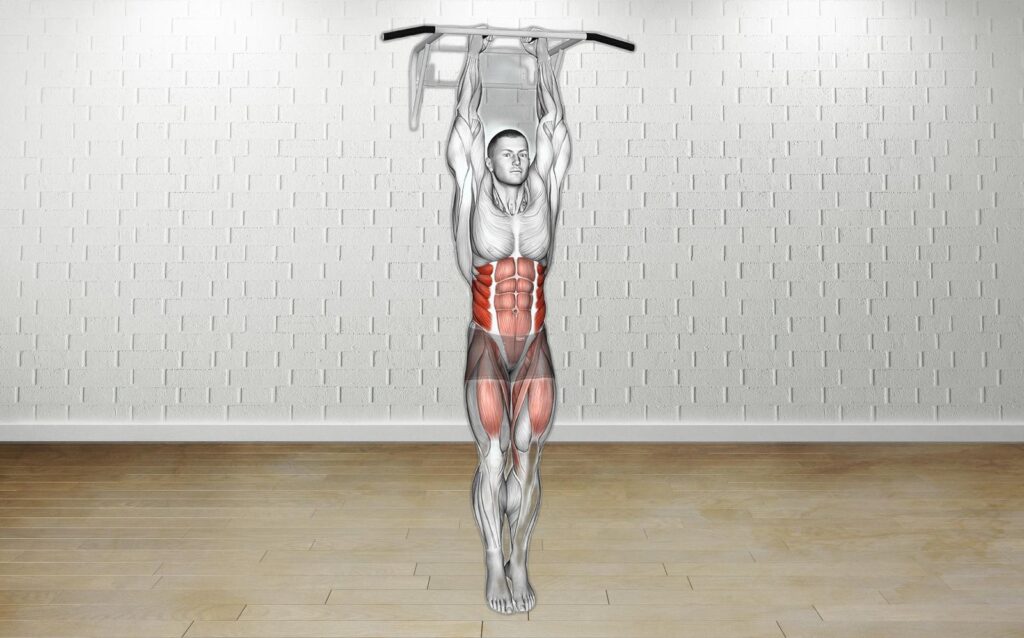
The hanging oblique knee raise is a harder flexion-and-rotation exercise because your grip, shoulders, pelvis, and trunk must work together. The goal is to curl the pelvis toward the ribs and guide the knees toward one side. Swinging the legs turns it into a momentum drill.
Best for: experienced trainees with solid hanging control. Modify it if: grip or shoulder discomfort limits the set before your trunk does.
- Hang from a pull-up bar with your ribs down and legs still.
- Bend your knees and tilt your pelvis toward your ribs.
- Guide both knees toward your right side without swinging.
- Lower until your body becomes still, then repeat toward the left.
- Complete 6-10 reps per side.
- Form cues: Start each rep from a quiet hang, curl the pelvis, and keep the turn small enough to control.
- Regression: Use a captain’s chair or perform lying bent-knee windshield wipers.
- Progression: Raise straighter legs or pause at the top before adding ankle weight.
If grip fails first, use shorter sets or straps only if they fit your training goals. More hanging time does not fix a swinging rep.
9. Medicine-Ball Rotational Toss
The medicine-ball rotational toss develops power by asking you to produce force through the floor, hips, trunk, and arms. Use a ball light enough to move fast. A heavy ball that crawls toward the wall turns a power exercise into a slow grind and often distorts the throwing path.
Best for: athletes who already control cable chops and other slower rotations. Modify it if: you lack a solid masonry wall, enough clear space, or pain-free rotational range.
- Stand side-on about 3-5 feet from a solid wall with a medicine ball at hip height.
- Load the outside hip and keep both feet in contact with the floor.
- Drive through the legs and rotate the hips and chest toward the wall.
- Release the ball at about waist-to-chest height.
- Reset after each throw and perform 3-6 crisp reps per side.
- Form cues: Let the rear foot pivot, finish tall, and reset your stance before the next throw.
- Regression: Practice a cable or band rotation, or use a light partner pass.
- Progression: Add a step-in or shuffle once every stationary throw lands in the same target area.
Keep power sets short. The axial-rotation study by Fan and colleagues found that higher movement velocity changed torque and antagonist coactivation, though it used an isokinetic machine rather than ball throws. That supports controlling speed as a training variable without claiming both exercises are identical.
10. Heel Taps
Heel taps use a small side-to-side trunk motion from a supported floor position. They give beginners a simple way to feel the obliques without managing a cable, hanging from a bar, or supporting the body in a plank. The short range also makes the exercise easy to over-speed, so pause near each heel.
Best for: home workouts and people learning lateral trunk flexion. Modify it if: lifting your head and shoulders creates neck fatigue.
- Lie on your back with your knees bent and feet flat.
- Lift your shoulder blades and reach both arms toward your heels.
- Slide your right hand toward your right heel.
- Return through the center and reach toward the left heel.
- Complete 12-20 reps per side.
- Form cues: Keep your chin slightly tucked, ribs down, and feet close enough to reach without jerking.
- Regression: Keep your head on a folded towel and shorten the reach.
- Progression: Move your feet farther away or hold a light plate across your chest.
Use a slow left-right rhythm. If you feel the movement only in your neck, lower your head, rest, and restart with a shorter set.
Which popular oblique exercises did we leave out?
This list favors exercises that cover distinct trunk functions, scale cleanly, and are easy to coach. Several useful movements missed the final ten because another choice filled the same role with a clearer progression.
- Russian twist: Useful when controlled, but commonly rushed through a large lower-back range. Cable chops provide steadier resistance and an easier load progression.
- Copenhagen plank: Excellent for the adductors and lateral trunk, but the side plank is more accessible and isolates the trunk-stability decision more clearly.
- Kettlebell windmill: A valuable hip-hinge and shoulder-stability drill that demands more mobility and technique than most readers need from direct oblique work.
- Dead-bug variations: Strong anti-extension options, especially for beginners, but the Pallof press adds a clearer anti-rotation challenge.
How should you program oblique exercises?
Train the obliques on two days per week and start with six to nine direct working sets across the entire week. The 2026 American College of Sports Medicine position stand supports training major muscle groups at least twice weekly and using multiple sets for strength development in healthy adults. It reviewed broad resistance-training evidence, not an oblique-specific dose, so the weekly target here is FitnessVolt’s practical starting recommendation.
Place explosive throws near the start of a session, after your warm-up and before fatigue slows you down. Carries and cable work fit after your main lifts. Floor exercises can finish the session, though a side plank also works as a low-fatigue primer.
Progress one variable at a time:
- Add 5-10 seconds to an isometric hold.
- Add 2-5 reps while keeping the same form.
- Add a small load increase once you reach the top of the rep range.
- Add distance to carries in 5-10 meter steps.
- Add speed to throws only while the target and body position stay consistent.
Acute muscle activation can help compare tasks inside a study, but reviews by Vigotsky and colleagues in 2017 and 2022 warn against treating higher surface EMG as proof of greater future hypertrophy. Use performance markers you can repeat: longer clean holds, more load, steadier gait, better rep control, or faster throws with the same ball.
Which two-day oblique workout works at home?
This home plan uses two movements per day and eight direct working sets per week. Leave at least 48 hours between sessions. Add a third set to one exercise only after the starting dose feels controlled and does not interfere with your larger workouts.
| Day | Exercise | Sets and reps | Rest |
|---|---|---|---|
| Day 1 | Side plank | 2 x 20-30 sec/side | 45 sec |
| Day 1 | Bicycle crunch | 2 x 8-12/side | 45 sec |
| Day 2 | Heel taps | 2 x 15-20/side | 45 sec |
| Day 2 | Slow cross-body mountain climber | 2 x 8-12/side | 60 sec |
If high planks bother your wrists, replace both mountain-climber slots with dead-bug cross-body presses. If floor flexion bothers your neck, use another side-plank set and keep your head supported.
Which two-day oblique workout works in a gym?
This gym plan separates controlled strength from rotational power and totals nine direct working sets per week. Day 1 emphasizes anti-rotation and loaded gait. Day 2 starts with low-rep throws, then moves to controlled rotation. Keep one or two reps in reserve on strength exercises and stop power sets when speed drops.
| Day | Exercise | Sets and reps | Rest |
|---|---|---|---|
| Day 1 | Pallof press | 2 x 8-12/side | 45-60 sec |
| Day 1 | Suitcase carry | 2 x 25-40 m/side | 60-90 sec |
| Day 2 | Medicine-ball rotational toss | 3 x 4/side | 60-90 sec |
| Day 2 | Cable wood chop | 2 x 8-12/side | 60 sec |
Run either plan for four to six weeks before replacing exercises. Keep a simple log of load, reps, hold time, or carry distance. If another training day already includes heavy unilateral carries or throwing, cut the duplicate work here rather than stacking fatigue.
What form mistakes reduce the value of oblique training?
Most oblique-training mistakes come from using more speed, range, or load than you can control. The fix is easy to spot: your target muscles should manage the motion while your pelvis, ribs, shoulders, and feet follow the exercise’s intended path.
- Twisting only through the lower back: Let the hips and upper back share rotation during wood chops and throws.
- Using momentum: Reset between hanging raises and medicine-ball tosses. Swinging hides weak positions.
- Leaning during carries: Reduce the load until both shoulders stay level and your steps match.
- Pulling the neck during crunches: Keep your fingertips light and rotate the shoulder toward the opposite hip.
- Progressing every variable at once: Add load, reps, range, speed, or distance. Pick one per week.
Sharp pain, numbness, or symptoms that travel into an arm or leg call for a change of exercise and assessment by a qualified clinician. Ordinary muscular effort should settle after the set. Joint pain or worsening symptoms deserve a different approach, especially if you have an existing spine, shoulder, or hip condition. Our guide to lower-back pain in athletes explains why symptom patterns matter more than generic rules.
How often should you train your obliques?
Two weekly sessions suit most healthy adults because they provide repeated practice without turning every workout into a core marathon. Start with six to nine total working sets per week across two or three movement patterns. Add volume only when performance improves and soreness does not interfere with your main lifts or sport.
Your squats, deadlifts, rows, presses, and loaded carries already ask the trunk to brace. Direct oblique work fills gaps in side stability, anti-rotation, and controlled rotation. It does not need to replace your larger strength movements. If you want more bodyweight options, the old-school ab exercise guide offers several simple additions.
Can oblique exercises reduce love handles?
Oblique exercises can strengthen and develop the muscles at the sides of your waist, but they cannot choose where your body loses fat. The cited six-week trial used seven abdominal exercises for two sets of ten reps, five days per week. Participants improved abdominal endurance but did not reduce abdominal fat, waist circumference, or body-fat percentage.
Use nutrition and whole-body activity to create the energy deficit needed for fat loss. Keep oblique training for strength, posture control, and performance. That distinction protects you from wasting time on high-rep side bends sold as a spot-reduction method.
Do side bends make your waist wider?
Any muscle can grow when training supplies enough tension and progressive volume, but the cited EMG studies cannot predict how much an individual’s obliques will hypertrophy. Two reviews caution against using acute EMG amplitude as a stand-in for long-term growth. Your genetics, total volume, load, nutrition, and training history affect the visible result.
If your goal favors a smaller visual waist, keep loaded side bends at a modest dose and prioritize anti-rotation work, carries, and overall fat-loss habits. If trunk strength matters more, progress side bends like any other resistance exercise and judge the result over several months.
How should beginners start oblique training?
Beginners should start with a knee-supported side plank and light Pallof press. Perform two sets of each exercise twice per week for eight direct working sets in total. Use a range that lets you breathe, keep the ribs stacked over the pelvis, and finish every rep without jerking or shifting.
After two or three weeks, progress one movement. Extend the legs in the side plank, step farther from the Pallof anchor, or add five heel taps per side. Move to loaded carries and cable rotation after you can keep your trunk position during the simpler drills.
Are compound lifts enough for the obliques?
Squats, deadlifts, rows, presses, and bilateral carries all require trunk bracing, so they already train the obliques indirectly. Direct work earns its place when you want more lateral stability, anti-rotation practice, controlled rotation, or a measurable carry progression. Start with two direct exercises per week if your main program is already demanding.
Which oblique exercises are easiest on the lower back?
Side planks, Pallof presses, and suitcase carries let you challenge the obliques while asking the trunk to resist motion. That can make them easier to control than repeated twisting or deep side bending, but no exercise is universally pain-free. Use a comfortable range and stop if symptoms sharpen, spread, or worsen from set to set.
Sources
- Kinney, A. L., Giel, M., Harre, B., et al. (2020). Surface Electromyography of the Internal and External Oblique Muscles During Isometric Tasks Targeting the Lateral Trunk. Journal of Sport Rehabilitation, 30(2), 255-260. DOI: 10.1123/jsr.2018-0442. PMID: 32369764.
- Youdas, J. W., Boor, M. M., Darfler, A. L., et al. (2014). Surface electromyographic analysis of core trunk and hip muscles during selected rehabilitation exercises in the side-bridge to neutral spine position. Sports Health, 6(5), 416-421. DOI: 10.1177/1941738114539266. PMID: 25177418.
- Ellestad, S. H., Holcomb, T. P., Swiergol, A. M., et al. (2024). The Quantification of Muscle Activation During the Loaded Carry Movement Pattern. International Journal of Exercise Science, 17(1), 480-490. DOI: 10.70252/NWUE9985. PMID: 38665162.
- Vispute, S. S., Smith, J. D., LeCheminant, J. D., and Hurley, K. S. (2011). The effect of abdominal exercise on abdominal fat. Journal of Strength and Conditioning Research, 25(9), 2559-2564. DOI: 10.1519/JSC.0b013e3181fb4a46. PMID: 21804427.
- Vigotsky, A. D., Halperin, I., Lehman, G. J., et al. (2017). Interpreting Signal Amplitudes in Surface Electromyography Studies in Sport and Rehabilitation Sciences. Frontiers in Physiology, 8, 985. DOI: 10.3389/fphys.2017.00985. PMID: 29354060.
- Vigotsky, A. D., Halperin, I., Trajano, G. S., and Vieira, T. M. (2022). Longing for a Longitudinal Proxy: Acutely Measured Surface EMG Amplitude is not a Validated Predictor of Muscle Hypertrophy. Sports Medicine, 52(2), 193-199. DOI: 10.1007/s40279-021-01619-2. PMID: 35006527.
- Urquhart, D. M., Barker, P. J., Hodges, P. W., et al. (2005). Regional morphology of the transversus abdominis and obliquus internus and externus abdominis muscles. Clinical Biomechanics, 20(3), 233-241. DOI: 10.1016/j.clinbiomech.2004.11.007. PMID: 15698694.
- Fan, J. Z., Liu, X., and Ni, G. X. (2014). Angular velocity affects trunk muscle strength and EMG activation during isokinetic axial rotation. BioMed Research International, 2014, 623191. DOI: 10.1155/2014/623191. PMID: 24804227.
- Currier, B. S., D’Souza, A. C., Singh, M. A. F., et al. (2026). American College of Sports Medicine Position Stand. Resistance Training Prescription for Muscle Function, Hypertrophy, and Physical Performance in Healthy Adults: An Overview of Reviews. Medicine & Science in Sports & Exercise, 58(4), 851-872. DOI: 10.1249/MSS.0000000000003897. PMID: 41843416.