
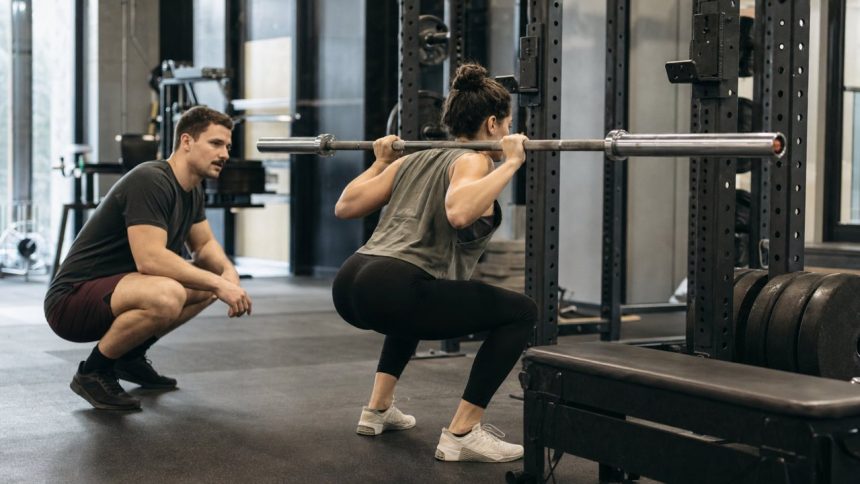
Back pain makes squats emotional fast. One lifter hears “never squat again.” Another tries to prove toughness and turns a small issue into a month-long layoff. Neither response is useful. The right question is not whether squats are good or bad. The right question is which squat, what range, what load, and what symptoms are present today.
This guide is for lifters with non-emergency back sensitivity who want a decision system. It will not diagnose you. It will help you decide when to stop, when to regress, and how to rebuild without treating pain as weakness or ignoring warning signs.
You can often squat with mild, stable lower-back discomfort if symptoms do not worsen during the session, do not radiate, and settle within 24 hours. Stop and get medical help for numbness, weakness, bowel or bladder changes, trauma, fever, night pain, or pain that rapidly escalates.
Should you squat if your lower back hurts?
Maybe. A sensitive back is not an automatic squat ban, but it is a demand for better rules. If pain is sharp, spreading down the leg, changing your strength, or making normal movement worse, the session is over. If discomfort is mild, local, stable, and improves as you warm up, a regressed squat may be reasonable.
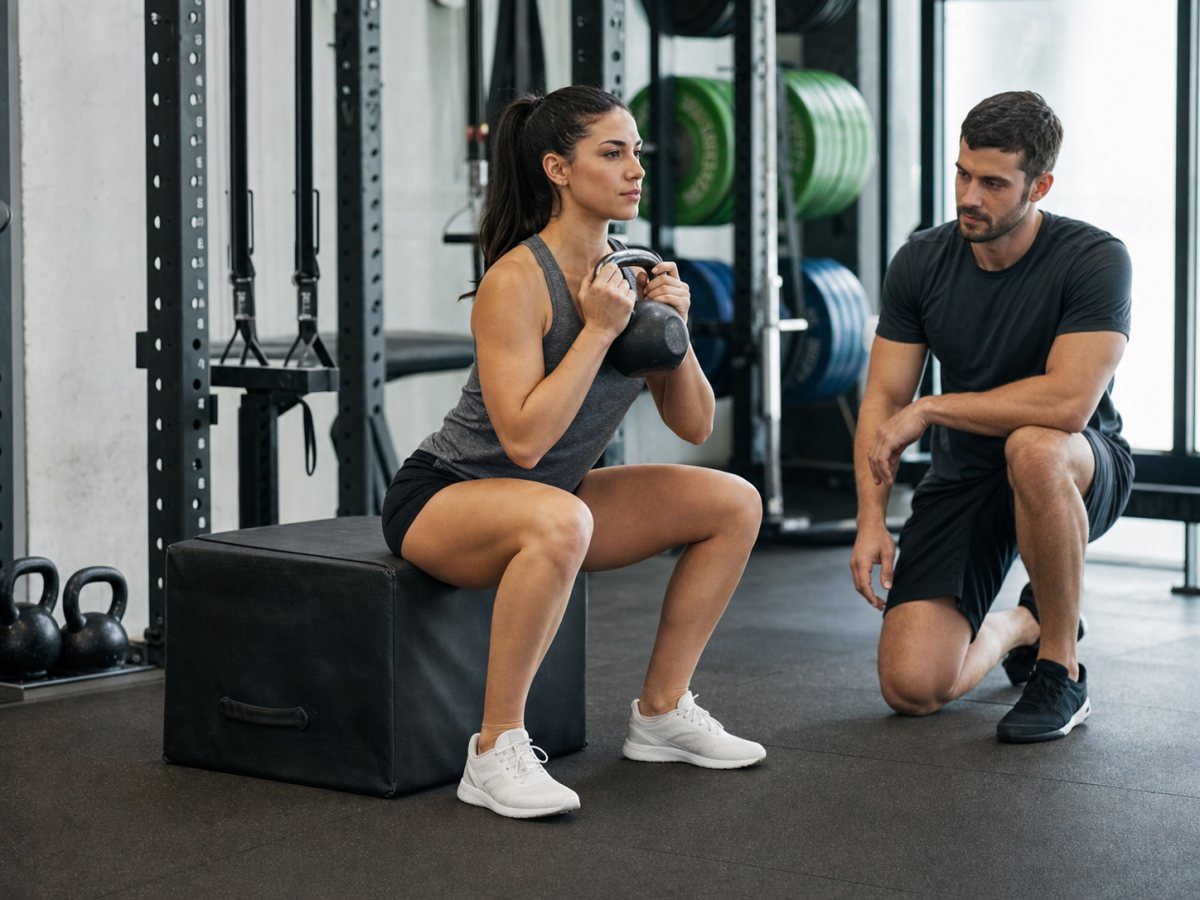
The key is to test the pattern before loading it. Bodyweight squats, box squats, goblet squats, and split-stance work can reveal whether the back dislikes depth, load, stance, bracing, fatigue, or a specific bar position. Our squat biomechanics guide explains why small setup changes can shift stress dramatically.
What red flags mean you should stop?
Stop training the squat pattern and seek medical guidance if you have numbness, tingling, weakness, loss of coordination, bowel or bladder changes, fever, unexplained weight loss, major trauma, pain that wakes you at night, or pain that worsens no matter how much you reduce the exercise. Those are not programming problems.
Also stop the set if your movement becomes protective and distorted. A technically different squat may be fine, but a panic squat is not training. Use the traffic-light rule below before touching working weight.
| Signal | What it means | Action |
|---|---|---|
| Green | 0-2/10 discomfort, stable or improving | Use light/moderate work and monitor next day |
| Yellow | 3-4/10 discomfort or technique changing | Regress range, load, or variation |
| Red | Sharp, radiating, escalating, or neurological symptoms | Stop and get qualified evaluation |
Why can squats irritate the lower back?
Squats can irritate the back when the lifter loses position, uses a range they cannot control, loads too aggressively, fatigues past bracing capacity, or chooses a variation that does not match their current mobility. The barbell does not care what exercise you intended. It only responds to the positions you create.
Common patterns include hips shooting up, pelvis tucking hard at the bottom, knees refusing to travel, weight shifting to the toes, and the lifter trying to stay too upright for their anatomy. These issues are not moral failures. They are clues for exercise selection.
Which squat variation is best for a sore back?
The best variation is the one that lets you train legs while keeping symptoms quiet. For many lifters, goblet squats, box squats, safety-bar squats, front squats, belt squats, split squats, and leg presses are easier to manage than a heavy low-bar back squat. That does not make them less serious.
If back squats and front squats both feel possible, compare the stress honestly. Our back squat versus front squat guide breaks down how bar position changes torso angle, load, and training effect.
How do you find a pain-free range?
Start higher than your ego wants. Use a box, pins, or a controlled tempo and stop before the position that triggers symptoms. If a box squat to parallel is quiet, test slightly deeper next week. If symptoms increase, keep the higher box and build tolerance there first.
Depth is earned by control, not forced by internet standards. Powerlifters, weightlifters, bodybuilders, and general fitness readers do not all need the same squat. The correct range is the deepest range that serves your goal without making the back problem louder.
How should you warm up?
A good warm-up for a sensitive back should raise temperature, rehearse positions, and give you information. Use five to ten minutes of easy movement, then unloaded squat patterning, hip hinges, light goblet squats, and progressive ramp sets. The warm-up is not a ritual. It is a diagnostic screen.
If every warm-up set feels worse, do not negotiate with the bar. Switch to a non-irritating leg option and live to train hard later in the week. If symptoms settle and movement improves, keep loading conservative and stop with reps in reserve.
How much load should you use?
Use less load than you think you need. A useful rebuild often starts around 50-70 percent of normal working weight, or even lower if symptoms have been recent. The goal is not to prove you still have strength. The goal is to collect pain-free reps and rebuild trust.
Progress only one variable at a time. Add range, load, or volume, but not all three. The training program guide can help you place the squat inside a week that leaves recovery room.
What technique cues help?
Use cues that create control without stiffness. Brace before descent, keep the whole foot connected to the floor, let knees and hips share the work, and keep the bar path organized over midfoot. Do not over-arch the low back to look tight. Excessive extension can feel strong for a rep and irritating over a session.
The best cue is often external: squat between the hips, push the floor away, or keep ribs stacked over pelvis. If a cue makes you move smoother and pain quieter, keep it. If it makes you rigid and anxious, replace it.
What should you do instead on bad days?
Bad days still allow training. Use sled pushes, leg presses, split squats, step-ups, hip thrusts, hamstring curls, leg extensions, carries, or machine work if they are quiet. The objective is to train the lower body without feeding the irritated pattern.
This is also where our are squats good or bad guide matters. Squats are a tool. They are not a loyalty test. Good training adapts the tool to the body in front of you.
How do you return to normal squatting?
Return when symptoms are stable, daily movement is normal, and lighter squat variations have been quiet for at least one to two weeks. Start with conservative working sets, leave two to four reps in reserve, and watch the next-day response. Pain that settles quickly is different from pain that lingers or spreads.
| Phase | Main squat choice | Progression target |
|---|---|---|
| Reset | Bodyweight or goblet box squat | Quiet reps and normal daily movement |
| Rebuild | Goblet, safety-bar, or front squat | Add range or load slowly |
| Return | Preferred barbell squat | Small weekly load jumps with reps in reserve |
FitnessVolt bottom line
You do not need to worship the squat or fear it. If lower-back pain is mild and stable, use the traffic-light system, regress the pattern, control range, and progress slowly. If symptoms are sharp, spreading, neurological, or getting worse, stop pretending it is a mindset issue and get evaluated.
The goal is not to squat through pain. The goal is to keep training while building back to a squat you can trust.
How should you program squats during a back rebuild?
Use fewer hard squat exposures than normal and put them where recovery is best. Two squat-pattern sessions per week is enough for many lifters during a rebuild. One can be the main pattern, such as a goblet box squat or safety-bar squat, and the other can be a lower-stress accessory, such as split squats or leg press.
Keep the first two weeks boring. Use controlled sets of five to ten reps, stop well before form degrades, and record next-day symptoms. If the back feels the same or better after 24 hours, add a small amount of range, load, or volume. If it feels worse, reduce one variable and keep training the lower body with quieter options.
What does a smart four-week rebuild look like?
A good rebuild is a ladder. Week one proves you can squat to a controlled range. Week two adds a little volume. Week three adds a little load. Week four tests whether your preferred squat variation is ready to return. The point is to create evidence, not suspense.
| Week | Main goal | Example |
|---|---|---|
| 1 | Find quiet range | Goblet box squat, 3 sets of 8 |
| 2 | Add volume | Goblet box squat, 4 sets of 8 |
| 3 | Add load slowly | Safety-bar or front squat, 3 sets of 6 |
| 4 | Re-test preferred squat | Light back squat, 3 sets of 5 with reps in reserve |
What accessories help without poking the bear?
Use accessories that train legs and trunk control without forcing the painful position. Split squats, step-ups, sled pushes, hamstring curls, hip thrusts, Copenhagen planks, carries, and controlled back extensions may help depending on symptoms. Choose exercises by response, not by reputation.
The trunk work should make you feel more stable, not more irritated. Side planks, dead bugs, bird dogs, carries, and breathing drills can be useful because they teach control without turning every session into a max-effort brace contest. If an accessory flares symptoms, it is not mandatory. Replace it.
When is the barbell back squat worth returning to?
Return to the barbell back squat when you have a quiet hinge, quiet goblet or front-loaded squat, normal daily movement, and no delayed symptom spike after lower-body sessions. Even then, treat the first barbell session as a test, not a comeback party.
Use empty bar and light ramp sets. Keep the load low enough that you can stop with confidence. If the back stays quiet that day and the next morning, you have useful permission to progress. If symptoms return, you learned the pattern still needs more time.
What should you tell your coach or physical therapist?
Bring better information than “squats hurt.” Note where the pain sits, what variation triggered it, what load and depth you used, whether symptoms changed during warm-ups, and how the back felt the next morning. That turns a vague complaint into useful training data.
Also share what still feels fine. If split squats, step-ups, carries, or leg presses are quiet, that tells the coach what capacity remains. A good rebuild uses what works while gradually testing what does not. The more precise your notes are, the less the process depends on guesswork.
Sources
- Delitto, A., et al. (2012). Low back pain clinical practice guidelines. Journal of Orthopaedic and Sports Physical Therapy.
- American College of Sports Medicine. (2009). Progression models in resistance training for healthy adults. Medicine and Science in Sports and Exercise.
- Steffens, D., et al. (2016). Prevention of low back pain: a systematic review and meta-analysis. JAMA Internal Medicine.
- American College of Sports Medicine. (n.d.). Physical activity guidelines resources. Accessed June 4, 2026.