

10 Best Weighted Jump Squat Alternatives for Strength and Power
If you can't perform barbell weighted jump squats, use five alternatives that preserve quad power and explosive hip/knee extension: trap-bar jumps, goblet jump squats, heavy front squats, Bulgarian split squats, and box jumps. Cue: load hips back, explode through the midfoot, and fully extend the knees to emphasize quadriceps drive.
Original Exercise: Weighted Jump Squat
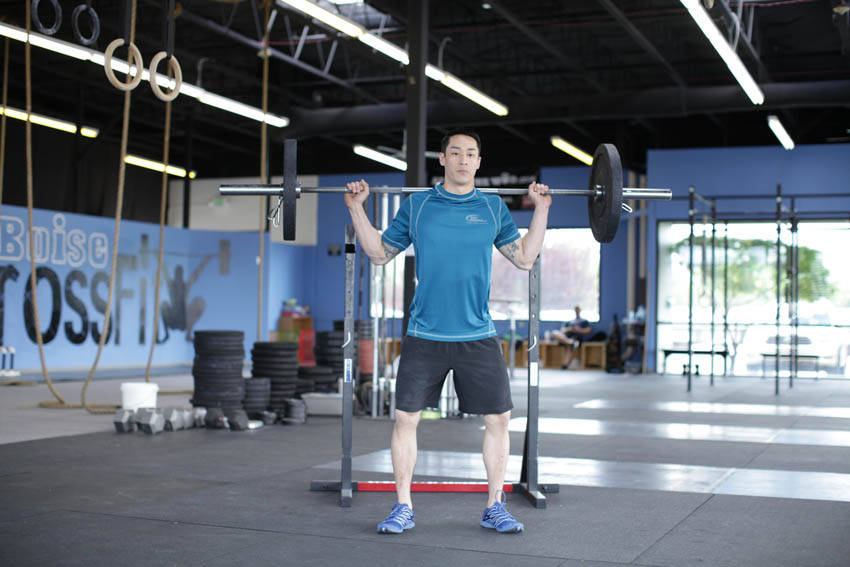
How to Perform Weighted Jump Squat
- Position a lightly loaded barbell across the back of your shoulders. You could also use a weighted vest, sandbag, or other type of resistance for this exercise.
- The weight should be light enough that it doesn't slow you down significantly. Your feet should be just outside of shoulder width with your head and chest up. This will be your starting position.
- Using a countermovement, squat partially down and immediately reverse your direction to explode off of the ground, extending through your hips, knees, and ankles. Maintain good posture throughout the jump.
- As you return to the ground, absorb the impact through your legs.
Pro Tips
- Category: Strength
- Force: Push
- Movement type: Compound
Ranked Weighted Jump Squat Alternatives
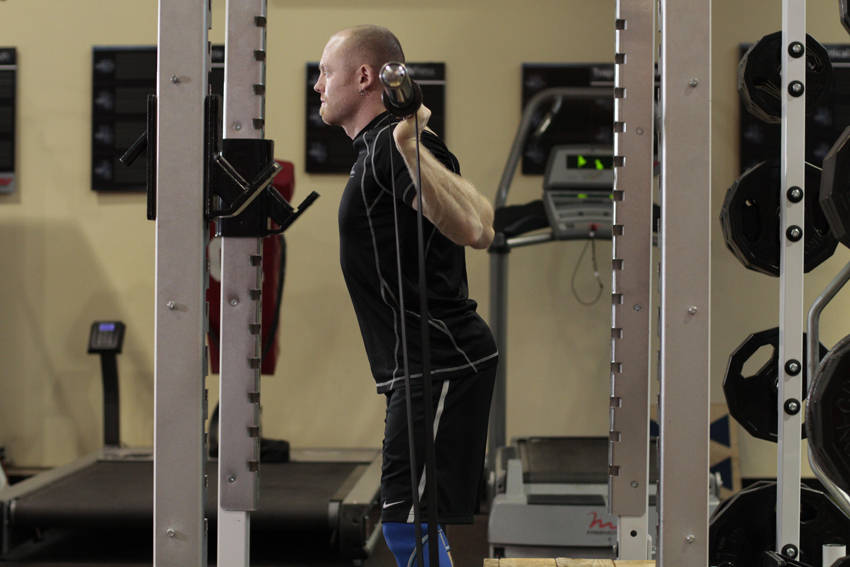
1. Box Squat With Bands
94.4% MatchHow to perform this exercise
- Begin in a power rack with a box at the appropriate height behind you. Set up the bands on the sleeves, secured to either band pegs, the rack, or dumbbells so that there is appropriate tension. If dumbbells are used, secure them so that they don't move. Also, ensure that the dumbbells you are using are heavy enough for the bands that you are using. Additional plates can be used to hold the dumbbells down. If more tension is needed, you can either widen the base on the floor or choke the bands. Typically, you would aim for a box height that brings you to a parallel squat, but you can train higher or lower if desired.
- Begin by stepping under the bar and placing it across the back of the shoulders. Squeeze your shoulder blades together and rotate your elbows forward, attempting to bend the bar across your shoulders. Remove the bar from the rack, creating a tight arch in your lower back, and step back into position. Place your feet wider for more emphasis on the back, glutes, adductors, and hamstrings, or closer together for more quad development. Keep your head facing forward.
- With your back, shoulders, and core tight, push your knees and butt out and you begin your descent. Sit back with your hips until you are seated on the box. Ideally, your shins should be perpendicular to the ground. Pause when you reach the box, and relax the hip flexors. Never bounce off of a box.
- Keeping the weight on your heels and pushing your feet and knees out, drive upward off of the box as you lead the movement with your head. Continue upward, maintaining tightness head to toe. Use care to return the barbell to the rack.
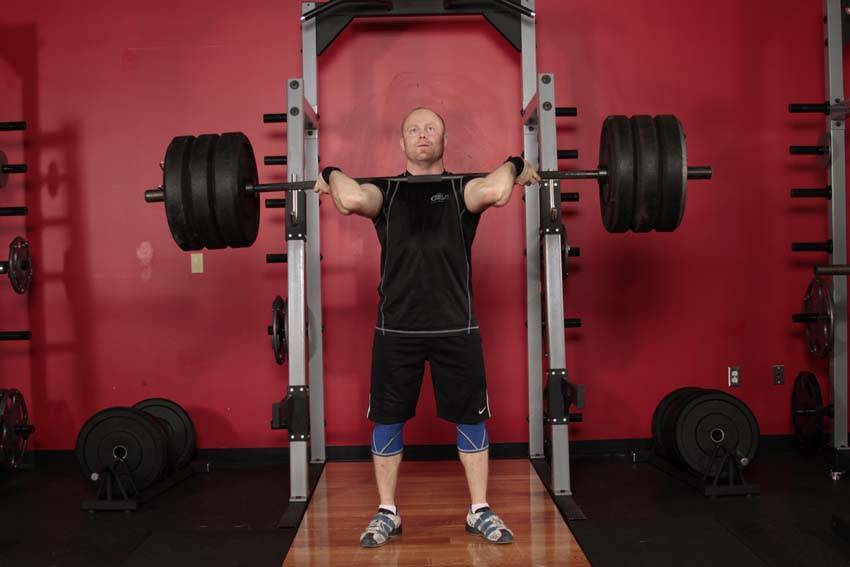
2. Jerk Dip Squat
94.4% MatchHow to perform this exercise
- This movement strengthens the dip portion of the jerk. Begin with the bar racked in the jerk position, with the shoulders forward to create a shelf and the bar lightly contacting the throat. The feet should be directly under the hips, with the feet turned out as is comfortable.
- Keeping the torso vertical, dip by flexing the knees, allowing them to travel forward and without moving the hips to the rear. The dip should not be excessive. Return the weight to the starting position by driving forcefully though the feet.
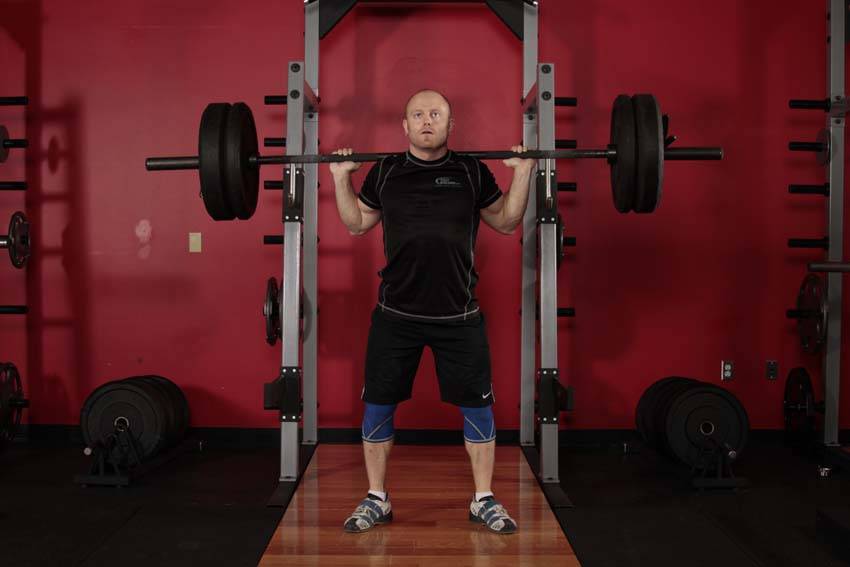
3. Olympic Squat
94.4% MatchHow to perform this exercise
- Begin with a barbell supported on top of the traps. The chest should be up, and the head facing forward. Adopt a hip width stance with the feet turned out as needed.
- Descend by flexing the knees, refraining from moving the hips back as much as possible. This requires that the knees travel forward; ensure that they stay aligned with the feet. The goal is to keep the torso as upright as possible. Continue all the way down, keeping the weight on the front of the heel.
- At the moment the upper legs contact the lower, reverse the motion, driving the weight upward.
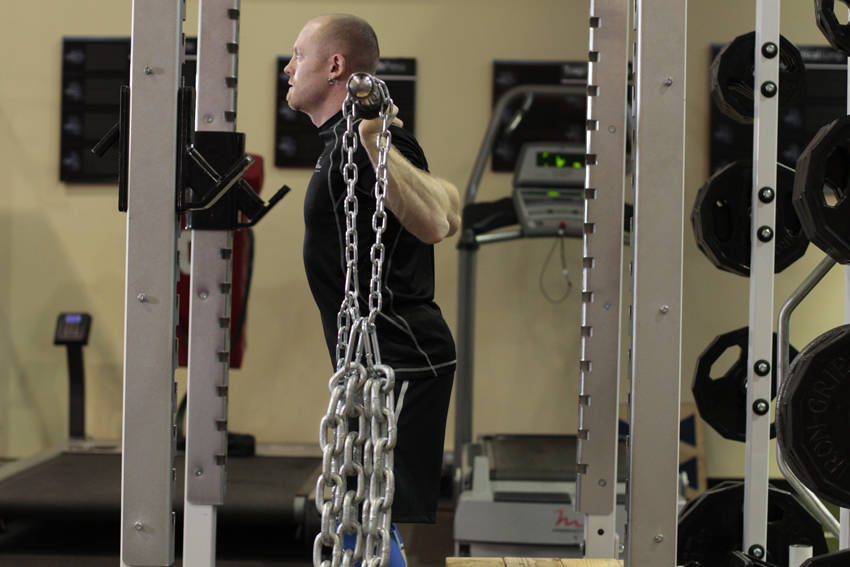
4. Box Squat With Chains
93.9% MatchHow to perform this exercise
- Begin in a power rack with a box at the appropriate height behind you. Typically, you would aim for a box height that brings you to a parallel squat, but you can train higher or lower if desired.
- To set up the chains, begin by looping the leader chain over the sleeves of the bar. The heavy chain should be attached using a snap hook. Adjust the length of the lead chain so that a few links are still on the floor at the top of the movement.
- Begin by stepping under the bar and placing it across the back of the shoulders. Squeeze your shoulder blades together and rotate your elbows forward, attempting to bend the bar across your shoulders. Remove the bar from the rack, creating a tight arch in your lower back, and step back into position. Place your feet wider for more emphasis on the back, glutes, adductors, and hamstrings, or closer together for more quad development. Keep your head facing forward.
- With your back, shoulders, and core tight, push your knees and butt out and you begin your descent. Sit back with your hips until you are seated on the box. Ideally, your shins should be perpendicular to the ground. Pause when you reach the box, and relax the hip flexors. Never bounce off of a box.
- Keeping the weight on your heels and pushing your feet and knees out, drive upward off of the box as you lead the movement with your head. Continue upward, maintaining tightness head to toe.
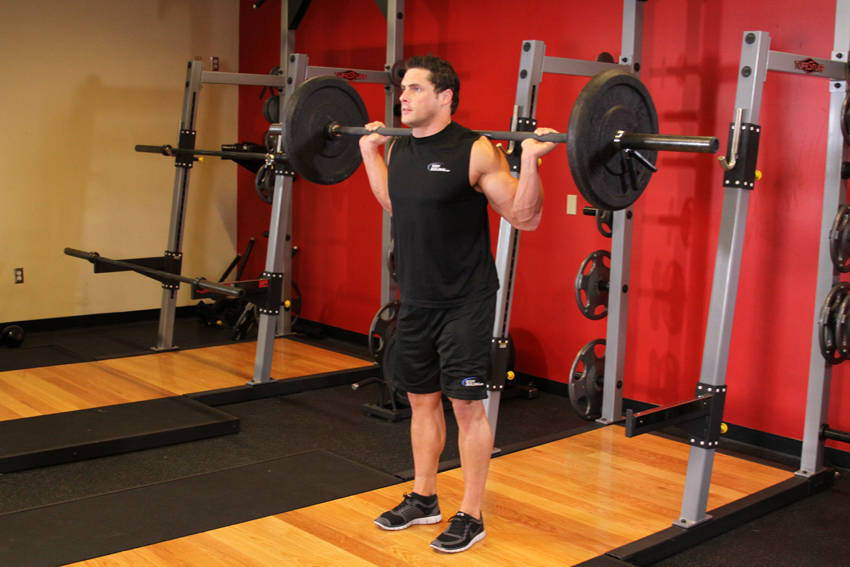
5. Narrow Stance Squats
93.9% MatchHow to perform this exercise
- This exercise is best performed inside a squat rack for safety purposes. To begin, first set the bar on a rack that best matches your height. Once the correct height is chosen and the bar is loaded, step under the bar and place the back of your shoulders (slightly below the neck) across it.
- Hold on to the bar using both arms at each side and lift it off the rack by first pushing with your legs and at the same time straightening your torso.
- Step away from the rack and position your legs using a less-than-shoulder-width narrow stance with the toes slightly pointed out. Feet should be around 3-6 inches apart. Keep your head up at all times (looking down will get you off balance) and maintain a straight back. This will be your starting position. (Note: For the purposes of this discussion we will use the medium stance described above which targets overall development; however you can choose any of the three stances discussed in the foot stances section).
- Begin to slowly lower the bar by bending the knees as you maintain a straight posture with the head up. Continue down until the angle between the upper leg and the calves becomes slightly less than 90-degrees (which is the point in which the upper legs are below parallel to the floor). Inhale as you perform this portion of the movement. Tip: If you performed the exercise correctly, the front of the knees should make an imaginary straight line with the toes that is perpendicular to the front. If your knees are past that imaginary line (if they are past your toes) then you are placing undue stress on the knee and the exercise has been performed incorrectly.
- Begin to raise the bar as you exhale by pushing the floor with the heel of your foot mainly as you straighten the legs again and go back to the starting position.
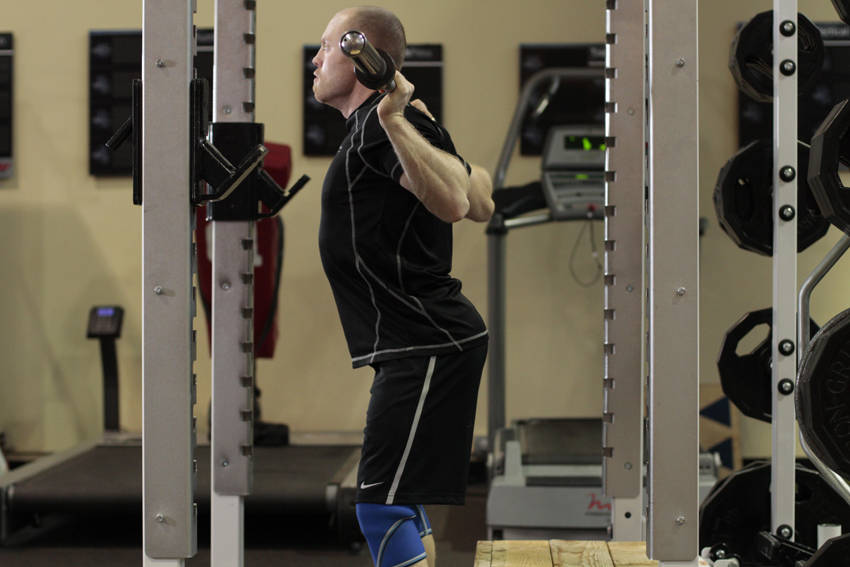
6. Box Squat
93.1% MatchHow to perform this exercise
- The box squat allows you to squat to desired depth and develop explosive strength in the squat movement. Begin in a power rack with a box at the appropriate height behind you. Typically, you would aim for a box height that brings you to a parallel squat, but you can train higher or lower if desired.
- Begin by stepping under the bar and placing it across the back of the shoulders. Squeeze your shoulder blades together and rotate your elbows forward, attempting to bend the bar across your shoulders. Remove the bar from the rack, creating a tight arch in your lower back, and step back into position. Place your feet wider for more emphasis on the back, glutes, adductors, and hamstrings, or closer together for more quad development. Keep your head facing forward.
- With your back, shoulders, and core tight, push your knees and butt out and you begin your descent. Sit back with your hips until you are seated on the box. Ideally, your shins should be perpendicular to the ground. Pause when you reach the box, and relax the hip flexors. Never bounce off of a box.
- Keeping the weight on your heels and pushing your feet and knees out, drive upward off of the box as you lead the movement with your head. Continue upward, maintaining tightness head to toe.
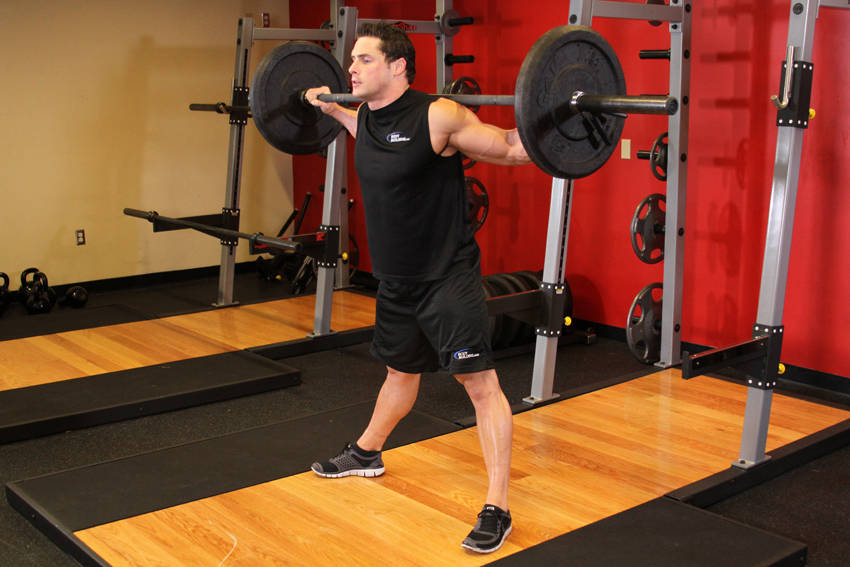
7. Wide Stance Barbell Squat
93.1% MatchHow to perform this exercise
- This exercise is best performed inside a squat rack for safety purposes. To begin, first set the bar on a rack that best matches your height. Once the correct height is chosen and the bar is loaded, step under the bar and place the back of your shoulders (slightly below the neck) across it.
- Hold on to the bar using both arms at each side and lift it off the rack by first pushing with your legs and at the same time straightening your torso.
- Step away from the rack and position your legs using a wider-than-shoulder-width stance with the toes slightly pointed out. Keep your head up at all times as looking down will get you off balance, and also maintain a straight back. This will be your starting position.
- Begin to slowly lower the bar by bending the knees as you maintain a straight posture with the head up. Continue down until the angle between the upper leg and the calves becomes slightly less than 90-degrees (which is the point in which the upper legs are below parallel to the floor). Inhale as you perform this portion of the movement. Tip: If you performed the exercise correctly, the front of the knees should make an imaginary straight line with the toes that is perpendicular to the front. If your knees are past that imaginary line (if they are past your toes) then you are placing undue stress on the knee and the exercise has been performed incorrectly.
- Begin to raise the bar as you exhale by pushing the floor with the heel of your foot as you straighten the legs again and go back to the starting position.
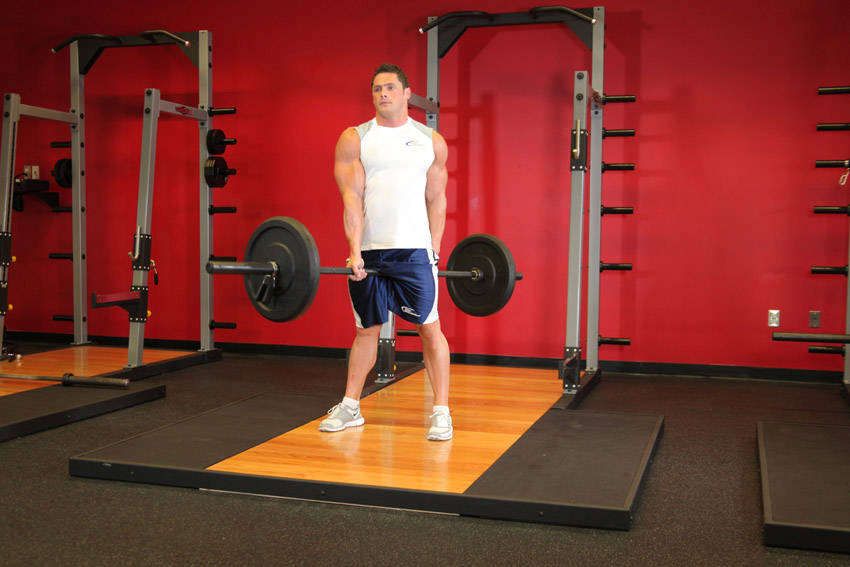
8. Jefferson Squats
90.7% MatchHow to perform this exercise
- Place a barbell on the floor.
- Stand in the middle of the bar length wise.
- Bend down by bending at the knees and keeping your back straight and grasp the front of the bar with your right hand. Your palm should be in (neutral grip) facing the left side.
- Grasp the rear of the bar with your left hand. The palm of your hand should be in neutral grip alignment (palms facing the right side). Tip: Ensure that your grip is even on the bar. Your torso should be positioned right in the middle of the bar and the distance between your torso and your right hand (which should be at the front) should be the same as the distance between your torso and your left hand (which should be to your back).
- Now stand straight up with the weight. Tip: Your feet should be shoulder width apart and your toes slightly pointed out.
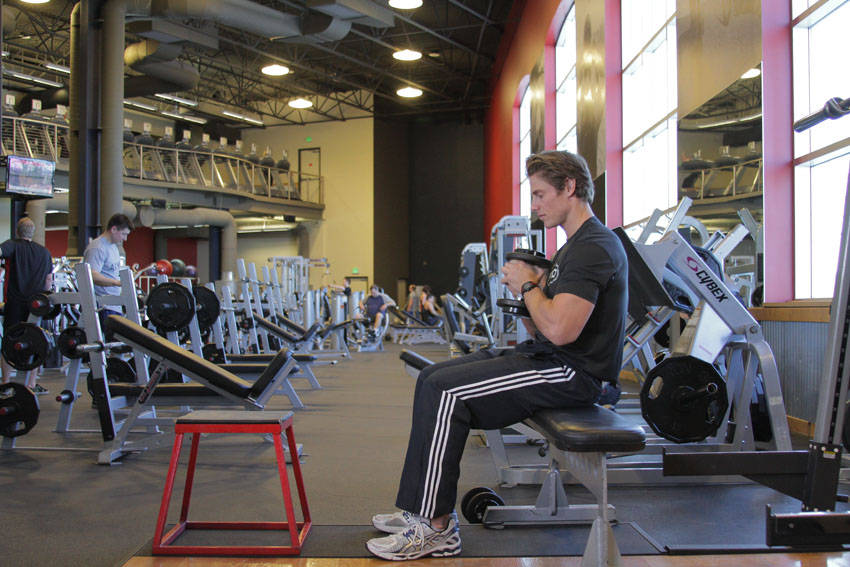
9. Dumbbell Seated Box Jump
81.2% MatchHow to perform this exercise
- Position a box a couple feet to the side of a bench. Hold a dumbbell to your chest with both hands and seat yourself on the bench facing the box. This will be your starting position.
- Plant your feet firmly on the ground as you lean forward, extending through the hips and knees to jump up and forward.
- Land on the box with both feet, absorbing the impact by allowing the hips and knees to bend.
- Step down and return to the starting position.
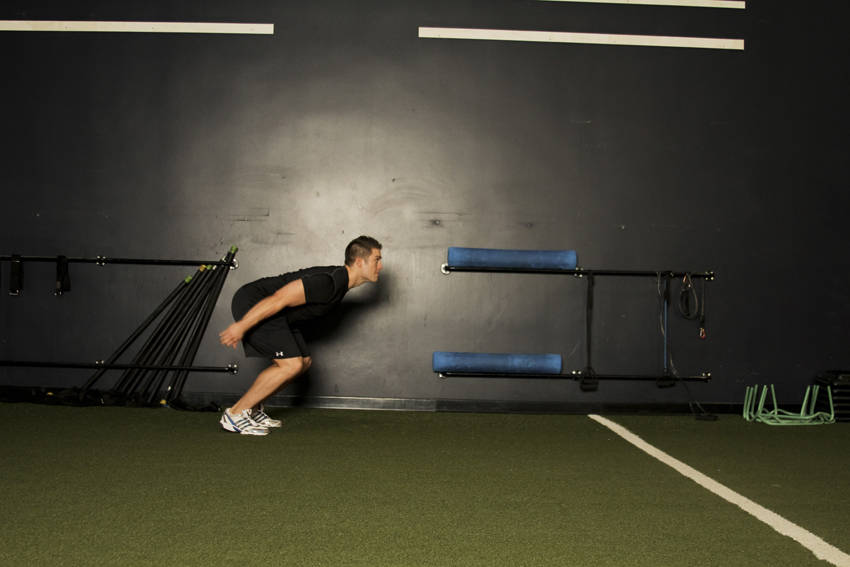
10. Standing Long Jump
80.2% MatchHow to perform this exercise
- This drill is best done in sand or other soft landing surface. Ensure that you are able to measure distance. Stand in a partial squat stance with feet shoulder width apart.
- Utilizing a big arm swing and a countermovement of the legs, jump forward as far as you can.
- Attempt to land with your feet out in front you, reaching as far as possible with your legs.
- Measure the distance from your landing point to the starting point and track results.
Why You Might Need a Weighted Jump Squat Alternative
You may need substitutes because of limited equipment, knee or back pain, programming goals, or coaching access. Weighted jump squats place high peak forces on the knee and require coordinated triple-extension; if you lack a spotter or a safe landing surface, pick a lower-impact option. Choose exercises that reduce peak impulse (for example, trap-bar jumps or front squats) or shift load unilaterally to correct imbalances (Bulgarian split squat). Cue knee tracking over toes and a controlled eccentric to protect joints while maintaining quad activation and rate-of-force development.
How to Choose the Right Substitute
Match the substitute to your goal: prioritize ground-reaction and rate-of-force development for power (trap-bar or box jumps), or time-under-tension and concentric overload for hypertrophy (front squats, Bulgarian split squats). Consider joint tolerance, swap to bilateral machine or goblet variations if you need less shear at the spine. Also weigh equipment availability and progression: start with goblet jump squats for technique, then add load or move to trap-bar. Cue a tall chest, active core, and drive through the midfoot to maintain quadriceps-dominant extension and safe biomechanics.
Frequently Asked Questions
What muscles does Weighted Jump Squat work?
Weighted jump squats primarily target the quadriceps through rapid knee extension. They also recruit the glutes and hamstrings for hip extension, plus calves and core for stabilization during the explosion and landing.
What is the best bodyweight alternative to Weighted Jump Squat?
A precise bodyweight alternative is the unweighted jump squat. Cue a shallow hip hinge, quick dip to 90° knee flexion, then explode upward driving through the midfoot and fully extend the knees to maximize quadriceps recruitment.
Can I build muscle without doing Weighted Jump Squat?
Yes. You can build quadriceps size and strength with heavy front squats, Bulgarian split squats, leg press, and controlled tempo squats using progressive overload and proper eccentric control to stimulate muscle growth.
More Exercise Alternatives
Find Alternatives for Any Exercise
Use the exercise substitution finder to compare ranked alternatives for your available equipment and training preference.
Try the Exercise Substitution Finder →