
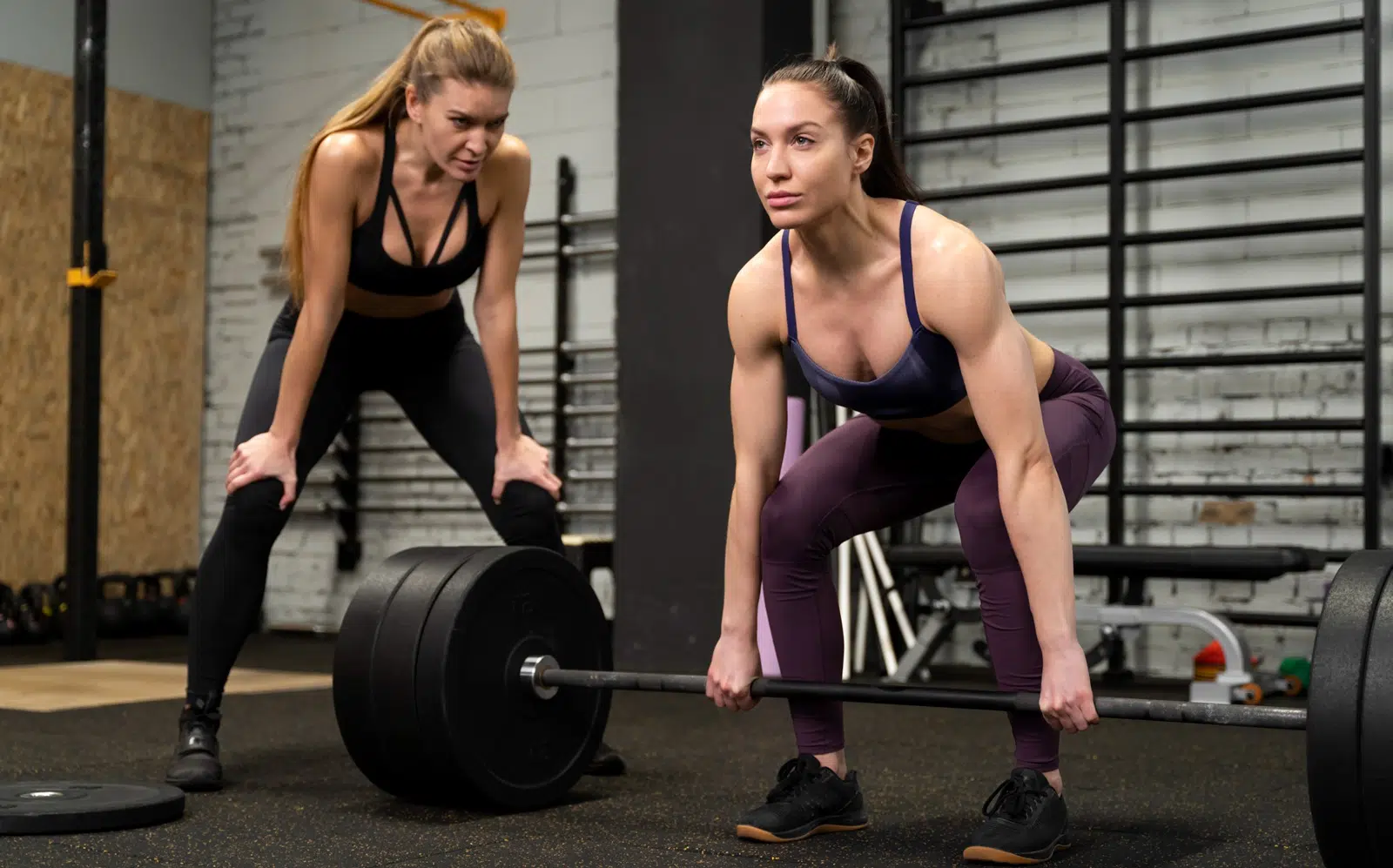
Touch-and-go deadlifts are a slight variation of the traditional deadlifts and are my favorite way of performing this exercise. The slow and controlled eccentric and the lack of a complete stop at the bottom make my hamstrings explode, and according to a 2021 study, slow eccentrics can lead to significant strength increases. (1)
However, as a personal trainer, I see tons of people perform this variation with absolutely horrid form. Therefore, I decided to teach you how to perform touch-and-go deadlifts with perfect technique so you can reap the benefits others are missing out on.
How To Perform Touch and Go Deadlift
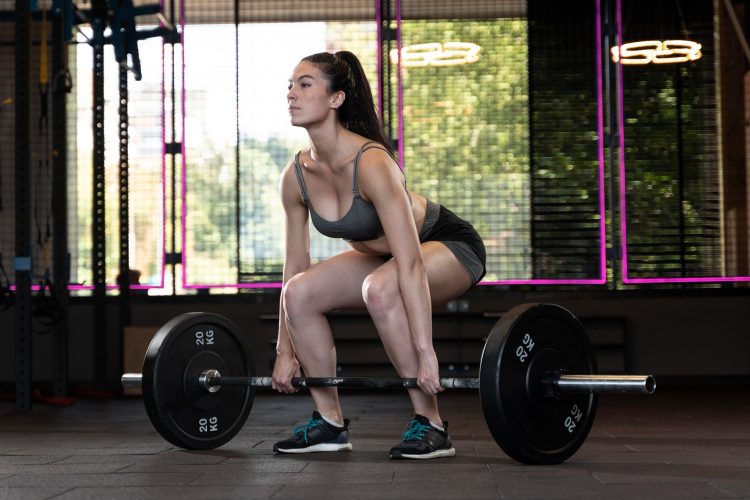
If you want to build explosive strength and improve your overall deadlifting technique, perform touch-and-go deadlifts in the following way:
Step One — Assume the Starting Position
Stand with your feet shoulder-width apart. Position the barbell over the middle of your feet, ensuring your shins are close to the bar. Grip the bar with hands just outside your knees, using an overhand or mixed grip. Your back should be straight, chest up, and shoulders over the bar.
Pro Tip: Start with lighter weights to master the form. You probably won’t be able to perform touch-and-go deadlifts with the same load you use for traditional deadlifts because you are not allowed to rest at the bottom, which could hinder your form after you perform several reps.
Step Two — Lift the Weight
Take a deep breath, engage your core, and drive through your heels to lift the bar. Keep the barbell close to your body as you extend your hips and knees simultaneously. Continue lifting until you are standing upright with your shoulders pulled back.
Pro Tip: Pause briefly (for less than a second) at the top before going back down. This will help you maintain balance and control the weight as you descend.
Step Three — Lower the Weight
Lower the bar slowly, bending at the hips and then the knees. Exhale on your way down. Always maintain control, and don’t let the bar free fall. The bar should stay close to your body, and your back should remain straight throughout the descent. Lower the bar until it touches the ground.
Pro Tip: Use lifting straps if your grip is giving out a few reps.
Step Four — Lift the Weight Back Up Immediately
Lift the weight back up as soon as it touches the ground. Don’t reset your grip or rest. Follow the same movement explained in the second step.
Pro Tip: Do not bounce the weight! Bouncing the weight of the ground defeats the purpose of the lift and makes the exercise significantly easier. However, bouncing the weight (especially if you’re lifting several hundred pounds) can throw you off balance, potentially causing a nasty injury.
Muscles Worked During Touch and Go Deadlift
Here’s a closer look at the muscles engaged during this lift:
Glutes
The glutes are the primary movers during the hip extension phase of the deadlift (after the bar passes your knees). As you lift the barbell, your glutes contract to bring your hips forward. This helps build a strong and shapely backside and enhances your overall lower body power and athletic performance.
Hamstrings
The hamstrings are crucial for controlling the eccentric, but they also work alongside the glutes to extend the hips and lift the weight. Proper hamstring activation is essential for maintaining control and preventing injuries, so staying slow and in control on your way down will ensure your hamstrings get a ton of stimulus.
Lower Back
The lower back, specifically the erector spinae muscles, is vital in maintaining spinal alignment and correct posture during the lift. These muscles contract to keep your back straight and prevent rounding, which is critical for lifting safely and effectively. Strengthening your lower back through touch-and-go deadlifts will reduce the risk of lower back injuries and improve balance and athletic performance.
Quads
The quadriceps are active primarily during the initial lift-off. As you push through your heels to raise the bar, your quads work hard to extend your knees. This is crucial for generating the power needed to lift heavy weights, contributing to building stronger, more defined thighs. It could also help you kick stronger, run faster, or jump higher.
Core
A strong core is essential for stabilizing your body during the deadlift. Keeping your core tight will train your abdominal muscles, prevent your lower back from rounding, and reduce the likelihood of injury. (2)
Upper Back
The upper back muscles, including the traps, rhomboids, and rear deltoids, are hard at work during deadlifts. These muscles help keep your shoulder blades retracted and the barbell close to your body, ensuring a smooth and efficient lift. Building strength in your upper back improves your deadlift form and supports overall upper body strength.
Benefits of Touch and Go Deadlift
The following benefits are why the touch-and-go deadlift is my go-to deadlift movement:
Improved Explosive Strength
Touch-and-go deadlifts are exceptional for building explosive strength. By continuously lifting without a complete reset, your muscles learn to generate maximum force quickly. This is crucial for sports where sudden bursts of power and explosiveness are vital.
In addition, since this exercise keeps constant tension on the muscles, it leads to significant gains in overall strength.
Better Coordination and Balance
Performing touch-and-go deadlifts requires maximum control over the weight throughout the lift. As I said previously, continuous movement without resetting helps improve your body’s ability to maintain coordination. This constant control also challenges your stabilizing muscles (especially your core muscles), greatly affecting your overall balance.
Builds Grip Strength
One of the often-overlooked benefits of touch-and-go deadlifts is their effect on grip strength. Since you maintain your grip between reps without resetting, your hands are under constant tension throughout the set.
This constant engagement of your forearm and hand muscles helps build a stronger grip, which is crucial not only for deadlifting but also for other lifts. Improving grip strength can lead to better overall lifting performance (for instance, during pull-ups) and reduced risk of wrist injuries.
Stimulates Hypertrophy
Touch-and-go deadlifts are excellent for stimulating muscle hypertrophy for two reasons: the significant time under tension and the controlled eccentric phase.
Although the data supporting TUT’s effect on hypertrophy are mixed, the slow eccentric phase (the main contributing factor to TUT) provides a powerful stimulus for muscle growth, especially compared to traditional reset deadlifts, where most lifters let go of the weight during the descent.
The touch-and-go deadlift also thoroughly stretches the muscles and keeps them engaged longer, promoting greater muscle fiber recruitment and growth.
Common Mistakes During Touch and Go Deadlift
Here are the most redundant errors I see people make during touch-and-go deadlifts:
Rounding the Back
It is very easy to lose control of your back when you’re not resetting, so by far, the most common mistake I’ve seen is rounding the back. This not only compromises your form but also places undue stress on your spine and lower back, greatly increasing the chance of injury. So, focus on keeping your chest up, shoulders back, and core tight to prevent rounding your back.
In his video on the most common deadlifting technique errors, natural bodybuilder and science-based content creator Jeff Nippard discussed back rounding. His take on back flexion is greatly influenced by the works of Bret Contreras, a strength and conditioning specialist with a Ph.D. in Sports Sciences, and it goes like this:
“Rounding is a controversial area because, in almost every heavy deadlift, there will be some degree of spinal flexion or back rounding. This is because it just tends to be a biomechanically stronger position for most trainees. As Dr. Bret Contreras showed in his biomechanics book, a rounded back does allow the hips to get closer to the bar, reducing the torque requirement that the glutes and hamstrings need to overcome. However, he recommends that if you do round, it should be in the upper back only and that lower back rounding should be kept to a minimum when pulling heavy loads.”
Rushing the Eccentric
Rushing the eccentric, or lowering phase, of the lift is another common mistake I see. It usually results from using too heavy a load you can’t quite control.
The eccentric phase is where much (read: most) of the muscle-building happens, as it places the muscles under tension and stress, so by rushing this part of the lift, you’re missing out on significant hypertrophy benefits. If you drop the weight, you’re essentially losing half of your gains, as you’re doing half the work.
Take your time to lower the weight in a controlled manner. Keep the tension on the muscles and hold the weight until you reach the floor.
Bouncing the Weight
Bouncing the weight off the ground defeats the primary purpose of the touch-and-go deadlift. This mistake reduces the workload on your muscles and relies on momentum and bounce rather than muscle power to lift the bar.
Instead, maintain control, touch the ground lightly, and immediately lift the weight again, ensuring that each rep is performed with maximum engagement.
Alternatives and Variations: Touch-and-Go Deadlift
If you’re looking to diversify your deadlift routine or find alternatives that target similar muscle groups, here’s what you can do:
Traditional Deadlift
The traditional deadlift is a foundational exercise in strength training that engages multiple muscle groups, including the glutes, hamstrings, lower back, and core. Unlike the touch-and-go deadlift, it allows you to place the weight on the floor, recuperate, and lift it from the dead position.
Apart from resetting and briefly pausing at the bottom, the form and technique for performing traditional deadlifts are identical to touch-and-go deadlifts.
Romanian Deadlift
The Romanian deadlift (RDL) focuses more on the hamstrings and glutes than the touch-and-go deadlift, but like the TnG, it prevents you from setting the weight down and resting mid-set.
How to:
- Stand with your feet hip-width apart, holding the barbell in front of your thighs with an overhand grip.
- Tighten your core and keep your back straight. Your knees should be slightly bent.
- Hinge at the hips, pushing them back while lowering the barbell down the front of your legs.
- Keep the bar close to your body and maintain a straight back.
- Lower the bar (usually below the knees) until you feel a big stretch in your hamstrings.
- Drive your hips forward to return to the starting position, squeezing your glutes at the top.
Wrapping Up
For the last several years, I’ve relied mostly on touch-and-go deadlifts, and I’ve seen massive improvements across the board—especially strength-wise. I’ve become sturdier and stronger, and my hamstrings have grown quite a bit.
So, as far as I’m concerned, incorporating touch-and-go deadlifts into your leg or back day will guarantee massive gains as long as you perform the exercise with the proper technique. If you do so, you’ll quickly realize just how much you’ve been missing out on by exclusively doing full-stop deadlifts.
References:
- Kojić F, Ranisavljev I, Ćosić D, Popović D, Stojiljković S, Ilić V. Effects of resistance training on hypertrophy, strength and tensiomyography parameters of elbow flexors: role of eccentric phase duration. Biol Sport. 2021 Oct;38(4):587-594. doi: 10.5114/biolsport.2021.99323. Epub 2021 Jan 14. PMID: 34937968; PMCID: PMC8670796.
- Huxel Bliven KC, Anderson BE. Core stability training for injury prevention. Sports Health. 2013 Nov;5(6):514-22. doi: 10.1177/1941738113481200. PMID: 24427426; PMCID: PMC3806175.
Interested in measuring your progress? Check out our strength standards for Half Squat, Superman, Reverse Hyperextension, and more exercises.